


A dietary supplement guide is a structured resource that explains what supplements are, how they are regulated, and how to evaluate them before you buy. The U.S. market now carries over 100,000 supplement products, and the FDA does not review them for safety or effectiveness before they reach store shelves. That gap between marketing claims and clinical reality is exactly why a clear, practical guide to dietary supplements matters. This article gives you the regulatory context, quality criteria, and decision framework you need to choose supplements with confidence.
What is a dietary supplement guide, and why does it matter?
A dietary supplement is any product taken by mouth that contains a dietary ingredient intended to add nutritional value to the diet. That definition covers vitamins, minerals, herbs, probiotics, enzymes, amino acids, and combinations of these. The term “dietary supplement guide” is the consumer-facing phrase for what the nutrition and clinical world calls a supplement evaluation framework.
The regulatory foundation for all U.S. supplements is the Dietary Supplement Health and Education Act of 1994, known as DSHEA. Under DSHEA, supplements are classified as foods, not drugs. That classification has a direct consequence: manufacturers do not need FDA approval before selling a product.

The FDA’s role is limited to post-market surveillance. The agency can act after a product causes harm, but it does not conduct pre-market safety or efficacy checks. This is the single most important fact any adult should understand before buying a supplement.
Manufacturers must follow Current Good Manufacturing Practices, or cGMPs. The FDA requires cGMP compliance to help ensure that products contain what their labels claim, at the stated potency, without contamination. cGMPs address identity, purity, strength, and composition. They do not, however, confirm that a product actually works.
Key regulatory facts every buyer should know:
- The FDA does not evaluate supplement claims for effectiveness before sale.
- Manufacturers are responsible for product safety, not the FDA.
- Labels must list all ingredients and comply with cGMP standards.
- Structure/function claims on labels (e.g., “supports immune health”) do not require FDA proof.
- The disclaimer “This statement has not been evaluated by the Food and Drug Administration” is legally required on most supplement labels.
How to evaluate dietary supplements for quality and safety
Quality evaluation is the most practical skill in any guide to dietary supplements. The process has four layers: certification, label reading, dosage review, and professional consultation.
Step 1: Look for third-party certification. Organizations like USP (U.S. Pharmacopeia), NSF International, and ConsumerLab test supplements independently. Third-party certifications verify ingredient identity, purity, and the absence of contaminants. They do not confirm that a supplement produces the health outcomes claimed on the label. A USP seal means the pill contains what it says. It does not mean the ingredient works.
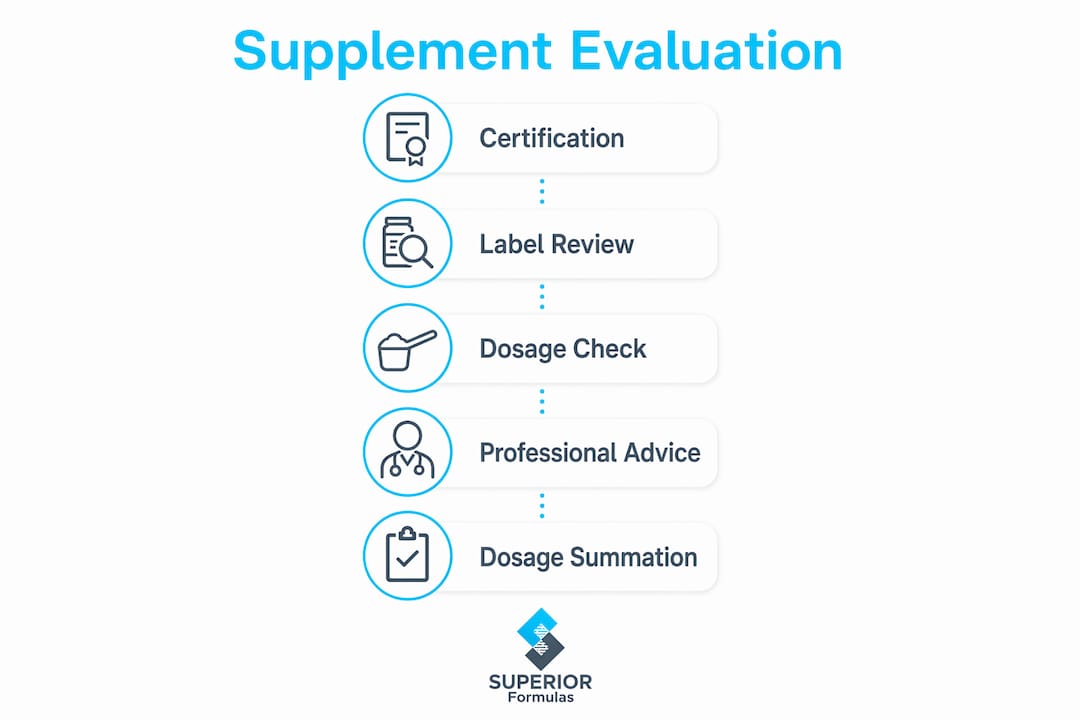
Step 2: Read the Supplement Facts label carefully. Check every ingredient, its form, and its dose. Look for allergens, fillers, and artificial additives. A clean supplement label lists only what is necessary, with no hidden proprietary blends that obscure individual ingredient amounts.
Step 3: Review dosages against established Daily Values. The Linus Pauling Institute recommends choosing multivitamins with nutrients between 50% and 150% of the Daily Value. Avoid products that exceed 200% of the Daily Value for most nutrients unless a healthcare provider has specifically directed otherwise.
Step 4: Consult a healthcare professional before starting. Professional evaluation confirms whether you actually need a supplement and identifies potential interactions with medications or other supplements you already take. Self-diagnosing a deficiency and self-prescribing a supplement is the most common mistake adults make.
Pro Tip: When you take more than one supplement, add up the total dose of each nutrient across all products. Vitamin D toxicity, for example, becomes a real risk when multiple supplements each contribute to your daily intake. The safe upper limit for vitamin D is around 4,000 IU per day.
| Certification body | What it verifies | What it does not verify |
|---|---|---|
| USP | Identity, purity, potency, and dissolution | Clinical effectiveness |
| NSF International | Label accuracy, contaminant absence | Health outcomes |
| ConsumerLab | Ingredient amounts, contamination | Efficacy of health claims |
What are the main types of dietary supplements?
Dietary supplements include vitamins, minerals, herbs, probiotics, enzymes, botanicals, and specialty compounds. They come in capsules, tablets, softgels, gummies, powders, and liquids. Understanding the category helps you match a product to a specific, documented need.
| Category | Common examples | Typical intended use |
|---|---|---|
| Vitamins | Vitamin D, B12, folate, vitamin C | Correct deficiencies, support metabolic function |
| Minerals | Magnesium, zinc, iron, calcium | Bone health, immune support, enzyme function |
| Herbs and botanicals | Ashwagandha, turmeric, echinacea | Stress adaptation, inflammation support |
| Probiotics and enzymes | Lactobacillus strains, digestive enzymes | Gut health, nutrient absorption |
| Protein and amino acids | Whey protein, creatine, BCAAs | Muscle support, recovery |
| Specialty compounds | Coenzyme Q10, NMN, resveratrol, polyphenols | Cellular energy, longevity pathways |
The specialty compounds category is where the science moves fastest. Compounds like resveratrol and NMN (nicotinamide mononucleotide) target cellular aging pathways, including Nrf2 activation and mitochondrial function. These are not household names yet, but they are the focus of serious clinical research. A health-conscious supplement guide will distinguish between these emerging compounds and the well-established vitamins and minerals with decades of safety data.
Gummies deserve a specific note. They are the fastest-growing delivery format in the U.S. supplement market. Many gummies contain added sugars, lower active ingredient concentrations, and shorter shelf lives than capsules or tablets. The format is convenient, but it often trades potency for palatability.
What does the science actually say about supplement benefits?
The evidence on supplement benefits is more nuanced than most marketing suggests. Large studies show that daily multivitamins do not reduce mortality or provide consistent protection against cardiovascular disease or cancer. An analysis of over 390,000 participants published in 2026 confirmed this finding. That does not mean supplements are useless. It means they are not a substitute for a balanced diet and healthy lifestyle.
Supplements produce clear, documented benefits in specific situations: correcting a confirmed deficiency, supporting needs during pregnancy (folate, iron), or addressing absorption issues caused by a medical condition. Outside of those defined scenarios, the evidence for broad preventive benefit is weak.
“Supplement users often lead healthier lifestyles overall, which may bias observational studies toward showing benefits that are actually explained by diet, exercise, and other behaviors rather than the supplement itself.” — American Medical Association
This confounding factor is critical to understand. When a study shows that supplement users have better health outcomes, the result may reflect who takes supplements, not what the supplements do. People who buy vitamin D capsules also tend to exercise, sleep well, and eat vegetables. Separating the supplement effect from the lifestyle effect is genuinely difficult.
The honest summary: supplements fill gaps. They do not replace the foundation. A scientific approach to supplements starts with diet, confirms deficiencies through lab testing, and uses targeted products to address documented shortfalls.
Key evidence-based takeaways:
- Multivitamins show limited benefit for healthy adults with adequate diets.
- Confirmed deficiencies (vitamin D, B12, iron) respond well to targeted supplementation.
- Supplements do not compensate for poor diet, inadequate sleep, or physical inactivity.
- Observational data on supplement benefits is frequently confounded by healthier user behavior.
Practical steps for choosing and using supplements wisely
The best supplement decision starts before you open a product page. These steps reflect what dietitians and physician-scientists consistently recommend.
- Get a baseline blood panel. Ask your doctor to test vitamin D, B12, iron, magnesium, and any other nutrients relevant to your symptoms or health goals. Supplementing without knowing your baseline is guesswork.
- Improve your diet first. Whole foods deliver nutrients in forms the body absorbs efficiently, alongside fiber, phytonutrients, and cofactors that supplements cannot replicate. Supplements work best as additions to a good diet, not replacements for one.
- Choose products with third-party certification. USP, NSF, or ConsumerLab seals confirm that the product contains what it claims. This is the minimum quality standard for any supplement you take regularly.
- Avoid mega-doses without medical direction. More is not better. Fat-soluble vitamins (A, D, E, K) accumulate in tissue and can cause toxicity at high doses. Water-soluble vitamins are safer at higher intakes, but excess B6, for example, causes nerve damage over time.
- Review your full supplement stack with a professional. A step-by-step supplement selection process with a dietitian or physician catches interactions and redundancies that most adults miss.
- Monitor your response. Retest relevant biomarkers after 90 days of consistent use. If your vitamin D level has not moved, the dose may be wrong, or absorption may be impaired.
Pro Tip: Transparency on a supplement label is a quality signal. Brands that list exact ingredient amounts, disclose their manufacturing facility’s certification status, and publish third-party test results have nothing to hide. Proprietary blends that list ingredients without individual doses are a red flag.
Key Takeaways
A dietary supplement guide is only useful if it leads to better decisions. The most important decision is confirming a real need through professional testing before buying anything.
| Point | Details |
|---|---|
| Regulation has limits | The FDA does not approve supplements before sale; cGMPs ensure quality, not efficacy. |
| Certification matters | USP, NSF, and ConsumerLab seals verify purity and label accuracy, not health outcomes. |
| Evidence is specific | Supplements correct confirmed deficiencies well but show limited benefit for healthy adults. |
| Dosage requires attention | Stacking multiple supplements can push nutrients like vitamin D past safe upper limits. |
| Professional input is non-negotiable | A healthcare provider confirms your need, prevents interactions, and tracks your results. |
Why most supplement advice misses the point
I have spent years reviewing clinical research on dietary supplements, and the pattern I see most often is this: adults spend money on products they do not need because the marketing filled a gap that a blood test should have filled instead.
The supplement industry is not dishonest by design. Most products are safe. Many contain ingredients with genuine research behind them. The problem is the order of operations. People see a claim about cellular energy or immune support, feel a vague resonance with their own fatigue or seasonal colds, and buy. No baseline. No professional input. No follow-up testing.
The other misconception I see constantly is that “natural” means safe at any dose. Herbs like ashwagandha and compounds like resveratrol are biologically active. They interact with medications, affect hormone pathways, and produce dose-dependent effects. Treating them as harmless because they come from plants is a category error.
My honest recommendation: treat supplements the way a physician-scientist would. Start with data. Confirm a deficiency or a specific clinical need. Choose a product with third-party certification and a transparent label. Then measure whether it worked. That process is slower than clicking “add to cart,” but it is the only approach that actually protects your health and your money.
— cristopher
Superiorformulas: science-backed supplements built for adults who want answers
Superiorformulas was founded by a physician-scientist with one goal: close the gap between clinical research and what adults can actually buy. Every formulation in the Superiorformulas line is built around clinically studied ingredients, manufactured in GMP-certified facilities, and tested by third parties for purity and potency.
If you are ready to move past generic multivitamins and toward targeted, evidence-based support for longevity and cellular health, Superiorformulas offers a clear starting point. The brand’s supplement quality checklist walks you through exactly what to look for before you buy. For adults who want physician-level thinking applied to their daily wellness routine, explore the full Superiorformulas product line and see what clean, transparent formulation actually looks like.
FAQ
What is a dietary supplement guide?
A dietary supplement guide is a resource that explains what supplements are, how they are regulated, and how to evaluate them for quality and safety. It helps adults make informed choices based on evidence rather than marketing claims.
Are dietary supplements approved by the FDA?
The FDA does not review dietary supplements for safety or effectiveness before they go to market. Manufacturers are responsible for product safety, and the FDA acts only after a problem is reported.
What do third-party certifications like USP and NSF actually verify?
USP and NSF certifications confirm that a supplement contains what its label states, at the listed potency, and is free from harmful contaminants. They do not confirm that the supplement produces any specific health benefit.
How do I know if I actually need a supplement?
The most reliable way is a blood panel ordered by a healthcare provider. Testing for vitamin D, B12, iron, and magnesium gives you a factual baseline. Supplementing without that data means you may be addressing a problem you do not have.
Can taking multiple supplements at once be harmful?
Yes. Stacking supplements that each contain the same nutrient can push your total daily intake past safe upper limits. Vitamin D toxicity is a documented risk when multiple products each contribute to your daily dose, especially above 4,000 IU per day.
Recommended
- Step by Step Supplement Selection for Adults 35+ | SUPERIOR Formulas
- How Dietary Supplements Support Longevity and Cellular Health - SUPERIOR Formulas
- How to assess dietary supplements for real wellness gains - SUPERIOR Formulas
- Implement science-driven supplementation for better health - SUPERIOR Formulas


