


Reading supplement labels is the process of understanding the legally required Supplement Facts panel, ingredient forms, serving sizes, and quality verification marks to make informed wellness decisions. Most adults scan the front of a bottle and move on. That habit leads to wasted money, ineffective doses, and occasionally real safety risks. Knowing how to read supplement labels correctly means focusing on what the FDA actually regulates, not what marketers print in bold. This guide gives you a practical, clinically grounded framework for evaluating any supplement before you buy it.
How to read supplement labels: start with the Supplement Facts panel
The Supplement Facts panel is the only legally regulated section on a supplement label. Under 21 CFR 101.36, manufacturers must display serving size, total servings per container, ingredient amounts, and % Daily Value (%DV) where established. Every other section on the label, including the front, is largely unregulated.
The panel follows a three-zone structure. The first zone states serving size and servings per container. The second zone lists active ingredients with their amounts and %DV. The third zone covers “Other Ingredients,” which includes fillers, binders, and coatings. Reading all three zones gives you the full picture of what you are actually consuming.

The table below shows the key elements of each zone and what to check in each one.
| Panel zone | What it contains | What to verify |
|---|---|---|
| Serving info | Serving size, servings per container | Number of capsules per serving |
| Active ingredients | Ingredient names, amounts, %DV | Dose vs. clinical evidence |
| Other ingredients | Fillers, binders, coatings, allergens | Unnecessary additives, allergen flags |
Why serving size is the most misread number on the label
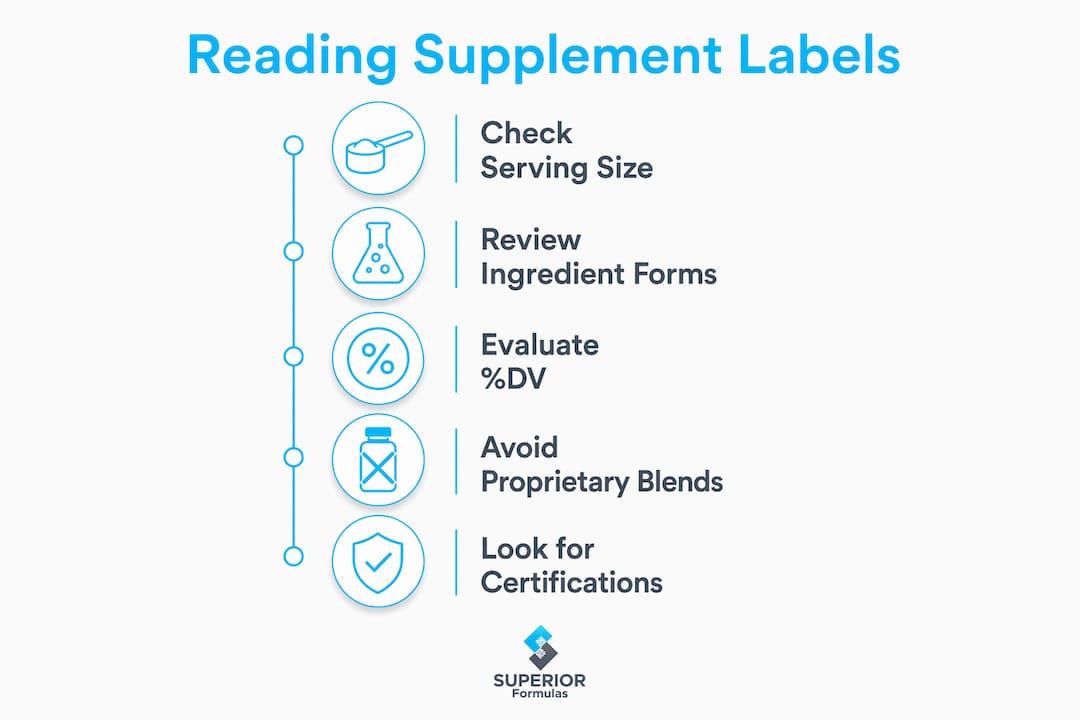
Serving size directly determines how you calculate every dose and the true cost per use. A bottle listing 60 capsules at two capsules per serving contains only 30 servings, not 60. That distinction cuts the apparent value in half and doubles your actual monthly cost.
Serving size is manufacturer-defined, not standardized across the industry. Two magnesium products can list the same milligram amount per serving while requiring very different capsule counts to reach it. Always multiply the per-serving dose by the number of servings per container before comparing products.
Understanding % Daily Value and its limits
%DV tells you how much of a nutrient one serving contributes toward a general daily reference intake. Consumers often mistake a high %DV for a better or more effective dose. %DV is designed to help you balance total intake across food and supplements, not to indicate the optimal therapeutic dose for a specific health goal. A supplement with 500% DV of vitamin B12 is not five times more effective than one with 100% DV. It simply delivers a much larger amount relative to a baseline reference.
How to identify quality through ingredient forms and proprietary blends
The chemical form of an ingredient determines how well your body absorbs and uses it. Ingredient forms can increase bioavailability by up to 20 times compared to lower-quality alternatives. Magnesium citrate and magnesium glycinate absorb far more efficiently than magnesium oxide, yet all three appear on labels simply as “magnesium.” The form tells you which one you are actually getting.
Generic ingredient names without a specified form are a signal of lower quality. A label listing “magnesium 200 mg” without specifying citrate, glycinate, or another form gives you no way to assess what you are absorbing. Specific chemical names indicate a manufacturer who understands and discloses what they are formulating.
Proprietary blends: a transparency red flag
Proprietary blends combine multiple ingredients into one total weight without disclosing individual amounts. A blend labeled “Energy Matrix 500 mg” might contain 490 mg of caffeine and 10 mg of everything else. You cannot assess whether any single ingredient reaches an effective dose. FDA regulations permit proprietary blends, which creates a legal but significant transparency gap.
Criteria for evaluating ingredient transparency on any label:
- Each active ingredient lists a specific chemical form, not just a generic name
- Individual ingredient amounts are disclosed, not grouped into a blend total
- The label shows no vague terms like “proprietary complex” or “matrix”
- Doses align with amounts used in published clinical research
- The manufacturer provides a Certificate of Analysis on request
Pro Tip: If a label lists a proprietary blend for any ingredient you are taking for a specific health goal, treat it as a disqualifying factor. You cannot confirm effective dosing without individual amounts.
Why third-party testing certifications matter
Third-party certifications confirm that an independent organization tested the product and verified it matches its label claims. USP and NSF certifications confirm a supplement is free from significant contamination and contains what the label states. These marks represent a meaningful quality floor in a market where manufacturers are not required to prove safety or efficacy before selling.
What certifications verify and what they do not:
- USP Verified: Confirms ingredient identity, potency, and purity; does not evaluate clinical effectiveness
- NSF Certified for Sport: Confirms no banned substances; relevant for athletes and active adults
- ConsumerLab Approved: Confirms the product passed independent testing for label accuracy
Certifications do not guarantee a supplement will work for your specific health goal. They confirm the product contains what it claims and is not contaminated. That baseline matters because unverified products show wide variability in actual ingredient content compared to label claims.
Pro Tip: Visit the certifying organization’s website directly and search for the product by name. Counterfeit seals exist. Verification takes under two minutes and confirms the logo is legitimate.
A practical 5-step audit for any supplement label
Apply this sequence before purchasing any supplement. It takes less than five minutes and filters out the majority of low-quality products.
- Check dose against clinical evidence. Look up the ingredient and compare the label dose to amounts used in published clinical trials. Doses under 50% of clinically studied levels are unlikely to produce meaningful results.
- Reject proprietary blends. If individual ingredient amounts are hidden inside a blend total, move on. You cannot confirm effective dosing without disclosed amounts.
- Verify ingredient forms. Confirm the label lists specific chemical forms, not generic names. Magnesium citrate, not just magnesium. Methylcobalamin, not just vitamin B12.
- Calculate true cost per serving. Divide the price by the number of servings per container, not the capsule count. A cost per serving calculation reveals the real value of any product.
- Confirm third-party testing. Look for USP, NSF, or ConsumerLab marks. Verify the seal on the certifying organization’s website before trusting it.
The table below summarizes what to look for across the key quality dimensions of any supplement.
| Quality dimension | Strong label signal | Weak label signal |
|---|---|---|
| Dose transparency | Individual amounts listed | Proprietary blend total only |
| Ingredient form | Specific chemical form named | Generic ingredient name only |
| Certification status | USP, NSF, or ConsumerLab seal | No third-party verification |
| Serving clarity | Servings per container stated | Only total capsule count listed |
| Additive profile | Minimal, named inactive ingredients | Long list of dyes, fillers, vague additives |
What the “Other Ingredients” section and front-label claims reveal
The “Other Ingredients” section appears below the active ingredient table and lists everything else in the capsule or tablet. This section reveals a product’s true quality profile. Minimal fillers and synthetic additives reflect a cleaner formulation. A long list of artificial dyes, titanium dioxide, and unspecified “natural flavors” signals a manufacturer prioritizing cost over quality.
Adults with allergies face a specific risk here. Cross-contamination statements like “manufactured in a facility that also processes tree nuts” appear in this section. Hidden allergens such as soy, gluten, or shellfish derivatives can also appear as inactive ingredients. Scanning this section carefully is not optional for anyone with known sensitivities.
Key things to check in the Other Ingredients section:
- Avoid products with artificial dyes (FD&C Red No. 40, Blue No. 1) unless medically necessary
- Watch for hydrogenated oils, which serve as cheap binders but carry cardiovascular concerns
- Note cross-contamination warnings relevant to your known allergens
- Prefer products with clean-label formulations that name each inactive ingredient specifically
Front-of-bottle claims like “Premium Formula,” “Maximum Strength,” or “Advanced Complex” are unregulated marketing language. The FDA enforces accuracy only within the Supplement Facts panel. A front label can legally claim almost anything. Treat front-label language as advertising, not evidence.
Pro Tip: Flip the bottle before reading anything on the front. Start with the Supplement Facts panel and Other Ingredients. The front label is the last thing worth your attention.
Key takeaways
Reading supplement labels accurately requires checking the Supplement Facts panel for specific ingredient forms, disclosed individual doses, and verified third-party certification marks before any purchase.
| Point | Details |
|---|---|
| Supplement Facts panel is the only regulated section | Focus your analysis here; front-label claims carry no regulatory weight. |
| Serving size drives all dose and cost calculations | Always divide price by servings per container, not total capsule count. |
| Ingredient form determines absorption | Specific chemical forms like magnesium citrate signal quality; generic names do not. |
| Proprietary blends hide effective dosing | Reject any product that groups ingredients into a blend without individual amounts. |
| Third-party certification is a quality floor | Verify USP, NSF, or ConsumerLab seals directly on the certifying organization’s website. |
What I’ve learned after years of reading supplement labels
Most adults over 35 make the same two mistakes. They trust the front of the bottle, and they assume a higher %DV means a better product. Both habits lead to spending money on supplements that either do nothing or deliver the wrong dose entirely.
The %DV confusion is particularly common. Consumers see 1,000% DV of a B vitamin and assume the product is potent. %DV is a reference tool for balancing total daily intake, not a measure of therapeutic effectiveness. Chasing high %DV numbers without checking clinical dosing evidence is a reliable way to buy expensive supplements that underdeliver.
Ingredient forms are where I see the biggest gap between what people read and what they understand. Most adults do not know that magnesium oxide absorbs poorly compared to magnesium citrate or glycinate. That difference is not a minor detail. It determines whether the supplement actually works. A step-by-step selection process built around ingredient form verification saves more money than any discount.
Third-party certification has become non-negotiable for me. The supplement market is not pre-screened by the FDA before products reach shelves. Certifications from USP, NSF, or ConsumerLab are the closest thing to independent quality assurance available to consumers. A product without any certification is asking you to trust the manufacturer on faith alone. That is a reasonable ask only when the manufacturer has a documented track record of transparency.
The practical reality is that you do not need to spend 20 minutes on every label. The five-step audit takes less than five minutes once you know what to look for. Dose, form, blend transparency, cost per serving, and certification status. Those five checkpoints filter out the majority of low-quality products before you ever open your wallet.
— cristopher
Superiorformulas: supplements built for label-literate adults
Knowing what to look for on a supplement label changes how you shop. Superiorformulas was founded by a physician-scientist specifically to meet the standard that informed adults now expect: disclosed ingredient forms, individual amounts for every active ingredient, GMP-certified manufacturing, and third-party testing for purity and potency.
Every Superiorformulas product lists specific chemical forms, carries no proprietary blends, and minimizes inactive ingredients to those with a clear functional purpose. Adults 35 and older who have done the label work know exactly what that means. For a deeper look at how to apply these standards across your full supplement routine, the supplement quality checklist on the Superiorformulas blog walks through each criterion in detail. When you are ready to shop with confidence, the full product line is available at Superiorformulas.
FAQ
What is the Supplement Facts panel?
The Supplement Facts panel is the only legally regulated section of a supplement label, required under 21 CFR 101.36 to display serving size, ingredient amounts, and % Daily Value where established.
How do proprietary blends affect dosing?
Proprietary blends list a combined weight for multiple ingredients without disclosing individual amounts, making it impossible to confirm whether any single ingredient reaches a clinically effective dose.
What does % Daily Value mean on a supplement label?
%DV shows how much of a nutrient one serving contributes toward a general daily reference intake. A high %DV does not indicate a more effective therapeutic dose; it simply reflects a larger amount relative to a baseline reference.
Which third-party certifications are most reliable?
USP, NSF, and ConsumerLab are the three most recognized independent certifying organizations. Each verifies label accuracy and purity through testing; always confirm a seal by searching the product on the certifying organization’s website.
Why does ingredient form matter when choosing supplements?
The chemical form of an ingredient determines how well your body absorbs it. Specific forms like magnesium citrate absorb far more efficiently than generic alternatives like magnesium oxide, making form disclosure a key quality indicator.


