


Millions of health-focused adults spend hundreds of dollars each year on supplements without a clear method for determining whether those products are truly necessary, accurately labeled, or even safe. The supplement market topped $177 billion globally in 2023, yet 42% of U.S. adults remain vitamin D deficient despite widespread supplementation, which tells you something important: buying supplements and actually benefiting from them are two very different things. This guide walks you through a disciplined, evidence-based process for assessing what you take, what you actually need, and how to verify that your supplements are delivering real value.
Table of Contents
- Prepare: What you need before assessing supplements
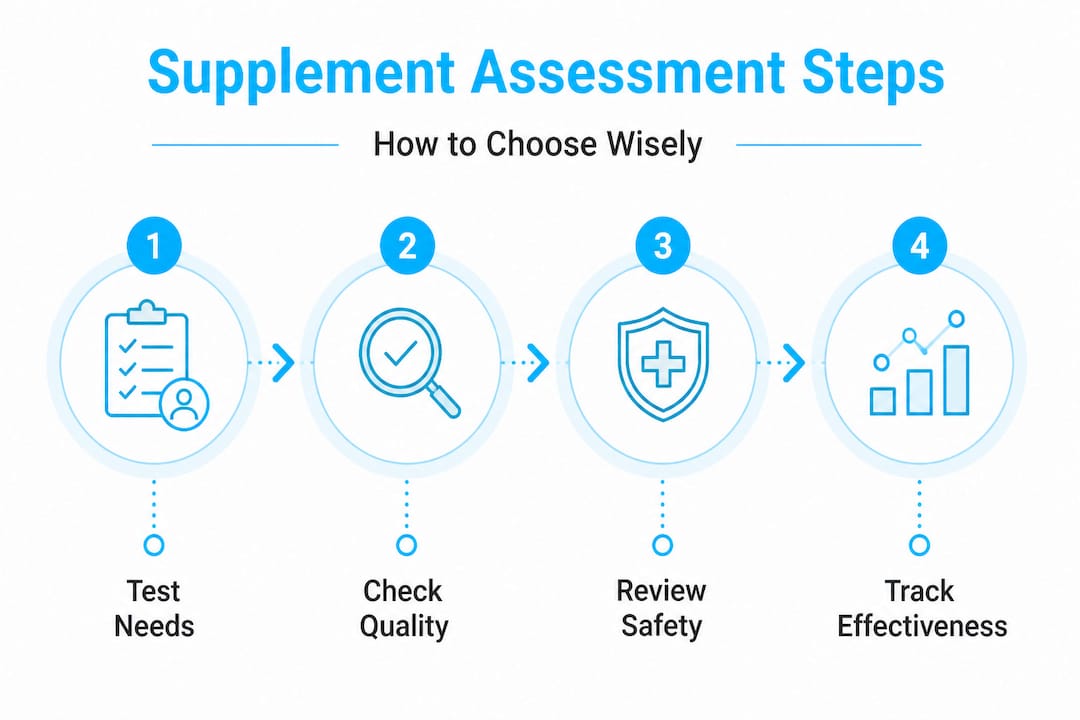
- Step 1: Assess your true supplement needs
- Step 2: Validate quality and efficacy of supplement choices
- Step 3: Check for safety and drug interactions
- Step 4: Verify your supplement’s ongoing effectiveness
- What most supplement guides miss: Real-world pitfalls and the evidence gap
- Take the next step: Choose smarter supplements for wellness
- Frequently asked questions
Key Takeaways
| Point | Details |
|---|---|
| Start with lab tests | Use bloodwork to identify real supplement needs before purchasing. |
| Check for third-party verification | Look for USP, ConsumerLab, or NSF seals to ensure supplement quality. |
| Verify label accuracy | Cross-check ingredients with DSLD and DSID databases for reliable composition. |
| Protect against interactions | Always review supplement and medication combinations with your physician. |
| Monitor supplement effects | Track your health response and adjust your regimen as your needs change. |
Prepare: What you need before assessing supplements
With the need for clear, science-based guidance established, start by gathering all necessary tools and understanding what information matters most. Proper preparation separates a productive supplement audit from a guessing game.
What to gather before you begin:
- All current supplement bottles, including any protein powders, greens blends, or functional foods
- A list of your current prescription medications and over-the-counter drugs
- Recent lab results, especially panels for vitamin D, B12, iron, ferritin, and magnesium
- Notes from your most recent physician visit regarding deficiencies or health conditions
- Access to the NIH Dietary Supplement Label Database (DSLD) and the Dietary Supplement Ingredient Database (DSID)
The DSLD and DSID are not widely known outside clinical research, but they are among the most powerful free tools available to any supplement user. ODS links supplement intake data with DSLD and DSID for precise exposure estimation, meaning researchers and consumers alike can cross-reference exactly what is on a label with independent compositional records. This matters because label claims and actual ingredient levels do not always match.
Understanding the Supplement Facts label is your next foundational step. Look specifically at:
- Serving size and servings per container (many products use a misleading “per serving” dose that requires multiple capsules)
- The “% Daily Value” column, which reflects government-set reference amounts
- The “Other Ingredients” section, which reveals fillers, binders, and excipients
- Whether the form of a nutrient is bioavailable (for example, magnesium glycinate absorbs significantly better than magnesium oxide)
Comparison of major third-party supplement certifications:
| Certification | What it tests | Scope | Cost to brands |
|---|---|---|---|
| USP Verified | Label accuracy, purity, dissolution | Broad | High |
| NSF Certified | Contaminants, label claims | Broad + sport | High |
| ConsumerLab | Ingredient content, contamination | Independent | N/A (subscriber model) |
| Informed Sport | Banned substances for athletes | Narrow | Moderate |
Third-party certification is not a guarantee of efficacy, but it is the strongest available signal of label accuracy and safety standards. A supplement without any independent certification deserves extra scrutiny, regardless of how polished its branding appears.
Pro Tip: Before assessing any supplement, look it up in the NIH DSLD at dsld.od.nih.gov. You can search by product name or brand and access the full ingredient list as submitted to the FDA, which sometimes differs from what appears on current retail packaging.
For a broader orientation on what separates well-formulated supplements from crowded-shelf products, explore our premium supplements guide before continuing your audit.
Step 1: Assess your true supplement needs
Once you’ve assembled your resources, the first practical step is to clarify whether you truly need any supplements and which ones are actually appropriate for your biology.
Follow this sequence to determine genuine need:
- Request targeted lab work. A standard metabolic panel often misses subclinical deficiencies. Ask specifically for 25-hydroxyvitamin D, serum B12, ferritin (not just hemoglobin), and serum or RBC magnesium. These four nutrients account for the majority of clinically meaningful deficiencies in adults over 35.
- Account for absorption barriers. Age, gut health, certain medications (like metformin, which depletes B12, or proton pump inhibitors, which reduce magnesium absorption), and chronic conditions like hypothyroidism all reduce how efficiently your body extracts nutrients from food.
- Audit your diet honestly. If you eat diverse, whole-food meals consistently, your need for broad multivitamin supplementation is genuinely lower. If you follow a vegan diet, skip fatty fish, or eat few leafy greens, targeted gaps are more likely.
- Apply a “food first” filter. For every supplement you are considering, ask whether dietary changes could address the same gap. If the answer is yes and those changes are realistic, start there.
- Identify medically supported use cases. Pregnant women need folate. Older adults often benefit from D3 and B12. Post-bariatric surgery patients require comprehensive micronutrient support. Situational need differs sharply from general wellness marketing.
“The evidence supports targeting supplementation to verified deficiencies rather than adopting broad regimens. Blood tests for deficiencies such as vitamin D and B12 remain the most reliable starting point for any evidence-based supplementation plan.”
One of the most persistent misconceptions is that everyone benefits from a daily multivitamin. Large randomized trials, including the Physicians’ Health Study II, found no significant reduction in cardiovascular disease or cancer risk from long-term multivitamin use in well-nourished adults. The data simply does not support universal supplementation as a longevity strategy. Learn more about supplements that truly work and which ones are overhyped in clinical reality.
Pro Tip: If your physician says your labs are “normal,” ask for your actual numeric values. A vitamin D level of 22 ng/mL is technically within the lab reference range but is considered insufficient by most functional medicine standards, which target 40 to 60 ng/mL for optimal immune and bone health.
Step 2: Validate quality and efficacy of supplement choices
After identifying potential supplement needs, the next step is to rigorously evaluate the quality and efficacy of the products you are considering. This is where most consumers fall short.
Label claims versus actual tested content:
| Supplement type | Common label claim | What testing often finds |
|---|---|---|
| Omega-3 fish oil | 1000 mg EPA/DHA per serving | Actual EPA/DHA can be 30-50% lower due to oxidation |
| Vitamin D3 | 2000 IU per capsule | Generally accurate; form matters more than dose |
| Magnesium | 400 mg elemental magnesium | Oxide form yields less than 5% absorption |
| Probiotic | 10 billion CFU at manufacture | CFU counts often drop significantly by expiration |
| Herbal extract | Standardized to 5% active compound | Batch variability is common without third-party testing |
The analytical gap between what is claimed and what is actually present is not a fringe concern. Validation of analytical methods for supplement constituents requires accuracy, precision, limit of detection (LOD), limit of quantification (LOQ), linearity, and matrix effects using certified reference materials, meaning the science of proving a label is accurate is genuinely rigorous. Many companies skip it entirely.
Meanwhile, industry marketing often outpaces actual clinical validation, and compositional discrepancies between labeled and actual ingredient content are well-documented across supplement categories. This is not isolated to low-cost brands.
Key validation checkpoints:
- Search the product in the NIH DSLD to compare the label on file with what you hold in your hand
- Run the brand through ConsumerLab.com’s verified product list, which tests for label accuracy and contaminants
- Check whether the product carries a USP or NSF seal, not just a generic “GMP certified” claim (GMP refers to manufacturing process standards, not ingredient accuracy)
- Look up individual ingredients in PubMed to verify that human clinical trials, not just animal or in-vitro studies, support the claimed benefit
For a more thorough breakdown of how to apply science-driven standards to your buying decisions, read our guide on science-driven supplement choices. If you want to understand what those “Other Ingredients” actually mean, our explainer on supplement fillers covers why some additives are harmless and others are worth avoiding.
Step 3: Check for safety and drug interactions
With validated, quality supplements in hand, ensure you’ve covered safety basics by ruling out any medication or nutrient interactions. This step is non-negotiable for anyone over 40 who takes even one prescription medication.
Interaction risks to review systematically:
- Anticoagulants and vitamin K or omega-3s: High-dose fish oil and vitamin K can both affect blood clotting, which is critical if you take warfarin or newer anticoagulants
- Thyroid medications and calcium or iron: These minerals bind to levothyroxine in the gut and dramatically reduce absorption if taken within two hours of your dose
- SSRIs and St. John’s Wort: This herbal supplement is frequently underreported to physicians, yet it significantly alters serotonin activity and can reduce the efficacy of antidepressants
- Statins and high-dose niacin or CoQ10: The relationship between statins, CoQ10 depletion, and supplementation is nuanced and worth discussing with your prescriber
- Overlapping nutrients across products: If you take a multivitamin, a separate B-complex, and an energy supplement, you may be consuming three to four times the tolerable upper intake level for B6, which is associated with peripheral neuropathy at chronic high doses
“Experts advise prioritizing drug interaction checks in older adults; polypharmacy raises risk substantially. The more medications and supplements you combine, the more unpredictable the interactions become.”
Proprietary blends deserve special caution. When a label lists a “Longevity Blend” with six ingredients totaling 500 mg, you have no way to know whether any single ingredient is present at a therapeutically meaningful dose or is included as a token amount for marketing purposes. Transparency in labeling is an ethical standard, not just a regulatory one.
For formulations designed with these safety principles in mind from the start, explore our library of physician-formulated longevity supplements built around open-label, fully disclosed ingredient dosing.
Step 4: Verify your supplement’s ongoing effectiveness
Now that you’ve started your supplements, the final step is maintaining accountability and confirming they deliver real benefits for your health. Starting a supplement is easy. Verifying its impact requires discipline.
Follow this ongoing monitoring protocol:
- Re-test relevant biomarkers at 90 days. Most nutrient levels, including vitamin D, B12, and ferritin, stabilize within 8 to 12 weeks of consistent supplementation. A follow-up lab panel at 90 days tells you whether your dose and product are working.
- Track subjective changes systematically. Keep a brief daily log noting energy, sleep quality, digestion, and any symptoms that led you to start the supplement. Subjective tracking is not scientific proof, but patterns over weeks become informative.
- Watch for diminishing returns or new symptoms. If you felt improvement at 60 days and nothing has changed by 6 months, that may indicate you’ve corrected the deficiency and can reduce the dose. New symptoms warrant immediate reassessment.
- Schedule an annual reassessment. Your needs at 45 differ from your needs at 55. Hormonal shifts, changes in gut health, new medications, and evolving dietary patterns all alter your nutrient requirements over time.
ODS methodologies include ongoing exposure assessment and dissolution studies to reveal efficacy gaps in supplements, which means even the research community recognizes that a supplement’s effectiveness must be continuously evaluated rather than assumed at purchase. The same principle applies to your personal health monitoring.
Pro Tip: Photograph your supplement labels before and after the 90-day test period. Product reformulations happen more often than consumers realize, and having a record of the original formula you tested protects your ability to replicate results.
To understand the methods scientists use to assess how well supplements perform in real biological systems, visit our science resource page on methods scientists use to assess supplement effectiveness.
What most supplement guides miss: Real-world pitfalls and the evidence gap
Stepping back, it is vital to recognize the limits and hidden biases built into supplement assessment, even when you follow the best protocols available.
The supplement industry generates enormous revenue by conflating mechanism with outcome. A compound may activate the Nrf2 pathway in a cell culture study, and that is a genuinely interesting finding. But the leap from “activates a pathway in vitro” to “extends human lifespan” is not supported by the same evidence. Industry often conflates mechanisms with actual outcomes, and the low supplement use among centenarians studied in longevity hotspots around the world directly contradicts the heaviest marketing messages in the anti-aging space.
What actually characterizes long-lived populations? Consistent plant-forward eating, strong social bonds, regular low-intensity physical activity, and minimal chronic stress. No supplement stack replicates that. This does not mean supplements are useless. It means they occupy a supporting role, not a leading one.
The guides that teach supplement assessment without acknowledging this context are doing you a partial service. Knowing how to read a label is valuable. Knowing that the label is attached to something that may not change your health trajectory at all is equally important. Use the preventive health supplement realities framework to calibrate your expectations before investing significant money in any regimen.
Context and moderation matter enormously. An adult who sleeps poorly, exercises inconsistently, and manages ongoing chronic stress will see minimal return from even the most rigorously validated supplement program. Address the foundations first. Then use supplements strategically to fill verified gaps.
Take the next step: Choose smarter supplements for wellness
Armed with expert strategies for supplement assessment, take confident action with rigorously formulated options and trustworthy educational resources.
Superior Formulas products are physician-formulated, manufactured in GMP-certified facilities, and use fully disclosed ingredient dosing so you never have to guess what you are taking or why. If your assessment reveals a need for broad micronutrient coverage, Superior Multi+ Daily delivers AREDS2-aligned nutrients in bioavailable forms designed for adults prioritizing cellular health. If your focus is on supporting healthy aging pathways at the cellular level, LONGEVITY Daily Nrf2 Activate+ combines clinically studied polyphenols and phytonutrients to support Nrf2 activation and antioxidant resilience.
For a deeper look at the science behind how we select, validate, and formulate our products, take a deep dive into supplement validation on our science resource page. The evidence is there. We just make it easy to find.
Frequently asked questions
How can I know if a dietary supplement is really necessary?
Start with recent lab tests to evaluate deficiencies and consult your health provider before choosing supplements. Blood tests for deficiencies such as vitamin D and B12 remain the most reliable starting point for any evidence-based supplementation decision.
What is the most reliable way to check supplement quality?
Look for third-party seals like USP, ConsumerLab, or NSF and verify with online label databases like the DSLD. These tools together provide the strongest available signal that a product contains what it claims at verified content levels free from significant contamination.
How do I avoid dangerous interactions between supplements and medications?
Review all products with your physician and use reputable medical sources to screen for interactions before combining anything. Polypharmacy heightens risk substantially, so the more medications and supplements you use simultaneously, the more critical provider oversight becomes.
Why do some supplements fail to work as advertised?
Some labels exaggerate benefits and actual ingredient content can differ meaningfully from what is listed on the front panel. Validation studies find composition discrepancies across multiple supplement categories, particularly in herbal extracts and probiotic products.
Is it safe to use multiple supplements together?
Using many supplements simultaneously increases the risk of nutrient overdoses and unpredictable interactions. Older adults with polypharmacy must be especially cautious, and a provider review of your full supplement and medication list is the safest path forward.
Recommended
- Supplements in preventive health: What really works? - SUPERIOR Formulas
- Implement science-driven supplementation for better health - SUPERIOR Formulas
- Physician-formulated supplements for longevity and cellular health - SUPERIOR Formulas
- What Are Premium Supplements? A Science-Backed Longevity Guide - SUPERIOR Formulas
- RankOfSupplements


