


Most people assume the supplements they buy have been tested and approved before reaching store shelves. That assumption is wrong. Understanding why choose clean supplements is one of the most practical decisions you can make for your long-term health, because the conventional supplement market operates with far less oversight than most consumers realize. Nearly 61% of adults aged 18 to 65 regularly take supplements, yet many of those products are unregulated and may not contain effective doses. This article clarifies what clean supplements actually are, how independent verification works, and how to apply that knowledge when choosing products that genuinely serve your wellness goals.
Table of Contents
- Key takeaways
- Why choose clean supplements: what they actually are
- The regulatory landscape you need to understand
- Third-party certification: your best verification tool
- Health benefits of choosing clean over conventional
- How to select and use clean supplements wisely
- My honest perspective on clean supplements
- Where to find supplements you can actually trust
- FAQ
Key takeaways
| Point | Details |
|---|---|
| Regulation gaps are real | Supplement manufacturers are not required to prove safety or efficacy before marketing their products. |
| Third-party certification is rare | Fewer than 5% of supplements carry independent certification marks, making them a reliable differentiator. |
| Clean means transparent | Clean supplements use simple ingredient lists, avoid unnecessary additives, and disclose sourcing clearly. |
| Certification has limits | Third-party marks confirm purity and potency but do not guarantee a supplement will produce specific clinical outcomes. |
| Practical steps matter | Reading labels critically, verifying batch numbers, and consulting a healthcare provider improves supplement outcomes. |
Why choose clean supplements: what they actually are
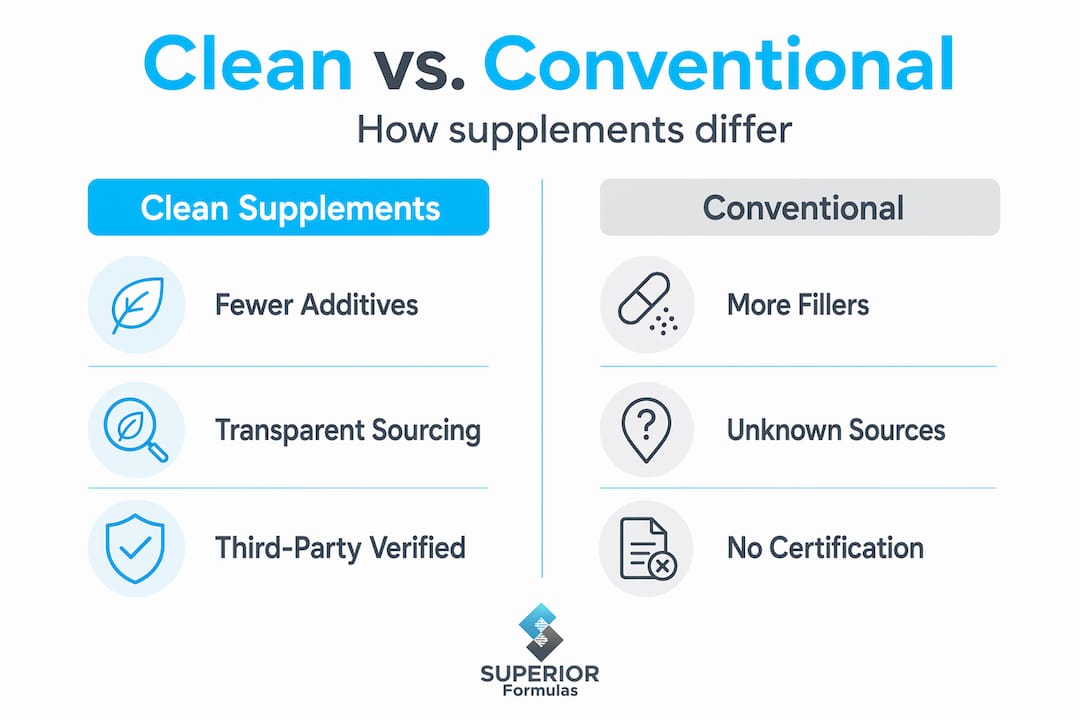
The term “clean supplement” gets used loosely in marketing, so defining it precisely matters. At its core, a clean supplement uses ingredients that are minimally processed, clearly sourced, and free from compounds that serve the manufacturer rather than the consumer.
Here is what distinguishes a genuinely clean supplement from a conventional one:
- Whole-food or minimally processed ingredients. Clean formulations prioritize organic or naturally derived compounds, polyphenols, and phytonutrients with documented biological activity rather than synthetic analogs.
- No unnecessary fillers or additives. Artificial colors, titanium dioxide, carrageenan, polyethylene glycol, and synthetic preservatives appear in many conventional supplements but add no nutritional value.
- Short, readable ingredient lists. Transparent sourcing and simple ingredient lists are hallmarks of clean formulations. If you cannot identify what most ingredients are or why they are present, that is a warning sign.
- No proprietary blends hiding doses. Proprietary blends allow manufacturers to list ingredients without disclosing individual amounts. A clean supplement shows you exactly how much of each ingredient you are getting.
- Absence of common allergens and synthetic binders. Clean supplements for health avoid gluten, soy fillers, artificial sweeteners, and hydrogenated oils that can compromise tolerance and absorption.
Pro Tip: When evaluating a supplement label, count the inactive ingredients. If there are more inactive ingredients than active ones, set the product down and look for something simpler.
The clean supplement advantages extend beyond ingredient lists. Manufacturing environment matters too. Products made in current Good Manufacturing Practice (cGMP) certified facilities follow stricter production and documentation standards than those that do not.
The regulatory landscape you need to understand
The most important thing to know about the supplement industry is that it does not work like pharmaceuticals. Under DSHEA, supplement manufacturers are not required to prove safety or efficacy before marketing their products. The Dietary Supplement Health and Education Act of 1994 placed the burden of proving a product unsafe on the FDA rather than requiring manufacturers to prove it safe first.
What that means in practice is significant:
- A company can formulate, produce, and sell a supplement without ever submitting evidence to any government body that the product works.
- The FDA acts only after a safety issue is reported, meaning harm has to occur before regulatory action typically begins.
- Mislabeling, contamination, underdosing, and adulteration are documented problems across the conventional supplement market.
- cGMP certification reduces manufacturing errors but does not verify that a finished product contains what its label claims.
“Third-party verification is the primary consumer safeguard given the FDA’s limited pre-market regulation.” — ScienceInsights
This regulatory gap is not theoretical. Independent testing organizations have repeatedly found commercial supplements that contain less of an active ingredient than stated, or that include contaminants not listed on the label. The clean vs. conventional supplements distinction matters precisely because this gap is real and widespread.
The importance of clean ingredients becomes clearer when you understand that choosing a conventional product without any independent verification is essentially an act of trust in a system that does not require accountability. That is not a position most health-conscious adults want to be in.

Third-party certification: your best verification tool
Given that pre-market approval does not exist for supplements, independent third-party certification fills the gap. But fewer than 5% of all dietary supplements carry independent third-party certification marks. That scarcity makes certification one of the clearest signals of quality available to consumers.
The three most recognized programs are USP, NSF International, and Informed Sport or Informed Choice. Here is how they compare:
| Certification | What it tests | Unannounced audits | Batch verification available |
|---|---|---|---|
| USP Verified | Identity, potency, purity, dissolution | Yes | Yes |
| NSF Certified for Sport | Contaminants, label accuracy, banned substances | Yes | Yes |
| Informed Sport | Banned substances, label accuracy | No | Yes |
| Informed Choice | Same as Informed Sport, consumer products | No | Yes |
The USP Verified Mark requires rigorous testing including proof of ingredient identity, potency, purity, and proper dissolution, verified through unannounced facility audits. NSF Certified for Sport goes further by screening for substances banned in athletic competition, making it the gold standard for performance-focused consumers.
That said, the critical nuance here is that third-party certifications confirm label accuracy and purity but do not guarantee clinical effectiveness. A certified magnesium glycinate supplement has been verified to contain what it claims. Whether magnesium glycinate will resolve your specific sleep issue is a separate clinical question entirely.
Pro Tip: Always verify the batch number of a certified supplement against the official database of the certifying body before purchasing. Batch number verification is the only way to confirm that your specific bottle was part of the certified batch.
When choosing quality supplements, the presence of a certification mark is a starting point, not a finish line. Use it alongside label transparency, cGMP manufacturing status, and clear ingredient sourcing.
Health benefits of choosing clean over conventional
The benefits of clean supplements are both direct and cumulative. When you consistently choose products free from unnecessary additives and properly dosed with bioavailable nutrient forms, your body processes them more efficiently and with fewer adverse reactions.
Here is how those advantages play out in real terms:
- Improved bioavailability. Certain nutrient forms absorb dramatically better than others. Magnesium glycinate absorbs more readily than magnesium oxide. Methylfolate crosses into the cell more effectively than folic acid for many people. Clean formulations tend to use clinically validated forms rather than cheaper synthetic alternatives.
- Reduced gut inflammation risk. Supplements can contain additives that cause gut inflammation and other adverse reactions, yet most consumers never make the connection between a supplement and gastrointestinal discomfort. Removing those additives removes the variable.
- Better adherence through trust. When you understand exactly what is in your supplement and why each ingredient is present, you are more likely to take it consistently. Consistency drives outcomes.
- Alignment with holistic wellness goals. Clean supplements fit naturally alongside whole food diets, Nrf2-activating lifestyle practices, and evidence-based longevity strategies. Conventional supplements loaded with artificial ingredients create an incongruence with those goals.
- Environmental and ethical sourcing. Clean supplement manufacturers tend to apply higher sourcing standards that consider environmental impact, fair labor, and ecological sustainability. That matters to many health-conscious consumers.
The importance of clean ingredients also extends to what you are not ingesting. Avoiding synthetic dyes, artificial sweeteners, and low-quality binders over months and years reduces cumulative exposure to compounds with poorly understood long-term effects.
How to select and use clean supplements wisely
Knowing the theory behind clean supplements matters far less than applying it at the point of purchase. Here is how to do that practically:
- Read every ingredient on the label, not just the active ones. The inactive ingredients section is where most shortcuts hide. Look for titanium dioxide, carrageenan, and artificial colors as instant disqualifiers.
- Confirm third-party certification and batch status. A certification logo on the front panel means nothing if your specific batch was not tested. Use the certifying body’s online lookup tool with your batch number.
- Avoid gummy supplements as your primary format. Gummy supplements are often loaded with sugars and additives that classify them closer to ultra-processed foods than health products.
- Ask your physician before adding any supplement. Supplements should support, not replace, balanced diets and medical care. A healthcare provider can also identify potential interactions with medications.
- Reject proprietary blends for critical nutrients. If a label lists a “cellular support blend” at 400mg without telling you how much of each ingredient that includes, you cannot evaluate the dose.
- Remember that more is not always better. Higher nutrient doses do not necessarily mean better results and excessive supplementation can genuinely harm health. Target evidence-based doses over megadoses.
For a structured framework on assessing any supplement before you buy it, the supplement assessment guide from Superiorformulas walks through label evaluation, manufacturer credibility, and ingredient verification step by step.
Pro Tip: When starting a new supplement regimen, introduce one product at a time and give it at least 8 weeks before evaluating results. That isolation period makes it far easier to identify what is working and catch any adverse reactions early.
My honest perspective on clean supplements
I have spent years reading clinical research on supplement formulations, and the single most frustrating pattern I keep seeing is health-conscious consumers who do everything right with their diet and lifestyle but then unknowingly introduce low-quality supplements that work against their goals.
The uncomfortable reality is that most supplements sold in mainstream retail channels would not pass third-party testing if randomly selected and independently analyzed. That is not alarmism. It is an industry-documented pattern that has been confirmed repeatedly by independent labs. The market is large, the regulation is light, and the opportunity for corner-cutting is significant.
What I have learned is that the “are clean supplements better” debate mostly misses the point. The real question is whether you want certainty or chance. A certified, clean supplement from a transparent manufacturer gives you a known quantity. A conventional product without independent verification gives you a label and a marketing claim.
I also want to be direct about something most supplement articles avoid: clean supplements are not magic. They work when combined with real food, adequate sleep, movement, and stress management. The science-driven approach to supplementation that I find most credible treats supplements as precision support tools, not shortcuts.
My recommendation: prioritize certification, prioritize transparency, and use supplements to fill genuine nutritional gaps rather than to compensate for lifestyle deficits. That combination consistently produces the most meaningful results.
— cristopher
Where to find supplements you can actually trust
If you are ready to move beyond guesswork and into evidence-backed supplementation, Superiorformulas offers physician-formulated products built specifically around the principles covered in this article. Every formulation uses clinically studied ingredients with disclosed sourcing, manufactured in cGMP-certified facilities with third-party testing for purity and potency. The science behind each formula is documented and accessible, not hidden behind marketing language. For a premium starting point, Formula 9 Superior Multi+ delivers comprehensive daily nutrition including AREDS2 nutrients in a clean, transparent formulation designed for those who take their long-term health seriously.
FAQ
What are clean supplements exactly?
Clean supplements use minimally processed, clearly sourced ingredients with transparent labeling, no proprietary blends, and no unnecessary fillers or synthetic additives. They are manufactured under cGMP standards and often carry independent third-party certification.
Are clean supplements better than conventional supplements?
For most health-conscious consumers, yes. Clean supplements offer higher ingredient transparency, better nutrient forms, and fewer additives that can cause gut irritation or allergic reactions. Independent certification also provides a level of quality assurance that conventional products typically lack.
How do I verify a supplement is genuinely third-party certified?
Check the certifying organization’s official website and use their batch lookup tool with the batch number printed on your specific bottle. A logo alone does not confirm your product was tested.
Do clean supplements require FDA approval?
No dietary supplement requires FDA pre-market approval under current U.S. law. The FDA only acts after a safety concern is reported. Third-party certification is the most reliable quality verification available to consumers in this regulatory environment.
Can clean supplements replace a healthy diet?
No. Supplements are designed to support nutritional intake, not replace whole foods or medical care. They work best when used to address specific, identified gaps alongside a balanced diet and healthy lifestyle habits.
Recommended
- Implement science-driven supplementation for better health - SUPERIOR Formulas
- How to assess dietary supplements for real wellness gains - SUPERIOR Formulas
- Why choose science-driven supplements for longevity gains - SUPERIOR Formulas
- Supplements in preventive health: What really works? - SUPERIOR Formulas


