


After 35, the supplement aisle stops feeling like an opportunity and starts feeling like a minefield. Thousands of products, contradictory studies, and influencer stacks compete for your attention and your wallet. The uncomfortable reality is that most people are supplementing based on trends, not biology. A recent push in precision medicine is changing that: by grounding your regimen in biomarker data and clinical evidence, you can stop guessing and start targeting what your body actually needs. This guide walks you through every step of that process.
Table of Contents
- Why a science-driven approach matters
- Personalization: Identifying what your body really needs
- Selecting supplements based on evidence and your profile
- Implementing and cycling your regimen for best results
- Verifying progress and refining your approach
- Our take: Why true science-driven supplementation requires ongoing adaptation, not set-it-and-forget-it
- Ready to personalize your regimen? Superior Formulas can help
- Frequently asked questions
Key Takeaways
| Point | Details |
|---|---|
| Let data guide you | Lab testing lets you select only the supplements your body truly needs—no guesswork. |
| Review and refine | Science-driven supplementation means regularly retesting biomarkers and fine-tuning your regimen. |
| Avoid static stacks | Best results come from ongoing adaptation—not set-it-and-forget-it routines or trend-driven shopping. |
| Never skip the basics | Supplements complement but never replace a strong foundation of diet, exercise, and quality sleep. |
Why a science-driven approach matters
To make your supplement routine count, you need to go beyond generic recommendations. The difference between a meaningful regimen and an expensive guessing game comes down to one thing: personalization.
The established position from institutions like Harvard and the NIH is clear. Food, movement, sleep, and stress management come first. Supplements fill verifiable gaps, not imagined ones. Multivitamins show modest cognitive benefits in the COSMOS trial, equivalent to roughly three years of cognitive aging reversed, but they offer no meaningful protection against cardiovascular disease or cancer according to USPSTF recommendations.
At the same time, a distinct voice is emerging from the longevity research community. Researchers and clinicians like David Sinclair and Andrew Huberman advocate a more targeted approach, focusing on specific hallmarks of aging. Targeted longevity stacks built around compounds like NMN and Urolithin A are gaining traction, even as the human trial data remains in early stages.
Here is what the evidence actually supports for most adults over 35:
- Whole foods and lifestyle provide the irreplaceable foundation for cellular health
- Targeted supplementation becomes meaningful when a genuine gap is confirmed by lab data
- Longevity compounds such as NMN, Urolithin A, and omega-3s address specific aging mechanisms rather than broad deficiencies
- Multivitamins offer cognitive support but should not be seen as a health insurance policy
“The strongest evidence still points to diet and lifestyle as the primary drivers of healthy aging. Supplements become genuinely powerful only when they are deployed with precision.” This is the framing that shapes everything we do at Superior Formulas. Read more about supplement science explained to understand how we apply this standard.
Personalization: Identifying what your body really needs
But how do you know where to focus? Start with your personal biochemistry.
A handful of biomarkers give you a clear and actionable picture of your supplementation needs. Rather than assuming you need vitamin D because you live in a northern climate, or magnesium because you feel tired, you test. You confirm. Then you act. According to published clinical research, key biomarkers for personalized supplementation include 25-OH vitamin D, RBC magnesium, omega-3 index, hs-CRP (a marker of systemic inflammation), homocysteine, fasting insulin, ferritin, and B12. These eight markers represent a solid data foundation for any adult serious about long-term wellness.
Here is what each marker tells you:
| Biomarker | What it measures | Actionable threshold |
|---|---|---|
| 25-OH vitamin D | Bone, immune, and metabolic health | Below 30 ng/mL: consider supplementation |
| RBC magnesium | Cellular energy, muscle, and sleep quality | Low normal: add glycinate or malate form |
| Omega-3 index | Cardiovascular and cognitive protection | Below 8%: increase EPA/DHA intake |
| hs-CRP | Systemic inflammation (inflammaging) | Above 1.0 mg/L: evaluate omega-3, curcumin |
| Homocysteine | Methylation, cardiovascular risk | Above 10 umol/L: consider B6, B12, folate |
| Fasting insulin | Metabolic health and longevity signaling | Elevated: lifestyle first, then berberine |
| Ferritin | Iron storage and energy production | Low or high: address before supplementing iron |
| B12 | Nerve function, methylation, energy | Below 400 pg/mL: methylcobalamin preferred |
How to build your data-driven foundation:
- Request a comprehensive panel at your next annual physical. Most of these markers require a simple blood draw.
- Ask specifically for hs-CRP and homocysteine, as these are not always included in standard panels.
- Use an personalized biomarker analysis framework to interpret results relative to optimal ranges, not just the reference ranges printed on lab reports.
- Record your baseline values so you have a clear before-and-after comparison once you begin supplementing.
- Retest within 12 weeks of starting a new protocol to assess measurable change.
Pro Tip: Reference ranges on lab reports reflect the general population, which skews unhealthy. For longevity-focused goals, optimal vitamin D sits above 50 ng/mL, and an omega-3 index above 8% is the research-backed target for cognitive and cardiovascular protection.
Selecting supplements based on evidence and your profile
Once you have your biomarker roadmap, you can identify and prioritize the supplements you truly need.
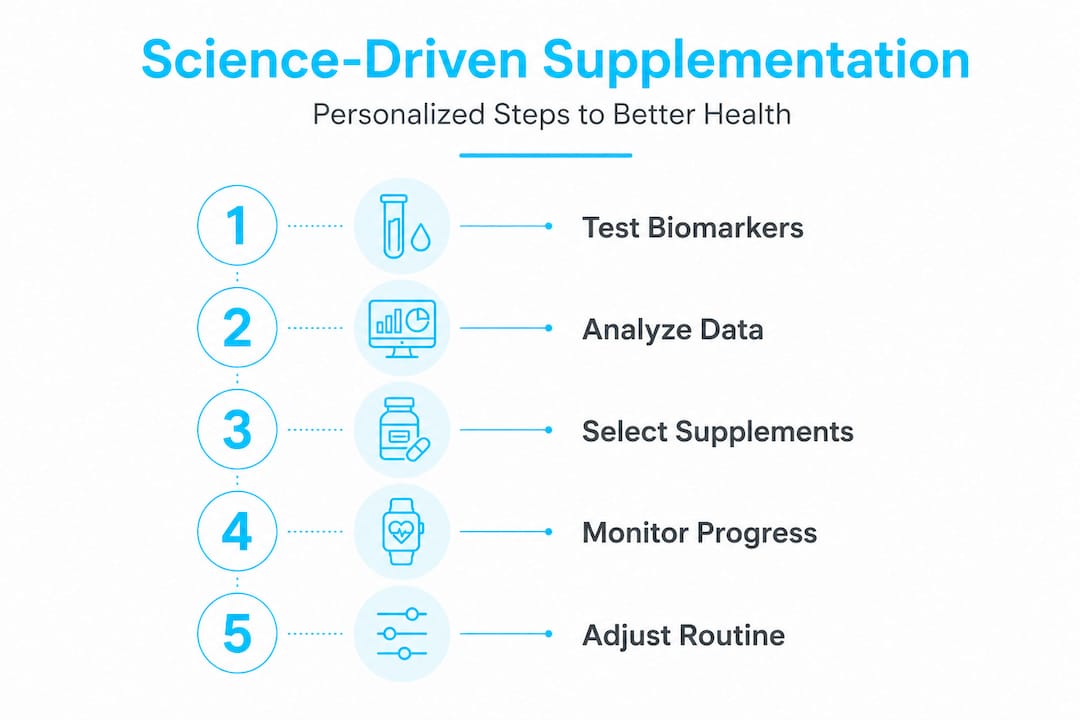
The core principle is straightforward: match each supplement to a confirmed gap. If your omega-3 index falls below 8%, prioritize EPA/DHA from a triglyceride-form fish oil or algae-based source. If your vitamin D sits under 30 ng/mL, start with 2,000 to 5,000 IU daily depending on how low you are, then retest. Do not take both unless both gaps are confirmed.
For adults over 35, the aging-specific priorities shift in important ways. Longevity-focused physician stacks highlight four primary areas to address:
- Sarcopenia prevention: Creatine monohydrate (3 to 5 grams daily) and adequate protein intake protect muscle mass, which declines at roughly 1% per year after age 35
- NAD+ pathway support: NMN (nicotinamide mononucleotide) or NR (nicotinamide riboside) address the natural decline of NAD+, a molecule critical for mitochondrial function and DNA repair
- Mitophagy activation: Urolithin A supports the clearance of dysfunctional mitochondria, a process called mitophagy that weakens with age
- Inflammaging management: Omega-3 fatty acids remain the most clinically validated anti-inflammatory supplement for adults in this age range
One compound worth noting for what it does not deliver: resveratrol. Despite years of excitement, human trials have been disappointing and resveratrol does not belong in a rigorous longevity stack based on current evidence. This is exactly the kind of critical filter a science-driven approach requires.
How daily essentials compare to longevity-focused stacks:
| Category | Key supplements | Primary goal | Evidence strength |
|---|---|---|---|
| Daily essentials | D3, magnesium, omega-3, B12 | Fill nutritional gaps | Strong, well-established |
| Cognitive support | Multivitamin, B-complex, omega-3 | Brain health, memory | Moderate (COSMOS data) |
| Longevity-specific | NMN/NR, Urolithin A, creatine | Aging pathways | Emerging, promising |
| Metabolic health | Berberine, magnesium, CoQ10 | Insulin sensitivity, energy | Moderate to strong |
A well-formulated multivitamin for daily nutrient support can serve as your essential baseline while you layer in targeted longevity compounds. Just recognize that the multivitamin fills common gaps, not specific deficiencies confirmed by lab work. Those require individual, measured supplementation.
Statistic to know: The COSMOS trial found that cognitive benefits from multivitamins were equivalent to reversing approximately three years of cognitive aging. Meaningful, but not a replacement for targeted supplementation based on your biomarker profile. Monitoring peak performance biomarkers alongside your supplement protocol helps you interpret what these gains look like for your specific physiology.
Implementing and cycling your regimen for best results
With your targeted stack chosen, implementation and ongoing review are crucial for success.
Most people make one of two mistakes when launching a supplement protocol: they start everything at once, or they stick with a static regimen for years without revisiting the evidence. Both approaches dilute your results and your ability to measure what is actually working.
Here is a structured implementation approach:
- Start with your highest-priority gap. If your vitamin D is severely low, address that first. A single focused intervention makes it easier to detect both benefit and side effects.
- Add one new supplement every two weeks. This allows your system to register changes and makes it clear which product is driving any response, positive or negative.
- Track symptoms alongside biomarkers. Energy levels, sleep quality, joint comfort, and cognitive clarity are meaningful signals even before your next blood test.
- Cycle supplements with limited long-term data. For compounds like NMN, a cycling protocol of 3 months on, 1 month off is a reasonable precaution given that long-term human safety data is still accumulating.
- Handle edge cases with clinical guidance. B12 absorption declines significantly with age and is further compromised by proton pump inhibitor use. If you are in either category, methylcobalamin at 500 to 2,000 mcg is appropriate. Similarly, CoQ10 for statin users at 100 to 300 mg of ubiquinol form helps offset the mitochondrial depletion that statins can cause.
Pro Tip: Always choose USP-verified or third-party-tested products. Supplement quality is genuinely variable, and verification ensures that what the label says is actually in the capsule at the stated dose. GMP-certified manufacturing facilities set the minimum acceptable standard.
No supplement replaces the fundamentals. If sleep is poor, if exercise is inconsistent, and if diet is highly processed, even the most sophisticated longevity stack will deliver a fraction of its potential. Build the foundation before building the stack.
One safety point that is frequently overlooked: omega-3s at higher doses can thin the blood meaningfully. If you take prescription anticoagulants or are heading into surgery, flag this with your physician. Read the latest supplementation research updates for ongoing safety and efficacy information as the evidence base evolves.
Verifying progress and refining your approach
Taking a science-driven approach means regularly measuring what is working and pivoting as needed.
A 12-week personalized supplementation protocol has been shown to reduce inflammatory biomarkers including CRP and TNF-alpha in clinical research. That 12-week window is not arbitrary. It reflects roughly how long it takes for meaningful changes in nutrient status to become measurable in blood. Plan your first follow-up retest around this timeframe.
Key areas to track and verify:
- Lab retesting schedule: Retest your core markers every 3 to 6 months, or after any significant protocol change
- Symptom diary: Note subjective changes in energy, sleep duration and quality, mood stability, and physical recovery from exercise
- Dosage adjustments: If vitamin D climbs above 80 ng/mL, reduce your dose; if omega-3 index remains low after 12 weeks, increase or reassess absorption factors
- Stack refinement: Remove supplements that produce no measurable change after two full testing cycles
| Timeline | Action | What to assess |
|---|---|---|
| Weeks 1 to 2 | Start highest-priority supplement | Tolerability, any immediate side effects |
| Weeks 3 to 4 | Add second supplement if tolerated | Symptom changes, energy and sleep signals |
| Week 12 | First biomarker retest | Compare to baseline, adjust doses |
| Month 6 | Full panel retest | Evaluate all markers, refine or reduce stack |
| Month 12 | Annual review | Reassess goals, consult physician, update protocol |
Reviewing your biomarker tracking approach at each milestone is one of the most efficient ways to improve your regimen without wasting money on products that are not moving your numbers.
Our take: Why true science-driven supplementation requires ongoing adaptation, not set-it-and-forget-it
The supplement industry profits enormously from permanence. Buy a product, subscribe, and forget about it. That model works well for subscription revenue. It works poorly for your cellular health.
Here is the uncomfortable truth: your biomarkers change. NAD+ declines accelerate in your 40s compared to your late 30s. Hormonal shifts alter how you process and absorb key nutrients. Inflammation markers can creep upward with career stress, poor sleep seasons, or a new medication. A supplement stack that was perfectly matched to your biology at 38 may no longer fit at 44.
The most disciplined supplement users we work with do not have the most complex stacks. They have the most responsive ones. They cut products when lab data stops improving. They add new compounds when research reaches a threshold they find credible. They resist the pull of market trends when human trial data is thin, which is where navigating supplement hype becomes a genuine skill worth developing.
The hardest habit to build is not consistency in taking capsules. It is intellectual humility about what the science actually shows at any given moment. Resveratrol was a star a decade ago. The human data did not hold up. That should not be embarrassing. It is the normal arc of science. The mistake is refusing to update your regimen when the evidence moves.
Adapt, verify, cut what is not working, and resist the emotional pull of expensive new molecules without sufficient human data. That discipline, more than any single compound, is what separates a strategic longevity protocol from a very expensive placebo routine.
Ready to personalize your regimen? Superior Formulas can help
If you want to put rigorous science at the center of your daily supplement routine, here is where to start.
Superior Formulas builds every product around clinically studied ingredients, physician-reviewed formulations, and GMP-certified manufacturing. No unnecessary fillers. No ingredients added for marketing appeal.
Our daily multi with AREDS2 nutrients provides a clean, research-informed foundation for adults who want broad nutritional coverage without compromise. For those focused on cellular renewal and senolytic pathways, our senolytic supplement targets the clearance of dysfunctional cells that accumulate with age. Every formulation we create reflects our commitment to bridging the gap between clinical research and practical daily use. Explore the full depth of our formulation science to understand exactly what goes into each product and why.
Frequently asked questions
What biomarkers are most important for science-driven supplementation?
The most actionable markers are 25-OH vitamin D, RBC magnesium, omega-3 index, hs-CRP, homocysteine, fasting insulin, ferritin, and B12. These eight give you a complete picture of where targeted supplementation is genuinely needed.
How often should I retest my blood markers when tailoring supplements?
Retest every 3 to 6 months, since 12-week personalized protocols show measurable changes in inflammatory markers like CRP and TNF-alpha. Retesting at this interval keeps your adjustments precise and evidence-based.
Are all-in-one multivitamins beneficial for longevity?
Multivitamins produce a modest cognitive benefit equivalent to roughly three years of cognitive aging reversed in the COSMOS trial, but they do not significantly reduce heart disease or cancer risk. They serve best as a nutritional safety net, not a longevity strategy on their own.
When should someone consider cycling supplements?
Cycling is most appropriate for compounds like NMN, where a 3-month on, 1-month off approach is prudent given that long-term human safety data is still developing. Established nutrients like D3 or magnesium generally do not require cycling.
What are common supplement mistakes to avoid?
The most costly mistakes are supplementing without confirmed lab evidence, ignoring potential drug interactions, and treating supplements as a substitute for foundational habits like quality sleep, consistent exercise, and a nutrient-dense diet.


