


Dietary supplements are neither miracle cures nor pointless pills, yet millions of adults over 35 fall into the trap of treating them as one or the other. The real story is far more nuanced. Supplements fill nutrient gaps that even reasonably healthy diets leave behind, particularly for vitamins and minerals that support immune function, bone density, and cellular repair. What’s changed recently is the quality of the evidence connecting targeted supplementation to biological aging markers, and that shift is worth paying close attention to if you’re serious about healthy aging.
Table of Contents
- Why supplements matter: the science behind nutrients and aging
- Key benefits and limitations for adults over 35
- Smart supplement strategies: choosing and using safely
- Real-world examples: building your supplement plan
- The uncomfortable truth: supplements are not a magic bullet, but they’re not useless, either
- Next steps for evidence-based supplementation
- Frequently asked questions
Key Takeaways
| Point | Details |
|---|---|
| Bridge nutrient gaps | Dietary supplements can help fill essential nutrient needs often missing from typical diets. |
| Targeted benefits for aging | Recent research supports that certain supplements may modestly slow biological aging and support cognition in older adults. |
| Safety and verification matter | Avoid overuse and choose verified products to minimize health risks and ensure effectiveness. |
| Personalization is key | Consult healthcare professionals, consider your unique needs, and regularly assess your supplement plan. |
Why supplements matter: the science behind nutrients and aging
The word “supplement” is often misunderstood. Supplements are not food replacements. They’re precision tools designed to address specific biochemical gaps that accumulate when diet, absorption, or lifestyle fall short. For adults over 35, those gaps are more common than most people realize.
Modern diets, even well-intentioned ones, frequently fall short of optimal micronutrient levels. Soil depletion, food processing, and changing eating patterns have reduced the nutrient density of everyday meals. This is where scientific research on supplements becomes directly relevant. The evidence shows that supplementation supports real physiological functions, not abstract wellness claims.
Core micronutrients that adults should pay close attention to include:
- Vitamin D: Supports bone mineralization, immune modulation, and muscle function. Deficiency is widespread, especially in northern climates and office-based lifestyles.
- Vitamin B12: Essential for neurological integrity and DNA synthesis. Absorption declines significantly with age and in those taking metformin or proton pump inhibitors.
- Vitamin C: A water-soluble antioxidant involved in collagen synthesis and immune defense.
- Vitamin A: Critical for mucosal immunity, visual health, and cellular differentiation.
- Zinc: Plays a direct role in wound healing, protein synthesis, and T-cell function.
- Selenium: A cofactor for glutathione peroxidase, one of the body’s primary antioxidant enzymes.
- Magnesium: Involved in over 300 enzymatic reactions, including energy production and DNA repair.
Research confirms that vitamins A, C, D, E, selenium, and zinc are critical for immune function, and even marginal deficiencies can meaningfully weaken your body’s defenses.
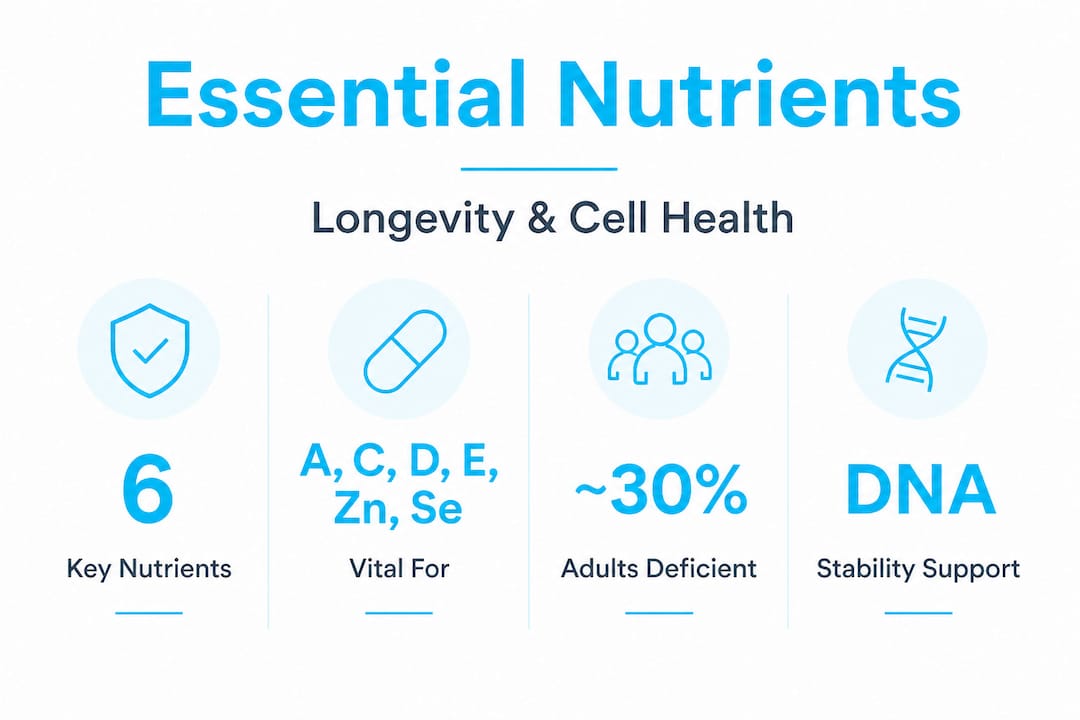
One of the most compelling recent developments involves supplements and DNA stability. Emerging research suggests that certain micronutrients may influence epigenetic aging clocks, biological markers that measure how fast your cells are aging relative to your chronological age. A major COSMOS trial on aging found that daily multivitamin supplementation was associated with measurable slowing of these clocks in older adults.
| Nutrient | Primary biological function | Who most often needs it |
|---|---|---|
| Vitamin D | Bone health, immunity, gene regulation | Adults 50+, darker skin tones, limited sun exposure |
| Vitamin B12 | Nerve function, red blood cell production | Adults 70+, vegans, metformin users |
| Magnesium | Enzyme function, sleep, blood pressure | Adults with high stress, poor diet quality |
| Zinc | Immune defense, cellular repair | Older adults, vegetarians |
| Omega-3 fatty acids | Cardiovascular, brain, anti-inflammatory | Low fish intake, cognitive health concerns |
| Folate | DNA synthesis, cardiovascular support | Pregnant women, adults with high homocysteine |
The data here is not about replacing meals. It’s about recognizing that targeted nutritional support operates at the cellular level, influencing the very processes that determine how you age.
Key benefits and limitations for adults over 35
Understanding what supplements can and cannot do is just as important as knowing which ones to take. For adults in this age group, the benefits are real but measured. They are not dramatic overnight transformations.
The COSMOS trial, one of the largest supplement studies ever conducted, found that daily multivitamin supplementation slowed epigenetic aging in older adults, with the most pronounced effects seen in those who already showed signs of accelerated biological aging. This is significant. It means supplementation is not just preventive maintenance; it may help course-correct aging trajectories that have already diverged.
That said, routine supplementation offers little benefit unless a deficiency actually exists. Calcium and vitamin D may be warranted for postmenopausal women and older men. B12 is particularly relevant after 65. The point is specificity, not blanket supplementation.
Here’s how to assess whether supplementation actually makes sense for you:
- Review your diet honestly. Track three to five days of actual eating. Are you consistently hitting vegetables, quality proteins, whole grains, and healthy fats? Or are there frequent gaps?
- Check your bloodwork. Ask your physician for a panel that includes vitamin D (25-OH), B12, folate, ferritin, magnesium, and homocysteine. These numbers tell the real story.
- Factor in your medications. Metformin depletes B12. Statins may affect CoQ10 levels. Proton pump inhibitors impair B12 and magnesium absorption. This context changes your supplement needs considerably.
- Consider your life stage. A 38-year-old woman with a varied diet needs different support than a 68-year-old man with absorption challenges or a 55-year-old vegan.
- Evaluate your absorption capacity. With age, stomach acid production declines, which directly reduces absorption of B12, calcium, iron, and zinc. This is a physiological reality, not a dietary failure.
| Age group | Common deficiency risks | Supplements worth considering |
|---|---|---|
| 35 to 50 | Vitamin D, magnesium, omega-3s | Targeted D3/K2, magnesium glycinate |
| 50 to 65 | B12, D, calcium, folate | B-complex, D3, evidence-backed multivitamins |
| 65 and older | B12, D, zinc, omega-3s | High-absorption B12, D3, supplements for cellular health |
Pro Tip: Before purchasing any supplement, verify that it carries third-party testing certification from organizations like USP, NSF International, or ConsumerLab. These verifications confirm that what’s on the label is actually in the bottle, at the stated dose, without harmful contaminants.
Smart supplement strategies: choosing and using safely
Choosing the right supplement is only half the equation. How you use it, and what you combine it with, determines whether it helps or harms. This is where most people make costly mistakes.
Overuse is a real and underappreciated risk. Fat-soluble vitamins such as A, D, E, and K accumulate in tissue over time. Excess vitamin A has been linked to bone loss and liver damage. High-dose vitamin E supplementation has shown concerning associations with prostate cancer risk in some trials. Calcium supplements taken in excess of needs have shown potential cardiovascular risks in certain populations. The principle is clear: more is not better.
Certain scenarios demand direct physician guidance before starting any new supplement:
- You are currently undergoing cancer treatment or are in remission
- You take blood thinners, immunosuppressants, or antiepileptic medications
- You have chronic kidney disease, liver disease, or a malabsorption condition
- You are pregnant or planning to become pregnant
- You are managing thyroid disorders, particularly if taking levothyroxine
“Supplements should never be mistaken for a substitute for a well-balanced diet or conventional medical care. Their role is supportive, not curative, and that distinction matters deeply for safe, effective use.”
USP-verified products and physician guidance reduce risks considerably. For older adults, a well-formulated multivitamin can serve as genuine nutritional insurance, particularly when dietary variety narrows with age. Products designed around verified supplement selection and manufactured in GMP-certified facilities offer an additional layer of confidence.
When evaluating any supplement product, ask these questions:
- Is it manufactured in a GMP-certified facility?
- Does it carry third-party testing verification?
- Are the ingredients at clinically relevant doses, not just label-decoration amounts?
- Does the formulation avoid unnecessary fillers, dyes, and artificial additives?
For those interested in more advanced cellular support beyond basic micronutrients, cellular support supplements that activate pathways like Nrf2, the body’s master antioxidant regulator, represent a newer and increasingly well-studied category. These are not replacements for foundational nutrition but rather complementary tools for adults who want to support resilience at the cellular level.
Pro Tip: Customize your supplement choices to your actual health status, not your age alone. A 42-year-old with low vitamin D and high inflammation markers has very different needs from a 42-year-old with optimal labs and a nutrient-dense diet. Your bloodwork is your guide.
Real-world examples: building your supplement plan
The gap between knowing the evidence and applying it personally is where most people get stuck. Here is a practical framework for translating research into a real supplement plan.
Step-by-step blueprint for personalizing your supplement approach:
- Start with a baseline blood panel. Request vitamin D (25-OH), B12, complete blood count, ferritin, lipid panel, and fasting glucose as a minimum. These establish where gaps actually exist.
- Prioritize deficiencies first. Address documented gaps before adding any “optimization” or longevity-focused supplements. Foundation before enhancement.
- Choose a high-quality multivitamin as a baseline. For most adults over 40, a well-formulated multivitamin covers the most common gaps consistently without requiring a complex supplement stack.
- Add targeted support based on your profile. Vegan? Add B12 and algae-based omega-3s. Postmenopausal? Consider D3/K2 and magnesium. High cardiovascular risk? Omega-3 EPA/DHA is supported by strong clinical evidence.
- Introduce advanced formulations thoughtfully. If cellular resilience and longevity are priorities, research Nrf2-activating compounds, mitochondrial support formulas, and senolytic nutrients. Follow the latest updates on supplement news to stay current.
- Recheck labs annually. Supplement needs shift with age, season, medication changes, and health transitions. A plan that worked at 45 may need meaningful revision at 55.
Three practical scenarios:
Adult, age 55, balanced diet, normal labs: A daily multivitamin with AREDS2 nutrients (supporting eye health), vitamin D3 at 1,000 to 2,000 IU, and omega-3 fatty acids covers most bases without excess. A cellular resilience formula may be a rational next step.
Adult, age 70+, reduced appetite, limited sun exposure: Vitamin D and B12 supplementation is especially recommended at this stage, along with calcium from food sources first and magnesium to support sleep and muscle function.
Adult, age 42, vegan, on metformin for prediabetes: B12 supplementation is non-negotiable here, as both veganism and metformin significantly deplete this nutrient. Personalized approaches matter particularly when medication use and dietary patterns intersect.
Pro Tip: Reevaluate your supplement regimen every year, ideally timed around an annual physical exam. Bring your supplement list to your appointment and discuss it with your physician. Needs change, and what you’re taking should reflect where your health is now, not where it was three years ago.
The uncomfortable truth: supplements are not a magic bullet, but they’re not useless, either
Here is something most supplement content gets wrong: it tends to land on one extreme or the other. Either supplements are presented as the key to extraordinary longevity, or they’re dismissed as expensive placebo effects. Neither position reflects the actual evidence.
The honest picture is this. Supplements’ benefits are modest, most meaningful when addressing real gaps, and should never be mistaken for a shortcut around poor diet, chronic stress, or inadequate sleep. Adults who treat supplementation as a substitute for nutritional fundamentals will be disappointed. The research is consistent on this point.
What most articles also miss is the cumulative, long-range value of consistent, targeted supplementation. Slowing an epigenetic aging clock by a few months over several years sounds modest in isolation. But compounded over decades, the implications for cellular resilience, cognitive function, and physical capacity are substantial. The analogy is financial compounding: small consistent contributions to your cellular health account add up meaningfully over time.
The wisest approach is neither blanket supplementation nor reflexive skepticism. It’s tailored, informed, and periodically recalibrated. Adults over 35 who take a deliberate, data-driven approach to supplementation, one grounded in their actual labs, diet, and health profile, are the ones who derive genuine benefit. Supporting Nrf2 activation and aging through targeted formulations represents exactly this kind of thoughtful strategy. It’s not about chasing trends. It’s about supporting the biological processes that matter most as you age.
Next steps for evidence-based supplementation
You’ve covered the research, worked through the decision framework, and seen how supplementation plays out across real scenarios. Now comes the practical step: finding products that meet the standards the evidence demands.
Superior Formulas builds every formulation around clinically studied ingredients, third-party testing, and GMP-certified manufacturing. Whether you’re starting with a foundational Superior Multi+ Daily formula designed with AREDS2 nutrients, or you want to explore advanced cellular resilience support, the goal is the same: evidence-based nutrition that actually works for where you are in life. Take the next step and discover the science behind ingredient selection to make truly informed choices for your longevity and cellular health.
Frequently asked questions
When should adults over 35 start considering dietary supplements?
Supplements are worth considering when your diet consistently falls short of key nutrients, or when lab tests show deficiencies in vitamin D, B12, or related markers. Supplements fill nutrient gaps that diet alone may not address, particularly as absorption efficiency decreases with age.
Can taking multivitamins really slow the aging process?
Large clinical studies suggest multivitamins may influence biological aging clocks. Epigenetic aging slowed measurably in older adults taking daily multivitamin-multimineral supplements, with effects most pronounced in those who had accelerated biological aging at baseline.
Are there risks to routine supplement use?
Yes. Excess intake of fat-soluble vitamins accumulates in tissue and can cause toxicity, and supplements are risky during cancer treatment or when combined with certain medications. Always review your supplement regimen with your physician.
How do I know if a supplement is high-quality?
Look for third-party verification from organizations like USP or NSF International, which confirm label accuracy and purity. USP-verified products significantly reduce the risk of contamination, mislabeling, and ineffective dosing.
Should I take supplements if I already eat a balanced diet?
If you consistently meet nutritional needs through food, most supplements add little benefit. However, routine supplementation without deficiency offers minimal advantage, though nutrients like vitamin D and B12 may still warrant targeted support depending on your absorption capacity and sun exposure.
Recommended
- Formula 1 — LONGEVITY Daily Nrf2 Activate+ - SUPERIOR Formulas
- Explore the Science - SUPERIOR Formulas
- Formula 9 — Superior Multi+ Daily (with AREDS2 nutrients) - SUPERIOR Formulas
- Formula 3 — Superior Senolytic+ (Fisetin + Quercetin) - SUPERIOR Formulas
- What is health longevity: advanced insights for 2026 – Aihealthician


