


Cinnamon extract supplements offer a modest, adjunctive benefit for blood sugar management when dosed at clinically studied levels and sourced from the right species. The evidence is real but not dramatic: clinical reviews report modest improvements in fasting glucose and lipid markers at doses generally at or above daily doses shown effective in clinical studies, or an equivalent standardized extract. Before you buy, three criteria separate a useful product from a wasted purchase:
- Species: Ceylon cinnamon (Cinnamomum verum) is preferred for daily use because it contains far less coumarin than cassia (Cinnamomum cassia). The NCCIH confirms that species differences are clinically meaningful for safety.
- Standardization: Look for a declared cinnamaldehyde percentage or Type-A polymer measure, not just “cinnamon powder.”
- Third-party testing: A current certificate of analysis (COA) with lot-specific heavy-metal results is non-negotiable, given FDA alerts about elevated lead in some cinnamon products.
Superiorformulas offers a physician-formulated cinnamon extract that meets all three criteria, with GMP-certified manufacturing and transparent COA documentation.
Pro Tip: If a product label lists only “cinnamon” without a species name, treat it as cassia by default and factor in the coumarin risk accordingly.
Key Takeaways
Cinnamon extract supplements offer modest, adjunctive blood sugar support when sourced from the right species, standardized to a known active marker, and dosed at clinically studied levels of roughly 1.5 g daily or the extract equivalent.
| Point | Details |
|---|---|
| Species determines safety | Choose Ceylon (Cinnamomum verum) for daily use; cassia carries higher coumarin and greater liver-risk potential. |
| Dose must reach studied levels | Clinical reviews associate metabolic benefits with doses at or above ~1.5 g/day; verify your serving reaches that threshold. |
| Third-party COA is non-negotiable | FDA alerts on lead contamination in cinnamon products make lot-specific heavy-metal testing a baseline requirement. |
| Drug interactions require clinician input | Additive glucose-lowering with diabetes medications and mild antiplatelet effects with anticoagulants warrant medical oversight. |
| Superiorformulas fits the checklist | Physician-formulated, species-declared, standardized extract, GMP-certified, with accessible COA documentation. |
Table of Contents
- What should you check before buying a cinnamon extract supplement?
- What does the research actually say about cinnamon extract benefits?
- How do capsule doses map to clinically studied amounts?
- What are the safety risks and drug interactions to know?
- How do you read a cinnamon supplement label and spot red flags?
- Why does physician formulation matter for a cinnamon extract?
- How does the FDA regulate cinnamon supplements in the U.S.?
- Does extraction method affect how well cinnamon extract works?
- Where can you find reputable cinnamon extract supplements in the U.S.?
- Superiorformulas physician-formulated cinnamon extract
- Sources
What should you check before buying a cinnamon extract supplement?
Six criteria determine whether a product is worth your money. Run through this list on any retail page before adding to cart.
- Species declaration: The label must state Cinnamomum verum (Ceylon) or Cinnamomum cassia. Ceylon is the lower-coumarin choice for daily supplementation. No species listed means you cannot assess safety.
- Standardization marker: A quality extract declares either a cinnamaldehyde percentage or a Type-A polymer (MHCP) measure. An extract ratio alone (e.g., “10:1”) tells you concentration but not which actives are present.
- Serving dose and daily equivalence: Check whether one serving reaches the ~1.5 g powder-equivalent threshold that clinical reviews associate with metabolic effects. Many single-capsule products fall short without taking multiple per day.
- Third-party testing and COA: A GMP facility statement plus an accessible, lot-specific COA for heavy metals, microbials, and identity is the minimum bar. USP or NSF certification adds another layer of assurance.
- Formulation type and excipients: Water-based (aqueous) extracts and ethanol extracts concentrate different active fractions. Avoid products with unnecessary fillers, artificial flow agents, or undisclosed binders.
- Price per clinically effective daily dose: Calculate cost per day at the studied dose, not cost per capsule. A cheaper bottle with half the active content per serving often costs more per effective dose.
Pro Tip: Request a COA directly from customer service before purchasing. Ask for the lot number matching current stock, and screenshot the response. A brand that cannot or will not provide one is telling you something important about its quality controls. You can also review how to evaluate supplement quality for a full walkthrough.
What does the research actually say about cinnamon extract benefits?
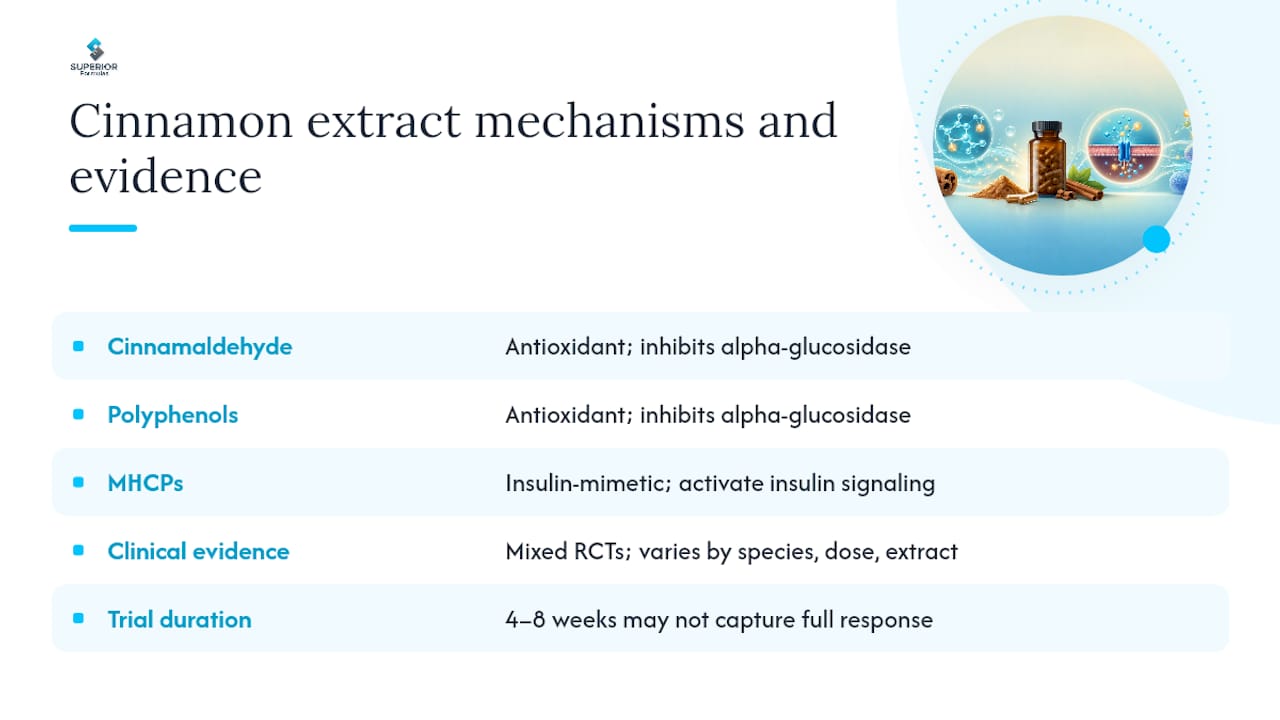
The biological case for cinnamon is grounded in three well-characterized mechanisms. Examine’s research breakdown identifies cinnamaldehyde, polyphenols, and methylhydroxychalcone polymers (MHCPs) as the primary actives. Cinnamaldehyde and polyphenols act as antioxidants and inhibit alpha-glucosidase, the digestive enzyme that breaks down carbohydrates into glucose. MHCPs have insulin-mimetic activity, meaning they appear to activate cellular insulin-signaling pathways independently of insulin itself.
A comprehensive phytochemical review confirms antioxidant, anti-inflammatory, and antidiabetic bioactivities across preclinical models and some human studies, while noting that clinical outcomes vary considerably by species and extraction method. That variability is the honest story: the mechanisms are plausible and supported in the lab, but human trials are inconsistent.
Meta-analyses and randomized controlled trials show mixed results. Some trials report modest reductions in fasting glucose and improvements in triglycerides and total cholesterol; others show no statistically meaningful effect. The heterogeneity traces directly to differences in species used, dose, product standardization, and study duration. Short trials of four to eight weeks may not capture the full metabolic response.
The practical takeaway: cinnamon extract is adjunctive metabolic support. It can complement insulin sensitivity and slow carbohydrate absorption, but it does not replace medication or lifestyle measures. Readers focused on metabolic health after 35 will find it most useful as one layer in a broader strategy.
How do capsule doses map to clinically studied amounts?
The disconnect between a supplement label and a clinical trial dose is where most buyers go wrong. Whole-bark cinnamon powder and concentrated extracts are not interchangeable by weight.
*Equivalence depends on the declared cinnamaldehyde or MHCP content, not the extract ratio alone. USDA nutrient data captures the spice’s macronutrient profile but not the concentrated active polyphenols in standardized extracts, which is why spice amounts and supplement doses cannot be directly compared without standardization data.
Timing matters, too. MHCPs have a delayed intracellular onset compared with exogenous insulin, suggesting that taking your serving 20–30 minutes before a carbohydrate-containing meal may better support postprandial glucose control. Expect metabolic marker changes to emerge over weeks, not days. Most trials run eight to twelve weeks before meaningful HbA1c shifts appear.
Practical serving guidance:
- Start at the lower end of the studied range and assess tolerance for two weeks before increasing.
- Split the daily dose across two meals if GI sensitivity is a concern.
- If you are on insulin or an oral hypoglycemic agent, discuss timing and dose with your clinician before starting, since additive glucose-lowering effects are possible.
What are the safety risks and drug interactions to know?
Coumarin is the central safety variable. Cassia cinnamon contains substantially more coumarin than Ceylon, and long-term or high-dose cassia use can raise liver-risk concerns at the coumarin thresholds established by European food safety authorities. The NCCIH advises that Ceylon (Cinnamomum verum) is the lower-coumarin option and that species differences matter for ongoing supplementation.
Common side effects are generally mild: GI upset, nausea, and mouth or skin irritation in sensitive individuals. Allergic reactions are rare but possible, particularly in people with sensitivities to other spices in the Lauraceae family.
Two drug interactions deserve specific attention:
- Diabetes medications: Cinnamon’s glucose-lowering activity can add to the effect of metformin, sulfonylureas, or insulin. Monitor blood glucose more frequently when starting supplementation, and inform your prescribing clinician.
- Anticoagulants: Cinnamaldehyde has mild antiplatelet properties. People taking warfarin or other blood thinners should discuss cinnamon supplementation with their clinician and monitor INR if relevant.
Contamination is a separate, underappreciated risk. The FDA has issued alerts specifically about elevated lead levels in certain cinnamon products. A lot-specific COA covering heavy metals is not optional; it is the only way to verify that the product you are taking is free of that contamination.
Pro Tip: If you plan to supplement daily for more than three months and have any pre-existing liver condition or take hepatotoxic medications, ask your clinician about a baseline liver function panel. This is especially relevant with cassia-based products.
For a broader framework on monitoring and safety protocols, the supplement safety guide covers when to escalate to clinical oversight.
How do you read a cinnamon supplement label and spot red flags?
A label that passes the checklist below gives you reasonable confidence in what you are buying. One that fails even two of these points warrants a different product.
Require these on the label:
- Scientific species name (Cinnamomum verum or C. cassia) in the Supplement Facts panel
- Standardization statement: cinnamaldehyde percentage or Type-A polymer content
- Serving size and servings per container (so you can calculate total daily dose)
- GMP facility statement, ideally with a third-party certification mark (USP, NSF International, or an independent lab)
Walk away from these:
- “Proprietary cinnamon complex” without disclosed amounts
- No species listed anywhere on the label or product page
- No COA available on the website or by request
- “Natural cinnamon blend” language that obscures whether it is an extract or whole powder
Trust signals worth paying attention to include a QR code linking to a lot-specific COA, a named third-party testing laboratory, and a clearly stated extract ratio with standardization. Price per effective daily dose is the final filter. A product priced at $0.30 per day at the studied dose is more useful than a $0.10-per-capsule product that requires six capsules to reach the same threshold.
Pro Tip: Email customer service and ask: “Can you send me the COA for the current lot of your cinnamon extract, including heavy-metal results?” The speed and completeness of the response tells you as much as the document itself. A sophisticated supplement brand will answer within 24 hours with a complete, lot-specific document.
Why does physician formulation matter for a cinnamon extract?
Most cinnamon supplements on the market are formulated by contract manufacturers optimizing for cost, not clinical relevance. A physician-formulated product starts from a different set of questions: Which species minimizes coumarin risk? What standardization marker best reflects the active fraction studied in trials? Does the serving size actually reach the dose range where clinical data exists?
Clinician input shapes three production decisions that generic products often skip:
- Species selection: Defaulting to Ceylon (Cinnamomum verum) for daily-use products because the coumarin profile is safer for ongoing supplementation.
- Extract standardization: Specifying a cinnamaldehyde or MHCP percentage so that potency is consistent batch to batch, not just extraction-ratio consistent.
- Contaminant controls: Requiring third-party heavy-metal assays at the lot level, not just annual supplier audits.
Physician formulation also means the product is designed to fit within a broader metabolic care plan, not to replace one. A well-designed cinnamon extract complements diet, exercise, and prescribed medications rather than competing with them. That framing matters for how you use it and how you discuss it with your clinician.
Pro Tip: Look for products where a named physician or medical scientist is publicly associated with the formulation rationale, not just listed as a credential on a “about us” page. Published product protocols or clinical rationale documents are a stronger signal.
The supplement quality checklist for longevity and cellular health covers the full set of manufacturing and sourcing criteria worth applying to any high-use supplement.
How does the FDA regulate cinnamon supplements in the U.S.?
Dietary supplements, including cinnamon extract products, are regulated under the Dietary Supplement Health and Education Act (DSHEA) of 1994. Under DSHEA, manufacturers are responsible for ensuring their products are safe before going to market. The FDA does not approve dietary supplements for safety or efficacy before they are sold, which places the burden of quality assurance on the manufacturer and, ultimately, on the informed consumer.
What the FDA does require: accurate labeling, no false or misleading claims, and compliance with Current Good Manufacturing Practice (cGMP) regulations. cGMP rules cover facility standards, ingredient identity testing, contamination controls, and record-keeping. A GMP-certified facility has been audited against these standards, which is why that label claim carries real weight.
The FDA can and does act after the fact. Its alert on elevated lead in cinnamon products is a direct example of post-market enforcement. The agency also maintains a database of supplement adverse event reports (CFSAN Adverse Event Reporting System, or CAERS) that consumers and clinicians can reference.
For the buyer, this regulatory structure means third-party testing fills the gap that pre-market FDA approval does not. Independent lab verification of identity, potency, and contaminants is the practical substitute for the approval process that exists for pharmaceuticals. Reviewing supplement compliance standards gives a clearer picture of what compliant manufacturing actually looks like in practice.
Does extraction method affect how well cinnamon extract works?
Yes, and the difference is not trivial. The solvent and method used to extract cinnamon bark determine which active compounds end up concentrated in the final product, and in what proportions.

Aqueous (water-based) extraction tends to concentrate the water-soluble polyphenols and MHCPs, the fraction most associated with insulin-mimetic activity. Ethanol extraction pulls a broader range of compounds, including cinnamaldehyde and fat-soluble constituents, but may also concentrate coumarin more efficiently depending on the source material. A recent PubMed analysis of formulation differences across trials found that extraction method and standardization reporting materially affect how interpretable the results are across studies.
Supercritical CO2 extraction, used in some premium products, can selectively concentrate specific fractions while leaving behind unwanted compounds, but it is less common and typically reflected in a higher price point.
The practical implication: an extract standardized to a specific cinnamaldehyde percentage or MHCP content is more reproducible and comparable across batches than one defined only by its extraction ratio. When two products both claim “10:1 cinnamon extract,” they may contain very different active profiles depending on the solvent used and the source bark’s coumarin content. Standardization to a named marker is the only way to compare them meaningfully.
Where can you find reputable cinnamon extract supplements in the U.S.?
The U.S. supplement market is large and unevenly regulated, so the brand’s quality infrastructure matters as much as the ingredient itself. Reputable sources share a few characteristics: they declare species and standardization on the label, they manufacture in cGMP-certified facilities, and they make lot-specific COAs accessible without requiring a formal request.
Superiorformulas is one physician-formulated option built around exactly these criteria. Beyond that, look for brands that carry NSF International or USP verification, or that publish third-party lab results directly on product pages. Retailers like natural food co-ops and specialty supplement stores sometimes carry products with stronger sourcing transparency than mass-market channels, though the label checklist from the earlier section applies regardless of where you buy.
For context on how physician-formulated brands differentiate from contract-manufactured generics, the supplement brand evaluation guide is a useful external reference. Metabolic support supplements, including cinnamon, also pair well with clinical guidance on GLP-1 and triglyceride management for readers working with a clinician on broader cardiometabolic goals.
Superiorformulas physician-formulated cinnamon extract
Superiorformulas was founded by a physician-scientist with a specific mandate: formulate supplements the way a clinician would, not the way a contract manufacturer optimizes for margin. The cinnamon extract reflects that directly. It uses Ceylon (Cinnamomum verum) as the declared species, standardized to a defined active marker, manufactured in a GMP-certified facility, and backed by third-party testing with accessible COA documentation.
That combination addresses every red flag in the label checklist above. You know the species, you know the active fraction, and you can verify the lot-specific purity before you take the first capsule. The serving is sized to reach a clinically relevant daily dose without requiring you to take a handful of capsules.
If you are managing blood sugar with prescribed medications, discuss the addition of any cinnamon extract with your clinician before starting. For everyone else, this is a transparent, physician-designed option for adjunctive metabolic support. View the full product details and COA documentation at Superiorformulas.
A note on realistic expectations
Cinnamon extract is worth considering as part of a metabolic health strategy, but the evidence calls for calibrated expectations. The most defensible position is to treat it as one adjunctive tool among several, not a primary intervention. Start with a baseline fasting glucose measurement, run a consistent trial of eight to twelve weeks at a clinically relevant dose, and reassess. If you are on glucose-lowering medication, loop in your clinician before starting and monitor more frequently in the first few weeks. If you see no meaningful change after a full trial period, that is useful information, not a failure. Escalate to clinical evaluation rather than simply increasing the dose.
Sources
- Cinnamon: Usefulness and Safety | NCCIH
- Phytochemical and pharmacological review of cinnamon (PMC4003790)
- FDA alert concerning certain cinnamon products due to presence of elevated levels of lead
- Clinical trial evidence on cinnamon and glycemic control (PubMed ID 29661513)
This article is general information, not a substitute for advice from a qualified doctor. Consult a qualified healthcare professional about your own circumstances before acting on anything here.


