


Stimulants, certain adaptogens, and high-dose fat-soluble nutrients generally benefit from cycling. Basic daily nutrients, deficiency-correcting therapies, and cumulative-benefit supplements like creatine and omega-3s do not. A practical starting point: cycling supplements often involves taking them for several weeks followed by a shorter break; for example, several days on with a couple days off may be used for caffeine-based pre-workouts, while adaptogens like ashwagandha usually follow longer on and off periods. Always confirm the plan with your clinician before starting.
Quick protocol steps:
- Inventory your supplements and classify each as “cycle,” “daily,” or “clinician-only” (see Section 4).
- Choose a schedule template that fits the supplement category.
- Log start and stop dates, energy, sleep quality, and mood each week.
- Schedule a baseline lab panel before cycling high-dose fat-soluble vitamins, iron, or hormone-modulating agents.
- Review results after two full cycles and adjust duration based on what you observe.
Pro Tip: *When you restart a cyclable supplement after a break, your body’s receptor sensitivity has often partially reset.
Key Takeaways
Supplement cycling is a targeted strategy, not a universal rule: stimulants, high-dose adaptogens, and fat-soluble vitamins at therapeutic doses benefit from structured breaks, while creatine, omega-3s, and deficiency-correcting nutrients should be taken continuously.
| Point | Details |
|---|---|
| Cycle stimulants and adaptogens | Use a 5-on/2-off or 6–8 weeks on/2–4 weeks off schedule to prevent tolerance and receptor desensitization. |
| Keep daily nutrients continuous | Creatine, omega-3s, magnesium, and deficiency-correcting vitamins lose their benefit when interrupted. |
| Monitor labs for high-dose use | Test 25-OH vitamin D, ferritin, and liver enzymes (ALT, AST) at baseline and every 3 months for relevant supplements. |
| Taper stimulants, never stop abruptly | Reduce caffeine dose by 25% per week over 3–4 weeks to minimize withdrawal symptoms. |
| Superiorformulas for cycling protocols | GMP-certified, third-party tested, and fully transparent labeling makes Superiorformulas formulations clinician-reviewable and cycle-ready. |
Table of Contents
- What supplement cycling means and the key terms you need to know
- Why your body sometimes needs a break from supplements
- Which supplements you should cycle and which to take daily
- Practical cycling protocols and sample schedules
- Safety checklist and who should not cycle without medical supervision
- What to track while cycling — symptoms, vitals, and basic labs
- How to implement supplement cycling safely, step by step
- Clinician-recommended best practices and a quality checklist
- The trade-off most cycling guides get wrong
- Superiorformulas supports your cycling protocol from day one
- Sources
What supplement cycling means and the key terms you need to know
Supplement cycling refers to taking a supplement for a defined period, then pausing use for a set break before resuming. The pause is intentional, not accidental. Pulsing is a shorter-interval variant: short on/off windows like 5 days on, 2 days off, rather than multi-week blocks.
Applied to a four-week month, that means about three weeks on and one week off. Applied to a year, it translates to roughly nine months of use with three months off.
Other shorthand you may encounter when reading protocols or discussing plans with a clinician:
- On/off days: A daily alternating or weekend-break model, most common for caffeine and stimulant-based products.
- Tapering: Gradually reducing dose rather than stopping abruptly, used for stimulants and some adaptogens to reduce withdrawal risk.
- Loading phase: A short, higher-dose period at the start of a cycle, most associated with creatine, intended to saturate tissue stores faster.
- Washout period: The off phase, during which the compound clears from the body and receptor sensitivity recovers.
Understanding these terms matters because protocols in clinical literature, product labels, and coaching guides use them interchangeably. Knowing what each means lets you read a protocol critically and communicate clearly with your clinician.
For a broader overview of supplement categories and how they differ in use, the types of dietary supplements guide from Superiorformulas provides a useful reference.
Why your body sometimes needs a break from supplements
The short answer: some supplements work by acting on receptors, enzymes, or signaling pathways that adapt when continuously stimulated. Others accumulate in tissue. Both scenarios can reduce effectiveness or raise safety concerns over time.

Tolerance and receptor desensitization are the most common reasons to cycle. When a compound repeatedly activates the same receptor, the body often reduces receptor density or sensitivity as a homeostatic response. Caffeine’s effect on adenosine receptors is a well-documented example: daily high-dose use progressively blunts the alertness effect, and many users find they need increasing doses to achieve the same result.
Homeostatic adaptation extends beyond receptors. Adaptogens like ashwagandha and rhodiola modulate the HPA axis and cortisol response. Continuous use at high doses may blunt the adaptive stress response the supplement is meant to support, reducing its clinical value.
Fat-soluble nutrient accumulation is a distinct and more concrete safety concern. Vitamins A, D, E, and K are stored in adipose tissue and the liver rather than excreted. High-dose continuous use without monitoring can lead to accumulation and toxicity, particularly for vitamins A and D.
Continuous high-dose use of certain supplement extracts has been associated with safety signals, including liver toxicity reports linked to prolonged high-dose green tea extract use. This underscores why lab monitoring and clinician oversight matter for any supplement taken at doses above standard RDA levels.
Cycling helps prevent tolerance and dependence for many nootropics and performance enhancers, and the same principle applies to stimulants and some adaptogens. The goal is not to avoid supplements but to use them at the right intervals so they keep working.
Mitigation strategies that reduce risk across all categories include:
- Choosing products manufactured in GMP-certified facilities with third-party testing for purity and potency.
- Reading labels for dose transparency so you know exactly what you are taking.
- Scheduling periodic labs when using fat-soluble vitamins, iron, or hormone-modulating agents at higher doses.
- Discussing your full supplement list with a clinician, particularly if you take prescription medications.
Which supplements you should cycle and which to take daily
Sort your supplements into three categories before building any schedule. This one-step classification prevents both under-cycling (staying on something too long) and over-cycling (unnecessarily interrupting a therapy that needs continuity).
Cycle these:
- Caffeine-based pre-workouts and stimulants: Tolerance develops quickly; a 5-on/2-off or 4-weeks-on/1-week-off model preserves the ergogenic effect.
- Many nootropics (racetams, certain cholinergics, some herbal cognitive enhancers): Continuous use can lead to tolerance and reduced cognitive benefit.
- High-dose adaptogens (ashwagandha, rhodiola, eleuthero at therapeutic doses): Cycling adaptogens on a 6–8 week on/2–4 week off schedule is a common clinical recommendation.
- Thermogenics and fat-burner blends: Often contain stimulants or adrenergic compounds that lose effect with continuous use.
- Some hormone-modulating supplements (DHEA, certain testosterone-support blends): Require cycling and clinician oversight to avoid suppressing endogenous production.
Take these daily:
- Basic multivitamins at or near RDA levels: No meaningful tolerance risk; continuous use maintains micronutrient status.
- Fish oil and omega-3s: Cumulative benefit; creatine, omega-3s, and BCAAs generally do not require cycling according to mainstream sports nutrition guidance.
- Magnesium (at maintenance doses for sleep or muscle function): Continuous use is appropriate for most adults with dietary gaps.
- Probiotics (where clinically indicated): Ongoing colonization support typically requires daily use.
- Creatine: Tissue saturation is the mechanism; breaks interrupt the benefit without providing a meaningful physiological reset.
Clinician-only or closely monitored:
- High-dose vitamin D and vitamin A: Fat-soluble accumulation risk; blood testing is recommended before and during use at doses above 2,000 IU/day for vitamin D.
- Iron supplementation: Excess iron is pro-oxidant and accumulates; ferritin and hemoglobin monitoring are standard.
- Testosterone precursors and DHEA at clinical doses: Endocrine effects require baseline and follow-up hormone panels.
- Prescription-strength or pharmaceutical-grade agents: Outside the scope of self-directed cycling entirely.
For adults focused on longevity and cellular health, the healthy aging strategies guide from Superiorformulas provides additional dosing context for longevity-targeted formulations.
Practical cycling protocols and sample schedules
Most adults need one of three schedule templates. Choose based on the supplement category, not personal preference.
| Supplement Category | Typical On Period | Typical Off Period | Notes |
|---|---|---|---|
| Stimulants (caffeine, pre-workout) | 5 days | 2 days (weekends) | Or 4 weeks on / 1 week off for longer resets |
| Adaptogens (ashwagandha, rhodiola) | 6–8 weeks | 2–4 weeks | High-dose use warrants the longer break |
| Nootropics | 4–8 weeks | 1–2 weeks | Varies by compound; track cognitive effect |
| High-dose fat-soluble vitamins | 3 months | 1 month | Lab check before resuming |
- Count the total days in your intended use period (e.g., 12 weeks).
- Multiply by 0.75 to get your on-days (9 weeks on).
- Use the remaining 25% as your washout (3 weeks off).
- Restart at 75–80% of your previous dose for the first week back.
Tapering checklist for stimulants:
- Week 1 of taper: reduce dose by 25%.
- Week 2: reduce by another 25% (now at 50% of starting dose).
- Week 3: reduce to 25% or switch to a lower-caffeine alternative.
- Week 4: full washout. Expect 2–5 days of mild fatigue or headache; this is normal.
Abrupt cessation of high-dose caffeine can trigger withdrawal symptoms including headache, irritability, and reduced concentration. Stepwise dose reduction and planned substitution during the off period reduces withdrawal severity meaningfully.
Safety checklist and who should not cycle without medical supervision
Cycling is not appropriate for everyone in every context. The following conditions and situations require clinician input before starting any cycling protocol.
Contraindications requiring clinician clearance:
- Pregnancy or breastfeeding (most cyclable supplements lack safety data for these populations).
- Active liver or kidney disease (altered clearance changes accumulation risk for fat-soluble nutrients and herbal extracts).
- Diagnosed deficiency states (cycling a nutrient you are actively deficient in undermines the therapeutic goal).
- Cardiovascular conditions, particularly when considering stimulant-based supplements.
- Any current prescription medication regimen (see drug interactions below).
Drug-supplement interactions to flag with your pharmacist or clinician:
- Vitamin K and warfarin: dose changes during cycling can shift INR unpredictably.
- St. John’s Wort (sometimes included in mood-support blends): a known CYP3A4 inducer that reduces plasma levels of many medications including oral contraceptives and antiretrovirals.
- High-dose fish oil and anticoagulants: additive bleeding risk at doses above 3 g/day.
- Iron and thyroid medications (levothyroxine): concurrent use reduces drug absorption; timing and cycling both matter.
When to stop cycling and see a clinician immediately:
- New or worsening symptoms within 1–2 weeks of starting or restarting a supplement.
- Jaundice, dark urine, or right-upper-quadrant discomfort (potential hepatotoxicity signal).
- Palpitations, chest tightness, or significant blood pressure changes with stimulant use.
- Mood changes, sleep disruption, or anxiety that persists beyond the first week of a new cycle.
Pro Tip: Bring a written list of every supplement, dose, and schedule to every medical appointment. Clinicians cannot screen for interactions they do not know about, and many patients underreport supplement use assuming it is not relevant to their prescription medications.
The supplement safety best practices guide from Superiorformulas covers these risk categories in clinical detail and is worth reviewing before starting a new protocol.
What to track while cycling — symptoms, vitals, and basic labs
Monitoring is what separates a well-managed cycling protocol from guesswork. Track three layers: subjective symptoms, basic vitals, and targeted labs.
Subjective monitoring log (weekly):
- Energy level (1–10 scale, same time each day).
- Sleep quality and duration.
- Mood and stress resilience.
- Cognitive clarity or focus (relevant for nootropics).
- GI tolerance and appetite changes.
- Any new symptoms since last entry.
Vitals to watch:
- Resting heart rate and blood pressure, particularly with stimulants or thermogenics.
- Body weight (relevant for fat-soluble vitamin accumulation and some hormonal agents).
Targeted labs by supplement category:
Tracking cycles with structured logs and calendars improves the ability to detect tolerance or benefit changes and helps you optimize future cycle length. An app or a simple spreadsheet works equally well; the key is consistency, not the tool.
How to implement supplement cycling safely, step by step
The one-line action plan: classify, schedule, track, review, and adjust over your first two to three cycles.
-
Inventory every supplement you currently take. List the name, dose, frequency, and how long you have been taking it continuously.
-
Classify each supplement using the three categories from Section 4: cycle, daily, or clinician-only. Flag anything in the clinician-only category before proceeding.
-
Choose a schedule template from Section 5 that matches the supplement category. If you take multiple cyclable supplements, stagger their off periods so you are not stopping everything simultaneously.
-
Set up a tracking system. Mark start and stop dates on a calendar or app. Create a weekly log for the subjective metrics above. Schedule any baseline labs before the first cycle begins.
-
Run the first cycle. Record your weekly log entries without skipping. Note the day you stop and how quickly effects change during the washout period.
-
Review after two full cycles. Compare your logs: Did the effect return after the washout? Did tolerance appear before the scheduled break? Adjust the on/off ratio accordingly.
First-cycle checklist:
- Baseline labs completed (where applicable).
- Start date logged.
- Weekly symptom entries scheduled as calendar reminders.
- Clinician or pharmacist notified of the new protocol.
- Red flags identified in advance (see Section 6).
Red flags that require stopping the cycle immediately:
- Any symptom listed in the “stop and see a clinician” list in Section 6.
- Lab values outside reference range on a follow-up panel.
- Persistent tolerance despite a full washout period (may indicate the supplement is not appropriate for your physiology).
For a structured selection workflow tailored to adults 35+, the step-by-step supplement selection guide from Superiorformulas walks through intake, classification, and monitoring in clinical sequence.
Clinician-recommended best practices and a quality checklist
The single top recommendation: discuss your full supplement list with a clinician before starting any cycling protocol involving high-dose fat-soluble vitamins, hormone-modulating agents, or herbal extracts at therapeutic doses.
Clinician workflow for supplement cycling:
- Intake: document every supplement, dose, and duration of current use.
- Reason for use: clarify the clinical goal (deficiency correction, performance, longevity support, symptom management).
- Baseline labs: order relevant panels based on the supplement category (see Section 7 table).
- Cycle plan: select a schedule template; document on/off dates in the patient record.
- Monitoring schedule: set follow-up lab dates and symptom check-ins at weeks 4 and 8.
- Follow-up and iteration: review logs and labs; adjust cycle length or dose as indicated.
Product quality checklist:
- Manufactured in a GMP-certified facility (look for NSF, USP, or Informed Sport certification on the label).
- Third-party tested for purity, potency, and absence of contaminants.
- Transparent labeling: full ingredient list with doses, no proprietary blends that obscure amounts.
- Evidence-backed ingredients: active compounds present at doses used in clinical studies, not token amounts.
- No unnecessary fillers: clean formulation without artificial dyes, excessive binders, or undisclosed additives.
Pro Tip: When discussing supplements at a medical appointment, frame the conversation around your clinical goal, not the product name. “I’m using ashwagandha at 600 mg/day to support cortisol regulation — is that appropriate given my current medications?” gets a more useful clinical response than “I take this supplement, is it okay?”
Superiorformulas publishes clinical evidence standards that explain how evidence is applied to formulation decisions, which is useful context when evaluating any product’s label claims.

The trade-off most cycling guides get wrong
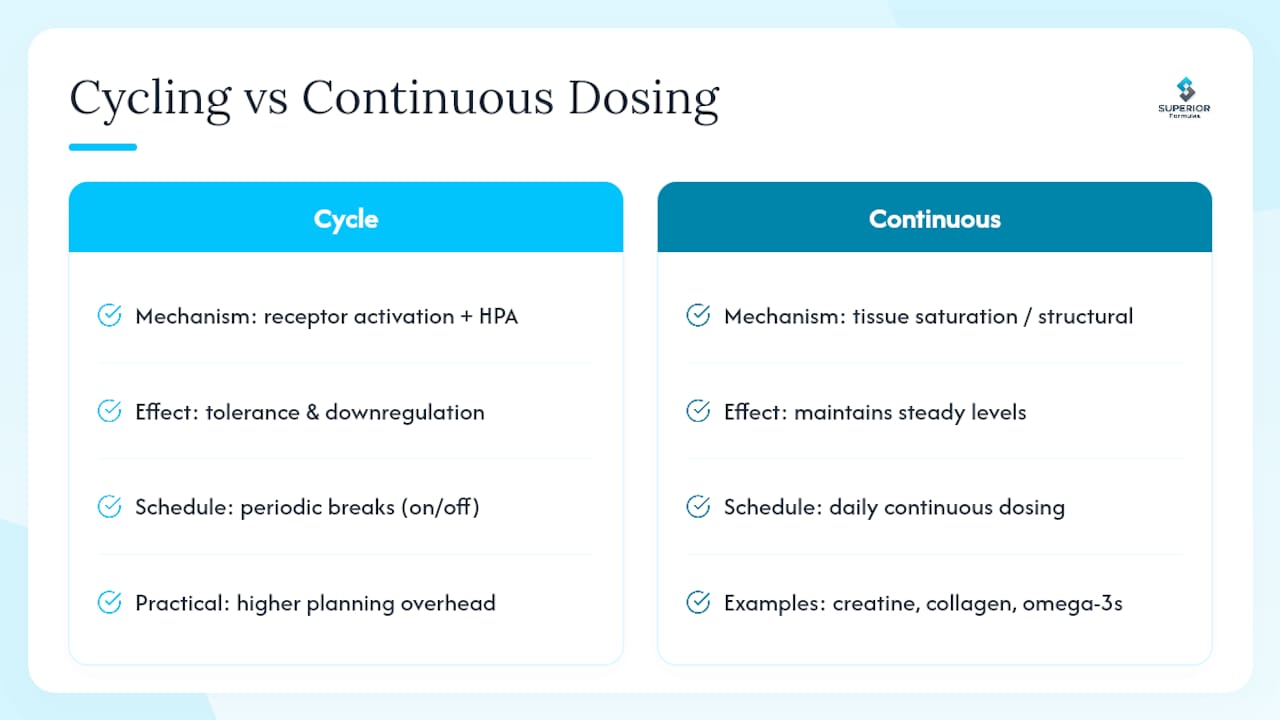
Most articles on supplement cycling frame the decision as binary: cycle everything, or cycle nothing. The more useful frame is matching the cycling decision to the mechanism of action.
Supplements that work through receptor activation or HPA modulation genuinely benefit from periodic breaks because the receptor system adapts. Supplements that work through tissue saturation or structural support (creatine, collagen, omega-3s) lose their benefit when interrupted, because the mechanism requires continuous presence. Treating these two categories identically is where most self-directed protocols go wrong.
There is also a convenience trade-off that rarely gets acknowledged. A well-designed cycling schedule requires more planning than simply taking the same capsules every morning. For adults managing multiple supplements alongside medications and a demanding schedule, the cognitive overhead of tracking on/off windows is real. The practical answer: cycle only the supplements where the physiological case is clear, and keep everything else on a simple daily schedule. Fewer moving parts means better adherence, and adherence matters more than theoretical optimization.
Continuous dosing is the right choice when the goal is deficiency correction, tissue saturation, or maintaining a baseline that erodes without daily input. Cycling is the right choice when tolerance, receptor adaptation, or accumulation risk is the primary concern.
Superiorformulas supports your cycling protocol from day one
Physician-formulated supplements designed with cycling in mind start with one non-negotiable: you need to know exactly what is in each capsule and at what dose. Superiorformulas builds every formulation with full label transparency, clinically studied ingredient amounts, and GMP-certified manufacturing so your cycling schedule is based on real, verifiable doses rather than estimates.

Every product in the Superiorformulas line undergoes third-party testing for purity and potency, which means the dose on the label is the dose in the capsule. For adults building a longevity-focused supplement stack, that consistency is what makes a cycling protocol reproducible and clinician-reviewable. Whether you are cycling an adaptogen for HPA support, managing a high-dose antioxidant protocol, or building a physician-formulated longevity stack, Superiorformulas provides the clinical-grade foundation your protocol needs. Review the full product line and safety resources at Superiorformulas to find formulations that fit your cycle plan.
Disclosure: This article is published by Superiorformulas. Product links above lead to Superiorformulas offerings.
Sources
- Should You Cycle Supplements? Science-Based Guide – Topvitamine
- How to Cycle Supplements & What Supplements Should I Cycle? · MuscleTech
This article is general information, not a substitute for advice from a qualified doctor. Consult a qualified healthcare professional about your own circumstances before acting on anything here.


