


Most Americans assume the supplements lining pharmacy shelves have been reviewed for safety and effectiveness before they go on sale. That assumption is wrong. Dietary supplements reach consumers without premarket FDA approval for either safety or efficacy, which means the burden of judgment falls entirely on you. For adults over 35 who are actively investing in longevity, cellular health, and long-term well-being, this gap in oversight isn’t a technicality. It’s a real and immediate challenge that shapes every purchasing decision you make.
Table of Contents
- Understanding supplement quality and FDA regulation
- Risks of low-quality supplements: Mislabeling, contamination, and dose mismatch
- Quality’s role in evidence and outcomes: Not just ingredients, but formulation and dose
- Quality and evidence for longevity: Navigating hype versus proof
- When prioritizing quality pays off: Closing real nutrient gaps and supporting well-being
- Why quality skepticism is your best friend for healthy aging
- Explore evidence-backed, quality-focused supplements
- Frequently asked questions
Key Takeaways
| Point | Details |
|---|---|
| FDA regulation gaps | Supplements are not screened for safety or efficacy before reaching consumers, so product quality varies. |
| Risks of poor quality | Low-quality supplements may contain contaminants, inaccurate doses, or hidden drugs, posing health risks. |
| Quality ensures effectiveness | Manufacturing, formulation, and dosing impact whether supplements actually deliver health benefits. |
| Clinical evidence matters | The best products are backed by transparent, randomized controlled trials—not just marketing claims. |
| Older adults are more vulnerable | People 35+ and those taking medications should be especially careful to prioritize supplement quality. |
Understanding supplement quality and FDA regulation
When we talk about supplement “quality,” we aren’t describing a vague sense of prestige or a premium price tag. Quality in this context means something specific and measurable: accurate labeling, ingredient purity, correct dosing, and consistent manufacturing from batch to batch.
The FDA does not pre-approve supplements for safety or effectiveness. Its role is largely post-market, meaning the agency responds after problems are reported rather than preventing them in advance. This regulatory structure puts the responsibility on manufacturers to self-police and on consumers to verify independently.
Current Good Manufacturing Practices, or CGMP, are the FDA’s standards for how supplements should be produced. CGMP compliance covers facility cleanliness, equipment calibration, ingredient testing, and record-keeping. However, CGMP certification alone doesn’t guarantee clinical performance. It ensures the product is what it says it is. That’s a necessary first step, not a finish line.
“The regulatory system focuses on post-market enforcement and limiting prohibited claims rather than requiring advance clinical review.” This is the structural reality every supplement buyer needs to understand before spending a dollar on any health product.
For adults 35 and older, this matters more than it does for younger consumers. By your mid-thirties and beyond, many people are managing at least one prescription medication. Supplement-drug interactions, contamination with undisclosed compounds, and wildly inaccurate dosing can all cause harm that’s harder to detect and recover from as you age. You can start by assessing supplement quality through specific, verifiable criteria rather than relying on label claims alone.
Key aspects that define true supplement quality:
- Purity: No heavy metals, pesticides, or undisclosed fillers beyond what’s labeled
- Potency accuracy: The dose on the label matches what’s actually in the capsule or tablet
- Bioavailability: The form of the ingredient used is one the body can absorb and use
- Batch consistency: Every bottle performs the same way, not just the first production run
- Transparency: Full disclosure of all ingredients, including excipients and carriers
Risks of low-quality supplements: Mislabeling, contamination, and dose mismatch
The risks aren’t hypothetical. They are documented, widespread, and sometimes life-threatening. Prioritizing quality reduces the risk that what you buy is not what you get, whether that means mislabeling, underdosing, overdosing, or contamination. This risk is especially serious for older adults using multiple medications and those with higher sensitivity to adverse effects.
Consumer Reports testing found that popular protein powders contained significant levels of lead, arsenic, cadmium, and mercury. These aren’t obscure contaminants. They accumulate in the body over time and can impair kidney function, neurological health, and cardiovascular performance, all systems that become more vulnerable with age.
| Quality issue | Potential consequence | Higher risk group |
|---|---|---|
| Heavy metal contamination | Organ damage, neurotoxicity | Adults over 50 |
| Mislabeled ingredients | Allergic reactions, drug interactions | Adults on medications |
| Underdosed actives | No therapeutic benefit | Anyone seeking clinical results |
| Overdosed compounds | Toxicity, adverse effects | Adults with liver or kidney issues |
| Undisclosed fillers | Digestive distress, sensitivities | Adults with GI conditions |
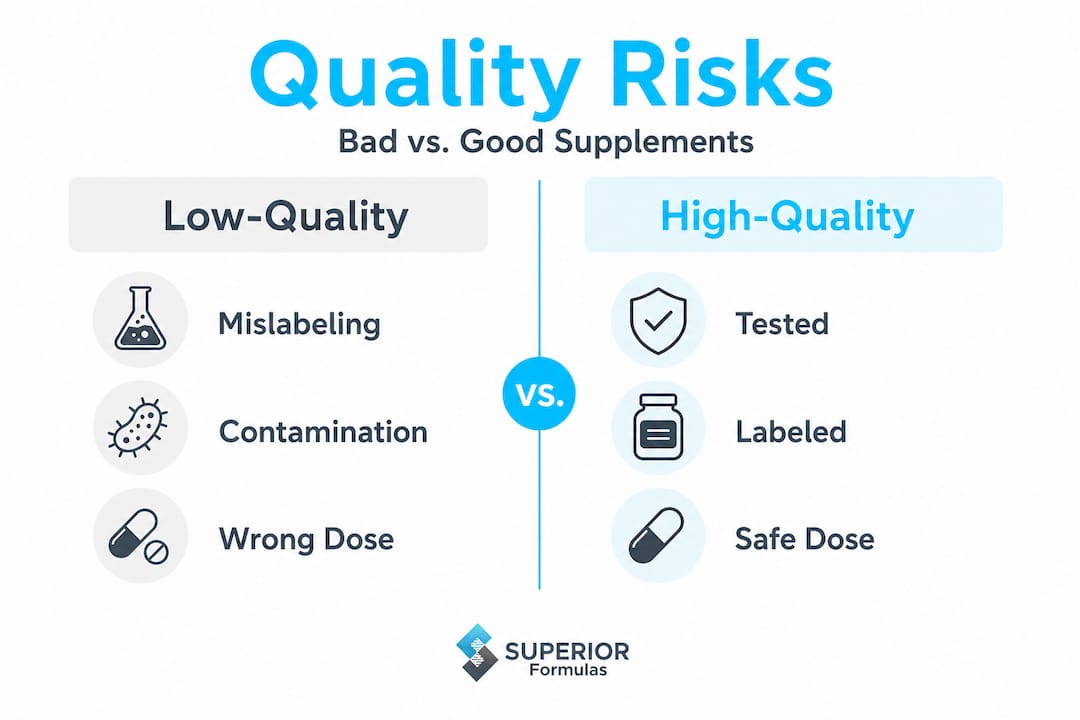
Key stat: A Consumer Reports investigation identified multiple protein products with heavy metal levels exceeding safe daily thresholds, some by a factor of two to three times the acceptable limit for regular daily use.
One particularly dangerous category involves supplements spiked with undisclosed pharmaceutical compounds. The FDA has issued hundreds of warnings over the years about products, especially those marketed for weight loss, sexual performance, or muscle building, that contained hidden prescription drugs. These aren’t edge cases from disreputable sellers. Some were found on mainstream retail platforms.
Dose mismatch creates a different but equally serious problem. If a supplement delivers twice the intended dose of a fat-soluble vitamin like vitamin A or vitamin D, toxicity can develop gradually and silently. Conversely, an underdosed product gives you the false confidence of “taking your supplements” while providing no measurable physiological benefit.
Understanding supplement fillers is another layer of this conversation. Excipients and fillers are added for manufacturing purposes, and most are harmless in small amounts. But in low-quality products, fillers can constitute a significant portion of the capsule’s contents, crowding out the active ingredients you’re actually paying for.
Pro Tip: Before purchasing any supplement, verify that the brand provides lot-specific batch testing results, either on the label, via QR code, or directly on their website. Third-party certification from organizations like NSF International, USP, or Informed Sport adds an additional layer of verification that the label accurately reflects the product’s contents.
Quality’s role in evidence and outcomes: Not just ingredients, but formulation and dose
Here’s a subtle but critical distinction that most people miss: the scientific evidence for an ingredient is not the same as evidence for a finished product. A clinical trial showing that curcumin supports joint health was conducted with a specific form, a specific dose, and often a specific delivery method. That result doesn’t automatically transfer to every curcumin supplement on the market.
Finished formulation matters in ways ingredient lists simply can’t capture. Ratios between compounds, the chemical form of each active, whether the product uses a liposomal delivery mechanism or a basic powder, all of these variables can shift clinical effectiveness dramatically. Two products with identical ingredient labels may produce completely different outcomes in your body.
| Variable | Example | Impact on effectiveness |
|---|---|---|
| Chemical form | Magnesium glycinate vs. magnesium oxide | Absorption difference of up to 4x |
| Delivery method | Liposomal vs. standard capsule | Significant bioavailability boost |
| Ingredient ratio | Resveratrol with piperine vs. without | Enhanced uptake and metabolic activity |
| Dose accuracy | CGMP-verified vs. unverified | Consistency across every batch |
CGMP manufacturing helps ensure batch-to-batch reliability, which is the backbone of any clinical outcome you’re trying to replicate from a study. If the product changes between production runs, your results will too.
How to evaluate supplement evidence practically:
- Look for finished product trials, not just ingredient-level studies. The gold standard is a randomized controlled trial (RCT) conducted on the actual formulation you’re buying.
- Check the dose used in the study against what’s in the product. A compound studied at 500mg daily provides no evidence for a product containing 50mg.
- Identify the form of each active. Methylcobalamin and cyanocobalamin are both vitamin B12, but they differ in how the body processes them.
- Confirm CGMP manufacturing. This ensures the product you buy today is consistent with the product that was tested.
- Seek third-party verification. An independent lab confirming potency and purity removes the manufacturer’s conflict of interest from the equation.
Understanding science-driven supplementation means applying this framework before you invest in any product, especially those marketed for preventive health effects that promise broad, long-term results.
Quality and evidence for longevity: Navigating hype versus proof
The longevity supplement category is where marketing ambition most often outpaces clinical reality. Products promising to “reverse biological age,” “activate youth genes,” or “extend cellular lifespan” flood the market each year. Some are built on compelling early-stage science. Many are not.
Take NAD+ precursors like NMN (nicotinamide mononucleotide) and NR (nicotinamide riboside) as a case study. Some products may raise NAD+ biomarkers, but there is often limited clinical evidence for direct longevity outcomes in humans. The mechanistic science is intriguing and legitimate. The leap from “raises a biomarker in a mouse model” to “extends your healthy lifespan” is where the evidence frequently runs thin.
This is precisely where quality and evidence work together. A low-quality NMN product might not even raise NAD+ levels reliably due to poor absorption or inaccurate dosing. A high-quality product will do what it claims on a molecular level. But even then, honest science requires you to acknowledge what it has and hasn’t been proven to do in rigorous human trials.
Signs of marketing hype versus real science:
- Hype: Testimonials as primary evidence, language like “proven to reverse aging,” no citation of clinical trials
- Hype: Proprietary blends that hide individual ingredient doses
- Hype: Claims about outcomes that no existing RCT supports
- Science: Transparent references to peer-reviewed, human clinical trials
- Science: Specific doses that match what was studied
- Science: Clear differentiation between mechanistic support and proven clinical outcomes
- Science: Third-party batch verification available to the public
“Quality prioritization helps you avoid confounding from low-quality product variability while you assess evidence honestly.” This is the mindset that separates informed supplementation from expensive guesswork.
Pro Tip: When a longevity supplement cites a clinical study as evidence, look up that study directly. Confirm it was an RCT, conducted in humans, at the dose the product provides, and that the outcome measured is the one being claimed. This single step will filter out the vast majority of unsupported claims.
Guides on premium longevity supplements and frameworks for choosing science-driven longevity supplements can help you apply this level of critical evaluation more consistently.
When prioritizing quality pays off: Closing real nutrient gaps and supporting well-being
High-quality supplementation, applied appropriately, absolutely can improve measurable health outcomes. The key phrase is “applied appropriately.” When product quality and dosing are reliable, clinical outcomes become genuinely credible02857-4/fulltext), and specific supplements can close nutrient gaps or improve health-relevant endpoints.
A 12-week randomized controlled trial examining AG1, a comprehensive daily nutrition product, found meaningful improvements across multiple nutritional markers compared to placebo. The study design, product quality controls, and dose consistency were all factors in producing replicable results. That’s the model worth following.
For adults over 35, common nutrient gaps include magnesium (involved in over 300 enzymatic processes), vitamin D3 (critical for immune regulation and bone density), omega-3 fatty acids (supporting cardiovascular and cognitive health), and B vitamins (essential for energy metabolism and methylation pathways). High-quality products addressing these gaps have a solid evidence base and a track record of clinical benefit.
Markers of genuinely effective, high-quality products:
- RCT-backed formulations: At least one randomized controlled trial supports the specific finished product or its clinically equivalent formulation
- Transparent labeling: No proprietary blends hiding individual ingredient doses
- Third-party verified purity: Batch-specific testing results available
- CGMP manufacturing: Consistent production standards across every run
- Clinically relevant dosing: Doses match what was shown effective in published research
- Physician or scientist involvement: Medical or research expertise integrated into formulation decisions
Exploring supplements and cellular health through this evidence-based lens, and understanding the value of physician-formulated approaches, gives you a practical framework for identifying products worth your investment.
Why quality skepticism is your best friend for healthy aging
Here’s the honest, sometimes uncomfortable truth: most people treat supplement shopping like grocery shopping. They scan the label, notice a few familiar ingredient names, and make a decision based on price and packaging. The supplement industry is structured to encourage exactly that behavior.
But real wellness assessment demands more, especially as you get older and your physiological margin for error narrows. The risks are asymmetric. A low-quality product at best wastes your money. At worst, it introduces contaminants, creates drug interactions, or gives you false confidence that you’re supporting a health goal you’re actually not addressing.
The expert standard is clear: prioritize quality plus evidence level. Even a high-quality product can be ineffective for your specific health goal if the clinical evidence for that target outcome is weak. Both dimensions matter. Quality without evidence is well-manufactured hope. Evidence without quality is a clinical promise that never reaches you intact.
Healthy skepticism is not cynicism. It’s the discipline of demanding transparency, verified testing, and randomized trial support before trusting any “premium” label. The brands that earn your trust will welcome that scrutiny. Those that don’t are telling you something important.
Explore evidence-backed, quality-focused supplements
You’ve now seen exactly why quality and evidence go hand in hand, and why this combination is non-negotiable for anyone serious about healthy aging, cellular resilience, and long-term vitality.
Superior Formulas was built on this exact standard: physician-formulated, CGMP-manufactured, third-party tested, and grounded in published science. Whether you’re exploring targeted cellular support through Formula 1: Longevity Daily Nrf2 Activate+ or seeking comprehensive daily nutritional coverage with Formula 9: Superior Multi+ Daily, every formulation is built to meet the criteria this article outlines. Visit our scientific supplement research page to review the clinical backing behind each product before you decide.
Frequently asked questions
How can I verify supplement quality before buying?
Look for CGMP manufacturing certification, confirm third-party batch testing is publicly available, and prioritize brands that disclose full ingredient doses and sourcing details rather than hiding behind proprietary blends.
Do all supplements labeled “premium” or “for longevity” offer real benefits?
No. Many such claims are not backed by human randomized controlled trials. Limited evidence for direct longevity outcomes is common in this category, so demand product-specific clinical data, not just ingredient-level science.
What are the main dangers of low-quality supplements?
The primary risks include mislabeling, heavy metal contamination, hidden pharmaceutical compounds, and significant dose inaccuracies. These dangers are amplified for adults managing multiple medications.
Is supplement quality more important as I age or take more medications?
Yes. Older adults using multiple prescriptions are more sensitive to quality lapses and face a higher risk of harmful interactions from mislabeled or contaminated products.
Can quality supplements really fill nutrient gaps?
Yes. Clinical trials confirm02857-4/fulltext) that properly dosed, high-quality supplements can close measurable nutrient gaps and improve specific health endpoints in adults with suboptimal dietary intake.
Recommended
- What Are Premium Supplements? A Science-Backed Longevity Guide - SUPERIOR Formulas
- How Dietary Supplements Support Longevity and Cellular Health - SUPERIOR Formulas
- Why choose science-driven supplements for longevity gains - SUPERIOR Formulas
- Physician-formulated supplements for longevity and cellular health - SUPERIOR Formulas


