


You pick up a supplement expecting a clean dose of active ingredients. What you may not realize is that a significant portion of that capsule or tablet could be made up of substances that have nothing to do with your health goal. These are called fillers, and they’re far more prevalent in the supplement industry than most consumers realize. Understanding what they are, why they’re used, and which ones to watch out for is one of the most important steps you can take toward making truly informed choices about your nutritional regimen.
Table of Contents
- What are supplement fillers?
- Why fillers are used in supplements
- Potential risks and considerations for supplement fillers
- How to choose supplements with fewer or safer fillers
- Our take: why filler transparency matters more than ever
- Explore cleaner supplement options with Superior Formulas
- Frequently asked questions
Key Takeaways
| Point | Details |
|---|---|
| Fillers are common | Most supplements contain inactive ingredients added for manufacturing, dosing, or stability. |
| Risks for sensitive users | Certain fillers can trigger allergies or cause gut irritation, especially in tablets. |
| Powders and liquids preferred | Powder and liquid supplements typically use fewer fillers than tablets or capsules. |
| Read labels carefully | Checking ingredient lists helps you avoid unwanted fillers and choose safer supplements. |
| Transparency builds trust | Manufacturers who clearly disclose fillers make it easier for health-conscious consumers to choose wisely. |
What are supplement fillers?
Before you can evaluate a supplement label with confidence, you need to know exactly what you’re looking at. Supplement fillers, also known as excipients, bulking agents, or inactive ingredients, are substances added to dietary supplements to aid manufacturing, ensure proper dosing, improve stability, and facilitate handling. The word “inactive” is somewhat misleading. While fillers don’t provide the primary therapeutic benefit of the supplement, they can absolutely influence how your body absorbs and responds to the active ingredients.
Manufacturers use a wide variety of fillers, and they serve distinct functions within a formulation. Some of the most common include:
- Magnesium stearate: A lubricant used to prevent ingredients from sticking to manufacturing equipment. It’s one of the most widely used fillers across all supplement categories.
- Microcrystalline cellulose (MCC): A plant-derived binder and filler that gives tablets their structure and helps control the release of active ingredients.
- Lactose: A sugar derived from milk, commonly used as a bulking agent. This is particularly relevant for those with lactose intolerance or dairy sensitivities.
- Silicon dioxide: An anti-caking agent that keeps powder-based ingredients from clumping, helping them flow properly during manufacturing.
- Titanium dioxide: A whitening agent used for coating and coloring tablets, with ongoing scientific debate about its long-term safety profile.
- Calcium carbonate: Often used as both a filler and a mineral source, it adds bulk to tablets while contributing some calcium content.
To understand the distinction between fillers and actives at a glance, this table breaks it down clearly:
| Category | Function | Examples | Effect on Health Goal |
|---|---|---|---|
| Active ingredients | Deliver intended health benefit | Vitamin D3, CoQ10, quercetin | Direct impact |
| Fillers/Excipients | Aid manufacturing and stability | Magnesium stearate, MCC | Indirect or neutral |
| Binders | Hold tablet shape together | Cellulose, starch | Minimal if plant-based |
| Lubricants | Prevent sticking to machines | Magnesium stearate | May affect absorption |
| Colorants/Coatings | Improve appearance or stability | Titanium dioxide, shellac | Potential sensitivity risk |
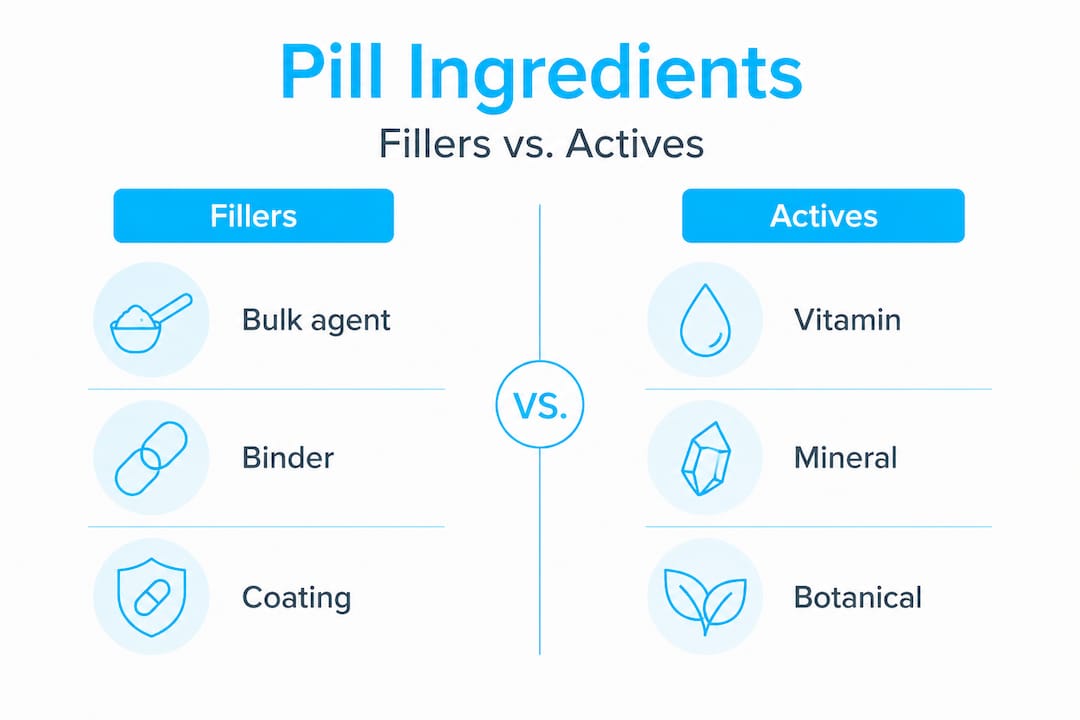
Understanding this taxonomy helps you move from passive supplement consumer to active label reader. Once you know what category each ingredient falls into, the label stops being a wall of confusing text and starts being a meaningful map of what you’re actually putting into your body.
Why fillers are used in supplements
Knowing the “what” naturally leads to the “why.” Manufacturers don’t add fillers without reason. In fact, many excipients are genuinely necessary for a product to function correctly at scale.
Here are the primary functional reasons fillers appear in your supplements:
- Dosing accuracy: Many active ingredients are present in quantities too small to fill a capsule on their own. Fillers add the necessary bulk so that each dose is consistent and measurable.
- Manufacturing efficiency: Fillers improve the flowability of powders through high-speed machinery. Without them, production would slow dramatically, and product uniformity would suffer.
- Tablet formation: Binders give tablets the structural integrity to survive transportation and shelf storage without crumbling. A tablet without a binder would fall apart before it reached you.
- Ingredient stability: Some active compounds degrade quickly when exposed to oxygen, moisture, or light. Certain excipients create a protective environment that extends the product’s shelf life and potency.
- Swallowability: Coatings improve the ease of swallowing tablets and can mask bitter or unpleasant tastes that would otherwise make consistent dosing difficult.
That said, not all filler use is motivated by function alone. As noted in a balanced review of supplement production, manufacturers see fillers as essential for production, but critics highlight profit-padding and potential gut irritation. A more balanced approach favors functional, plant-based excipients wherever possible.
“The question isn’t whether a supplement contains excipients. Nearly all do. The real question is whether those excipients serve a genuine functional purpose and whether they’re derived from sources that respect your body’s natural chemistry.”
This is where the science behind supplements becomes essential to understand. A physician-formulated product approaches filler selection with the same rigor applied to active ingredient selection. Not all excipients are created equal, and a thoughtful formulator knows the difference between a plant-derived cellulose that supports tablet integrity and a synthetic binder that simply cuts production costs.
The impact of fillers on bioavailability is a particularly underappreciated consideration. Bioavailability refers to the proportion of a nutrient that your body actually absorbs and uses. Certain lubricants like magnesium stearate, when used in excess, may coat active ingredients and reduce their dissolution rate in the digestive tract. This doesn’t mean magnesium stearate is inherently harmful, but it does mean that the proportion and context in which it’s used matters significantly.
Potential risks and considerations for supplement fillers
Now that you understand why fillers exist, let’s address what can go wrong. For the general population, most fillers used in supplements are considered safe at the quantities typically found in commercial products. However, specific risks emerge in certain contexts, and they’re worth knowing about.
Key risks to be aware of include:
- Allergic reactions: Lactose is one of the most common culprits. If you’re lactose intolerant and a supplement uses lactose as a bulking agent, you may experience bloating, cramping, or digestive discomfort without realizing the filler is the cause.
- Gluten sensitivity: Some starch-based fillers are derived from wheat. If you have celiac disease or non-celiac gluten sensitivity, this is a critical label detail to check.
- Digestive irritation: Certain synthetic binders and lubricants can irritate the gut lining, particularly with long-term use or in individuals with pre-existing gastrointestinal conditions.
- Reduced supplement efficacy: A high filler-to-active ratio reduces value and may indicate that the manufacturer prioritized production economics over therapeutic intent.
- Artificial colorants and coatings: Titanium dioxide has come under regulatory scrutiny in the European Union, and while it remains approved in the United States, some consumers prefer to avoid it as a precautionary measure.
One of the most practical distinctions in this conversation is the difference between supplement delivery forms. Tablets generally require the most fillers due to the physical demands of forming a compressed, stable solid. Capsules require fewer binding agents but may still include anti-caking agents. Powders and liquids tend to contain the fewest fillers overall.
| Supplement form | Typical filler load | Common filler types | Allergy potential |
|---|---|---|---|
| Tablets | High | Binders, lubricants, coatings, colorants | Moderate to high |
| Capsules | Moderate | Anti-caking agents, flow agents | Low to moderate |
| Powders | Low | Anti-caking agents (if any) | Low |
| Liquids | Very low | Preservatives, emulsifiers (if any) | Very low |
If you’re currently taking a tablet-form supplement and experiencing unexplained digestive symptoms, the fillers in that formulation may be worth examining before concluding the active ingredient is the cause.
Pro Tip: Always read the full ingredient list on your supplement, not just the active ingredients panel. Fillers appear under “Other Ingredients” or “Inactive Ingredients” on most U.S. supplement labels. For those exploring supplements for allergy-sensitive users, that secondary list is as important as the primary one.
If you want to stay current on emerging research around clean supplement formulations, finding cleaner supplements is a good starting point for understanding how the industry is evolving.
How to choose supplements with fewer or safer fillers
Armed with this knowledge, you’re in a far stronger position to select supplements that align with both your health goals and your tolerance profile. Here’s a practical five-step framework for evaluating any supplement you’re considering:
-
Read the full label, not just the front panel. Marketing claims live on the front. The truth lives in the ingredient list. Scroll to “Other Ingredients” first to see exactly what excipients are included before evaluating the active ingredients.
-
Identify any known allergens. Look for lactose, wheat starch, soy, shellfish derivatives (used in some coatings), and gluten-containing ingredients. If you have a known sensitivity, these should be automatic disqualifiers regardless of how strong the active ingredient profile looks.
-
Prioritize plant-based excipients. Microcrystalline cellulose derived from wood pulp, vegetable-based capsule shells (made from hydroxypropyl methylcellulose, or HPMC), and rice flour are among the cleanest options currently available. Synthetic lubricants and petroleum-derived coatings rank lower on the quality spectrum.
-
Look for GMP-certified manufacturing and third-party testing. A supplement made in a Good Manufacturing Practice (GMP) certified facility is subject to stricter quality controls, including oversight of how excipients are used. Third-party testing adds another layer of verification for purity and consistency.
-
Consider the delivery form. As noted, powders and liquids often have fewer fillers than tablets. When a high-quality formulation exists in powder or liquid form, it’s often the cleaner choice, particularly for long-term daily use.
Pro Tip: When evaluating supplement options for sensitivities, don’t assume that “natural” on the label means filler-free. Natural refers to the source of the active ingredients, not necessarily the excipients used to deliver them. Always verify both.
Beyond these steps, it’s worth building a relationship with brands that are transparent about their formulation philosophy. A company that openly discusses its excipient choices, explains why each ingredient is included, and makes its manufacturing standards visible is far more trustworthy than one hiding behind vague marketing language.
Our take: why filler transparency matters more than ever
Here’s an honest observation from a formulator’s perspective: the supplement industry has a transparency problem, and fillers are at the center of it.
Most consumers have been conditioned to evaluate supplements based on the active ingredient list alone. They look at the milligrams of vitamin C, the standardization percentage of an herbal extract, or the dose of omega-3 fatty acids, and they conclude that’s the complete picture. It isn’t. What surrounds those actives, and how they’re packaged for delivery, shapes the entire experience of taking that supplement.
The real question isn’t simply “does this supplement contain fillers?” Almost every supplement does. The more useful question is: Why is each filler included, what is it derived from, and is there a cleaner alternative that could serve the same function? A formulator who can answer those questions for every single excipient in a product is a formulator worth trusting.
We’ve also noticed a troubling trend in the “clean label” movement where brands remove a single controversial filler like magnesium stearate and market the product as entirely filler-free, when in reality they’ve simply substituted one excipient for another. This kind of selective transparency is arguably worse than no transparency at all, because it creates a false sense of reassurance.
What we believe consumers deserve is a full accounting of every substance in the product, an explanation of its function, its source, and any documented safety considerations. That’s not an unrealistic standard. It’s simply a higher standard than the industry has historically held itself to. Brands that commit to that level of disclosure, and back it up with GMP certification and third-party testing, represent what the future of this industry should look like.
For those who want to go deeper, a deep dive into supplement formulation reveals just how many choices go into building a formulation that respects both science and the consumer.
Explore cleaner supplement options with Superior Formulas
Understanding fillers is the first step. Finding products that reflect those standards in practice is the next one.
Superior Formulas was built on the principle that every ingredient in a formulation, active or excipient, should earn its place. Our physician-formulated products are manufactured in GMP-certified facilities, third-party tested for purity, and designed to minimize unnecessary additives without compromising product integrity. Whether you’re managing sensitivities, seeking cleaner long-term supplementation, or simply ready to know exactly what you’re taking, our product line and educational resources are built for you. Learn more about supplement ingredients and explore formulations designed with full transparency in mind.
Frequently asked questions
Are supplement fillers harmful?
Most fillers are safe for the general population at the quantities used in commercial supplements, but they can cause allergic reactions or digestive irritation in sensitive individuals, particularly those with lactose intolerance or gluten sensitivity.
How can I identify fillers on supplement labels?
Check the “Other Ingredients” section on the label for terms like magnesium stearate, microcrystalline cellulose, or lactose, which are common supplement excipients added to aid manufacturing and dosing consistency.
Are plant-based supplement fillers better?
Plant-based fillers are generally preferred because they carry a lower risk of triggering sensitivities and contain fewer synthetic compounds. A balanced formulation approach consistently favors functional, plant-derived excipients over synthetic alternatives.
Do powders and liquids have fewer fillers than tablets?
Yes. Powders and liquids typically require fewer fillers than tablets because they don’t need binders, lubricants, or coatings to maintain a compressed solid form, making them a cleaner choice for sensitive users.


