


Most adults over 35 take at least one supplement. Many take five or more, driven by the belief that filling a daily pill organizer translates directly into a longer, healthier life. But the science tells a more complicated story. Dietary supplements generally do not prevent diseases or extend life in well-nourished adults, and some high-dose antioxidants may actually increase mortality risk. That doesn’t mean supplements are useless. It means the question is no longer “should I take supplements?” but rather “which ones, for whom, and why?” This guide cuts through the noise and gives you a clear, evidence-based framework.
Table of Contents
- Rethinking the supplement myth: What the evidence actually shows
- When supplements make sense: Filling gaps and special situations
- Supplements for longevity and cellular health: What’s promising (and what’s not)
- Personalizing your preventive routine: Practical steps and pitfalls
- The uncomfortable truth: Why supplements matter less than you think (and when they matter most)
- Personalized supplements for greater preventive impact
- Frequently asked questions
Key Takeaways
| Point | Details |
|---|---|
| Targeted over routine | Supplements help most when used to address documented deficiencies, not as a daily catch-all for healthy adults. |
| Evidence varies by supplement | Only a few supplements, such as vitamin D and omega-3s, have proven disease-preventive effects in certain populations. |
| Food and lifestyle are core | A balanced diet and healthy habits provide greater long-term benefits for longevity and disease prevention. |
| Personalize your regimen | Testing nutrient levels and consulting with a doctor ensures your supplement use is both safe and meaningful. |
Rethinking the supplement myth: What the evidence actually shows
The supplement industry generates over $150 billion annually worldwide, and its marketing is extraordinarily effective at making healthy adults feel they are missing something critical if they skip their daily regimen. The truth is more nuanced, and sometimes uncomfortable.
Why hype outpaces evidence
Much of the optimism around supplements comes from observational studies, research designs that track what people eat and take over time and then correlate those habits with health outcomes. These studies have real limitations. People who take supplements tend to exercise more, eat better, sleep more consistently, and see their doctors regularly. Researchers call this “healthy user bias,” and it inflates the apparent benefit of supplements considerably.
When researchers run large randomized controlled trials (RCTs), where half the participants get the actual supplement and half get a placebo, the results are far less impressive. Observational benefits are often confounded by healthy user bias, and RCTs generally show limited or no broad preventive role for supplements, with targeted exceptions like omega-3 in high triglycerides.
The antioxidant paradox
One of the most striking reversals in nutrition science involves antioxidant supplements. For decades, vitamins A, E, and beta-carotene were marketed aggressively as cellular protectors. The logic was seductive: oxidative stress damages cells, antioxidants neutralize free radicals, therefore antioxidants prevent disease. The problem is that risks of antioxidant overuse are real, and excess supplementation can actually disrupt the body’s own redox signaling, which is the very process your cells use to mount an adaptive defense.
| Study type | Typical finding on supplements |
|---|---|
| Observational studies | Often show apparent benefit (confounded by healthy user bias) |
| Randomized controlled trials | Generally show limited or no preventive effect |
| Targeted RCTs (specific deficiency) | Show clear, clinically meaningful benefit |
The takeaway isn’t that supplements are always harmful. It’s that routine, high-dose supplementation without clinical justification is unlikely to help and can sometimes cause harm, particularly for:
- Smokers taking high-dose beta-carotene (increased lung cancer risk in clinical trials)
- Adults taking megadose vitamin E (associated with elevated hemorrhagic stroke risk)
- Anyone taking high-dose vitamin A long term (potential liver toxicity)
Targeted use, based on confirmed deficiency or a clearly defined clinical need, is a different matter entirely.
When supplements make sense: Filling gaps and special situations
Having dispelled the myth of universal supplement benefits, let’s explore scenarios where supplementation is not only justified but essential. The distinction between “I take this because everyone does” and “I take this because my lab work confirmed a gap” is the most important shift in thinking you can make.
Situations where supplementation is clearly warranted
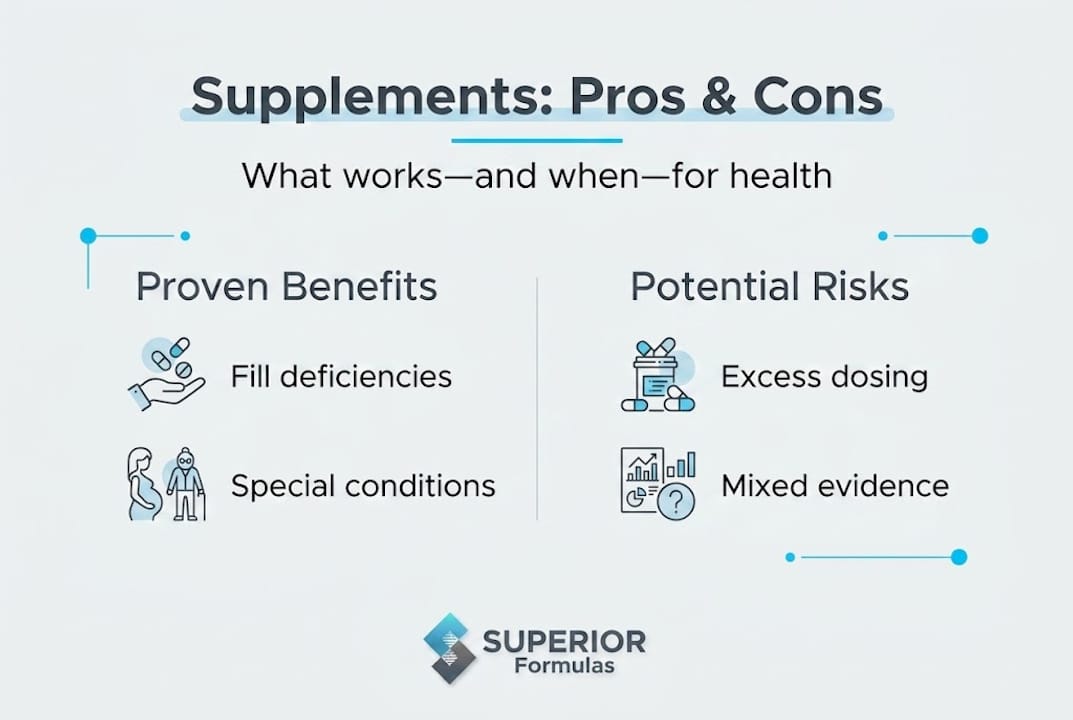
Supplements are recommended only for specific deficiencies, such as vitamin D in low sun exposure, folate in pregnancy, and B12 in pernicious anemia or dietary restriction. Food sources should always be prioritized, with supplements filling verified gaps.
Here are the most clinically supported scenarios:
- Vitamin D deficiency in low sun exposure. Northern latitudes, indoor occupations, and darker skin tones all reduce cutaneous vitamin D synthesis. A simple 25-OH vitamin D blood test confirms whether supplementation is warranted, and for many adults over 35, it is.
- Folate before and during pregnancy. Neural tube defect prevention requires adequate folate before conception, not just after a positive pregnancy test. Food alone rarely provides the 400 to 800 mcg of folic acid recommended in the periconceptional window.
- B12 for vegetarians, vegans, and older adults. B12 is found almost exclusively in animal products, and gastric acid production declines with age, impairing absorption even in meat eaters. Supplementation in these groups is not optional. It is medically necessary.
- Iron for confirmed iron-deficiency anemia. Heavy menstruation, malabsorption conditions like celiac disease, or inadequate dietary intake can deplete iron stores significantly. Confirming the deficiency with a ferritin level prevents unnecessary supplementation in those with normal stores.
- Omega-3s for elevated triglycerides. When dietary modification alone does not bring high triglycerides under control, medically indicated supplementation with high-dose EPA/DHA has a clear evidence base, particularly in conjunction with statin therapy.
Pro Tip: Before purchasing any supplement, ask your physician to run a targeted panel: 25-OH vitamin D, B12, folate, ferritin, a fasting lipid panel with triglycerides, and an omega-3 index if available. These five tests give you a clinically grounded foundation for deciding what you actually need.
| Supplement | Who needs it | Preferred source first |
|---|---|---|
| Vitamin D | Low sun, older adults, darker skin | Sunlight and fatty fish |
| Folate | Pregnancy planning, MTHFR variant | Leafy greens, legumes |
| B12 | Vegans, vegetarians, adults over 50 | Animal proteins, dairy |
| Iron | Confirmed deficiency only | Red meat, legumes |
| Omega-3 | High triglycerides, low seafood intake | Fatty fish (salmon, sardines) |
If you are looking for a well-formulated foundation that covers common nutritional gaps without excessive dosing, exploring balanced multivitamin options grounded in clinical research is a reasonable starting point. Understanding the science behind supplements can also help you evaluate any product you consider.
Supplements for longevity and cellular health: What’s promising (and what’s not)
With targeted use established, let’s spotlight the most talked-about supplements in longevity research and see where the evidence stands. This is where the field is moving fast, and where separating signal from noise requires careful reading of the data.
Vitamin D and telomere protection
One of the more striking recent findings comes from the VITAL trial, a large, well-designed randomized study. Vitamin D at 2,000 IU/day reduced leukocyte telomere attrition by approximately 140 base pairs over four years. Telomere shortening is a core marker of biological aging, so this finding suggests that adequate vitamin D status may genuinely slow one dimension of cellular aging, not just support bone density.
For general health maintenance, 600 to 800 IU of vitamin D supports bone health and immune function, with particular benefit for adults over 70, those with limited sun exposure, individuals with darker skin, and vegans. The critical step remains testing levels first before deciding on a dose.
Multivitamins and epigenetic aging
The COSMOS trial produced a genuinely surprising result. Multivitamins modestly slowed epigenetic aging clocks, specifically the PCGrimAge measure, by approximately 0.113 years per year, with stronger effects in participants whose biological clocks were already running fast. This is not a dramatic reversal of aging, but it does represent a measurable biological signal from a simple daily multivitamin, which is worth taking seriously.
Omega-3 fatty acids and cardiovascular risk
The omega-3 story is nuanced. High-dose omega-3 at 4 grams per day of icosapent ethyl reduces triglycerides and cardiovascular events in people with hypertriglyceridemia who are already on statin therapy. However, lower-dose general supplementation shows mixed results across the broader population. The benefit is real, but it is targeted, not universal.
CoQ10 for heart failure and mitochondrial function
CoQ10 at 300 mg per day improves heart failure outcomes, including mortality, hospitalizations, and ejection fraction, according to meta-analyses of randomized trials. For healthy adults, the evidence is less definitive, but CoQ10’s role in mitochondrial energy production makes it a rational consideration for those with confirmed cardiac risk or statin-induced myopathy.
| Supplement | Evidence level | Who benefits most |
|---|---|---|
| Vitamin D (2,000 IU) | Strong for telomere, bone, immune | Deficient adults, 35+, low sun |
| Multivitamin | Modest epigenetic benefit | Accelerated biological agers |
| Omega-3 (high dose) | Strong for high triglycerides | Hypertriglyceridemia on statins |
| CoQ10 (300 mg) | Strong for heart failure | Cardiac patients, statin users |
Pro Tip: If you are exploring Nrf2 activation and longevity as part of your cellular health strategy, Nrf2 pathway support works synergistically with adequate micronutrient status. Deficiencies in vitamin D or omega-3s can blunt the adaptive stress response that Nrf2 activation is designed to amplify.
It’s also worth noting that other anti-aging approaches including photobiomodulation and lifestyle-based interventions continue to show strong evidence, and they complement a well-considered supplement strategy rather than compete with it.
Personalizing your preventive routine: Practical steps and pitfalls
Armed with the latest evidence, here’s how to put knowledge into practice and personalize your preventive strategy. The most common mistake adults over 35 make is treating supplement shopping like grocery shopping: filling the cart with what looks good rather than what their body actually needs.
A structured approach to smarter supplementation
- Start with lab work, not labels. Test 25-OH vitamin D, B12, a complete metabolic panel, a fasting lipid panel, and ferritin. These give you a biological baseline. Everything you take should be justified by that baseline or a specific health condition.
- Track your diet for one week. Apps like Cronometer or Eat This Much can quantify your actual nutrient intake. Most adults discover they consistently fall short in only two or three key nutrients, not the fifteen categories covered by a typical multivitamin.
- Consult your physician before adding anything new. Supplements interact with medications. Vitamin K interferes with warfarin. High-dose calcium competes with thyroid medication absorption. St. John’s Wort affects dozens of drug metabolism pathways. Your physician needs to know what you are taking.
- Focus on the fundamentals first. For health-conscious adults over 35, the priority hierarchy is: balanced diet first, verified deficiency supplementation second, targeted clinical use third. High-dose antioxidants in smokers are explicitly contraindicated.
- Reassess every six to twelve months. Nutrient needs shift with age, season, health status, and changes in diet. A supplement that was appropriate at 40 may be unnecessary or even excessive at 55.
Mechanisms of harm from excess supplementation are real: fat-soluble vitamins accumulate in tissue, and pro-oxidant effects emerge when antioxidant supplements are taken at doses far exceeding physiological needs. Personalization via biomarkers is the only reliable way to stay in the therapeutic window.
For those formulating a daily regimen around these principles, evidence-based multivitamins that avoid megadosing represent a lower-risk foundation. Pairing that with personalized supplement science ensures your choices are grounded in clinical data rather than marketing.
Pro Tip: Use intolerance screening for personalization if you suspect food sensitivities are affecting your absorption. Subclinical intolerances can impair nutrient uptake even when dietary intake appears adequate, making supplementation look ineffective when the real problem is poor absorption.
The uncomfortable truth: Why supplements matter less than you think (and when they matter most)
Let’s step back and look at the real-world bottom line after all this research. We review the literature closely, and the most consistent finding across decades of supplement trials is this: food and lifestyle interventions outperform pills, almost every time, in well-nourished, generally healthy adults.
That isn’t a marketing position. It’s what the controlled data shows. A Mediterranean diet pattern reduces cardiovascular events more reliably than any supplement studied to date. Consistent aerobic exercise extends healthy lifespan more convincingly than CoQ10. Quality sleep protects cognitive function more powerfully than any stack of nootropics.
But here’s where the calculus changes: biomarkers. When a 47-year-old with limited sun exposure, a plant-based diet, and a family history of cardiovascular disease sits down to review lab work showing a vitamin D level of 18 ng/mL, a borderline B12, and triglycerides above 300 mg/dL, supplementation becomes a genuine clinical tool, not a marketing exercise.
The adults who benefit most from supplements are not the healthiest people in the room. They are the people with verified gaps, identified risk factors, and specific life stage needs (pregnancy, malabsorption, heart failure). The marketing industry has inverted this reality, making supplements feel necessary for everyone and optional for no one.
Exploring advanced longevity science is most valuable when it’s layered on top of a solid dietary and lifestyle foundation. Think of it as precision tuning for a well-maintained engine, not a replacement for engine maintenance.
Personalized supplements for greater preventive impact
If you’re ready to take the next step toward smarter, evidence-based supplementation, here’s how you can personalize your approach with support from Superior Formulas.
Superior Formulas builds every product on peer-reviewed clinical data, physician expertise, and transparent ingredient sourcing. If your lab work suggests nutritional gaps and you want a clean, well-dosed foundation, Superior Multi+ Daily provides evidence-supported micronutrient coverage without excessive dosing. For those focused specifically on cellular resilience and healthy aging at the pathway level, Nrf2 Activate+ targets the body’s own antioxidant defense system through Nrf2 pathway activation, an approach grounded in current longevity biochemistry. Explore the full body of science-backed supplement details behind each formulation to understand exactly what you’re taking and why it matters.
Frequently asked questions
Should most healthy adults take daily supplements for disease prevention?
Most healthy adults with balanced diets do not need daily supplements for disease prevention, as broad supplementation shows minimal benefit in well-nourished populations and some high-dose antioxidants may increase mortality risk.
Which supplements are proven beneficial for people over 35?
Vitamin D, omega-3s, and B12 may benefit some adults over 35 if they have verified deficiencies or limited dietary intake, since evidence supports targeted use rather than routine supplementation across the board.
Do multivitamins slow aging or improve longevity?
Some studies show modest slowing of epigenetic aging clocks with multivitamins, but effects are small. The COSMOS trial found multivitamins modestly slow epigenetic clocks (PCGrimAge by approximately 0.113 years/year), with stronger results in those with accelerated biological aging.
Is it safe to take high-dose antioxidants for disease prevention?
High-dose antioxidant supplements are not routinely recommended, as antioxidant megadosing may increase mortality risk, particularly for smokers taking beta-carotene or adults taking high-dose vitamin E long term.
How can I know if I need supplements for preventive health?
Ask your physician to test for nutrient deficiencies using targeted lab panels, and supplement only for verified gaps or specific medical conditions rather than taking supplements preemptively based on general wellness claims.


