


The supplement aisle can feel like a maze of bold claims, sleek packaging, and price tags that vary by hundreds of dollars for what appears to be the same nutrient. For adults over 35 who are actively investing in their long-term health, the stakes of choosing wrong are real. A capsule that costs more doesn’t automatically do more. What actually separates a supplement worth your investment from an overpriced placebo is a set of measurable, science-grounded standards that most marketing materials will never mention.
Table of Contents
- What defines a premium supplement?
- Bioavailability and ingredient form: Why absorption matters
- Longevity and science-backed ingredients for adults 35+
- Is paying more always worth it? Navigating price vs. real value
- What most supplement buyers miss about ‘premium’ quality
- Explore science-backed premium supplements for better aging
- Frequently asked questions
Key Takeaways
| Point | Details |
|---|---|
| Third-party certifications | Always check for independent certifications like USP or NSF for proven potency and safety. |
| Choose bioavailable forms | Opt for supplements with advanced delivery or chelated ingredients to enhance absorption and results. |
| Focus on proven ingredients | Select formulas with clinically-supported ingredients like NMN, fisetin, and resveratrol for healthy aging. |
| Price isn’t everything | Premium price is worthwhile for complex formulas, but simple nutrients often work just as well in generic, well-tested forms. |
| Science over branding | Prioritize science-backed evidence and rigorous testing over flashy marketing or high price tags. |
What defines a premium supplement?
Let’s start by clarifying what “premium” actually means in the world of supplements. Most people assume it’s about the price or the brand recognition. It isn’t. A truly premium supplement earns that label through objective, verifiable standards that go far beyond what’s printed on the front of the bottle.
The most reliable signal of real quality is independent, third-party certification. Organizations like USP (United States Pharmacopeia), NSF International, and Informed Sport test supplements against rigorous benchmarks. According to third-party testing standards, key characteristics include certifications from USP, NSF, or Informed Sport, ensuring identity, potency, purity, and freedom from contaminants like heavy metals and microbes. That’s not marketing language. It’s documented, reproducible validation.
Understanding supplement quality standards helps you recognize that certification is just the beginning. A truly premium product also demonstrates:
- Verified ingredient identity: The label says what’s inside, and lab testing confirms it.
- Accurate potency: The dose listed is the dose delivered, not an approximation.
- Contamination-free production: No residual solvents, no pesticide carry-over, no microbial load.
- GMP-certified manufacturing: Good Manufacturing Practice facilities are inspected for process consistency and hygiene.
- Transparent labeling: No “proprietary blends” that obscure actual doses.
“Premium doesn’t mean expensive. It means independently verified, accurately labeled, and manufactured to a standard that protects the person swallowing it.”
When you explore the science behind formulation design, you’ll also notice that premium supplements invest in sourcing. The raw material origin matters. A curcumin extract standardized to 95% curcuminoids is not the same as ground turmeric powder, even if both appear on a label under “curcumin.”
Bioavailability and ingredient form: Why absorption matters
Now that you know the hallmarks of a premium supplement, let’s explore why the form and delivery method make such a difference. This is where a lot of well-intentioned buyers lose money without realizing it.
Bioavailability refers to the fraction of a nutrient that actually reaches your bloodstream and target tissues after digestion. A supplement can contain 500mg of a mineral on paper, but if your body can only absorb 10% of that form, the effective dose is 50mg. You’re paying for the full amount and benefiting from a fraction of it.
Bioavailable supplement forms like liposomal delivery and chelated minerals absorb significantly better than cheap alternatives using low-bioavailability forms. This distinction drives real-world outcomes, not just theoretical chemistry.
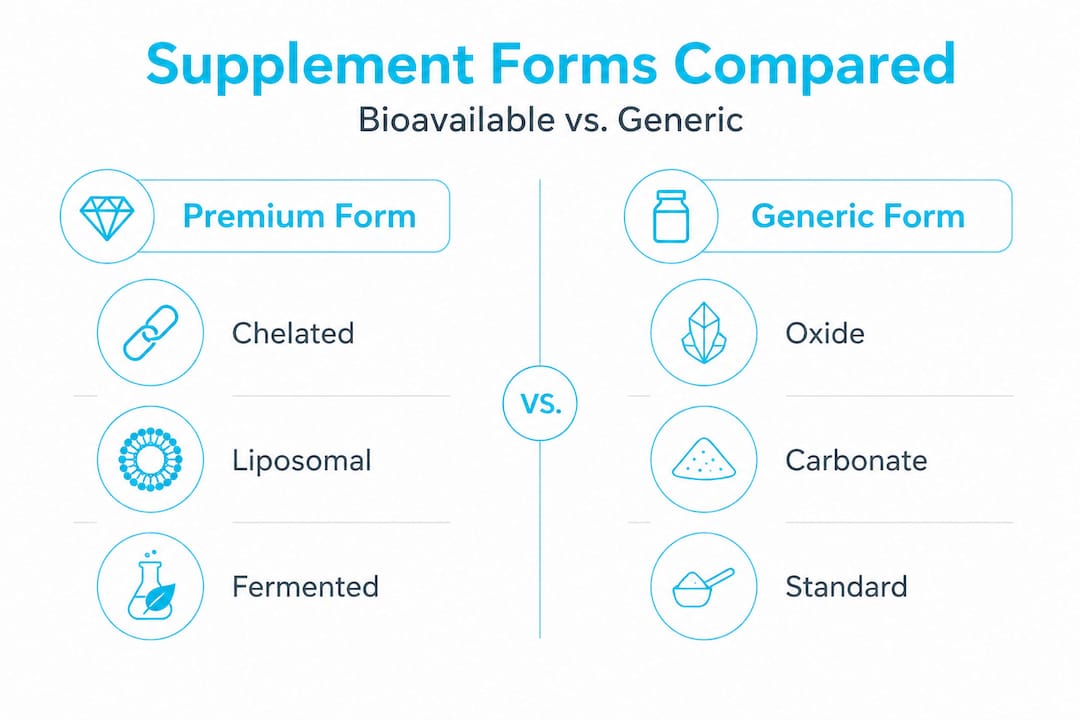
Here’s a practical comparison of common supplement forms and their relative absorption:
| Ingredient | Low-bioavailability form | Premium bioavailable form | Why it matters |
|---|---|---|---|
| Magnesium | Magnesium oxide (~4% absorbed) | Magnesium glycinate (~80% absorbed) | Oxide is mostly laxative; glycinate supports sleep and muscle function |
| Curcumin | Standard extract | Phospholipid complex (Meriva) | Plain curcumin is poorly absorbed; complexed form reaches tissues |
| Vitamin B12 | Cyanocobalamin | Methylcobalamin | Methyl form is active and ready for cellular use |
| Omega-3 | Ethyl ester | Triglyceride form | Triglyceride form absorbs 70% better with food |
| CoQ10 | Ubiquinone | Ubiquinol | Ubiquinol is the reduced, active form your cells use directly |
Fillers and excipients can also interfere with absorption. Calcium carbonate is commonly added as a filler, but it competes for absorption with other minerals. Titanium dioxide, used for whitening capsules, contributes no nutritional value. A lean, clean formulation with minimal inactive ingredients gives the active compounds room to do their job.
Pro Tip: When comparing two supplements with similar active ingredients, flip the bottle and read the “Other Ingredients” list. A shorter list with recognized, functional ingredients (like MCT oil for fat-soluble nutrients) signals a more considered formulation than one loaded with artificial colors or unnecessary binders.
The delivery system also matters. Liposomal encapsulation wraps nutrients in lipid (fat) spheres that merge with cell membranes, bypassing digestive breakdown. This is why liposomal vitamin C or glutathione commands a higher price and often justifies it. If you’re assessing a Fisetin supplement, for example, the form and co-ingredients used to enhance absorption can be the difference between a product that works and one that doesn’t.
- Avoid: magnesium oxide, cyanocobalamin, dl-alpha tocopherol (synthetic E), calcium carbonate filler
- Look for: chelated minerals (glycinate, malate), methylated B vitamins, natural tocopherols, phospholipid-bound or liposomal forms
Longevity and science-backed ingredients for adults 35+
With absorption and form explained, it’s time to highlight which premium ingredients actually count if your goal is longevity and healthy aging.
After 35, several biological shifts accelerate: NAD+ (nicotinamide adenine dinucleotide) levels begin to decline, senescent cell accumulation increases, mitochondrial efficiency drops, and chronic low-grade inflammation becomes more common. These aren’t abstract aging theories. They’re measurable changes that premium longevity supplements are specifically designed to address.
Longevity-targeted supplements for health-conscious adults 35 and older often focus on NAD+ boosters like NMN, antioxidants such as resveratrol, and cellular health ingredients like fisetin, frequently supported by clinical data. Here’s how the most researched ingredients break down:
| Ingredient | Primary mechanism | Clinically studied dose range | Notable research |
|---|---|---|---|
| NMN (nicotinamide mononucleotide) | NAD+ precursor, mitochondrial energy | 250mg to 900mg/day | Human trials show improved muscle insulin sensitivity |
| Resveratrol | Sirtuin activator, anti-inflammatory | 150mg to 500mg/day | Associated with cardiovascular and metabolic benefits |
| Fisetin | Senolytic, clears aging cells | 100mg to 500mg/day | Extends healthspan in animal models; human trials ongoing |
| Quercetin | Senolytic, anti-inflammatory | 500mg to 1,000mg/day | Synergistic with fisetin for senescent cell clearance |
| Berberine | AMPK activator, metabolic regulation | 500mg three times daily | Comparable to metformin in glucose regulation in some studies |
Here’s a framework for evaluating longevity ingredients before you buy:
- Verify clinical evidence exists. Look for human trials, not just animal data or in vitro studies. The research on NMN and fisetin is advancing rapidly, and some ingredients have genuinely crossed into human clinical territory.
- Check the dose matches studied amounts. A product with 5mg of resveratrol per capsule isn’t a longevity supplement. It’s a label claim. Match the ingredient dose to what clinical research actually used.
- Look for synergistic combinations. Some ingredients work better together. Fisetin and quercetin work synergistically as senolytics. Piperine (from black pepper) enhances curcumin absorption by up to 2,000%.
- Confirm the form is bioavailable. Even NMN varies in quality. Crystalline NMN with verified stability is what research typically uses.
- Assess the overall formula logic. A physician-formulated product reflects an understanding of how nutrients interact, compete for absorption, or potentiate each other.
Statistic worth knowing: NAD+ levels in human tissue decline by roughly 50% between ages 40 and 60. Supplementing with NMN or NR (nicotinamide riboside) has been shown in multiple studies to raise blood NAD+ levels, though optimal dosing for specific outcomes is still being refined.
A well-designed longevity daily formula should reflect this kind of multi-pathway thinking, addressing cellular energy, antioxidant defense, and inflammation simultaneously rather than isolating a single nutrient. Similarly, a multi+ daily supplement can provide foundational micronutrient coverage, including specialized AREDS2 nutrients linked to long-term eye health in clinical trials.
Is paying more always worth it? Navigating price vs. real value
Understanding price isn’t the end; now let’s see how to make smart choices about when premium is truly worth it.
The honest answer is that premium pricing is not always justified. For certain well-understood, single-molecule supplements, the research is settled and manufacturing is straightforward. Paying a luxury price for these adds no measurable benefit.
Price doesn’t always predict quality when it comes to supplements. For simple molecules like creatine monohydrate or vitamin D3, well-tested generics with third-party certification are fully adequate. Premium pricing becomes justified when complexity, novel delivery systems, or documented longevity-specific formulations are involved.
When a well-tested generic is smart:
- Creatine monohydrate: Decades of research, a well-understood mechanism, and a simple molecule that doesn’t require a fancy delivery system. A tested generic is fine.
- Vitamin D3: Cholecalciferol is cholecalciferol. As long as the dose is accurate and purity is confirmed, brand doesn’t add value.
- Basic vitamin C: Ascorbic acid is effective for most people. Liposomal C adds value mainly at high doses or for specific therapeutic goals.
- Magnesium oxide for constipation: If that’s the specific outcome you want, even the cheapest form works.
When premium formulation genuinely earns its price:
- Multi-ingredient longevity complexes: Combining NAD+ precursors, senolytics, and polyphenols in clinically relevant doses requires formulation expertise, quality sourcing, and stability testing that generics don’t provide.
- Liposomal nutrients: When you need actual cellular delivery (e.g., glutathione for antioxidant support), the delivery system is the product.
- Physician-designed formulas: These reflect an understanding of nutrient interactions, contraindications, and dose optimization that generic manufacturers don’t prioritize.
- Novel phytonutrients: Ingredients like fisetin, pterostilbene, or urolithin A require specialized extraction and standardization that cheap production can’t support.
Pro Tip: Before buying any supplement above $40 per month, search for the brand’s Certificate of Analysis (COA). This is a third-party lab document confirming what’s actually in the product. Legitimate premium brands make this easy to find. If a company can’t produce one, that tells you everything.
When you compare supplement value across the market, the differentiator isn’t always what’s on the label. It’s the combination of verified testing, bioavailable forms, clinically anchored dosing, and formulation intelligence that separates supplements worth your money from those that only look the part.
What most supplement buyers miss about ‘premium’ quality
Stepping back, here’s a practical perspective not enough buyers consider.
The supplement industry is uniquely vulnerable to perception bias. Elegant packaging, influencer endorsements, and aspirational branding create powerful associations between cost and quality that often have no basis in the actual product. We see this pattern repeatedly. A buyer pays three times the market rate for a collagen peptide with an Instagram-ready label, when a NSF-certified alternative at one-third the price would deliver identical results. The premium they paid was entirely social, not biochemical.
The buyers who consistently get the most from their supplement investment share one habit: they ask for the data before they ask the price. They want to see the third-party certificate, the exact ingredient form, the dose matched to human clinical research, and a clear explanation of why the formulation is structured the way it is. These are not difficult questions to ask. Reputable brands answer them immediately.
There’s also a subtler issue around obsession with single hero ingredients. The longevity supplement space is prone to “ingredient of the year” cycles where one compound gets enormous attention (NMN, then resveratrol, then urolithin A) and buyers assume that single ingredient is the answer. Real cellular resilience is multi-pathway. It requires NAD+ support, senolytic activity, antioxidant defense, and mitochondrial function support working together. Products like a well-formulated Berberine supplement that addresses AMPK pathways represent this kind of targeted, mechanism-aware thinking.
Our perspective is that the most sophisticated supplement buyer is not the one chasing the newest compound. It’s the one who knows how to read a COA, understands why magnesium glycinate outperforms oxide, and recognizes that physician formulation reflects a category of quality judgment that marketing simply cannot replicate.
Explore science-backed premium supplements for better aging
Ready to apply this knowledge? Here’s where to find premium, science-backed options for your health goals.
At Superior Formulas, every product begins with clinical evidence and is manufactured in GMP-certified facilities with third-party purity testing. Our physician-formulated line was built specifically for adults who want to invest in cellular health, not marketing.
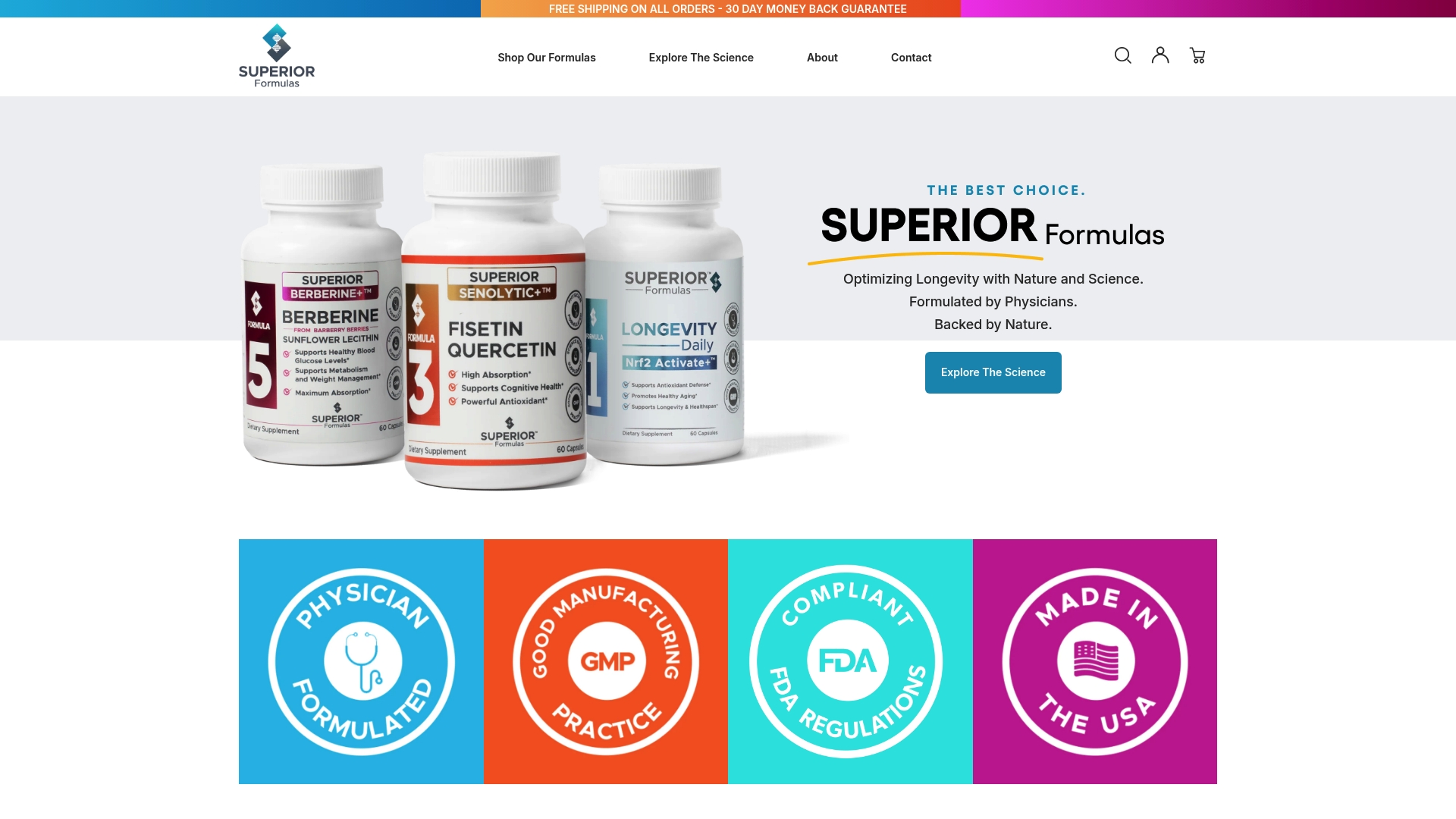
Explore our most targeted longevity formulations: Nrf2 Activate+ for longevity supports healthy aging through Nrf2 pathway activation, a cellular defense mechanism that declines with age. Senolytic+ with fisetin and quercetin targets senescent cell clearance using two of the most researched senolytic compounds available. And Multi+ Daily with AREDS2 nutrients delivers comprehensive micronutrient support with clinically validated eye-health compounds in one clean, daily foundation. Each formula is designed to work together, not compete. Shop now and make every capsule count.
Frequently asked questions
What certifications should I look for in premium supplements?
Look for third-party certifications like USP, NSF, or Informed Sport, which verify purity, potency, and freedom from contaminants including heavy metals and microbes.
Do expensive supplements always work better?
No. For straightforward nutrients like vitamin D3 or creatine, cost doesn’t predict quality; tested generics perform just as well. Premium pricing is justified primarily for complex longevity formulas requiring specialized delivery or novel ingredient combinations.
Why does ingredient form and bioavailability matter?
Bioavailable forms are absorbed at significantly higher rates, meaning your body actually receives and uses more of the nutrient per dose rather than excreting most of it.
What are the top evidence-based ingredients for longevity?
NMN, resveratrol, fisetin, and NAD+ precursors have the strongest current evidence for promoting longevity and cellular health in adults, with several progressing into human clinical trials.


