


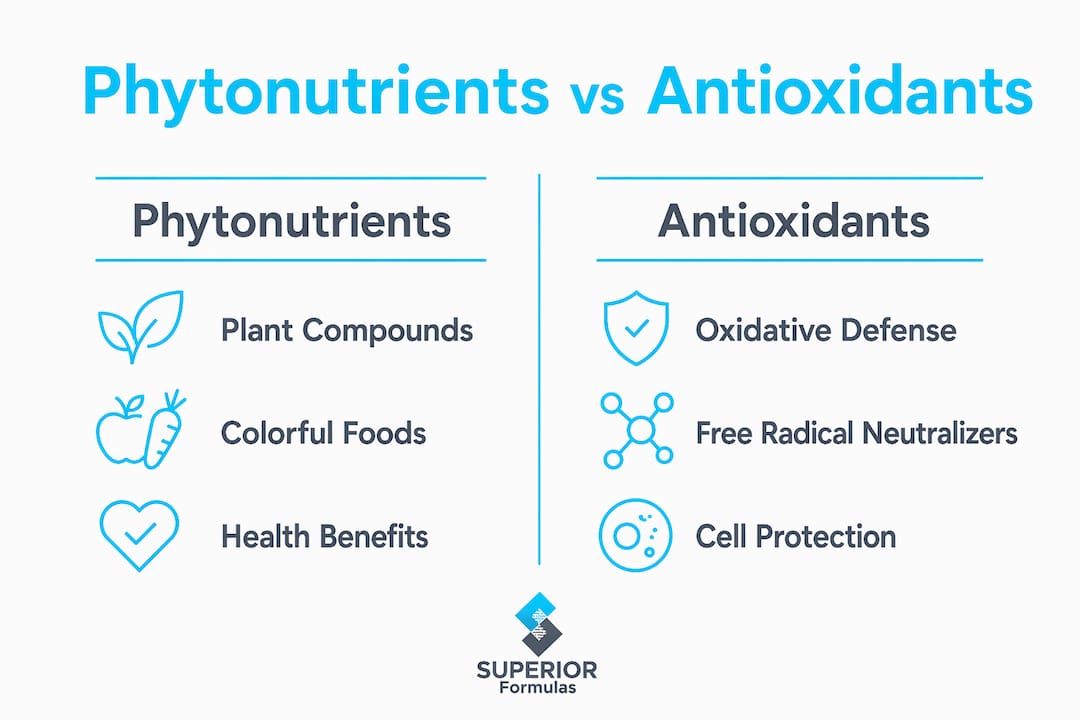
Phytonutrients are plant-produced bioactive compounds that often function as antioxidants, but the two terms are not interchangeable. Antioxidants form a broader category that includes vitamins, minerals, and phytonutrients, all united by one shared ability: neutralizing free radicals before they damage your cells. Over 10,000 types of phytonutrients exist in plant foods, yet essential antioxidants like vitamins C and E, selenium, and zinc are not phytonutrients at all. Understanding where these categories overlap, and where they diverge, is the foundation of smarter nutrition for healthy aging.
Here is a quick map of the relationship:
- Phytonutrients are plant-made chemicals (polyphenols, carotenoids, glucosinolates, phytosterols) that protect plants from pests and fungi and confer health benefits to humans who eat them.
- Antioxidants are any substance, whether made by the body, obtained from food, or taken as a supplement, that prevents or delays oxidative cell damage by neutralizing free radicals.
- The overlap: many phytonutrients possess strong antioxidant activity, making them a subset of the antioxidant category.
- The distinction: antioxidants also include essential nutrients (vitamins C, E, A; minerals selenium and zinc) that the body cannot survive without. Phytonutrients are non-essential, meaning deficiency does not cause acute disease, yet they deliver measurable protective effects.
- Biological roles beyond antioxidation: phytonutrients also modulate inflammation, support immune signaling, and interact with hormonal pathways, functions that go well beyond simple free-radical scavenging.
How antioxidants protect your cells from oxidative damage
Every cell in your body produces reactive oxygen species as a byproduct of normal metabolism. When production outpaces the body’s natural defenses, the result is oxidative stress, a condition linked to chronic diseases including heart disease and cancer. Free radicals are the culprits: unstable molecules missing an electron that steal electrons from DNA, cell membranes, and proteins, triggering a damaging chain reaction.
Antioxidants interrupt that chain. As Harvard Health explains, they neutralize free radicals by donating electrons, effectively acting as an “off switch” without becoming destructive themselves. Your body produces some antioxidants endogenously, including alpha-lipoic acid and glutathione. Diet supplies the rest.
Major antioxidant categories found in food include:
- Vitamin C: citrus fruits, bell peppers, strawberries, broccoli
- Vitamin E: sunflower seeds, almonds, wheat germ oil, spinach
- Beta-carotene (provitamin A): carrots, sweet potatoes, cantaloupe, kale
- Selenium: Brazil nuts, tuna, eggs, whole grains
- Zinc: oysters, beef, pumpkin seeds, legumes
- Flavonoids: cocoa, green tea, apples, onions, blueberries
- Lycopene: tomatoes, watermelon, pink grapefruit
- Lutein and zeaxanthin: spinach, kale, collard greens, corn
The role of antioxidants extends beyond any single compound. Each antioxidant has distinct chemical properties and targets different cellular structures, which is why dietary variety matters more than loading up on one source.
What does the evidence say about diets rich in phytonutrients and antioxidants?
The science here is consistent and compelling. A 2017 review of 95 studies involving more than 2 million participants found that diets rich in fruits and vegetables are associated with reduced risk of cardiovascular disease and several cancers. A 2023 UK cohort study of 72,160 people followed over 9 years linked higher fruit and vegetable intake to a meaningfully reduced risk of cataracts, one of the most common age-related conditions worldwide.
The critical caveat: these benefits come from whole foods, not isolated supplements. Randomized controlled trials of antioxidant supplements have repeatedly failed to reproduce the protective effects seen in dietary studies. Phytonutrients reduce disease risk and support immune balance, but that protection appears to depend on the full complexity of the food matrix, not a single extracted compound.
Pro Tip: Aim for a diverse variety of colorful fruits and vegetables each day. Each pigment group, from the anthocyanins in red berries to the chlorophyll in leafy greens, represents a distinct class of phytonutrients with different protective mechanisms.
Where do you actually find phytonutrients and antioxidants in food?
Plant pigments are your most reliable guide. The deeper and more varied the color on your plate, the broader the range of phytonutrients you are getting. Cooking method matters too: lycopene in tomatoes becomes more bioavailable after heating, while some heat-sensitive vitamin C degrades with prolonged cooking.
Key food sources by phytonutrient class:
- Polyphenols (flavonoids, resveratrol, quercetin): dark chocolate, red wine, green tea, apples, onions, soy, olive oil
- Carotenoids (lycopene, lutein, beta-carotene): tomatoes, carrots, sweet potatoes, spinach, kale, watermelon
- Glucosinolates: broccoli, Brussels sprouts, cauliflower, cabbage, arugula
- Phytosterols: legumes (beans, lentils, peas), nuts, whole grains
- Anthocyanins: blueberries, blackberries, red cabbage, cherries, eggplant
- Isoflavones: soybeans, tofu, tempeh, edamame
Whole grains, nuts, seeds, herbs, and spices round out the picture. Turmeric contains curcumin, a polyphenol with well-studied anti-inflammatory properties. Cinnamon delivers cinnamaldehyde. Garlic provides organosulfur compounds. No single food covers every class, which is exactly why dietary diversity is the most practical strategy.
Why antioxidant supplements often fall short

The supplement industry markets antioxidants aggressively, but the clinical evidence tells a more complicated story. Supplements do not replicate the benefits of antioxidants in whole foods because they lack the fiber, co-nutrients, and complex interactions that govern absorption and biological activity in a real food matrix.
High-dose supplementation carries real risks. Beta-carotene supplements have been linked to increased lung cancer risk in smokers, and high-dose vitamin E has been associated with elevated prostate cancer risk in some populations. These are not theoretical concerns; they emerged from large clinical trials.
Key limitations and safety considerations:
- Isolated antioxidants lack the synergistic co-factors present in whole foods.
- High doses can interfere with normal cell signaling and the body’s own defense mechanisms.
- Antioxidant supplements may reduce the effectiveness of certain cancer treatments that rely on reactive oxygen species.
- Free radicals are not purely harmful; they perform necessary physiological roles including immune defense and cell signaling, so complete suppression is neither possible nor desirable.
- The science on supplements consistently shows that no pill replicates the protective effect of a diet built around diverse plant foods.
For a broader look at how plant-based compounds compare to isolated supplements, plant-based supplement research continues to reinforce the whole-food advantage.
Expert perspectives on getting the most from phytonutrients and antioxidants
The consensus among registered dietitians and physician nutrition specialists is clear: eat the food, not just the extract. Phytonutrients act as antioxidant enhancers as much as direct scavengers. A well-documented example is hesperetin, a flavonoid found in oranges, which chemically regenerates vitamin C after it has neutralized a free radical, restoring it to active antioxidant form. That kind of network efficiency cannot be replicated by a single-ingredient capsule.
The goal is not to eliminate oxidative stress entirely. Free radicals perform necessary physiological functions, and the body’s antioxidant network is designed to modulate reactive oxygen species, not erase them. Physician-formulated approaches, like those developed at Superiorformulas, focus on supporting pathways such as Nrf2 activation, which upregulates the body’s own antioxidant enzyme production rather than simply flooding the system with exogenous compounds.
Practical strategies that align with both clinical evidence and whole-food principles:
- Build meals around a wide variety of colorful vegetables and fruits to capture diverse phytonutrient classes.
- Include cruciferous vegetables (broccoli, Brussels sprouts) several times weekly for glucosinolate exposure.
- Use herbs and spices liberally; they deliver concentrated polyphenols with minimal calories.
- When considering supplementation, prioritize formulations that work with the body’s endogenous antioxidant pathways rather than replacing them.
The antioxidant role in herbal healing literature reinforces this point: compounds from whole plant sources consistently outperform their isolated counterparts in clinical settings.
Key Takeaways
Phytonutrients and antioxidants overlap significantly, but whole-food sources consistently outperform isolated supplements for cellular protection and long-term health.
| Point | Details |
|---|---|
| Phytonutrients vs. antioxidants | Phytonutrients are plant compounds; antioxidants are a broader category that includes vitamins, minerals, and phytonutrients. |
| Scale of phytonutrient diversity | Over 10,000 types of phytonutrients exist in plant foods, each with distinct biological roles. |
| Whole-food advantage | A 2017 review of 95 studies with 2 million+ participants links fruit and vegetable-rich diets to reduced chronic disease risk. |
| Supplement risks | High-dose beta-carotene supplements raise lung cancer risk in smokers; high-dose vitamin E raises prostate cancer risk in some groups. |
| Network synergy | Phytonutrients like hesperetin regenerate vitamin C after free-radical neutralization, amplifying the body’s antioxidant network. |


