


Nutraceutical formulations are defined as bioactive compounds delivered through a specific dosage form, such as a capsule, gummy, jelly, or fortified food, to produce a measurable health benefit. The field spans four primary categories: traditional functional foods, fortified foods, dietary supplements, and medical foods. Each category demands a distinct development approach, from ingredient selection and stability testing to bioavailability engineering. Superiorformulas builds its product line within this framework, applying Nrf2 pathway activation, polyphenol science, and GMP-certified manufacturing to produce physician-formulated supplements with clinical backing.
1. Nutraceutical formulation examples: traditional and fortified functional foods
Traditional functional foods are whole or minimally processed foods that deliver health benefits beyond basic nutrition. Garlic, for example, contains allicin, a sulfur compound with well-documented antimicrobial and cardiovascular effects. Tomatoes supply lycopene, a carotenoid that reduces oxidative stress in vascular tissue. These foods require no manufacturing intervention; their bioactive compounds are naturally present and activated through normal digestion.
Fortified foods take a different approach. Manufacturers add nutrients that are not naturally present, or add them at levels above what the food naturally contains. Omega-3 enriched eggs and calcium-fortified orange juice are two of the most widely recognized examples. The goal is to close nutritional gaps in populations that cannot or do not consume enough of a given nutrient through diet alone.
| Feature | Traditional functional foods | Fortified foods |
|---|---|---|
| Bioactive source | Naturally occurring | Added during processing |
| Examples | Garlic, tomatoes, green tea | Omega-3 eggs, calcium-fortified juice |
| Primary benefit | Antioxidant, anti-inflammatory | Nutrient gap correction |
| Bioavailability factor | Food matrix dependent | Formulation and carrier dependent |
| Regulatory category | Generally recognized as safe | Requires nutrient addition approval |
Pro Tip: When selecting functional foods for a specific health goal, match the bioactive compound to a clinically studied mechanism. Lycopene targets vascular oxidation; allicin targets microbial and lipid pathways. Choosing by mechanism rather than general “health food” reputation produces more consistent results.
2. Dietary supplement formulations: polyherbal gummies as a practical example
Polyherbal gummy supplements represent one of the most scientifically interesting advances in supplement dosage forms. A published formulation combining Moringa oleifera, Phyllanthus emblica, and Hibiscus sabdariffa in a gelatin-pectin base demonstrated uniform appearance, stable pH, and concentration-dependent antioxidant activity. Each plant extract contributes a distinct bioactive profile: moringa supplies isothiocyanates and flavonoids, amla (Phyllanthus emblica) delivers vitamin C and tannins, and hibiscus provides anthocyanins with antioxidant and anti-inflammatory properties.
The formulation challenge is not simply combining extracts. Gelatin-pectin matrices must balance moisture content, pH stability, and texture to prevent degradation of heat-sensitive compounds during manufacturing. Moisture above acceptable thresholds promotes microbial growth and accelerates ingredient breakdown. pH outside the target range can destabilize anthocyanins, causing color and potency loss.

Gummies offer a meaningful compliance advantage over tablets and capsules, particularly for children and older adults who struggle with swallowing solid dosage forms. Consumer-friendly formats like gummies and medicated jellies improve adherence in these populations without sacrificing therapeutic intent.
Gummies vs. capsules: key trade-offs
- Gummies: Higher palatability, better compliance for children and elderly, limited to heat-stable ingredients, higher sugar content, more complex manufacturing
- Capsules: Broader ingredient compatibility, easier to include enteric coatings for targeted release, lower sugar burden, less appealing to taste-sensitive populations
- Tablets: Most cost-effective at scale, highest ingredient load per unit, lowest palatability, poorest compliance in vulnerable groups
Pro Tip: When formulating polyherbal gummies, verify synergistic antioxidant activity experimentally rather than assuming the combined effect equals the sum of individual extracts. Synergistic effects must be confirmed through stability and activity testing, not inferred from ingredient profiles alone.
3. Medicated jellies for immune support and patient compliance
Medicated nutraceutical jellies occupy a distinct niche between functional foods and pharmaceutical dosage forms. A published formulation using Ficus carica (fig) and Annona reticulata (custard apple) as the primary fruit bases, combined with immune-supporting herbal decoctions, demonstrated good physical stability, smooth texture, and satisfactory in-vitro release. The gelatin-sugar matrix provided a palatable vehicle for delivering multiple botanical actives simultaneously.
The immune-supporting ingredient profile in such formulations typically includes herbs with established immunomodulatory activity, combined with vitamins and minerals that support innate immune function. The jelly format allows for higher water activity than gummies, which affects both ingredient solubility and shelf stability. Formulators must monitor pH, moisture, texture, and microbial stability as primary quality attributes throughout the product’s shelf life.
Medicated jelly formulation steps:
- Select and standardize herbal extracts for consistent bioactive concentration
- Prepare herbal decoction by controlled aqueous extraction at defined temperature and time
- Combine gelatin and sugar base with measured water to achieve target viscosity
- Incorporate fruit pulp (fig, custard apple) and herbal decoction under controlled temperature
- Add preservatives and pH adjusters to meet stability targets
- Pour into molds and allow controlled setting at defined temperature
- Conduct organoleptic evaluation: color, odor, taste, and texture
- Perform physicochemical testing: pH, moisture content, weight uniformity
- Complete in-vitro release testing to confirm bioactive delivery
- Conduct microbial stability testing across the intended shelf life
The jelly format is particularly effective for pediatric and geriatric populations who find tablets unacceptable. It also allows formulators to mask bitter herbal flavors more effectively than capsules, since the sugar-fruit matrix provides strong sensory cover.
4. Bioactive ingredient classes and their mechanisms in evidence-based formulations
The scientific rationale behind nutraceutical formulations rests on specific classes of bioactive compounds, each with a defined mechanism of action. Polyphenols, flavonoids, carotenoids, probiotics, and plant extracts represent the core ingredient categories used across dietary supplements, functional foods, and medical foods. Each class acts through a distinct biological pathway, which is why formulation decisions must align ingredient selection with the intended health outcome.
Evidence-based nutraceuticals support longevity and disease risk reduction by modulating pathways such as Nrf2 activation and inflammatory signaling. Nrf2 is the body’s primary transcription factor for antioxidant defense. Polyphenols like resveratrol and curcumin activate Nrf2, upregulating protective enzymes that neutralize reactive oxygen species. This mechanism connects directly to cellular resilience and healthy aging, which is why Superiorformulas centers its formulations on longevity pathways with clinical evidence behind each ingredient.
| Ingredient class | Key examples | Primary mechanism | Health application |
|---|---|---|---|
| Polyphenols | Resveratrol, curcumin, EGCG | Nrf2 activation, antioxidant defense | Cellular aging, inflammation |
| Flavonoids | Quercetin, kaempferol | Inflammatory cytokine modulation | Immune support, cardiovascular |
| Carotenoids | Lycopene, beta-carotene | Singlet oxygen quenching | Vascular health, eye health |
| Probiotics | Lactobacillus, Bifidobacterium | Gut microbiome modulation | Digestive health, immunity |
| Adaptogens | Ashwagandha, rhodiola | HPA axis regulation | Stress response, energy |
Nutraceuticals function best as adjunctive interventions alongside healthy diet and lifestyle practices, not as replacements for them. This distinction matters for both formulators and consumers. A well-designed polyphenol supplement amplifies the benefits of a nutrient-dense diet; it does not compensate for a poor one.
Key Takeaways
Effective nutraceutical formulations combine the right bioactive ingredient class, a clinically appropriate dosage form, and rigorous stability testing to deliver consistent, measurable health benefits.
| Point | Details |
|---|---|
| Four core categories | Traditional functional foods, fortified foods, dietary supplements, and medical foods each require distinct formulation approaches. |
| Dosage form determines bioavailability | Gummies, jellies, capsules, and enteric-coated tablets each deliver bioactives at different rates and absorption sites. |
| Polyherbal synergy must be tested | Combined herbal extracts require experimental verification of antioxidant activity, not assumed additive effects. |
| Compliance drives format selection | Gummies and medicated jellies improve adherence in children and older adults compared to tablets. |
| Nrf2 and polyphenols anchor longevity science | Evidence-based formulations targeting cellular aging center on Nrf2 activation through polyphenols and phytonutrients. |
What I’ve learned about formulation science that most guides skip
The nutraceutical industry has matured significantly, but one gap persists: most formulation guides treat dosage form selection as a packaging decision rather than a scientific one. That framing is wrong. Dosage form directly determines how much of an active ingredient reaches systemic circulation, and at what rate. A polyphenol in a standard capsule and the same polyphenol in an enteric-coated softgel can produce meaningfully different plasma concentrations, even at identical doses.
The polyherbal gummy research reinforces a point I think gets underweighted: synergy between plant extracts is a hypothesis until you test it. Moringa, amla, and hibiscus each have strong individual profiles, but their combined antioxidant activity in a gelatin-pectin matrix had to be confirmed experimentally. Formulators who skip that step are guessing at efficacy.
The shift toward evidence-based formulation is not a trend. It is the baseline expectation for any brand that wants to earn long-term consumer trust. Superiorformulas builds from this standard: every ingredient is selected for its clinical evidence, every formulation is tested for stability and purity, and nothing goes into a product because it sounds good on a label.
— cristopher
Superiorformulas: science-driven nutraceutical formulations you can trust
Superiorformulas applies the same formulation principles covered in this article to every product in its line. Physician-formulated and manufactured in GMP-certified facilities, each supplement is third-party tested for purity, potency, and stability before it reaches you.
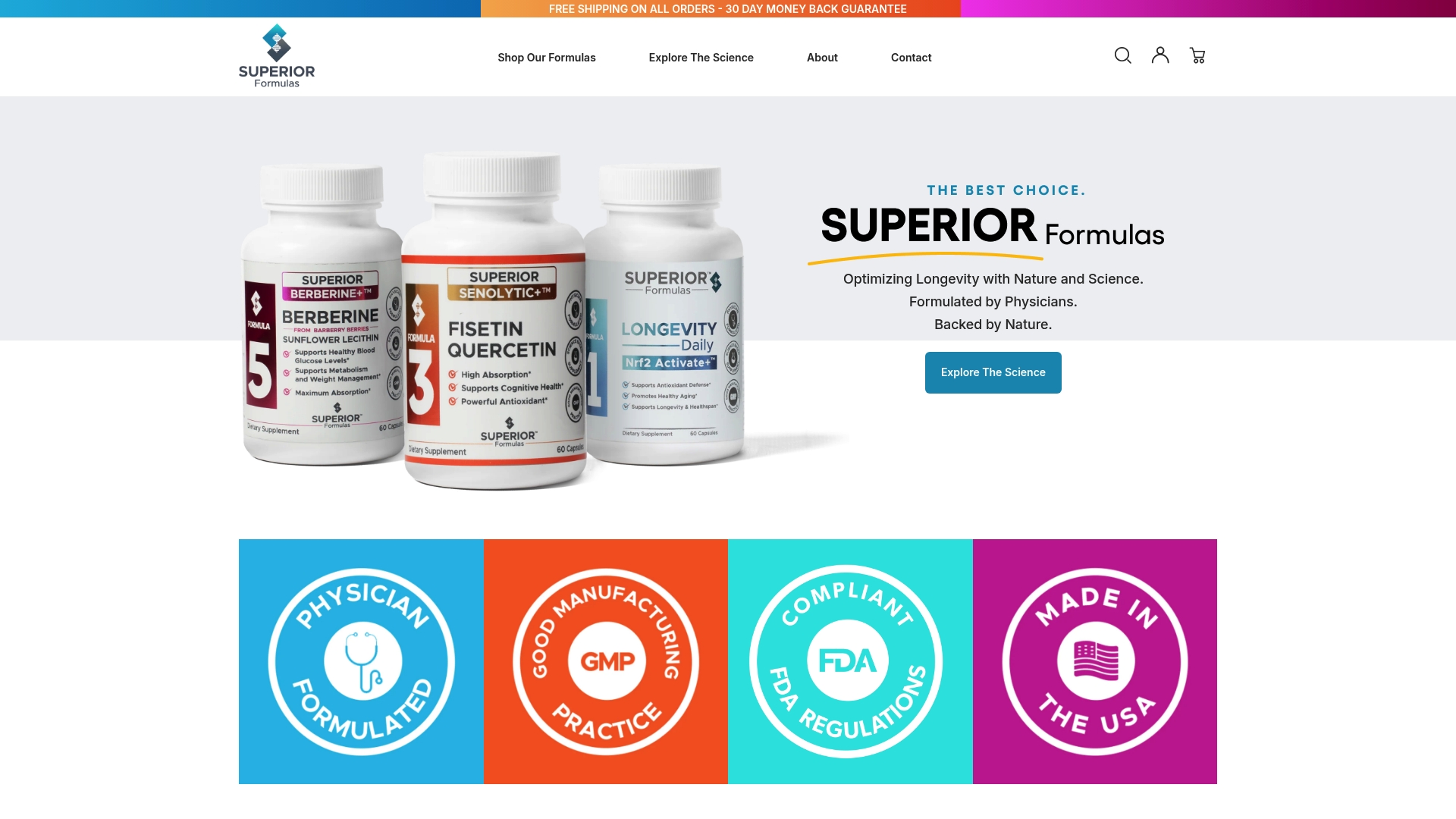
The product range targets longevity, cellular health, and metabolic support using clinically studied ingredients including polyphenols, adaptogens, and Nrf2-activating phytonutrients. If you are ready to move from researching formulations to using them, the Superiorformulas supplement line gives you a direct path to evidence-based wellness support. You can also review the brand’s quality assurance standards to understand exactly what goes into each product before you buy.
FAQ
What are the main nutraceutical formulation examples?
The four main categories are traditional functional foods (garlic, green tea), fortified foods (omega-3 eggs, calcium-fortified juice), dietary supplements (polyherbal gummies, capsules), and medical foods. Each category uses a distinct delivery form and development process.
How does dosage form affect nutraceutical efficacy?
Dosage form directly impacts bioavailability and absorption rate. Enteric-coated capsules protect acid-sensitive compounds, while gummies and jellies improve compliance but require careful pH and moisture control to maintain potency.
What is a polyherbal nutraceutical formulation?
A polyherbal formulation combines multiple plant extracts in a single dosage form to produce synergistic health effects. Examples include gummies made with Moringa oleifera, Phyllanthus emblica, and Hibiscus sabdariffa, where combined antioxidant activity is verified experimentally.
Why are gummies and jellies used in nutraceutical products?
Gummies and medicated jellies improve adherence in populations who struggle with tablets, particularly children and older adults. They also allow formulators to mask bitter herbal flavors through fruit-based and sugar matrices.
What role does the Nrf2 pathway play in nutraceutical formulations?
Nrf2 is the body’s primary antioxidant defense transcription factor. Polyphenols like resveratrol and curcumin activate Nrf2, making it a central target in formulations designed to support cellular resilience and healthy aging.


