


Many people scanning supplement labels assume that any product making a health claim must be backed by solid science. That assumption is wrong, and it costs people real money and, sometimes, real health outcomes. Understanding what is clinical evidence in supplements is one of the most practical skills a health-conscious adult can develop, especially when your goals include longevity, cellular resilience, and healthy aging. Not all evidence is created equal, and the gap between a compelling marketing claim and a well-designed human clinical trial is wider than most consumers realize.
Table of Contents
- What clinical evidence means in dietary supplements
- The types of research behind clinical evidence
- Nuances and challenges in evaluating supplement clinical evidence
- The evidence gap for longevity and cellular health supplements
- How to apply clinical evidence knowledge when choosing supplements
- Why typical longevity supplement claims need a reality check
- How Superior Formulas supports your evidence-based supplement choices
- Frequently asked questions
Key Takeaways
| Point | Details |
|---|---|
| Clinical evidence definition | Clinical evidence for supplements means reliable human studies matching the product’s dose and claimed benefits. |
| Types of research | Studies range from cell and animal to human trials; human clinical trials matter most for valid claims. |
| Evidence nuances | Trial design, formulation, and outcome relevance critically impact the strength of clinical evidence. |
| Longevity claims gap | Many longevity supplements rely on preliminary biomarkers instead of proven clinical health effects. |
| Informed choices | Consumers should seek supplements with transparent, product-specific clinical data and realistic claims. |
What clinical evidence means in dietary supplements
Clinical evidence, in the context of dietary supplements sold in the United States, refers to a specific standard of scientific proof. The Federal Trade Commission and the FDA both require that any health-related claim be backed by what they call “competent and reliable scientific evidence.” In practice, that phrase carries real weight. Companies must have “competent and reliable scientific evidence” typically involving high-quality human trials to substantiate health claims for supplements in the US.
Randomized controlled trials (RCTs) are the gold standard here. An RCT randomly assigns participants to either receive the supplement or a placebo, then measures outcomes under controlled conditions. This design controls for bias and confounding variables better than any other method.
There is also a critical distinction most consumers miss: ingredient-level evidence versus product-level evidence. A study conducted on a specific compound at a specific dose in a specific population does not automatically transfer to a commercial product using a different formulation, lower dose, or different delivery method. Learning how to approach identifying research-backed supplements starts with understanding this gap.
Key distinctions in US supplement clinical evidence:
- Structure/function claims (e.g., “supports immune health”) are permitted by the FDA with a disclaimer, but the evidence standards for these are set by the FTC, not the FDA
- Ingredient-level evidence differs from finished-product evidence; the exact dose and formulation matter
- RCTs carry more weight than observational studies, case reports, or expert opinion alone
- The FTC’s two-trial rule suggests that at least two independent, well-controlled trials are preferable for strong claim substantiation
The types of research behind clinical evidence
Dietary supplement research spans cell, animal, clinical, and population studies evaluating mechanisms, safety, and effectiveness in humans. Each level of research plays a different role, and understanding where a claim originates tells you a great deal about its strength.
Preclinical studies (cell cultures and animal models) establish biological plausibility. They show that a compound can interact with a relevant pathway. For example, resveratrol activates SIRT1 in cell studies, which is interesting. But cell studies cannot tell you how much resveratrol a human needs to absorb for that activation to be meaningful, or whether any clinical benefit follows.
Human clinical trials are where evidence becomes actionable. They assess real safety and real-world effectiveness in people. The AREDS and AREDS2 trials are among the most cited examples in supplement history: these large, multi-year, NIH-funded trials demonstrated that specific combinations of antioxidants and zinc could reduce risk of advanced AMD in high-risk patients, establishing a rare and meaningful evidence benchmark for a dietary supplement.
Population studies track large groups over time, linking dietary supplement intake with health outcomes. These are useful for generating hypotheses but cannot prove causation.

The research hierarchy matters for understanding why quality supplements for longevity require more than a few promising cell studies to justify their claims.
Types of research that contribute to clinical evidence:
- In vitro (cell) studies: Identify mechanisms, generate hypotheses
- Animal studies: Test safety, explore biological pathways
- Human pilot trials: Small-scale, early signals of safety and tolerability
- Randomized controlled trials: The strongest direct evidence in humans
- Systematic reviews and meta-analyses: Pool data across multiple trials for broader conclusions
Nuances and challenges in evaluating supplement clinical evidence
Evaluating clinical evidence quality is rarely straightforward, and this is where most consumers are misled. Several factors determine whether a study genuinely supports a supplement claim.
Biomarker changes versus functional outcomes is one of the most important distinctions in supplement science. A supplement may raise blood levels of a particular antioxidant, but that does not mean it reduces disease risk or improves how you feel or function. Clinicians focus on patient-important outcomes, not just numbers on a lab panel. Clinical evidence requires objective, qualified, and relevant trials matching the exact product, dose, and population to support claims.
Formulation and dosage mismatches are common in supplement marketing. A trial might test 500 mg of a compound twice daily, but the product being sold delivers 100 mg once daily. That is not the same intervention. Similarly, a trial conducted in elderly adults with diagnosed nutrient deficiencies does not automatically support claims for healthy middle-aged adults.
Trial quality variability is also significant. Supplement trials often face challenges: small sample sizes, short durations, lack of blinding, and industry-sponsored designs that introduce potential bias. Independent trial conduct and pre-registration of study outcomes are markers of reliability.
For a deeper look at assessing supplement clinical evidence with practical steps, the frameworks there apply directly to what follows below.
Comparison: Weak versus strong clinical evidence in supplements
| Factor | Weak evidence | Strong evidence |
|---|---|---|
| Study type | Cell or animal only | Human RCT |
| Sample size | Under 30 participants | 100+ participants |
| Duration | 2 to 4 weeks | 3 months or longer |
| Population match | Different age/health status | Matches target consumer |
| Dosage match | Different from product | Matches marketed dose |
| Independence | Industry-funded only | Independent replication |
| Outcomes | Biomarkers only | Functional or disease outcomes |
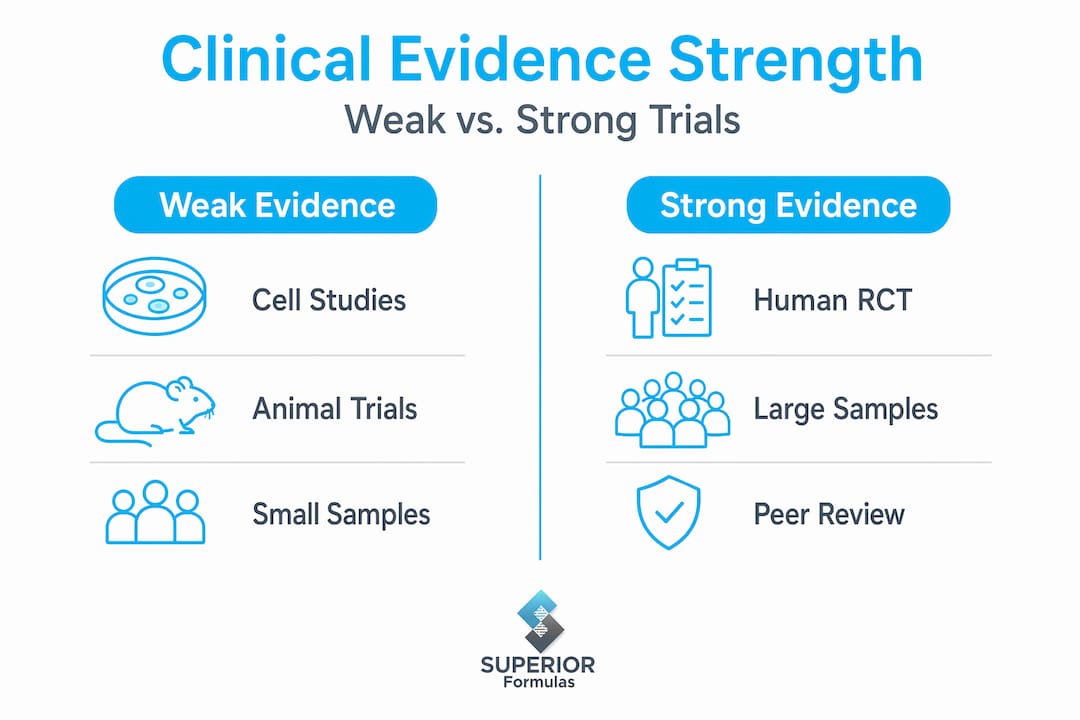
Pro Tip: When reviewing a supplement’s clinical evidence, look for the words “randomized,” “placebo-controlled,” and “double-blind” in the study description. If all three appear, you’re looking at a meaningfully higher standard of research than most supplement claims rest on.
The evidence gap for longevity and cellular health supplements
This is where science gets honest. Many longevity supplements rely on surrogate biomarkers instead of direct reductions in age-related diseases, creating evidence gaps for substantiating claims. Consumers want measurable results, but the trials most often cited for cellular health and longevity ingredients measure things like NAD+ levels, telomere length, or oxidative stress markers rather than direct improvements in healthspan or disease reduction.
The problem is not that these biomarkers are uninteresting. They are genuinely relevant. But their relationship to actual aging outcomes in humans is still being established. Validated aging biomarkers that reliably predict health outcomes across large populations remain an active area of research, not a settled science.
“The supplement industry needs to move beyond measuring surrogate markers and invest in trials designed around outcomes that patients actually experience and that clinicians can act on.” — paraphrased from evidence-gap discussions within the nutrition research community
What you should watch for when evaluating evidence gaps in longevity supplements:
- Claims referencing only preclinical (cell or animal) studies for anti-aging effects
- Biomarker improvements presented as equivalent to disease prevention
- Absence of long-term human trial data (3 months or longer)
- No disclosure of evidence limitations in marketing materials
Steps to assess a longevity supplement’s evidence quality:
- Identify whether any human clinical trials exist for the specific ingredient and dose
- Determine whether outcomes measured are functional (strength, cognition, disease risk) or biomarkers only
- Check whether trials were conducted in populations similar to you in age and health status
- Look for independent replication or systematic reviews pooling multiple studies
- Read the fine print for disclaimers that signal evidence limitations
Transparency about what the evidence does not yet show is one of the clearest signals that a brand takes scientific integrity seriously. Seeking out premium supplements with clear longevity evidence means prioritizing brands that acknowledge these boundaries.
How to apply clinical evidence knowledge when choosing supplements
With a clearer picture of what clinical evidence actually entails, you can make supplement decisions grounded in science rather than persuasive label copy. Matching evidence to the marketed product’s dose, formulation, and target population is essential for credible claims and informed choices.
What to look for:
- Human RCTs published in peer-reviewed journals, conducted on a finished formulation, not just an isolated ingredient
- Dosages in the trial that match what the product actually delivers
- Participants whose age, health status, and goals resemble yours
- Outcomes that matter to you functionally, not only lab values
- Third-party testing for purity and label accuracy, verifying that what’s stated is actually in the bottle
What to be cautious about:
- Phrases like “studies suggest” without specific citation
- Reliance on traditional use or historical evidence as the primary support for modern health claims
- Claims that extrapolate from animal research to human benefits without bridging human trial data
- Absence of any mention of evidence limits or disclaimers
Choosing physician-formulated supplements adds another layer of reliability, because clinical expertise shapes which ingredients are selected, at what doses, and why.
Pro Tip: Search for a supplement’s key ingredient followed by “randomized controlled trial” in PubMed (pubmed.ncbi.nlm.nih.gov). A five-minute search can tell you immediately whether any human trial data exists and whether it matches what the product claims.
Why typical longevity supplement claims need a reality check
Here is the uncomfortable truth about the longevity supplement category: most claims reach further than the evidence supports, not because companies are dishonest, but because the science itself is genuinely incomplete.
Clinicians focus on patient-important outcomes over biomarker shifts, viewing biomarker-based longevity claims as largely hypothesis-generating without long-term clinical data. Conducting a long-term, well-controlled trial on a longevity compound is logistically and ethically complex. True aging endpoints like lifespan extension or dramatic disease reduction in humans require decades of follow-up. No supplement company is running a 30-year trial. So the industry leans on shorter-term biomarker data and extrapolates. That extrapolation is where skepticism belongs.
This does not mean longevity supplements are worthless. Some ingredients have genuinely strong mechanistic rationale and meaningful short-term human evidence. The polyphenol quercetin, for example, has shown senolytic activity in early human trials. Omega-3 fatty acids have broad, long-term cardiovascular evidence. Vitamin D has decades of population and intervention data. The point is that these compounds earned their credibility through accumulated, rigorous human evidence, not marketing.
What we at Superior Formulas believe is that the most responsible approach is to help you understand what research-backed longevity supplements can and cannot do, because an informed consumer is a better-protected one. Healthy skepticism is not anti-supplement. It is pro-science.
How Superior Formulas supports your evidence-based supplement choices
You now know what separates a meaningful clinical claim from marketing noise. Superior Formulas was built precisely around that distinction. Every formulation we develop is grounded in physician-level clinical expertise and rooted in human evidence, not just promising preclinical data.
Our Formula 9 supplement with AREDS2 nutrients is a direct example of this commitment. It incorporates nutrients validated through the landmark AREDS2 randomized controlled trial, one of the most rigorously conducted supplement trials in history. Every ingredient is selected at clinically studied doses, manufactured in GMP-certified facilities, and verified through third-party testing. We also document our evidence sources transparently, because we believe you deserve to see the science, not just trust the label.
Frequently asked questions
What qualifies as clinical evidence for dietary supplements?
Clinical evidence typically means high-quality human studies, especially randomized controlled trials, that show reliable benefits matching the supplement’s dose, formulation, and claimed effects. The FTC requires “competent and reliable scientific evidence” usually met by human clinical trials relevant to the product and claim.
Can animal or cell studies alone substantiate supplement claims?
No; while useful for early research, animal and cell studies rarely meet regulatory standards alone and cannot prove safety or effectiveness in humans for supplement claims. Animal and in vitro studies provide valuable insights but are rarely sufficient for claim substantiation without human data.
Why are longevity supplement claims often disputed?
They often rely on surrogate biomarkers instead of direct evidence of disease reduction or improved function, and there is limited consensus on validated aging biomarkers. Longevity supplement claims rely heavily on biomarkers not yet fully validated as indicators of real aging or health outcomes.
How can consumers verify a supplement’s clinical evidence?
Look for published human clinical trials on the exact product formulation at the recommended dosage and population, transparent documentation of evidence quality, and disclosures about limitations. Products should have human trials matching the marketed dose and formula; transparency in claims is essential for informed choice.
What role does the FDA play in supplement clinical evidence?
The FDA allows truthful structure/function claims with disclaimers but does not specify exact evidence standards, leaving substantiation requirements mainly to the FTC and industry best practices. The FDA permits structure/function claims if truthful, with disclaimers, but lacks specific evidence standards unlike the FTC’s requirement for competent evidence.
Recommended
- How to assess dietary supplements for real wellness gains - SUPERIOR Formulas
- Supplements in preventive health: What really works? - SUPERIOR Formulas
- How to identify research-backed supplements for longevity - SUPERIOR Formulas
- Implement science-driven supplementation for better health - SUPERIOR Formulas


