


DHEA tablets are a hormone precursor supplement that can measurably shift blood sex-hormone levels. They are not a universal antiaging cure, but for specific, clinician-confirmed scenarios, the evidence is meaningful enough to warrant a serious look.
Here is what you need to know before going further:
- What they do: DHEA (dehydroepiandrosterone) converts into androgens and estrogens in the body. Taking an oral tablet raises serum DHEA-S and, in turn, can alter testosterone and estradiol levels.
- Evidence is mixed overall: For most antiaging claims, clinical support is limited or inconsistent. Stronger evidence exists for vaginal atrophy and, to a lesser degree, mood and sexual function.
- Regulatory status: DHEA is sold as a dietary supplement in the U.S. The FDA has not evaluated it for safety or effectiveness for any medical use.
- Who might consider it: Adults with documented low DHEA-S on labs, menopausal people with vaginal symptoms, or those with adrenal insufficiency, all under clinician supervision.
- Headline safety caveats: Avoid if you have a history of hormone-sensitive cancers, are pregnant, or have active liver disease. Baseline hormone testing before starting is strongly advisable.
Table of Contents
- What are DHEA tablets and how do they work?
- What does the research actually show for each condition?
- What forms and doses are used in clinical studies?
- What side effects and safety risks should you know about?
- Who should avoid DHEA, and what interactions matter?
- How do you choose a quality DHEA supplement in the U.S.?
- When do clinicians actually test for and prescribe DHEA?
- Key Takeaways
- A clinician’s honest perspective on DHEA
- Selected sources and further reading
What are DHEA tablets and how do they work?
DHEA, short for dehydroepiandrosterone, is a steroid hormone produced primarily by the adrenal glands. It serves as a biochemical raw material, a precursor the body converts downstream into androgens like testosterone and estrogens like estradiol. That conversion is what makes it physiologically significant and why dosing it without monitoring can produce unintended hormonal shifts.
Production peaks in your mid-20s and declines steadily with age, which is the biological rationale behind supplementation. By the time most adults reach their 70s, circulating DHEA levels are a fraction of what they were at their peak.
When you swallow an oral DHEA tablet, it passes through the gastrointestinal tract and undergoes first-pass hepatic metabolism before reaching systemic circulation. This limits bioavailability compared to topical or intravaginal routes. Standard oral tablets, micronized formulations, and lipid-matrix versions are all available in the U.S. market, and they differ meaningfully in how much active compound actually reaches your bloodstream. Understanding how dietary supplements support longevity and cellular health helps put DHEA’s mechanism in proper context alongside other aging-related interventions.
What does the research actually show for each condition?
The overall pattern across DHEA research is this: evidence is strongest for localized intravaginal use in menopause, moderate for mood and sexual function, and limited-to-mixed for most other claims. Marketing language often outpaces what trials actually demonstrate.
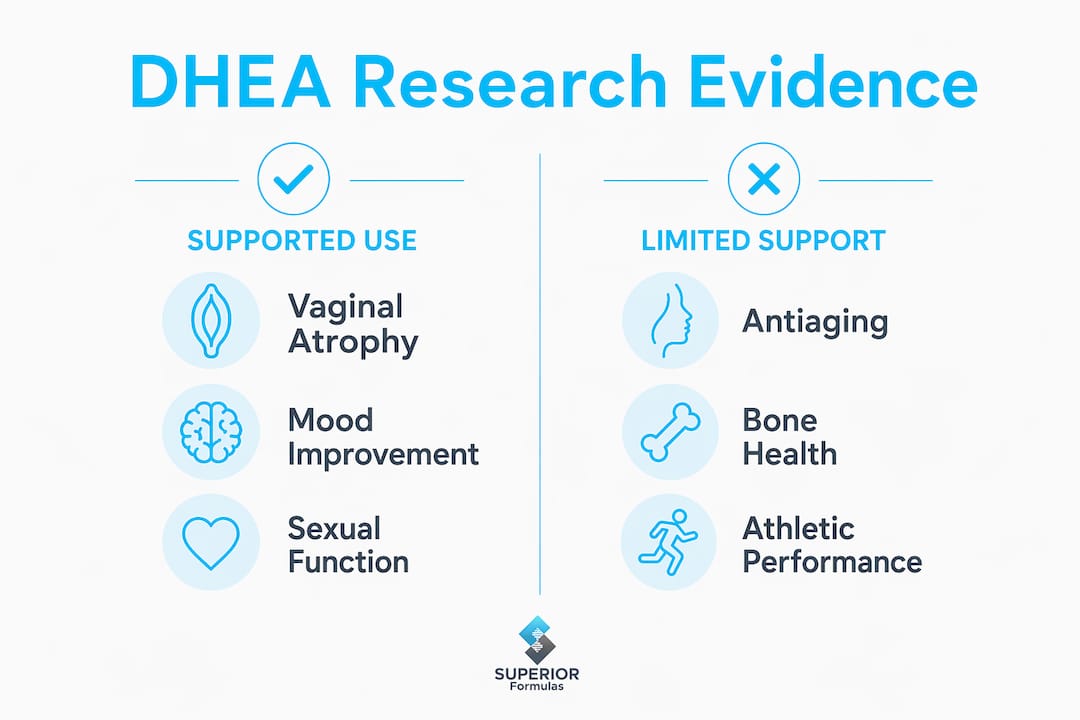
Aging and antiaging Evidence grade: limited. Studies have not consistently shown that oral DHEA supplementation meaningfully extends healthspan or reverses age-related decline in healthy adults. Some trials report modest improvements in well-being, but effect sizes are small and results vary by sex, baseline DHEA-S level, and age group.
Mood and depression Evidence grade: mixed. Several small trials suggest DHEA may improve depressive symptoms, particularly in people with low baseline DHEA-S or midlife-onset depression. The mechanism likely involves conversion to neuroactive steroids. However, no large randomized controlled trial has established it as a reliable antidepressant, and it should not replace evaluated treatments.
Menopause and vaginal atrophy Evidence grade: moderate to supported (intravaginal route). A systematic review published in PMC found that intravaginal DHEA (prasterone) produces meaningful improvements in vaginal atrophy symptoms, including dryness and dyspareunia. Oral DHEA’s effect on these symptoms is less direct. This is the condition with the most clinically credible evidence base.
Sexual function and libido Evidence grade: mixed. Some trials report improved sexual desire and satisfaction, especially in postmenopausal women with low DHEA-S. Effects in men are less consistent. Learning to assess dietary supplements for real wellness gains helps you weigh these promotional claims against what trials actually measured.
Bone density and muscle health Evidence grade: limited. A few studies show modest improvements in bone mineral density in older women, but results are not consistent enough to recommend DHEA as a primary bone-health intervention.
Athletic performance Evidence grade: not supported. Despite marketing claims about lean muscle mass, controlled trials have not demonstrated meaningful performance benefits in healthy athletes. DHEA is also banned by several sports organizations.
What forms and doses are used in clinical studies?
Available product formats
U.S. consumers encounter DHEA in four main formats:
- Standard oral tablets/capsules: The most common form. Subject to significant first-pass metabolism.
- Micronized oral formulations: Particle size reduced, sometimes under 50 microns, to improve surface area and absorption.
- Lipid-matrix formulations: Embedded in a lipid carrier to partially bypass hepatic first-pass metabolism and improve bioavailability.
- Topical and intravaginal: Applied directly to tissue; the intravaginal route (prasterone) has the strongest clinical evidence for vaginal atrophy.
Typical dose ranges
| Format | Common dose range | Notes |
|---|---|---|
| Standard oral tablet | 10–25 mg/day for women; 25–50 mg/day for men | Most study doses fall in this range |
| Micronized oral | 10–25 mg/day for women; 25–50 mg/day for men | Lower starting dose often recommended for women |
| Lipid-matrix tablet | 10–25 mg/day for women; 25–50 mg/day for men | Designed for improved absorption |
| Intravaginal (prasterone) | Prescription dose (as directed) | Prescription product; strongest evidence |
Product labels commonly list certain standard tablet strengths, and DHEA is available over the counter at pharmacies and supplement retailers across the U.S. Dosing guidance on product pages often differentiates by sex: lower initial doses for women (half to one tablet), higher for men (one tablet once or twice daily), though both groups should follow a clinician’s direction rather than label defaults.
Practical timing: take DHEA in the morning, since DHEA-S follows a mild diurnal pattern and morning dosing aligns with natural adrenal output. Start at the lower end of the range and do not escalate without follow-up testing.
Pro Tip: Micronized and lipid-matrix formulations are designed to improve bioavailability compared to standard tablets. If absorption is a concern, these formats are worth discussing with your clinician before you buy DHEA supplements.
What side effects and safety risks should you know about?
DHEA is a potent hormone precursor. Side effects are real and dose-dependent, which is why self-directed high-dose use carries genuine risk.
Common side effects reported with excessive or improper use include:
- Acne and oily skin
- Increased facial or body hair in women
- Hair thinning or loss (androgenic alopecia pattern)
- Irritability and mood changes
- Aggressiveness
Rare but serious reactions include palpitations and hallucinations. If you experience either, stop the supplement and contact a clinician promptly.
Contraindications: Do not use DHEA without specialist supervision if you have a history of hormone-sensitive cancers (breast, ovarian, prostate, uterine), are pregnant or breastfeeding, or have active liver disease. Adolescents should avoid it entirely, as exogenous hormone precursors can disrupt normal pubertal development.

Pro Tip: Never increase your dose based on how you feel. Androgenic side effects can develop gradually and become harder to reverse with prolonged high-dose exposure. Baseline blood testing before starting is the single most protective step you can take.
Who should avoid DHEA, and what interactions matter?
Populations who should not use DHEA without close clinical oversight
- People with hormone-sensitive tumors (breast, prostate, ovarian, uterine cancers)
- Pregnant or breastfeeding individuals
- Anyone with active or chronic liver disease
- Adolescents and children
- People with polycystic ovary syndrome (PCOS), where androgenic hormones are already elevated
Drug and supplement interactions
DHEA is metabolized through cytochrome P450 pathways, which creates interaction potential with drugs processed by the same enzymes. Clinically relevant considerations include:
- Hormone therapies: Combining DHEA with estrogen or testosterone replacement can produce additive hormonal effects and unpredictable serum levels. A clinician should review the full hormone picture before combining.
- Anticoagulants: Some evidence suggests DHEA may influence platelet function; people on blood thinners should flag this to their prescriber.
- Insulin and diabetes medications: DHEA may affect insulin sensitivity, warranting glucose monitoring if you are on antidiabetic therapy.
- Other performance or hormone supplements: Stacking DHEA with testosterone boosters, pregnenolone, or similar compounds multiplies hormonal load without proportional benefit and increases side-effect risk.
Clinical supervision is not optional when combining DHEA with any prescription medication. Bring your full supplement list to your next appointment.
How do you choose a quality DHEA supplement in the U.S.?
The FDA has not evaluated DHEA supplements for safety or effectiveness for any medical use. That regulatory gap means product quality varies widely across the U.S. market, and the burden of verification falls on you as the buyer.
A practical supplement quality checklist for DHEA tablets should include:
- Third-party testing: Look for verification from USP, NSF International, or an independent lab. A certificate of analysis (COA) should be available on request or posted on the vendor’s site.
- GMP-certified manufacturing: The facility should operate under current Good Manufacturing Practices, which the FDA requires for dietary supplement producers.
- Clear dose labeling: The label should state the exact amount of DHEA per serving, not just a proprietary blend weight.
- Transparent ingredient list: Avoid products with excessive fillers, undisclosed excipients, or vague “hormone support blend” language.
- Realistic marketing claims: Vendors who claim DHEA “reverses aging” or “builds muscle like testosterone” are overstating the evidence. Weigh those claims against what trials actually show.
Understanding why quality supplements matter for longevity is especially relevant here, because supplement labeling requirements for ingredients like DHEA follow the same framework as other dietary supplements. Superiorformulas manufactures in GMP-certified facilities and uses third-party testing to verify purity and potency, which is the standard any DHEA product you consider should meet.
When do clinicians actually test for and prescribe DHEA?
A clinician-guided DHEA trial typically starts with documented evidence of deficiency, not a symptom list alone. Here is a practical framework for how that process looks:
Conditions that might prompt a DHEA evaluation:
- Confirmed low DHEA-S on serum labs (age-adjusted reference ranges apply)
- Symptomatic hormone deficiency not explained by other causes
- Refractory vaginal atrophy in postmenopausal women unresponsive to first-line treatments
- Adrenal insufficiency (where DHEA replacement is sometimes included in a broader hormone protocol)
A sample monitoring plan:
- Baseline labs: DHEA-S, total and free testosterone, estradiol, liver function tests (LFTs), and a complete metabolic panel.
- Start low: Begin at 10–25 mg/day for women, 25–50 mg/day for men, depending on baseline levels and clinical context.
- Follow-up at 3–6 weeks: Recheck DHEA-S and sex hormones to assess conversion and adjust dose. Product guidance and clinical sources both support this 3–6 week monitoring window.
- Ongoing monitoring: LFTs and hormone panels every 3–6 months during sustained use.
- When to stop: Persistent androgenic side effects, hormone levels outside therapeutic range, or emergence of a hormone-sensitive condition.
Complex cases, particularly those involving adrenal disease or concurrent hormone therapy, belong with an endocrinologist or gynecologist. A physician-scientist approach to supplementation, like the one Superiorformulas applies across its formulations, starts with this kind of evidence-based individualization rather than one-size-fits-all dosing. You can explore the science behind that approach directly.
This article is general information, not medical advice. Confirm current guidelines and your individual hormone status with a qualified clinician before starting any DHEA protocol.
Key Takeaways
DHEA tablets can shift hormone levels and may help specific conditions, but they require clinical oversight, quality sourcing, and realistic expectations about what the evidence supports.
| Point | Details |
|---|---|
| Evidence is condition-specific | Strongest support exists for vaginal atrophy; mood and sexual function show mixed results; antiaging claims are largely unproven. |
| Formulation affects absorption | Micronized and lipid-matrix tablets offer better bioavailability than standard oral forms. |
| Safety requires monitoring | Baseline and follow-up hormone labs at 3–6 weeks reduce the risk of androgenic side effects and hormonal disruption. |
| FDA oversight is limited | DHEA is sold as a dietary supplement; choose products with third-party testing, GMP certification, and a clear COA. |
| Clinician involvement is not optional | Dosage and duration should be set by a qualified healthcare professional to avoid long-term hormonal disruption. |
A clinician’s honest perspective on DHEA
The most common mistake adults make with DHEA is treating it like a multivitamin. It is not. It is a hormone precursor with real downstream effects on testosterone and estrogen, and those effects are not always predictable from person to person. The same 25 mg tablet that produces a modest, well-tolerated DHEA-S rise in one person can push another into androgenic side effects within weeks, depending on individual conversion enzyme activity.
What the evidence actually justifies is narrower than the supplement aisle suggests. For a postmenopausal woman with confirmed low DHEA-S and vaginal atrophy symptoms that have not responded to first-line options, a supervised trial is clinically reasonable. For a 45-year-old man who feels tired and assumes his DHEA is low without testing, it is not. The symptom overlap between low DHEA and a dozen other conditions is too significant to skip the labs.
The other thing worth saying plainly: the healthy aging pathways that consistently show benefit across populations, things like sleep quality, resistance training, and targeted antioxidant support, do not require a hormone precursor at all. DHEA may have a role in a well-designed protocol, but it is rarely the first lever worth pulling. Start with a baseline panel, talk to a clinician who understands hormone physiology, and choose a product that can show you its third-party testing results before you buy.
Selected sources and further reading
The following sources informed this article and are recommended for deeper reading:
- DHEA supplements: Are they safe? Or effective? — Harvard Health Publishing
- Should Dehydroepiandrosterone Be Administered to Women? — PMC/NCBI
- DHEA — WebMD Vitamins & Supplements
- DHEA 50mg Micronized Lipid Matrix — Fullscript
- Life Extension DHEA 25 mg — iHerb
- What is clinical evidence in supplements? — Superiorformulas


