


Nutraceuticals are defined as food-derived bioactive compounds that support physiological functions beyond basic nutrition, with a primary focus on preventing and modulating chronic disease. The core principles of nutraceuticals sit at the intersection of nutrition science and clinical medicine, making them fundamentally different from both everyday food and pharmaceutical drugs. The FDA regulates these products under the dietary supplement framework, which means manufacturers must follow current Good Manufacturing Practices (cGMP) but do not receive pre-market efficacy approval. Understanding how nutraceuticals work, what the science actually supports, and how to use them responsibly is the difference between real health gains and expensive guesswork.
What are the core scientific principles that define nutraceuticals?
Nutraceuticals modulate physiological functions including anti-inflammatory response, antioxidant activity, and metabolic regulation to support cardiovascular, metabolic, and neurological health. That scope places them well beyond what a standard multivitamin does. They are not treating disease in the pharmaceutical sense. They are shifting the biological environment so disease is less likely to take hold.
The bioactive compounds at the center of nutraceutical science include polyphenols, flavonoids, carotenoids, omega-3 fatty acids, and probiotics. Each class works through distinct mechanisms. Polyphenols, for example, activate the Nrf2 pathway, which is the body’s internal switch for producing antioxidant enzymes. Probiotics modulate the gut microbiome, which in turn influences immune signaling and inflammatory tone throughout the body.
Understanding the difference between nutrients, supplements, and nutraceuticals matters here:
- Nutrients are compounds the body requires for basic survival, such as vitamins and minerals at their recommended daily amounts.
- Dietary supplements is the legal category the FDA uses, covering a broad range of products including vitamins, minerals, herbs, and amino acids.
- Nutraceuticals is a functional category describing bioactives with documented physiological effects beyond meeting a basic nutritional requirement.
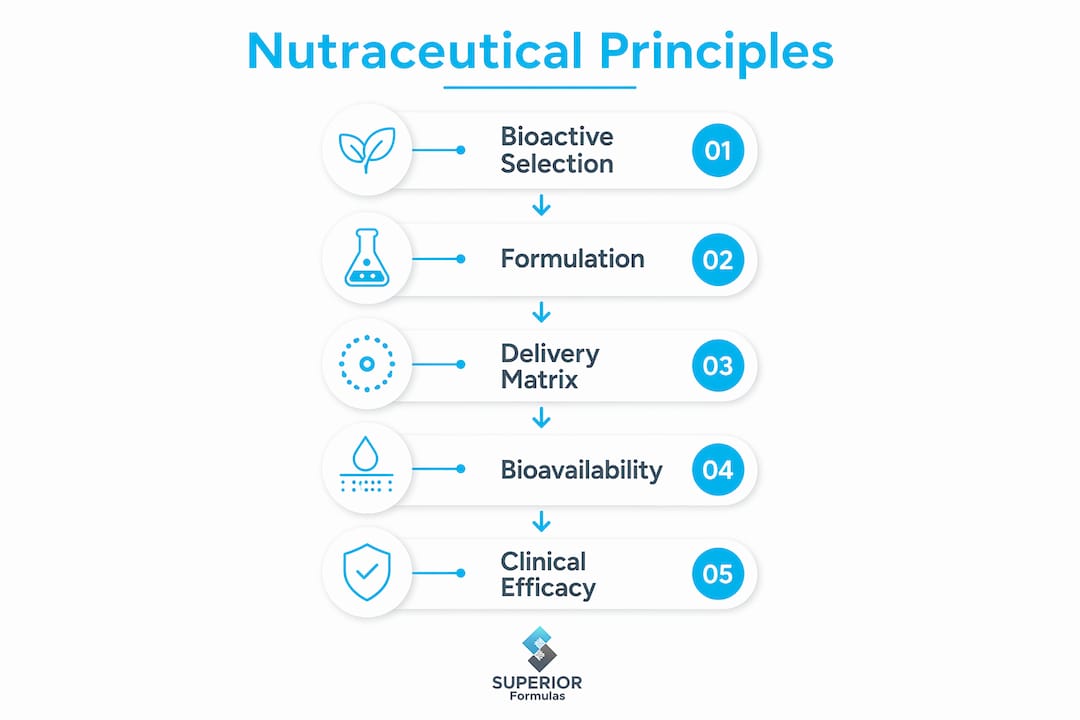
Efficacy depends heavily on pharmacokinetics and pharmacodynamics, meaning how the body absorbs, distributes, and responds to a compound, not just whether the ingredient is present. A polyphenol that degrades in the stomach before reaching the bloodstream delivers no benefit regardless of the dose on the label. That is why formulation technology is not a secondary concern. It is central to whether a product works at all.
Pro Tip: When evaluating any nutraceutical product, ask specifically about the delivery matrix. Liposomal, micellar, and encapsulated formats consistently outperform standard powder or tablet forms for fat-soluble and unstable bioactives.

Advanced encapsulation technology improves bioavailability and reduces instability, which are two of the most common reasons nutraceutical formulations fail to deliver results. This is not a marketing feature. It is a pharmacological requirement for certain compound classes.
How do 2026 regulatory standards shape nutraceutical production?
The FDA does not approve nutraceuticals for efficacy before they reach the market. That fact surprises many health-conscious consumers who assume regulatory oversight equals proven effectiveness. What the FDA does require is strict adherence to cGMP manufacturing standards, which govern facility conditions, ingredient sourcing, testing protocols, and labeling accuracy.
The regulatory framework draws a clear line on what manufacturers can claim:
- Structure/function claims are permitted. A label can state that a product “supports immune function” or “promotes bone health.”
- Disease treatment claims are prohibited. No supplement can legally claim to treat, cure, or prevent a specific disease.
- Facility registration with the FDA is required for all domestic and foreign manufacturers selling in the U.S. market.
- Labeling accuracy is mandatory, including a Supplement Facts panel, ingredient list, and net quantity of contents.
Manufacturers cannot legally claim that a supplement treats or cures diseases. That boundary protects consumers from misleading therapeutic promises. It also means the burden of evaluating clinical evidence falls on the consumer and their healthcare provider, not on a regulatory pre-approval process.
Pro Tip: Check whether a supplement manufacturer is registered with the FDA and whether their facility holds a third-party cGMP certification from organizations like NSF International or USP. These verifications are publicly searchable and take under two minutes to confirm.
For a practical overview of how these regulatory categories apply to specific product types, the types of dietary supplements guide from Superiorformulas breaks down the distinctions clearly and aligns them with current 2026 standards.
What factors determine safe and effective nutraceutical use?
Evidence-based nutraceutical use starts with clinical need, not general wellness enthusiasm. The rational use framework links supplement intake to documented deficiency or high-risk physiological states. Folic acid in pregnancy and vitamin D for bone health in deficient adults are the clearest examples of this principle applied correctly.
Four factors determine whether a nutraceutical delivers real benefit or poses risk:
- Clinical indication. Is there a documented deficiency, elevated risk state, or physiological need that the compound addresses? Without this, supplementation is speculative.
- Dose and purity. The therapeutic window for many bioactives is narrow. Too little produces no effect. Too much can cause toxicity, particularly with fat-soluble compounds like vitamins A, D, E, and K.
- Bioavailability and delivery matrix. The same ingredient in different formulations can produce dramatically different blood levels. Magnesium glycinate and magnesium oxide, for example, share the same mineral but differ significantly in absorption rate.
- Drug interactions and individual health status. Consumers need to consider deficiency, drug interactions, and product formulation quality before supplementation. St. John’s Wort, for instance, accelerates the metabolism of several prescription medications, reducing their effectiveness.
Indiscriminate supplement use without medical indication is a documented risk, not a theoretical one. The “natural” label on a product does not mean it is safe at any dose or for any person. Pharmacological understanding of nutraceuticals reveals real risks of toxicity at excessive doses, a fact that marketing language rarely communicates clearly.
For a structured approach to evaluating safety before you start any new supplement, the supplement safety best practices guide from Superiorformulas covers drug interaction screening, dosing thresholds, and red flags to watch for. Broader nutraceutical safety considerations also apply across specific health contexts, including vocal health supplement use, where interactions with medications and dosing precision matter equally.
How can you apply nutraceutical principles to improve wellness and longevity?
Applying the foundational concepts of nutraceuticals to your own health requires a structured approach, not a shopping list. The goal is matching the right compound to a real physiological need, at the right dose, in a form your body can actually absorb.
Start with these steps before purchasing any supplement:
- Assess your health baseline. Blood panels for vitamin D, B12, ferritin, omega-3 index, and inflammatory markers like hs-CRP give you a factual starting point. Supplementing without baseline data is guessing.
- Consult a healthcare provider. A physician or registered dietitian can identify true deficiencies, flag drug interactions, and recommend clinically supported compounds for your specific risk profile.
- Evaluate product quality. Look for third-party testing certifications, cGMP manufacturing, transparent ingredient sourcing, and formulation technology that supports bioavailability.
- Integrate with diet and lifestyle. Nutraceuticals work best as additions to a nutrient-dense diet, not replacements for one. Polyphenol supplements, for example, amplify the effects of a diet already rich in vegetables and whole foods.
The table below summarizes how to evaluate a nutraceutical product before committing to it:
| Evaluation Factor | What to Look For |
|---|---|
| Clinical evidence | Published human trials, not just animal or in vitro studies |
| Formulation technology | Encapsulated, liposomal, or bioenhanced delivery formats |
| Third-party certification | NSF International, USP, or Informed Sport verification |
| Ingredient transparency | Full ingredient list with doses, no proprietary blends hiding amounts |
| Manufacturer registration | FDA-registered facility with cGMP compliance |
Recognizing marketing red flags protects you from wasted spending and potential harm. Claims like “clinically proven” without a cited study, “detox” language without a defined mechanism, and proprietary blends that obscure individual ingredient doses are all signals that a product prioritizes marketing over science.
The nutraceutical benefits for longevity are real, but they are compound-specific and context-dependent. Resveratrol, NMN, quercetin, and berberine each have distinct mechanisms and evidence profiles. Treating them as interchangeable “anti-aging” compounds misses the point of evidence-based supplementation entirely.
Key Takeaways
The core principles of nutraceuticals require matching food-derived bioactives to documented clinical need, using formulations with proven bioavailability, and operating within the FDA’s cGMP and structure/function claim framework.
| Point | Details |
|---|---|
| Bioactives drive the mechanism | Polyphenols, flavonoids, and probiotics work through specific pathways, not general wellness effects. |
| Formulation determines efficacy | Delivery matrix and encapsulation technology decide whether a compound reaches its biological target. |
| Regulatory limits protect consumers | FDA cGMP standards ensure manufacturing quality, but pre-market efficacy approval does not exist for supplements. |
| Clinical need must come first | Supplement use grounded in documented deficiency or risk produces measurable benefit; speculative use does not. |
| Quality verification is non-negotiable | Third-party certification and transparent labeling are the minimum standard for any product worth taking. |
The part of nutraceutical science most people skip
The science of nutraceuticals is genuinely compelling. What I find consistently underappreciated, though, is how much the conversation gets hijacked by marketing before most people ever reach the actual science.
The paradigm shift toward preventive health through nutraceuticals is real and well-documented. What is less discussed is that this shift demands a higher level of scientific literacy from the consumer, not less. The absence of pre-market FDA efficacy approval means you cannot outsource your judgment to a regulatory stamp. You have to read the research, or work with someone who does.
The functional food research framework that translates bioactive compound science into reliable products is multi-phase and rigorous. Most products on retail shelves did not go through it. That gap between what the science supports and what gets sold is where most consumer harm occurs, not from dangerous ingredients, but from ineffective ones that delay real intervention.
My honest recommendation: treat nutraceuticals the way you would treat any clinical tool. Define the problem first. Then find the compound with the strongest evidence for that specific problem. Then verify the formulation quality. That sequence, applied consistently, is what separates people who get real results from those who accumulate a shelf of expensive bottles that do nothing.
— cristopher
Superiorformulas: where physician science meets supplement quality
Superiorformulas was founded by a physician-scientist with one goal: build supplements that actually reflect the science, not the marketing. Every formulation in the Superiorformulas line is built around clinically studied ingredients, GMP-certified manufacturing, and third-party purity testing.
If you want to apply what you have learned here to a real purchasing decision, the Superiorformulas supplement catalog is a practical starting point. Products are formulated around pathways like Nrf2 activation, cellular resilience, and metabolic health, with full ingredient transparency and no unnecessary fillers. For readers who want to go deeper on evaluating what they take, the clinical evidence guide from Superiorformulas explains exactly how to read supplement research before you buy.
FAQ
What is the definition of a nutraceutical?
A nutraceutical is a food-derived bioactive compound that supports physiological functions beyond basic nutrition, with a focus on preventing or modulating chronic disease. The term sits between food and medicine, covering compounds like polyphenols, probiotics, and omega-3 fatty acids.
How do nutraceuticals differ from dietary supplements?
“Dietary supplement” is the FDA’s legal category; “nutraceutical” is a functional descriptor for bioactives with documented physiological effects. All nutraceuticals sold in the U.S. fall under the dietary supplement regulatory framework, but not all dietary supplements qualify as nutraceuticals by scientific definition.
Are nutraceuticals FDA-approved?
The FDA does not approve dietary supplements for efficacy before they reach the market. Manufacturers must follow cGMP manufacturing standards and are prohibited from making disease treatment claims, but pre-market efficacy review does not apply to this product category.
What makes a nutraceutical actually effective?
Efficacy depends on the clinical indication, ingredient dose, formulation purity, and delivery matrix. A bioactive compound that degrades before absorption provides no benefit, which is why encapsulation technology and bioavailability data are critical factors in product selection.
How do I know if I need a nutraceutical?
Start with baseline blood work to identify documented deficiencies or elevated risk markers. Then consult a healthcare provider who can match a specific compound to your physiological need, which is the approach the rational use framework for dietary supplement bioactives recommends.


