


Metabolic health is defined as the body’s ability to regulate blood sugar, blood pressure, triglycerides, HDL cholesterol, and waist circumference within healthy ranges without medication. These five biomarkers are the clinical standard for assessing how well your body converts food into energy and manages the downstream effects of that process. About 1 in 3 U.S. adults have metabolic syndrome, and the gap between looking healthy and being metabolically healthy is wider than most people realize. Understanding what is metabolic health gives you a concrete framework for protecting your long-term vitality, not just avoiding disease.
What are the clinical markers of metabolic health?
Metabolic health is measured through five specific biomarkers, each reflecting a different aspect of how your body processes energy and manages internal chemistry. Routine testing of these markers through lipid panels, metabolic panels, and hemoglobin A1c assessments can detect dysfunction early, before serious disease develops. Early detection matters because metabolic dysfunction rarely announces itself with obvious symptoms.
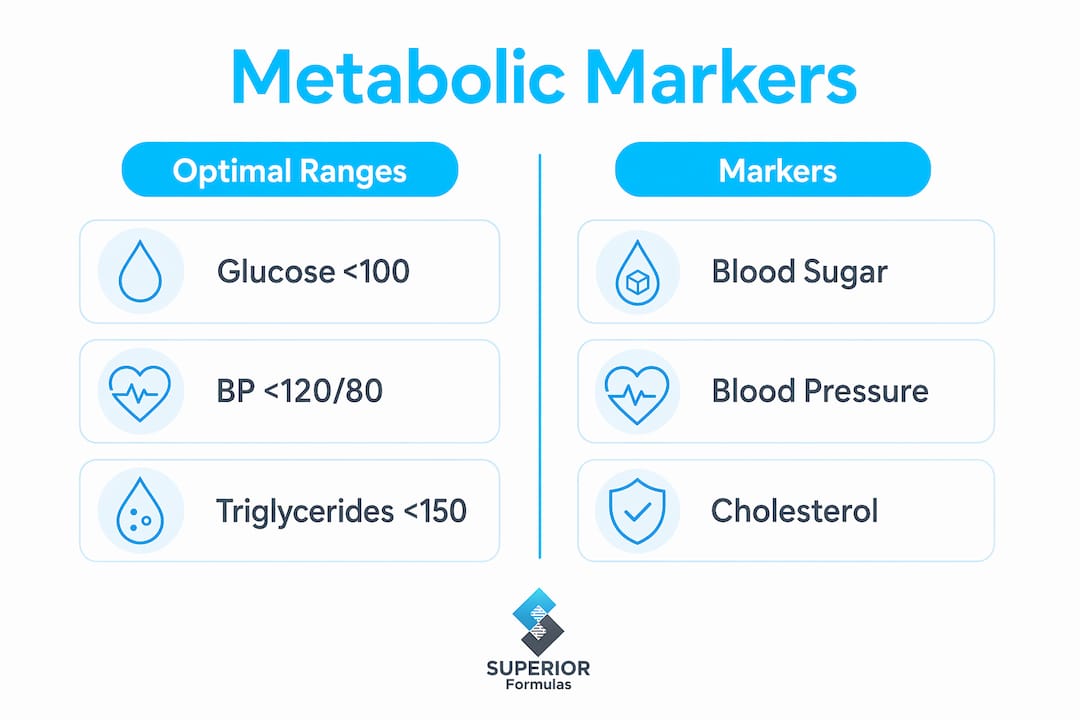
The five markers and their optimal ranges are:
- Fasting blood glucose: below 100 mg/dL
- Blood pressure: under 120/80 mmHg
- Triglycerides: below 150 mg/dL
- HDL cholesterol: above 50 mg/dL for women, above 40 mg/dL for men
- Waist circumference: within healthy limits for your height and sex
These optimal clinical ranges are assessed without the use of medication. If you need a drug to keep any of these markers in range, that marker does not count as metabolically healthy. That distinction matters clinically because it separates true metabolic function from medically managed dysfunction.
| Marker | Optimal Range |
|---|---|
| Fasting blood glucose | Below 100 mg/dL |
| Blood pressure | Under 120/80 mmHg |
| Triglycerides | Below 150 mg/dL |
| HDL cholesterol | Above 50 mg/dL (women), 40 mg/dL (men) |
| Waist circumference | Within sex-specific healthy limits |

Annual physicals typically include all five of these tests. Most adults, however, never receive a clear explanation of what the results mean together as a system. Reviewing your results as a cluster, not as isolated numbers, gives you a far more accurate picture of your metabolic function. Understanding cellular pathways and aging adds another layer of context for adults over 30 who want to act before dysfunction sets in.
How does metabolic health differ from metabolic syndrome?
Metabolic health and metabolic syndrome sit at opposite ends of the same continuum. Metabolic health means all five biomarkers are in their optimal ranges. Metabolic syndrome is the clinical diagnosis given when at least three of those five markers fall outside healthy limits simultaneously.
Metabolic syndrome significantly raises the risk of type 2 diabetes, cardiovascular disease, and stroke. The syndrome results from converging genetic, hormonal, and lifestyle factors, with chronic inflammation playing a central role in driving insulin resistance and fat accumulation. This is not a single disease but a cluster of interacting dysfunctions.
The progression from metabolic health to metabolic syndrome is gradual and often silent. Key warning signs include:
- Fasting blood sugar creeping above 100 mg/dL
- Blood pressure consistently above 120/80 mmHg
- Triglycerides rising above 150 mg/dL
- HDL cholesterol dropping below optimal thresholds
- Waist circumference expanding beyond healthy limits
Each marker that falls out of range increases your overall risk. Three out of five triggers the syndrome diagnosis. The practical implication is clear: catching one or two markers early gives you a window to reverse the trajectory before it becomes a clinical syndrome. Waiting until you have three abnormal markers means the body is already under significant metabolic stress.
What lifestyle practices effectively improve metabolic health?
Sustained lifestyle change is the most effective tool for improving metabolic function. Modest weight loss of 3% to 5%, combined with at least 150 minutes of moderate aerobic exercise per week, plus strength and balance training, significantly improves all five metabolic markers. That is not a dramatic number. A 180-pound adult needs to lose roughly 5–9 pounds to begin seeing measurable clinical improvement.
The most evidence-backed approach combines four areas:
- Aerobic exercise: Aim for at least 150 minutes per week of moderate-intensity activity such as brisk walking, cycling, or swimming. This directly lowers blood pressure, reduces triglycerides, and improves insulin sensitivity.
- Strength training: Two to three sessions per week build lean muscle mass, which acts as a metabolic sink for blood glucose. More muscle means better blood sugar regulation at rest.
- Dietary quality: The Mediterranean and DASH diets consistently outperform other dietary patterns for metabolic outcomes. Both emphasize vegetables, legumes, whole grains, lean protein, and healthy fats while reducing processed foods and added sugars. A nutrition for longevity approach aligns directly with these principles.
- Sleep and stress management: Poor sleep raises cortisol, which drives blood sugar up and promotes abdominal fat storage. Seven to nine hours of quality sleep per night is a non-negotiable metabolic input.
Short-term changes produce short-term results. Long-term adherence combined with medical therapies when needed delivers meaningful and lasting metabolic reversal. The goal is building habits that your body can sustain for years, not weeks.
Pro Tip: Visceral fat is the last fat your body releases during weight loss. Do not judge progress by the scale alone in the first 8–12 weeks. Track your waist circumference and energy levels alongside your weight to get a more accurate picture of metabolic improvement.
Why BMI is not a reliable indicator of metabolic health
BMI is a blunt instrument. Over 40% of U.S. adults with normal BMI are metabolically unhealthy, showing poor blood sugar, lipid, or blood pressure markers despite appearing lean. That statistic reframes the entire conversation about weight and health. Looking healthy on the outside does not mean your metabolism is functioning well on the inside.
The key distinction is between subcutaneous fat and visceral fat. Subcutaneous fat sits just under the skin and is relatively inert metabolically. Visceral fat surrounds the internal organs and is tightly linked to insulin resistance and inflammation. A person can carry significant visceral fat with a normal BMI, particularly if they are sedentary and eat a processed-food diet.
Metabolic flexibility adds another dimension that BMI completely ignores. Metabolic flexibility is the body’s ability to switch efficiently between burning glucose and burning fat as fuel sources, depending on what is available. A metabolically flexible person handles a carbohydrate-rich meal differently than someone with insulin resistance. Their blood sugar rises and returns to baseline quickly. Their cells respond to insulin signals efficiently.
The practical takeaway is straightforward:
- BMI alone cannot tell you whether your metabolism is healthy
- Waist circumference is a better proxy for visceral fat than BMI
- A full biomarker panel is the only reliable way to assess metabolic function
- Metabolic flexibility requires consistent exercise and dietary quality, not just caloric restriction
Pro Tip: Ask your doctor for a fasting lipid panel, fasting glucose, and blood pressure reading at your next annual physical. Review all five metabolic markers together, not in isolation. That single conversation can reveal patterns your BMI never would.
Key Takeaways
Metabolic health requires all five core biomarkers to stay within optimal ranges without medication, and lifestyle change is the most effective and durable path to achieving that.
| Point | Details |
|---|---|
| Five-marker definition | Metabolic health means optimal blood sugar, blood pressure, triglycerides, HDL, and waist circumference without medication. |
| BMI is misleading | Over 40% of normal-BMI adults are metabolically unhealthy; biomarker testing is the only reliable measure. |
| Syndrome vs. health | Metabolic syndrome is diagnosed when three or more of the five markers fall outside healthy ranges simultaneously. |
| Exercise is foundational | At least 150 minutes of aerobic activity per week, plus strength training, measurably improves all five markers. |
| Visceral fat is stubborn | Visceral fat requires consistent, long-term lifestyle intervention and cannot be addressed with short-term fixes. |
The metabolic health crisis hiding in plain sight
I have spent years reviewing the clinical literature on metabolic health, and the finding that consistently stops me is the BMI gap. Nearly half of adults who look lean by conventional standards are carrying hidden metabolic dysfunction. That is not a fringe statistic. It means the standard reassurance of “your weight looks fine” is actively misleading millions of people.
The deeper problem is that metabolic dysfunction is silent for years. Blood sugar creeps up. Triglycerides drift higher. Waist circumference expands slowly. None of these changes feel like anything until they cross a clinical threshold. By then, the body has often been under metabolic stress for a decade or more. Earlier and more proactive clinical definitions, as the Coalition for Metabolic Health argues, would catch this drift before it becomes syndrome.
What I find most underappreciated is metabolic flexibility. Most health conversations focus on weight or calories. Very few address whether the body can actually switch fuel sources efficiently. That capacity, built through consistent exercise and dietary quality, is what separates someone who ages well metabolically from someone who does not. It is not glamorous. It does not trend on social media. But it is the actual mechanism behind long-term vitality.
My honest view: metabolic health is not a lab report item. It is the foundation of your energy, your mood, and your longevity. Treat it that way before your markers tell you that you have to.
— cristopher
Superiorformulas and your metabolic health goals
Metabolic health is built on consistent daily choices, and the right nutritional support can reinforce those choices at the cellular level.

Superiorformulas develops physician-formulated supplements designed to support the biological pathways that underpin metabolic function, including antioxidant defense, cellular resilience, and healthy aging through Nrf2 activation. Every formulation uses clinically studied ingredients, manufactured in GMP-certified facilities with third-party testing for purity. If you are working to improve your metabolic markers through lifestyle change, Superiorformulas offers science-backed supplement support to complement that effort. You can also explore personalized metabolic health assessments to get a clearer baseline before making changes.
FAQ
What is the metabolic health definition used clinically?
Metabolic health is clinically defined as maintaining healthy levels of all five biomarkers, including blood glucose, blood pressure, triglycerides, HDL cholesterol, and waist circumference, without medication.
What are the signs of good metabolic health?
Signs of good metabolic health include stable energy throughout the day, fasting blood glucose below 100 mg/dL, blood pressure under 120/80 mmHg, triglycerides below 150 mg/dL, and HDL cholesterol above threshold levels for your sex.
How does metabolic health vs metabolic syndrome differ?
Metabolic health means all five biomarkers are in their optimal ranges. Metabolic syndrome is diagnosed when at least three of those five markers are outside healthy limits, significantly raising the risk of diabetes and cardiovascular disease.
What affects metabolic health the most?
Physical activity level, dietary quality, sleep duration, stress, and visceral fat accumulation are the primary drivers of metabolic health. Visceral fat in particular is tightly linked to insulin resistance and systemic inflammation.
How do I improve metabolic health without medication?
At least 150 minutes of moderate aerobic exercise per week, combined with strength training, a Mediterranean or DASH-style diet, and 7–9 hours of sleep per night, produces measurable improvement in all five metabolic markers over time.


