


Natural ingredients are defined as bioactive compounds derived from plants, fungi, and other biological sources that interact directly with cellular mechanisms governing aging, oxidative stress, and metabolic function. Understanding why natural ingredients matter goes beyond reading a product label. Compounds like polyphenols, flavonoids, and pyrroloquinoline quinone (PQQ) have demonstrated measurable effects on pathways such as Nrf2 activation, mTOR suppression, and sirtuin signaling. These are the same pathways researchers target when studying how to extend healthy human lifespan. The “natural” label alone, however, does not guarantee benefit or safety. What matters is the specific compound, its dose, and the evidence behind it.
What does science say about natural ingredients and longevity?
The strongest case for the importance of natural ingredients comes from compound-specific research, not broad category claims. Longevity researchers now view natural compounds through the lens of pathway biology, focusing on how individual molecules modulate antioxidant and metabolic programs at the cellular level.
The flavonoid Corylin, derived from the plant Psoralea corylifolia, offers one of the most striking recent examples. A 2026 Nature Communications study showed that Corylin extended median lifespan by 11.9% in female mice when administered mid-life. The mechanism involved suppression of the RAGA-mTOR pathway and activation of SIRT3, a key sirtuin linked to metabolic regulation. This finding matters because it demonstrates that a single natural flavonoid can target multiple aging pathways simultaneously, and that timing and sex-specific biology both influence outcomes.

PQQ is another compound with hard data behind it. A 2026 Food & Function study found that PQQ supplementation increased survival days by 73% in a mouse model and reduced age-related muscle decline. That is not a marginal effect. It points to PQQ’s role in supporting mitochondrial function and reducing midlife mortality risk, two outcomes directly relevant to anyone focused on longevity and cellular health.
Polyphenols like resveratrol and curcumin work through a different but equally important mechanism. Research published in a 2026 MDPI review confirms that natural polyphenols activate Nrf2, the master regulator of the body’s antioxidant response. When Nrf2 is activated, it upregulates genes that defend cells against oxidative damage. Chronic oxidative stress is a primary driver of cellular aging, so this pathway is a legitimate target for longevity support.
Pro Tip: When evaluating a preclinical study, check whether the dose used in animals translates to a realistic human equivalent. Many promising findings fail at this step. Look for human pharmacokinetic data or clinical trials before treating animal results as directly applicable.
Natural vs. synthetic ingredients: which is actually better?
The comparison between natural and synthetic ingredients is more nuanced than most product marketing suggests. Consumers consistently overvalue natural options due to what behavioral scientists call “naturalness bias,” a tendency to prefer natural products based on perceived safety rather than actual evidence. A 2026 Psyche article confirms that naturalness bias drives choices even when synthetic alternatives are equally effective or safer. Recognizing this bias is the first step toward making genuinely informed decisions.
The regulatory picture adds another layer of complexity. The European Union bans over 1,400 cosmetic ingredients considered hazardous, while the United States bans far fewer. This gap exists regardless of whether an ingredient is natural or synthetic. A 2026 Frontiers in Public Health article also notes that products labeled as “natural origin” can contain hidden unsafe substances that cause adverse effects. The natural label is a marketing claim, not a safety certification.
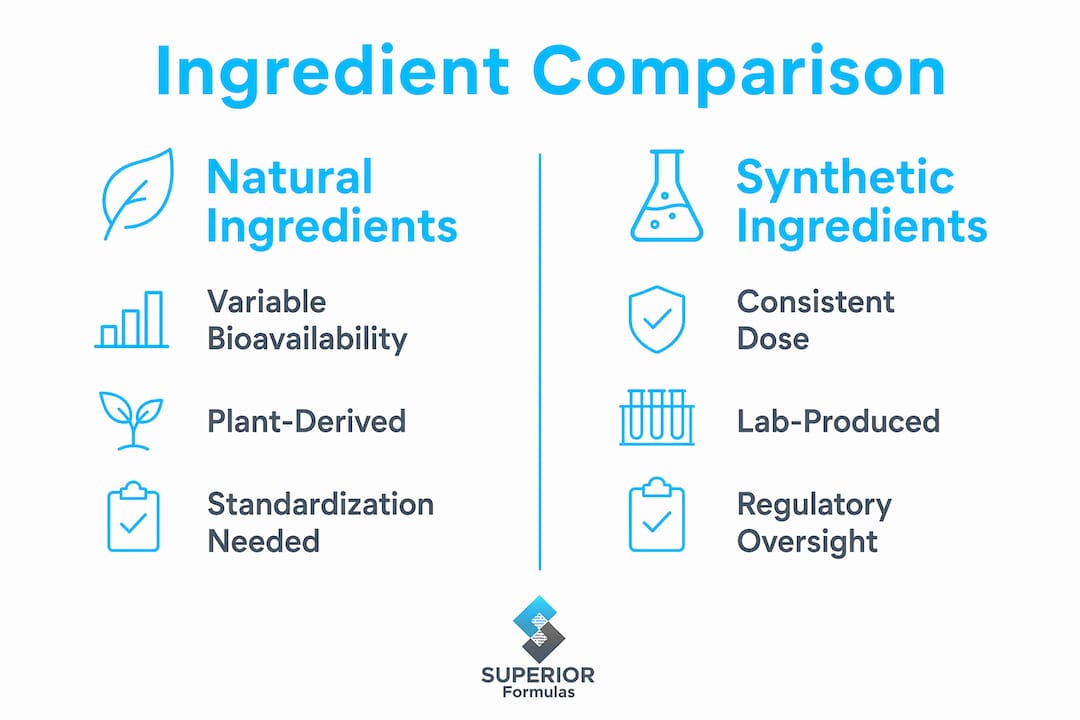
The table below summarizes the core trade-offs between natural and synthetic ingredients for health-conscious consumers.
| Category | Natural Ingredients | Synthetic Ingredients |
|---|---|---|
| Bioavailability | Variable; depends on extraction method and standardization | Often engineered for consistent absorption |
| Safety profile | Not inherently safer; toxicological risks apply equally | Risks are typically well-characterized through testing |
| Regulatory oversight | Inconsistent; labeling can be misleading | Generally subject to stricter pre-market review |
| Mechanism complexity | Often multi-pathway; can address several targets at once | Usually single-target; more predictable action |
| Evidence base | Growing rapidly; strongest for specific compounds | Extensive for pharmaceuticals; variable for supplements |
The practical takeaway is this: judge every ingredient by its evidence, not its origin. A standardized extract of curcumin with documented bioavailability data is a more defensible choice than a generic “herbal blend” with no disclosed active compound concentration.
Which natural compounds have the strongest longevity evidence?
The advantages of natural ingredients for longevity are most clearly demonstrated by a specific group of compounds with documented effects on cellular aging pathways. These are not broad categories. They are individual molecules with identified mechanisms and measurable outcomes.
The following compounds currently hold the strongest evidence base for longevity and cellular health support:
- Corylin (flavonoid): Extends lifespan via mTOR suppression and SIRT3 activation; effects are dose-dependent and sex-specific.
- Pyrroloquinoline quinone (PQQ): Supports mitochondrial biogenesis, reduces midlife mortality risk, and preserves muscle function with age.
- Resveratrol: Activates SIRT1 and modulates the Nrf2 pathway; most studied polyphenol for cardiovascular and metabolic aging support.
- Curcumin: Activates Nrf2, reduces inflammatory signaling, and shows telomerase-related activity in some models.
- Polygalae Radix constituent: A 2026 MDPI Cells study showed this compound extended yeast lifespan and increased telomerase activity while reducing oxidative stress markers in a dose-dependent pattern.
- Quercetin: A senolytic flavonoid that selectively clears senescent cells, reducing the inflammatory burden associated with aging.
Each of these compounds works through a distinct but overlapping set of pathways. Resveratrol and curcumin both activate Nrf2, but curcumin also suppresses NF-kB inflammatory signaling. PQQ targets mitochondrial function directly. Quercetin operates as a senolytic. This mechanistic diversity is one reason why evidence-based nutraceuticals are increasingly formulated as combinations rather than single compounds.
Sex-dependent and dosage considerations are not minor footnotes. The Corylin study found significant lifespan extension in female mice but not male mice at the same dose. This kind of finding has direct implications for how supplements should be formulated and evaluated. A compound that works at 50 mg may have no effect at 10 mg, or may produce adverse effects at 500 mg.
Pro Tip: Always look for supplements that list the standardized percentage of the active compound, not just the total weight of the plant extract. “500 mg of turmeric root” tells you very little. “500 mg of turmeric root standardized to 95% curcuminoids” tells you what you are actually getting.
How to choose natural products that actually work
Choosing natural products effectively requires a framework based on evidence, not marketing. The following steps give you a practical process for evaluating any natural supplement or ingredient.
- Identify the active compound. The plant name is not enough. Know which specific molecule is responsible for the claimed effect, whether that is curcuminoids in turmeric, EGCG in green tea, or PQQ in a mitochondrial support formula.
- Check for standardization. Standardized extracts guarantee a consistent concentration of the active compound in every dose. Non-standardized extracts vary batch to batch and cannot deliver reliable results.
- Evaluate the evidence tier. Animal studies are a starting point, not a conclusion. Look for human clinical trials or at minimum pharmacokinetic data showing the compound reaches target tissues at effective concentrations.
- Assess dose against studied amounts. Compare the dose in the product to the dose used in research. Many supplements underdose their active ingredients to reduce cost while still listing them on the label.
- Verify manufacturing standards. Products made in GMP-certified facilities with third-party testing provide a baseline quality assurance that self-certified “natural” labels do not.
- Treat supplementation as one part of a larger strategy. No compound compensates for poor sleep, chronic stress, or a diet high in processed foods. Natural ingredients work best when they support an already solid foundation of lifestyle habits.
Dermatologists and physicians consistently note that “natural” or “organic” labels do not guarantee hypoallergenic or superior safety profiles. This applies equally to skincare and dietary supplements. The same critical appraisal you would apply to a pharmaceutical should apply to any bioactive compound you put in or on your body.
For a deeper look at how to apply this framework to specific products, the guide on identifying research-backed supplements covers the evaluation process in detail.
Key takeaways
Natural ingredients deliver measurable longevity and cellular health benefits only when specific, standardized bioactive compounds are used at clinically relevant doses through verified mechanisms.
| Point | Details |
|---|---|
| Compound specificity matters | Corylin, PQQ, resveratrol, and curcumin each target distinct aging pathways with documented evidence. |
| “Natural” is not a safety guarantee | Products labeled natural can contain harmful substances; toxicological principles apply regardless of origin. |
| Naturalness bias distorts decisions | Consumers overvalue natural options due to perceived safety; evidence should drive every choice. |
| Standardization determines efficacy | Supplements listing standardized active compound percentages deliver consistent, measurable doses. |
| Lifestyle remains foundational | Natural compounds support but do not replace sleep, nutrition, and stress management in any longevity strategy. |
The evidence bar is higher than most labels suggest
I have spent years reading longevity research, and the single most persistent mistake I see health-conscious people make is treating “natural” as a proxy for “safe and effective.” It is not. Arsenic is natural. So is hemlock. The word describes origin, not outcome.
What actually moves the needle on cellular aging is compound-specific, dose-specific, and increasingly sex-specific. The Corylin and PQQ findings from 2026 are genuinely exciting, but they are also a reminder that the details matter enormously. A 73% increase in survival days from PQQ in mice is a striking result. Whether that translates to humans at a commercially available dose is a separate question that requires separate evidence.
The most useful shift I have seen in this field is the move away from ingredient lists and toward mechanism-first formulation. When a company can tell you which pathway a compound targets, at what dose, and what the human bioavailability data shows, that is a product worth taking seriously. When the pitch is “all-natural blend,” that is a label, not a science. You deserve the science.
— cristopher
How Superiorformulas puts this science to work
Superiorformulas was founded on exactly the principle this article describes: that natural compounds earn their place in a formula through evidence, not etymology. Every formulation in the Superiorformulas line is built around clinically studied ingredients selected for their documented effects on longevity pathways, including Nrf2 activation, mTOR modulation, and mitochondrial support.
The company manufactures in GMP-certified facilities and uses third-party testing to verify purity and active compound concentration. If you want to see the research behind each ingredient and understand how the formulations target cellular aging, the science behind the formulas is fully documented and available to review. This is what evidence-based supplementation looks like in practice.
FAQ
What makes natural ingredients effective for longevity?
Natural ingredients are effective for longevity when they contain specific bioactive compounds that modulate cellular aging pathways such as Nrf2, mTOR, and sirtuin signaling. Effectiveness depends on the compound, its dose, and its bioavailability, not the natural label itself.
Are natural ingredients safer than synthetic ones?
Natural ingredients are not inherently safer than synthetic ones. A 2026 Frontiers in Public Health article confirms that natural-origin products can contain hidden harmful substances, and toxicological principles apply equally to both categories.
What is the nrf2 pathway and why does it matter?
The Nrf2 pathway is the body’s master antioxidant switch, regulating genes that defend cells against oxidative damage. Natural polyphenols like resveratrol and curcumin activate this pathway, making it a central target for cellular health and aging support.
How do i know if a natural supplement is properly dosed?
Look for products that list the standardized percentage of the active compound rather than just the total plant extract weight. Compare that dose to the amounts used in published clinical or preclinical studies to assess whether the product delivers a meaningful concentration.
Does naturalness bias affect how people choose health products?
Yes. Research confirms that naturalness bias leads consumers to prefer natural products based on perceived safety rather than actual evidence, sometimes at the expense of better-studied options. Awareness of this bias supports more evidence-driven decisions.
As an example of a formulation built entirely on these natural, pathway-targeted ingredients, our Formula 1 — LONGEVITY Daily Nrf2 Activate+ was designed with exactly this clinical rationale in mind. Explore the science behind the formulation to see how it applies to your own routine.


