


You have probably seen the word “antioxidant” printed on everything from green tea to face cream. The promise is always the same: take this, slow aging, prevent disease. Understanding why antioxidant supplements matter requires looking past the marketing and into the actual biology, because the science is both more fascinating and more sobering than the label ever admits. This guide cuts through the noise to give you a clear, evidence-based picture of what antioxidants actually do, where supplements help, and where they can genuinely cause harm.
Table of Contents
- Key takeaways
- Why antioxidant supplements matter: the biology behind the buzz
- Food versus supplements: why the gap matters
- Risks you need to know before supplementing
- When and how to use antioxidant supplements wisely
- What the evidence actually says
- My honest take on the antioxidant supplement market
- Supporting your antioxidant health with Superiorformulas
- FAQ
Key takeaways
| Point | Details |
|---|---|
| Antioxidants neutralize free radicals | They donate electrons to unstable molecules, reducing oxidative damage linked to aging and chronic disease. |
| Food beats isolated supplements | Whole foods provide synergistic nutrients that isolated antioxidant pills cannot replicate. |
| High-dose supplements carry real risks | Clinical trials show beta-carotene and vitamin E supplements can increase cancer risk in certain populations. |
| The antioxidant paradox is real | Excess supplementation can disrupt redox signaling and blunt the benefits of exercise. |
| Diet-first is the safest strategy | A colorful, varied diet combined with targeted supplementation under medical guidance is the most evidence-backed approach. |
Why antioxidant supplements matter: the biology behind the buzz
To understand why antioxidant supplements matter, you first need to understand what you are supplementing against. Free radicals are unstable molecules produced naturally during metabolism, immune responses, and exposure to UV radiation, pollution, or cigarette smoke. They are missing an electron and will steal one from wherever they can, including your DNA, cell membranes, and proteins. That theft is called oxidative stress, and when it accumulates unchecked, it accelerates cellular aging and contributes to conditions including cardiovascular disease, neurodegeneration, and cancer.
Antioxidants work by donating an electron to a free radical without becoming unstable themselves. That simple act terminates a chain reaction that could otherwise damage hundreds of molecules in sequence. But here is what the supplement aisle rarely tells you: your body’s own enzymes perform the vast majority of this neutralization work. Superoxide dismutase, catalase, and glutathione peroxidase are your primary internal defense systems. Dietary antioxidants, whether from food or capsules, play a supporting role.
The critical concept that most people miss is redox signaling. The body does not just want zero free radicals. Small, controlled amounts of reactive oxygen species act as molecular messengers that tell cells to repair themselves, strengthen mitochondria, and mount immune responses. The goal is balance, not elimination.
Here is what that balance involves at the cellular level:
- Free radicals trigger stress-response pathways such as Nrf2, which upregulate the body’s own antioxidant enzyme production.
- Antioxidants from food modulate, rather than suppress, oxidative signaling.
- Chronic, low-grade oxidative stress accumulates when diet, sleep, or lifestyle are poor, and that is where targeted support makes the most difference.
Pro Tip: If you want to support your antioxidant defenses intelligently, focus first on reducing sources of oxidative stress, including poor sleep, processed food, and chronic psychological stress. Supplements work better when the baseline burden is already reduced.
Food versus supplements: why the gap matters
The antioxidants are not magic pills reality becomes clearest when you compare what a handful of blueberries delivers against what a standard vitamin C capsule provides.
A whole food does not ship a single antioxidant. It delivers a matrix of polyphenols, flavonoids, fiber, minerals, and cofactors that interact with each other and with your gut microbiome. That interaction is called the food matrix effect, and it profoundly shapes how nutrients are absorbed, metabolized, and used at the cellular level. An isolated supplement bypasses most of that context.
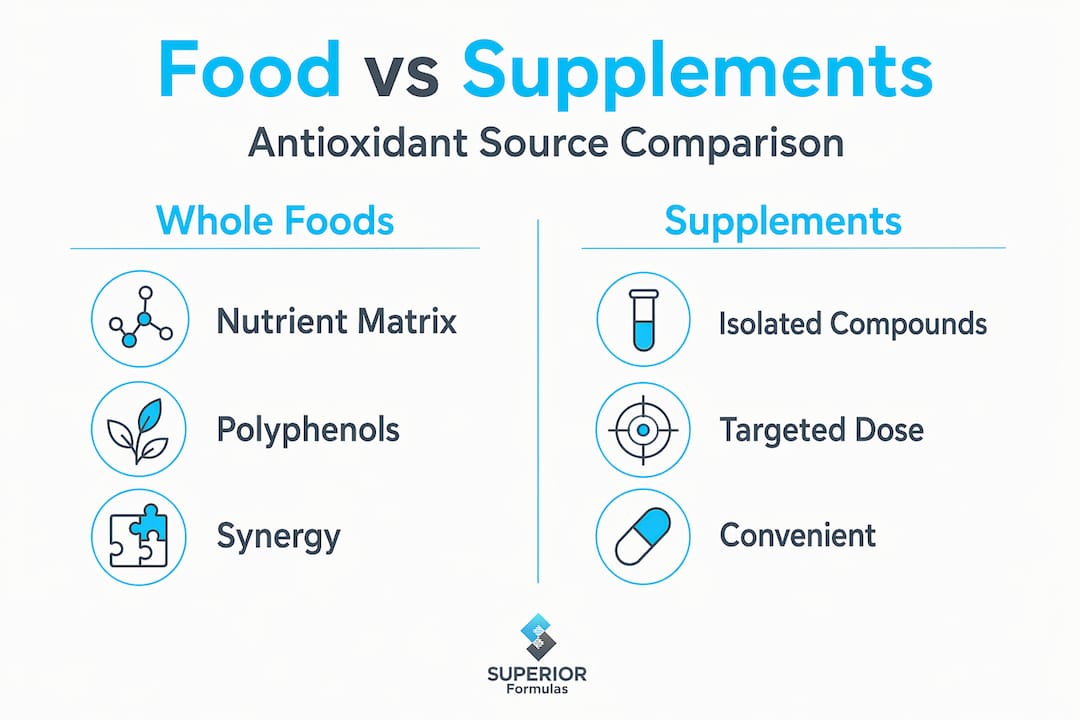
| Factor | Whole food antioxidants | Isolated supplements |
|---|---|---|
| Nutrient complexity | Hundreds of compounds working together | One or a few isolated molecules |
| Bioavailability | Enhanced by food matrix and fiber | Often poor without cofactors |
| Synergy | Yes, including polyphenols, vitamins, minerals | Rarely present |
| Safety at high doses | Naturally self-limiting | Risk increases with dose |
| Regulatory standing | Well-supported by nutrition research | ORAC values removed by FDA and USDA |
That last row deserves attention. For years, supplement brands used ORAC scores (Oxygen Radical Absorbance Capacity) to justify antioxidant content claims. The FDA and USDA removed ORAC scores from official nutrient databases because they showed poor correlation with actual human health outcomes. A supplement can score extraordinarily high on an ORAC test in a lab and still produce minimal benefit in your bloodstream.
Pro Tip: When evaluating a supplement’s antioxidant value, look for clinical trial data on the specific compound and dose, not ORAC scores or “equivalent to X servings of vegetables” comparisons on the label.
Polyphenol-rich foods like berries, dark leafy greens, walnuts, olive oil, and green tea deliver antioxidant compounds in forms your body recognizes and processes effectively. You can learn more about assessing supplements for real wellness from an evidence standpoint before adding anything to your routine.
Risks you need to know before supplementing
This is where the conversation gets uncomfortable for the supplement industry. The clinical trial record on high-dose antioxidant supplements is not encouraging, and anyone serious about longevity needs to understand it.
“The dose makes the poison. With antioxidants, the principle applies with unusual precision.”
The three most cited trials tell a consistent story:
- The ATBC Study tested beta-carotene in male smokers and found it increased lung cancer risk by 18 to 28%.
- The CARET trial was halted early after similar findings showing elevated cancer rates in participants taking beta-carotene plus vitamin A.
- The SELECT trial found that vitamin E supplementation at 400 IU per day increased prostate cancer risk by 17% in healthy men.
These are not small studies. They involved tens of thousands of participants and were designed with rigorous controls. The U.S. Preventive Services Task Force has since concluded that there is no strong evidence supporting routine vitamin and mineral supplementation to prevent cardiovascular disease or cancer in healthy adults, and specifically recommends against beta-carotene and vitamin E.
The mechanism behind these harms connects back to redox signaling. When you flood the system with exogenous antioxidants, you suppress the very reactive oxygen species that act as cellular stress signals. Cells stop producing their own antioxidant enzymes. Mitochondria receive less stimulus to adapt and become more resilient. The antioxidant paradox is that high-dose supplements can blunt the mitochondrial adaptations that exercise normally triggers, effectively reducing the return on your workouts.
For people with specific chronic conditions, excessive supplementation without medical oversight may also impair immune signaling and the body’s stress resilience pathways. The people who intuitively feel they need the most supplementation are sometimes the ones at greatest risk from it.
When and how to use antioxidant supplements wisely
None of the above means antioxidant supplementation is always wrong. It means indiscriminate, high-dose supplementation is wrong. There is a meaningful difference, and applying that distinction is where you gain practical control over your health.
Here is how to think about this systematically:
-
Build your dietary foundation first. Colorful fruits and vegetables provide a broad spectrum of antioxidants and supporting nutrients that reduce cellular damage and chronic disease risk. Aim for variety: berries, cruciferous vegetables, citrus, dark leafy greens, nuts, and legumes each deliver distinct polyphenol profiles.
-
Address lifestyle-level oxidative burden. Chronic sleep deprivation, sedentary behavior, and unmanaged psychological stress each generate persistent oxidative stress. Resolving these at the root is more effective than layering supplements on top.
-
Confirm deficiency or specific need before supplementing. A blood panel identifying low vitamin D, insufficient selenium, or poor glutathione status gives you a clinical rationale. Supplementing a confirmed gap is categorically different from routine pill-taking without data.
-
Choose supplements with clinical backing, not ORAC scores. Compounds like curcumin, resveratrol, and sulforaphane have research supporting their mechanisms in humans at specific doses. That specificity matters when deciding whether a supplement belongs in your protocol.
-
Work with a healthcare provider. Individual risk varies considerably. Beta-carotene’s cancer risk was concentrated in smokers, not the general population. Supplement recommendations need to reflect your health profile, not a generic label.
Pro Tip: Nrf2 activation is one of the most evidence-grounded approaches to supporting your body’s own antioxidant enzyme production. Compounds like sulforaphane from broccoli sprouts and polyphenols from green tea are among the most studied Nrf2-activating phytonutrients available.
What the evidence actually says
Synthesizing the research gives you a clear, if nuanced, picture. For healthy adults over 30, the benefits of antioxidant supplements are most compelling when they address specific nutritional gaps or work through pathways like Nrf2 activation rather than simply flooding the body with isolated antioxidants.
You can review science-backed guidance on supplementing antioxidants for a thorough look at what major studies actually found. The summary from current evidence:
- Daily multivitamin use showed no decrease in mortality risk across an analysis of more than 390,000 participants in major NIH-linked studies.
- Antioxidant marketing exploits incomplete biological truths, ignoring the body’s own enzyme systems and the full complexity of how antioxidants actually function in living tissue.
- Emerging science on polyphenols, mitochondrial health, and the Nrf2 pathway points toward smarter, more targeted approaches than the broad-spectrum megadose model of the past.
- Individual variation is real. Age, genetics, lifestyle, and existing health status all shape how your body responds to any supplementation strategy.
The role of antioxidants in aging and longevity is real, but it is most powerfully expressed through dietary patterns and lifestyle choices, not through capsule counts.
My honest take on the antioxidant supplement market
I have watched health-conscious, well-read adults spend years and real money on high-dose antioxidant regimens that the clinical evidence simply does not support. What I find more interesting than the failed trials is the reason people reach for supplements in the first place. The biology genuinely is fascinating. Free radicals really do accelerate aging. Oxidative stress really does contribute to chronic disease. The problem is that the supplement industry translates valid science into an oversimplified sales pitch.
In my experience, the people who get the most from antioxidant supplementation are not the ones taking the most pills. They are the ones who have genuinely cleaned up their diet, sleep, and stress levels, and then add a targeted, clinically grounded supplement to fill a specific gap. Nrf2-activating formulations interest me precisely because they work with the body’s existing architecture rather than trying to override it.
My honest recommendation: do not wait for a supplement to compensate for a diet dominated by processed food and fractured sleep. Get the lifestyle right, get a blood panel done, and then talk to a physician about whether a targeted formula makes sense for your situation. That sequence matters more than any single ingredient.
— cristopher
Supporting your antioxidant health with Superiorformulas
Superiorformulas was founded on exactly the kind of nuanced, evidence-first thinking this article describes. Rather than offering broad antioxidant megadoses, the brand’s physician-formulated products work through mechanisms like Nrf2 pathway activation, supporting your body’s own cellular defense systems at the molecular level.
The LONGEVITY Daily Nrf2 Activate+ is one of Superiorformulas’ most focused offerings for adults prioritizing cellular resilience and healthy aging. Each formula is produced in GMP-certified facilities and third-party tested for purity. If you want a deeper look at the clinical research informing these formulations, the science behind the formulas is fully documented and worth your time. Supplementation done correctly starts with knowing exactly what you are taking and why.
FAQ
What do antioxidants actually do in the body?
Antioxidants neutralize free radicals by donating electrons, stopping the chain reactions that damage DNA, cell membranes, and proteins. Your body produces its own antioxidant enzymes as the primary defense, and dietary antioxidants provide additional, targeted support.
Do antioxidant supplements really help with aging?
The effects of antioxidants on aging are real at the cellular level, but high-dose supplements have not reliably extended lifespan or prevented disease in clinical trials. A diet rich in polyphenols and whole foods, combined with targeted supplementation where clinically indicated, shows stronger evidence.
Should you take antioxidants if you exercise regularly?
High-dose antioxidant supplements can blunt the mitochondrial adaptations that exercise triggers, reducing long-term gains in cellular resilience. Lower-dose, food-based antioxidant intake does not carry this risk and is generally preferred for active adults.
Are there antioxidant supplements that are actually safe and effective?
Compounds that activate the Nrf2 pathway, including sulforaphane, curcumin, and green tea polyphenols, have better clinical support than isolated high-dose vitamins like beta-carotene or vitamin E. Always confirm dosage and quality through third-party tested products formulated with physician input.
Why do some antioxidant supplements increase cancer risk?
Clinical trials including ATBC, CARET, and SELECT found that specific supplements like beta-carotene and high-dose vitamin E increased cancer risk in certain populations. The mechanism involves disruption of redox signaling and suppression of the body’s natural stress-response pathways at excessive doses.
Recommended
- Should you supplement with antioxidants? Science-backed insights - SUPERIOR Formulas
- How Dietary Supplements Support Longevity and Cellular Health - SUPERIOR Formulas
- Why quality supplements matter for longevity and health - SUPERIOR Formulas
- Why choose science-driven supplements for longevity gains - SUPERIOR Formulas


