


Natural compounds are biologically produced chemical substances that deliver diverse and potent biological activities critical to human health and medicine. These molecules, found in plants, fungi, microorganisms, and animals, have shaped pharmaceutical science for centuries. Morphine, penicillin, and paclitaxel all trace their origins to living organisms. For adults over 30 who are actively managing their long-term health, understanding why natural compounds belong at the center of any evidence-based wellness strategy is not optional. It is foundational.
Why natural compounds are defined differently than synthetic molecules
Natural compounds, known formally as natural products or bioactive phytochemicals, originate from the metabolic processes of living organisms. They are not designed in a laboratory. They are refined over millions of years of evolutionary pressure to perform specific biological functions with precision that synthetic chemistry still struggles to match.
These molecules fall into two broad categories:
- Primary metabolites are compounds essential to basic life functions, including amino acids, lipids, and carbohydrates. Every living cell produces them.
- Secondary metabolites are where the real therapeutic interest lies. Alkaloids, terpenoids, flavonoids, and polyphenols are secondary metabolites produced by organisms to defend against pathogens, attract pollinators, or manage environmental stress. These are the compounds that become drugs, supplements, and functional food ingredients.
The ecological origin of a compound shapes its biological profile. A polyphenol produced by a plant under UV stress, for example, carries antioxidant properties directly relevant to human oxidative stress pathways. A fungal metabolite like lovastatin, the precursor to modern statins, was already optimized to inhibit cholesterol synthesis before any chemist touched it. This evolutionary context is not incidental. It is the reason natural compounds remain irreplaceable in modern medicine and wellness.
How natural compounds drive drug discovery and cancer therapy
The pharmaceutical relevance of natural compounds is not historical nostalgia. It is an active, measurable reality. Nearly 45% of all approved drugs are derived from or inspired by natural products, with approximately 70% of cancer drugs sharing this origin. That statistic means the majority of oncology treatments in clinical use today owe their existence to molecules first found in nature.

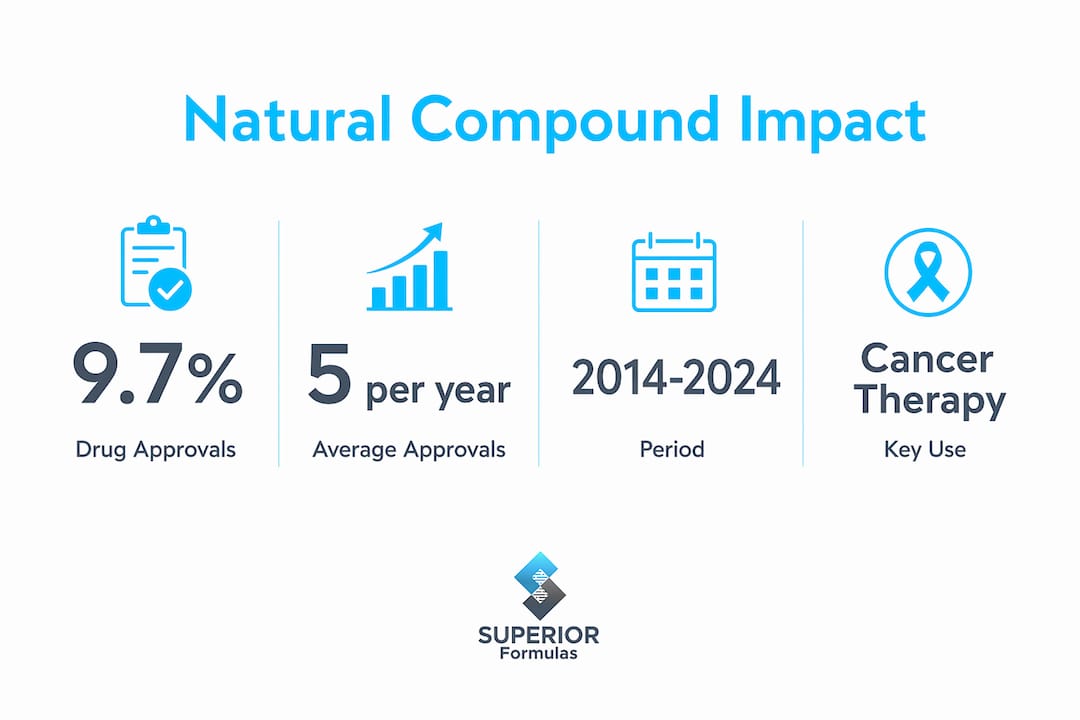
Between 2014 and 2024, 9.7% of 579 drug approvals were natural product-derived, averaging five approvals per year. That pace reflects sustained pharmaceutical investment in natural product research, not a passing trend.
| Drug | Natural Source | Therapeutic Use |
|---|---|---|
| Paclitaxel (Taxol) | Pacific yew tree (Taxus brevifolia) | Ovarian, breast, lung cancer |
| Penicillin | Penicillium mold | Bacterial infections |
| Morphine | Opium poppy (Papaver somniferum) | Pain management |
| Metformin | French lilac (Galega officinalis) | Type 2 diabetes |
| Artemisinin | Sweet wormwood (Artemisia annua) | Malaria treatment |
The structural complexity of natural molecules is difficult to replicate synthetically, yielding superior biological interactions while also complicating standardization. Synthetic chemists can spend decades attempting to reproduce what a plant produces routinely. That complexity is also why NP-derived drugs show fewer adverse effects and better clinical trial success rates than purely synthetic alternatives. The body recognizes these molecules because it has been interacting with them, through diet and environment, for the entirety of human evolution.
Pro Tip: When reviewing supplement labels, look for standardized extracts that specify the active compound and its concentration, such as “95% curcuminoids” or “50% EGCG.” Standardization is the closest the supplement industry gets to pharmaceutical-grade consistency for natural ingredients.
How do natural compounds work differently than synthetic drugs?
Synthetic drugs are typically designed to hit a single molecular target with maximum precision. That approach works well for acute conditions but creates problems in chronic disease management, where multiple biological pathways are dysregulated simultaneously. Natural compounds operate differently. They function as modulators in complex biological systems, restoring homeostasis rather than forcing a single pathway into submission.
Consider how polyphenols like resveratrol and quercetin work. They do not simply block one enzyme. They interact with the Nrf2 pathway to activate antioxidant defenses, modulate NF-kB to reduce inflammatory signaling, and influence gut microbiota composition to improve metabolic outcomes. That multi-target profile is not a side effect. It is the mechanism. You can read more about how these modulatory actions support cellular detoxification at the cellular level.
The specific advantages of this multi-target approach include:
- Gut microbiota interaction: Polyphenols and prebiotic fibers selectively feed beneficial bacterial strains, which in turn produce short-chain fatty acids that regulate immune function and metabolic health.
- Oxidative stress modulation: Compounds like sulforaphane from broccoli sprouts activate Nrf2, the body’s master antioxidant switch, producing a sustained protective effect rather than a one-time antioxidant donation.
- Immune system calibration: Adaptogens such as ashwagandha (Withania somnifera) and rhodiola (Rhodiola rosea) regulate cortisol and cytokine production, supporting immune resilience without suppressing normal immune responses.
- Antimicrobial resistance: Natural compounds provide multi-target inhibitory effects, making them promising candidates against drug-resistant pathogens where single-target antibiotics have failed.
This systems-level action is why natural compounds are increasingly studied for chronic conditions including metabolic syndrome, neurodegeneration, and cardiovascular disease, where no single drug target has proven sufficient.
What challenges affect the use of natural compounds in health?
The benefits of natural compounds are real, but so are the practical limitations. Understanding these challenges helps you make smarter decisions about sourcing, supplementation, and dietary strategy.
-
Bioavailability is the first barrier. Bioavailability and delivery matrix greatly influence efficacy for compounds like polyphenols. Curcumin, for example, is poorly absorbed on its own. Formulations that pair it with piperine (black pepper extract) or use phospholipid complexes can increase absorption by a meaningful margin.
-
Chemical variability complicates standardization. The concentration of active compounds in a plant varies based on soil quality, climate, harvest timing, and processing methods. Two bottles of the same herb can contain dramatically different amounts of the active constituent. This is why third-party testing and standardized extracts matter.
-
Processing and storage degrade potency. Processing, storage, and individual metabolism all affect the functional efficacy of bioactive food compounds. Heat, light, and oxidation can destroy the very molecules you are trying to consume. Whole foods consumed fresh and supplements stored properly in dark, cool conditions retain more biological activity.
-
Biodiversity loss threatens future discovery. Current species extinction rates are 1,000 to 10,000 times higher than natural background rates, putting potential therapeutic compounds at permanent risk. Many of the plant species currently unstudied may contain the next generation of cancer treatments or neuroprotective agents. Losing them before they are characterized is an irreversible scientific loss.
Pro Tip: For polyphenol-rich supplements, choose formulations that specify a bioavailability-enhancing delivery system. Liposomal, phytosome, or piperine-paired formats consistently outperform standard powder extracts in absorption studies.
How can adults 30+ incorporate natural compounds for longevity?
The practical application of natural compounds does not require a prescription or a clinical trial enrollment. It requires informed choices about food, supplementation, and product quality. Here is how to build a meaningful foundation:
-
Prioritize functional foods as your first delivery vehicle. Functional foods enhance stability, bioaccessibility, and efficacy of bioactive compounds for chronic disease prevention. Fermented foods like kimchi and kefir deliver live cultures alongside bioactive peptides. Cruciferous vegetables provide glucosinolates that convert to sulforaphane. Berries supply anthocyanins with documented effects on cognitive aging and vascular health.
-
Use supplements to fill targeted gaps, not replace diet. Compounds like berberine, NMN (nicotinamide mononucleotide), and pterostilbene are difficult to obtain in therapeutic concentrations from food alone. Physician-formulated supplements that specify clinical dosages and standardized extracts are the appropriate tool for these targets.
-
Understand quality indicators before purchasing. GMP-certified manufacturing, third-party testing certificates, and transparent ingredient sourcing are non-negotiable markers of a trustworthy product. Learning how to assess dietary supplements before you buy protects both your health and your investment.
-
Pair natural compounds strategically. Certain combinations amplify each other’s effects. Quercetin and bromelain improve each other’s absorption. Fat-soluble compounds like CoQ10 and astaxanthin require dietary fat for uptake. Understanding these interactions is the difference between a supplement protocol that works and one that does not.
-
Explore the breadth of plant-based bioactives. Plant-derived bioactive compounds offer antioxidant, anti-inflammatory, antimicrobial, and metabolic effects that benefit health across multiple systems simultaneously. Resources like Caribbean herbs for health highlight how traditional botanical knowledge continues to surface clinically relevant compounds that modern research is only beginning to validate.
Key takeaways
Natural compounds are evolutionarily optimized molecules that outperform synthetic alternatives in biological complexity, multi-target action, and clinical safety profiles, making them the most evidence-grounded foundation for adult longevity and wellness.
| Point | Details |
|---|---|
| Evolutionary advantage | Natural molecules refined over millions of years carry biological precision synthetic chemistry cannot easily replicate. |
| Pharmaceutical dominance | Nearly 45% of approved drugs and 70% of cancer therapies are derived from or inspired by natural products. |
| Multi-target mechanisms | Natural compounds modulate gut microbiota, oxidative pathways, and immune function simultaneously, unlike single-target synthetic drugs. |
| Bioavailability matters | Delivery format, processing, and storage directly determine whether a natural compound reaches its biological target. |
| Biodiversity is a health asset | Extinction rates 1,000 to 10,000 times above natural background levels put undiscovered therapeutic compounds at permanent risk. |
What I’ve learned from years of watching natural compounds get underestimated
The most persistent mistake I see adults make when approaching natural health is treating natural compounds as a softer, gentler alternative to real medicine. That framing is scientifically backward. Morphine is a natural compound. Penicillin is a natural compound. Paclitaxel, which has saved hundreds of thousands of lives in oncology, came from the bark of a Pacific yew tree. The idea that natural means mild is not just wrong. It is a bias that leads people to either dismiss these molecules entirely or use them carelessly without understanding their potency.
What I find genuinely compelling about the current research moment is the shift toward systems biology. Scientists are no longer asking what a single compound does to a single enzyme. They are asking how a network of bioactives reshapes the entire biological environment of a cell, a tissue, or a microbiome. That is the right question, and it is one that natural compounds are uniquely positioned to answer. Their multi-target profiles, which were once seen as a liability for drug development, are now recognized as a feature for chronic disease management.
My practical recommendation is this: do not wait for a diagnosis to take natural compounds seriously. The adults who benefit most from polyphenols, adaptogens, and phytonutrients are the ones who integrate them consistently in their 30s and 40s, before cellular aging compounds into clinical disease. The evidence for compounds like sulforaphane, berberine, and NMN in longevity pathways is not preliminary. It is substantial and growing. Pair that evidence with quality sourcing, and you have a genuinely powerful health strategy.
— cristopher
Science-backed natural compound supplements from Superiorformulas
Superiorformulas was founded by a physician-scientist with one purpose: to translate the best evidence on natural compounds into formulations that actually work. Every product in the Superiorformulas line uses clinically studied ingredients at documented dosages, manufactured in GMP-certified facilities and verified through third-party testing. There are no unnecessary fillers, no proprietary blends that obscure dosages, and no compromises on purity. If you are ready to build a longevity protocol grounded in real science, explore the full range of physician-formulated supplements and find the formulations designed for your specific health goals. Your biology deserves the same precision that went into developing them.
FAQ
What are natural compounds in health?
Natural compounds are biologically produced chemical substances, including polyphenols, alkaloids, terpenoids, and flavonoids, that exert measurable effects on human physiology. They originate from plants, fungi, microorganisms, and animals and form the basis of both traditional medicine and modern pharmaceutical development.
How do natural compounds differ from synthetic drugs?
Natural compounds typically modulate multiple biological targets simultaneously, including oxidative stress pathways, gut microbiota, and immune signaling, while synthetic drugs are usually designed to act on a single molecular target. This multi-target action makes natural compounds particularly relevant for chronic disease prevention and healthy aging.
Are natural compounds safe for long-term use?
NP-derived drugs and bioactive food compounds generally show lower toxicity and better clinical safety profiles than synthetic alternatives, though potency varies by compound, dosage, and delivery format. Standardized extracts from GMP-certified manufacturers with third-party testing provide the most reliable safety and efficacy data.
Why does bioavailability matter for natural supplements?
Bioavailability determines how much of an active compound actually reaches its biological target after ingestion. Compounds like curcumin and resveratrol have low natural absorption rates, so delivery formats using piperine, liposomal encapsulation, or phytosome technology are necessary to achieve clinically meaningful concentrations in the body.
What is the biggest threat to natural compound discovery?
Biodiversity loss is the most serious long-term threat. With species extinction rates currently 1,000 to 10,000 times above natural background levels, thousands of plant and microbial species carrying undiscovered therapeutic compounds may disappear before they are ever studied, permanently closing doors on future drug and supplement development.
For a formulation built around exactly these natural, pathway-targeted compounds, see our Formula 1 — LONGEVITY Daily Nrf2 Activate+, which was designed with exactly this clinical rationale in mind. Explore the science behind the formulation to see how it applies to your own routine.


