


The supplement industry generates over $50 billion annually in the United States, yet the majority of products on store shelves carry claims that far outpace their supporting evidence. For anyone over 35 who is serious about healthy aging, cellular resilience, and long-term vitality, navigating that landscape without a clear standard for what “research-backed” actually means is a genuine challenge. This guide cuts through the marketing noise, defines the scientific criteria that separate credible supplements from clever branding, and gives you a practical framework to make informed, confidence-driven decisions about the products you put in your body.
Table of Contents
- What makes a supplement research-backed?
- Evidence frameworks: Tiered levels of scientific support
- Top science-backed supplements for longevity and cellular health
- How to vet supplement claims and avoid hype
- What most supplement buyers miss: Lifestyle, transparency, and context
- Where to find evidence-based supplements for your health goals
- Frequently asked questions
Key Takeaways
| Point | Details |
|---|---|
| Evidence matters most | Prioritize supplements supported by robust human trials and meta-analyses for the best results. |
| Tiered framework | Use a tiered evidence system to choose supplements wisely and avoid hype. |
| Longevity proven | Vitamin D and select formulas demonstrate validated impact on cellular aging. |
| Vetting is critical | Always check for independent studies and transparent sourcing to ensure claims are credible. |
| Lifestyle first | Optimal wellness depends most on healthy lifestyle, with supplements as a science-backed support. |
What makes a supplement research-backed?
The phrase “research-backed” is one of the most overused terms in wellness marketing. A brand can technically cite a single mouse study or a small, uncontrolled human trial and still stamp “clinically studied” on the label. That is why understanding what real scientific backing looks like is the essential starting point.
Research-backed supplements are defined by evidence from high-quality human clinical trials, prioritizing randomized, double-blind, placebo-controlled trials (RCTs), systematic reviews, and meta-analyses over preclinical, observational, or in vitro studies. Those terms matter. Randomization means participants are assigned to groups by chance, eliminating selection bias. Double-blinding means neither the participant nor the researcher knows who is taking the active compound, which removes expectation effects. Placebo controls isolate the supplement’s true biological impact from the power of belief alone.
Observational studies, which track what people eat or take and correlate those habits with health outcomes, are valuable for generating hypotheses. They are not sufficient to prove that a supplement causes a benefit. Cell culture (in vitro) studies and animal models are even further down the credibility ladder. They explore mechanisms, but the human body is far more complex than a petri dish or a rodent model.
Science-driven supplementation also means scrutinizing who funded the research. Industry-sponsored studies are not automatically invalid, but they carry a higher risk of selective reporting and design choices that favor a product. Independent research, particularly large meta-analyses pooling data from multiple independent trials, carries the most weight.
Here is a quick reference for the types of evidence and what each tells you:
| Evidence type | What it shows | Reliability for humans |
|---|---|---|
| In vitro (cell) studies | Biological mechanism | Very low |
| Animal studies | Mechanism, safety signals | Low |
| Observational/cohort | Correlations in populations | Moderate |
| Single small RCT | Preliminary efficacy | Moderate |
| Multiple large RCTs | Reproducible human efficacy | High |
| Systematic review/meta-analysis | Pooled, weighted evidence | Very high |
Key attributes of genuinely research-backed supplements include:
- Evidence from at least one large, independent RCT in humans
- Results that have been replicated across multiple studies
- Dosages in the trial that match what the product actually contains
- Transparency about the funder and trial design
- Citations to peer-reviewed journals, not internal white papers
Exploring supplement science through these filters instantly narrows the field from thousands of products to a much shorter, more credible list.
Evidence frameworks: Tiered levels of scientific support
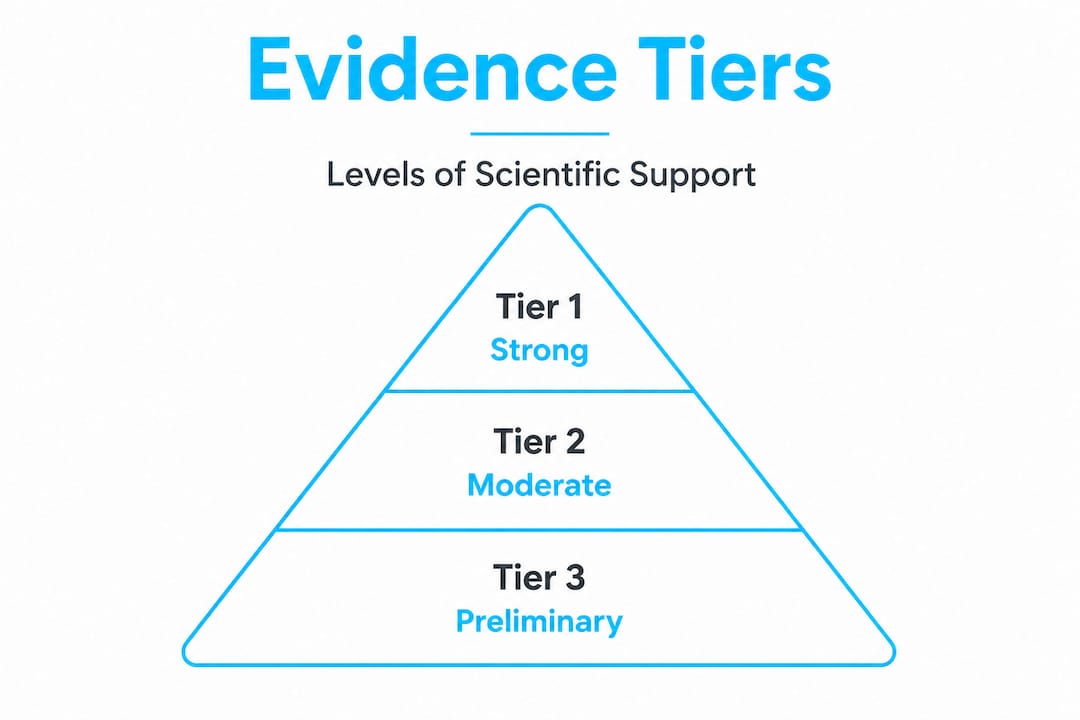
Once you know the difference between a mouse study and a meta-analysis, it helps to see the full evidence landscape organized into tiers. This structure is used by clinical researchers and informed formulators alike to categorize the strength of support behind any given ingredient or formula.
The evidence hierarchy breaks down into three practical tiers:
| Tier | Classification | Criteria | Examples |
|---|---|---|---|
| Tier 1 | Strong | Multiple large RCTs and/or meta-analyses with consistent results | Vitamin D, omega-3 fatty acids, creatine |
| Tier 2 | Likely | Several RCTs with generally positive findings, some variability | Magnesium, CoQ10, curcumin (with bioavailability enhancers) |
| Tier 3 | Mixed | Limited RCTs, inconsistent results, or evidence primarily from animal/in vitro models | Many proprietary botanical blends, some antioxidant complexes |
Tier 1 ingredients are the safest bets when your goal is long-term cellular health and longevity. They have been tested in large populations, often including adults over 50, and their benefits have been reproduced by multiple independent research groups. Tier 2 ingredients are promising and worthy of inclusion in a thoughtful formula, particularly when bioavailability is addressed through advanced delivery technologies. Tier 3 is where skepticism is warranted. This does not mean the ingredient is ineffective, but it does mean the evidence base has not yet matured enough to make confident recommendations.
Pro Tip: When evaluating any supplement, ask the brand or retailer to specify the type of study behind each key ingredient. If the answer is “preclinical data” or “traditional use,” you are looking at Tier 3 territory at best. Demand Tier 1 or Tier 2 before committing to a long-term health strategy.
Premium science-backed supplements are built around Tier 1 and Tier 2 ingredients, not around what sounds compelling in a marketing brochure. That distinction separates genuinely useful formulations from expensive placebos.
Top science-backed supplements for longevity and cellular health
With a clear evidence framework in place, you can make targeted choices that genuinely support healthy aging. Here are the most rigorously studied supplements for adults focused on longevity and cellular health, along with what the evidence actually shows.
-
Vitamin D (2,000 IU/day). This is arguably the most important supplement for adults over 35 with documented deficiency. Vitamin D supplementation slowed telomere shortening by 140 base pairs over four years in the landmark VITAL trial (n=1,054), a reduction equivalent to approximately three years less cellular aging. Telomere length is one of the most studied biomarkers of biological age, making this finding clinically significant. Most adults in northern latitudes are deficient without supplementation.
-
Omega-3 fatty acids (1 to 2g EPA/DHA per day). Omega-3s from marine sources have robust Tier 1 evidence for supporting cardiovascular health, reducing systemic inflammation, and protecting neurological function as you age. Multiple large RCTs and meta-analyses confirm benefit at doses of 1 to 2g of combined EPA and DHA daily. Quality matters here: look for products with verified purity and oxidation testing.
-
Creatine monohydrate (3 to 5g per day). Creatine is often associated with athletic performance, but its benefits for older adults extend well beyond muscle strength. RCTs show consistent support for cognitive function, muscle preservation (sarcopenia prevention), and mitochondrial energy production. At 3 to 5g per day, it is one of the safest and most cost-effective longevity compounds with genuine Tier 1 backing.
-
Magnesium (200 to 400mg per day, as glycinate or malate). Magnesium participates in over 300 enzymatic reactions and is critically involved in DNA repair, sleep regulation, and cardiovascular function. Widespread dietary insufficiency in adults over 40 makes supplementation particularly relevant. Magnesium glycinate and magnesium malate have the best absorption profiles with minimal gastrointestinal side effects.
-
Multi-nutrient formulas with clinical ingredient profiles. A well-formulated multi-system support formula addresses common micronutrient gaps across multiple systems simultaneously. Look for formulas that include clinically studied doses rather than token amounts of each ingredient, a distinction that separates effective daily supplements from underdosed products.
“Supplements work best as one component of a broader lifestyle strategy. Sleep quality, dietary diversity, stress management, and consistent movement remain the non-negotiable foundation. Evidence-based supplementation amplifies those efforts; it does not replace them.”
Physician-formulated longevity supplements integrate these principles by using dosages that reflect what was actually tested in human trials, not what fits neatly into a single capsule. If you are evaluating alternatives, comparing supplement options side by side on ingredient quality and dosage transparency is a smart approach.
How to vet supplement claims and avoid hype
Understanding evidence tiers gives you a strong foundation. Applying that knowledge in real purchasing decisions requires a few additional critical evaluation skills, because supplement marketing is sophisticated and often exploits genuine scientific uncertainty.
The first and most important filter is funding source. Industry-funded trials can introduce bias, even when the research appears rigorous on the surface. This is not a theoretical concern. Trials funded by manufacturers have consistently shown higher rates of positive outcomes compared to independently funded trials on the same compounds. That does not mean you ignore industry-funded research entirely, but it means you weight it differently and look for independent replication.
Here is a practical checklist for vetting any supplement claim:
- Source of evidence: Is it a peer-reviewed journal or a brand white paper? Peer-reviewed wins every time.
- Type of study: Is it an RCT in humans, an animal model, or a cell culture? Human RCTs are the standard.
- Sample size and duration: Small, short trials are less reliable. Look for studies with hundreds of participants over months or years.
- Dosage match: Does the product dose match what was used in the trial? A supplement with 50mg of an ingredient studied at 500mg is not delivering the studied benefit.
- Ingredient transparency: Are all active ingredients listed with exact amounts, or hidden in a “proprietary blend” that obscures dosing?
- Third-party testing: Is the product tested by an independent lab for purity and potency?
Pro Tip: Cross-reference supplement claims on resources like Examine.com, the NIH Office of Dietary Supplements, or speak with a clinician who is familiar with the research. These checks take less than five minutes and can save you months of taking an ineffective product.
What really works in preventive health comes down to this: strong evidence, honest labeling, and dosages that reflect clinical reality. Equally important is knowing what is not in your supplement. Understanding supplement fillers and inactive ingredients helps you avoid products where unnecessary additives may compromise absorption or purity.
What most supplement buyers miss: Lifestyle, transparency, and context
Here is the perspective most industry guides will not offer directly: the most common mistake adults make when approaching supplementation is treating it as a standalone intervention. The evidence for virtually every longevity-supporting supplement shows its greatest benefit in people who are already doing the foundational work. Sleep. Nutrient-dense eating. Regular movement. Stress regulation. These are not background conditions; they are the primary drivers of long-term cellular health.
Supplements are precision tools. They work best when targeted to a documented need, whether that is a confirmed vitamin D deficiency, an omega-3 gap from low fish consumption, or creatine support for someone dealing with early muscle loss. Using supplements without that context is like adding high-octane fuel to an engine that needs a tune-up first.
Transparency is equally undervalued by most buyers. Many adults scrutinize label claims but never ask who formulated the product, whether the ingredients were independently tested, or whether the clinical studies referenced actually used the ingredient in the form and dose present in the product. These are not minor details. Curcumin, for instance, has dramatically different bioavailability depending on whether it is formulated with piperine, phospholipid complexes, or nanoparticle delivery. A study conducted on one form does not automatically transfer to another.
The brands worth trusting are transparent about their formulation rationale, cite their clinical evidence publicly, and do not hide behind proprietary blends. That transparency is a signal that the science is genuinely driving the product, not the marketing. Science transparency in supplements is not a luxury feature. It is the minimum standard for any product asking for a long-term place in your health strategy.
Finally, personalization matters more than most general guides acknowledge. A 38-year-old woman managing stress-related cortisol dysregulation has different supplementation priorities than a 58-year-old man focused on cardiovascular and cognitive resilience. Evidence informs both, but the application is not identical. Working with a clinician who understands both the research and your individual health picture is the highest-value move you can make.
Where to find evidence-based supplements for your health goals
After understanding what separates credible science from marketing noise, the next step is finding formulas that actually meet that standard. Superior Formulas was built around precisely this gap.
Every product in the Superior Formulas line is physician-formulated using clinically studied ingredients at doses that reflect what human trials actually tested. The science-backed supplement collection covers longevity, cellular renewal, and multi-system support with full ingredient transparency and third-party testing. For a foundational daily formula, Superior Multi+ Daily delivers broad micronutrient support aligned with clinical evidence. For targeted cellular longevity and Nrf2 pathway activation, the LONGEVITY Daily Nrf2 Activate+ is formulated around the science of healthy aging at the cellular level. These are not marketing claims. They are the direct result of applying the evidence standards outlined in this guide.
Frequently asked questions
What qualifies a supplement as truly research-backed?
Supplements are research-backed when they have strong evidence from robust human trials, especially randomized controlled trials and meta-analyses that prioritize double-blind, placebo-controlled designs over preclinical or observational data.
Are industry-funded studies reliable for supplement choices?
Industry-funded trials can offer insights but are more likely to report favorable outcomes, so independent meta-analyses pooling data from multiple unaffiliated research teams are significantly more reliable for making sound supplement decisions.
What is an example of a supplement with strong evidence for healthy aging?
Vitamin D at 2,000 IU per day slowed telomere shortening by 140 base pairs over four years in the VITAL trial, which translates to approximately three years less biological aging, making it one of the strongest longevity-focused findings in recent clinical research.
How can I check if a supplement’s claims are scientifically credible?
Look for references to randomized human trials or meta-analyses rather than testimonials, in vitro studies, or animal models, and verify that the product dose actually matches what was used in the cited research.
Recommended
- What Are Premium Supplements? A Science-Backed Longevity Guide - SUPERIOR Formulas
- Physician-formulated supplements for longevity and cellular health - SUPERIOR Formulas
- Supplements in preventive health: What really works? - SUPERIOR Formulas
- Implement science-driven supplementation for better health - SUPERIOR Formulas


