


Most people searching for longevity nutrition end up down a rabbit hole of superfoods, detox protocols, and conflicting advice that promises more than it delivers. The role of nutrition in longevity is far more nuanced than any single ingredient can address. What decades of research and recent 2026 studies consistently show is that your overall dietary pattern, not the blueberries you add to your oatmeal, determines how well your cells age, how long your cardiovascular system holds up, and whether your final decades are marked by function or decline.
Table of Contents
- Key takeaways
- The role of nutrition in longevity: dietary patterns that extend life
- How nutrition affects aging at the cellular level
- Protein intake and preserving function after 35
- Practical nutrition strategies for adults 35 and older
- What centenarian populations teach us about longevity nutrition
- My take on what actually moves the needle
- How Superiorformulas supports your longevity nutrition
- FAQ
Key takeaways
| Point | Details |
|---|---|
| Dietary patterns outperform superfoods | Adherence to plant-rich, nutrient-dense patterns adds up to 4.3 years to life expectancy at age 50. |
| Molecular pathways connect food to aging | Nutrients regulate AMPK, mTORC1, and SIRT pathways that directly control cellular aging speed. |
| Protein intake protects function | Adults need at least 0.8 g/kg/day of protein to reduce mortality risk and preserve physical independence. |
| Restriction without balance backfires | Calorie restriction activates longevity pathways but increases infection vulnerability if not carefully managed. |
| Consistency beats perfection | Long-term diet adherence predicts longevity outcomes far better than short-term dietary overhauls. |
The role of nutrition in longevity: dietary patterns that extend life
The first thing to understand is that no study has ever shown a single food extends human lifespan. What research has shown, repeatedly, is that consistent adherence to specific dietary patterns produces measurable longevity gains.
A 2025 prospective cohort study found that high dietary adherence increases life expectancy at age 50 by 1.18 to 4.27 years depending on the pattern followed. That is not a marginal effect. The patterns studied included the Mediterranean diet, DASH, plant-based diets, and the Healthy Eating Index. All shared common structural features: heavy reliance on whole plant foods, limited ultra-processed foods, moderate healthy fat intake, and controlled refined sugar.
The cardiovascular mortality reduction alone explains much of this longevity benefit. In the CORDIOPREV trial, participants with the highest diet adherence experienced roughly 30 to 35% lower rates of major adverse cardiovascular events over seven years compared to the lowest adherence group. Since cardiovascular disease remains the leading cause of death in adults over 50, that reduction has a direct lifespan impact.
Here is a comparison of the major dietary patterns and their longevity-relevant features:
| Dietary Pattern | Core Foods | Key Longevity Benefit |
|---|---|---|
| Mediterranean | Olive oil, fish, legumes, vegetables | Cardiovascular protection, reduced inflammation |
| DASH | Low sodium, high potassium, lean proteins | Blood pressure control, reduced stroke risk |
| Plant-based | Whole grains, legumes, nuts, fruit | Oxidative stress reduction, metabolic health |
| Okinawan | Sweet potatoes, tofu, seaweed, vegetables | Caloric moderation, longevity pathway activation |
| Nordic | Fatty fish, berries, root vegetables, rye | Anti-inflammatory, microbiome diversity |
The biological mechanisms differ slightly across these patterns, but they converge on the same downstream outcomes: lower systemic inflammation, better vascular endothelial function, improved adiponectin levels, and a more favorable gut microbiome composition. These are not small effects. They are the cellular environment in which aging either accelerates or slows.
How nutrition affects aging at the cellular level
What you eat sends signals to your cells. That is not a metaphor. Specific nutrients directly activate or suppress molecular pathways that govern how fast your cells age.
The four most studied nutrient-sensing pathways are:
- AMPK (AMP-activated protein kinase): activated by caloric restriction and polyphenols like resveratrol; promotes cellular energy efficiency and autophagy
- mTORC1: suppressed by dietary restriction; when chronically overactivated by excess protein or calories, it accelerates cellular senescence
- SIRT pathways (sirtuins): activated by NAD+ precursors and caloric moderation; regulate DNA repair and mitochondrial function
- Autophagy: the cellular “cleanup” process triggered by fasting and polyphenol consumption that removes damaged proteins and organelles
A 2026 review in Nature Aging confirmed that dietary restriction activates these longevity pathways in humans, but with important caveats. Aggressive caloric restriction in older adults can increase susceptibility to infection and impair wound healing. The benefit is real, but the implementation requires precision.
Beyond these pathways, mitochondrial function deserves attention. Mitochondria are where cells convert nutrients into usable energy, and their efficiency declines with age. Dietary patterns rich in antioxidant-supporting compounds like polyphenols, carotenoids, and CoQ10 precursors help reduce mitochondrial oxidative stress and preserve energy production at the cellular level. This is why longevity nutrition is not just about avoiding bad foods. It is about actively supplying the compounds your cells need to function well under the biological stress of aging.

The gut microbiome adds another layer of complexity. A diverse, plant-supported microbiome produces short-chain fatty acids that regulate immune function, reduce intestinal inflammation, and influence neurological health. The centenarian diet patterns studied worldwide consistently include high fiber intake, which feeds the microbial diversity associated with healthspan extension.
Pro Tip: If you practice any form of intermittent fasting or caloric restriction, prioritize micronutrient density in the meals you do eat. Restricting calories without maintaining vitamin D, magnesium, and zinc levels can undermine the immune benefits you are trying to create.
Protein intake and preserving function after 35
Protein is where longevity nutrition gets most misunderstood. Many adults over 35, particularly those drawn to plant-based or calorie-restricted approaches, chronically undereat protein. The research on what this costs them is unambiguous.
A prospective study of community-dwelling older adults found that protein intake at or above 0.8 g/kg of body weight per day is associated with significantly lower mortality and reduced functional decline. Muscle mass is not just an aesthetic concern after middle age. It is directly tied to metabolic health, fall prevention, immune reserve, and independence in later decades.
The source of protein also matters in ways that go beyond simple macronutrient totals. Research shows that animal-source protein more strongly mediates the association between healthy dietary patterns and preserved physical mobility in older adults. This does not mean abandoning plant proteins. It means that if you follow a predominantly plant-based pattern, you need to pay deliberate attention to leucine-rich sources like edamame, lentils, tempeh, and hemp seeds, which drive muscle protein synthesis more effectively than lower-leucine plant proteins.
The practical framework for protein in longevity nutrition looks like this:
- Aim for 1.0 to 1.2 g/kg/day if you are over 55, physically active, or recovering from illness
- Distribute protein across all meals rather than concentrating it in one sitting, since the body can only utilize roughly 30 to 40 grams per meal for muscle synthesis
- Combine plant and animal proteins strategically to cover all essential amino acids without exceeding caloric targets
- Prioritize whole food protein sources over protein isolates, which lack the cofactors that support absorption
Pro Tip: A simple daily target for a 160-pound adult is roughly 65 to 80 grams of protein. Spread across three meals, that is 22 to 27 grams per meal, which is entirely achievable with eggs, Greek yogurt, legumes, or a small portion of fish.
Practical nutrition strategies for adults 35 and older
Knowing the science is the starting point. Applying it consistently is where longevity is actually built. The research on dietary habits and lifespan shows that long-term adherence to a healthy dietary pattern predicts outcomes far better than short-term dietary perfection followed by abandonment.
Here are six practical steps you can implement without overhauling your life:
- Shift your plate composition. Make vegetables and legumes the largest portion of at least two meals per day. This single change increases fiber, polyphenols, and micronutrient intake simultaneously.
- Use the MEDAS score as a self-check. The 14-item Mediterranean Diet Adherence Screener lets you quickly gauge how closely your eating aligns with a pattern shown to reduce cardiovascular mortality. You do not need perfection; a score above 7 is associated with meaningful protection.
- Protect micronutrient intake during caloric restriction. If you practice intermittent fasting or follow a lower-calorie approach, prioritize nutrient-dense foods like leafy greens, fatty fish, nuts, and seeds within your eating window.
- Reduce ultra-processed food to below 20% of total calories. This is a more realistic and evidence-grounded target than complete elimination, and it allows for dietary flexibility without undermining the anti-inflammatory structure of your overall pattern.
- Diversify your food sources weekly. Aim for 30 or more distinct plant foods per week. This is one of the strongest drivers of gut microbiome diversity, which supports healthy aging nutrients that reduce systemic inflammation.
- Consider targeted supplementation where diet falls short. Nutrients like vitamin D, omega-3 fatty acids, and specific polyphenols are difficult to obtain consistently from food alone. Quality supplementation, guided by clinical evidence, fills those gaps without replacing dietary foundations.
What centenarian populations teach us about longevity nutrition
The longest-lived populations on earth have been studied exhaustively, and they do not eat exotic diets. Their patterns are, in fact, remarkably consistent with the evidence reviewed above.
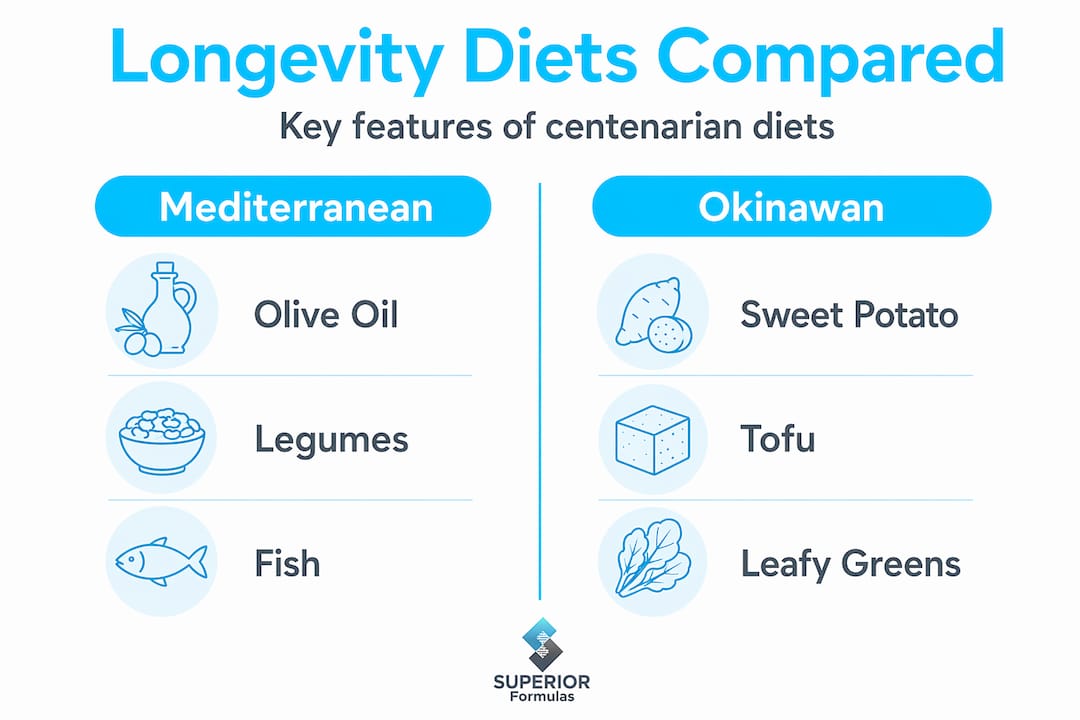
Mediterranean, Okinawan, Nordic, and Nicoyan centenarian diets share several structural features that reinforce each other at the molecular level:
| Centenarian Population | Dietary Emphasis | Molecular Benefit |
|---|---|---|
| Mediterranean (Sardinia, Greece) | Olive oil, legumes, whole grains, fish | Reduced LDL oxidation, anti-inflammatory |
| Okinawan (Japan) | Sweet potatoes, tofu, moderate caloric intake | mTORC1 suppression, autophagy activation |
| Nordic (Scandinavia) | Fatty fish, berries, fermented dairy, rye | Gut microbiome diversity, omega-3 support |
| Nicoyan (Costa Rica) | Corn, beans, tropical fruits, minimal meat | High fiber, stable blood glucose |
What unites these populations is not genetic luck alone. A 2026 review of centenarian nutrition confirmed that these plant-predominant diets modulate oxidative stress, systemic inflammation, mitochondrial efficiency, and gut microbiota composition in ways that directly support the longevity pathways discussed earlier. The genomic stability these populations maintain is, in large part, a product of what they consistently eat over decades.
Among centenarians with strong cardiovascular health metrics, high cardiovascular health status is associated with a 54.8% lower mortality risk. Diet is a primary driver of those cardiovascular metrics. The lesson from centenarian research is not “eat like an Okinawan.” It is that plant-rich, calorie-moderate, minimally processed dietary patterns protect the biological machinery of aging regardless of cultural context. You can apply those principles in any food environment.
My take on what actually moves the needle
I have spent considerable time studying the longevity nutrition literature, and one pattern stands out clearly. Most people who want to age well get derailed not by lack of information but by chasing dramatic interventions instead of building durable habits.
The single biggest mistake I see is the pursuit of one “longevity food” or one protocol, whether that is extreme caloric restriction, carnivore, or fasting regimens pushed to unsustainable limits. None of them, in isolation, replicate what whole dietary patterns do when followed consistently for years. The science is not ambiguous on this. Adherence over time is the variable that predicts outcomes. Not perfection at any single point.
What I find particularly underappreciated is the protein question. In clinical longevity circles, there is genuine tension between the mTORC1-suppressing benefits of protein restriction and the muscle-preserving necessity of adequate protein intake after 50. My read of the current evidence is that for most adults in this age group, undereating protein is the greater risk. Frailty is a more immediate threat to healthspan than the theoretical longevity signal from marginal protein reduction.
The practical approach I advocate is this: build a plant-dominant diet around legumes, whole grains, and vegetables, but do not sacrifice protein adequacy in the process. Use science-backed longevity nutrients to fill micronutrient gaps, and track adherence over months, not days. That is where longevity is actually built.
— cristopher
How Superiorformulas supports your longevity nutrition
If your diet is solid but you know there are gaps, particularly in antioxidants, mitochondrial support, and micronutrients that are difficult to obtain consistently from food, targeted supplementation becomes worth considering.

Superiorformulas developed Formula 9 Multi+ Daily specifically to support the cellular and cardiovascular health priorities that longevity nutrition research identifies as most critical. Physician-formulated and manufactured in GMP-certified facilities, it complements the dietary patterns discussed in this article rather than replacing them. You can also explore the broader framework of dietary supplements for longevity to understand how supplementation fits within a science-grounded approach to healthy aging.
FAQ
What is the most important factor in longevity nutrition?
Consistent adherence to a plant-rich, nutrient-dense dietary pattern over time is the strongest predictor of longevity outcomes. Research shows this adds up to 4.27 years to life expectancy at age 50 compared to low dietary adherence.
How does protein intake affect longevity after 35?
Adequate protein intake at or above 0.8 g/kg/day is associated with lower mortality and reduced functional decline in older adults. Protein supports muscle mass, immune reserve, and physical independence, all of which directly affect healthspan.
Is caloric restriction safe for aging adults?
Caloric restriction activates proven longevity pathways like AMPK and SIRT, but aggressive restriction in older adults increases infection risk and can impair wound healing. A balanced approach that preserves micronutrient intake is safer and more effective.
Which diet is best for longevity?
No single diet is universally best, but Mediterranean, Okinawan, Nordic, and DASH patterns consistently show the strongest association with reduced cardiovascular mortality and extended healthspan across large population studies.
Can supplements replace a healthy diet for longevity?
Supplements cannot replace the complex synergy of whole food dietary patterns, but they can fill specific micronutrient gaps that diet alone struggles to address consistently, particularly for nutrients like vitamin D, omega-3 fatty acids, and certain polyphenols.
Recommended
- How Dietary Supplements Support Longevity and Cellular Health - SUPERIOR Formulas
- Longevity Nutrients: Science-Backed Choices for Cellular Health - SUPERIOR Formulas
- Examples of Healthy Aging Nutrients for Adults 35+ | SUPERIOR Formulas
- How to Boost Antioxidant Levels After 30 Naturally | SUPERIOR Formulas


