


Cellular pathways are defined as sequences of molecular interactions within a cell that regulate metabolism, gene expression, and cell division. These pathways are the reason your body can respond to a meal, repair damaged tissue, or clear out a dysfunctional cell before it causes harm. Understanding why cellular pathways matter is not an academic exercise. It is the foundation of every evidence-based strategy for healthy aging, disease prevention, and lasting vitality. When these pathways function well, your cells make smart decisions. When they break down, chronic disease follows.
Why cellular pathways matter: the core science
Cellular pathways are the body’s organized molecular routes. Each pathway is a chain of events where one molecule activates the next, producing a specific biological outcome. Think of them as the grammar of biological function. Without them, chemical reactions inside your cells would be random and uncoordinated.
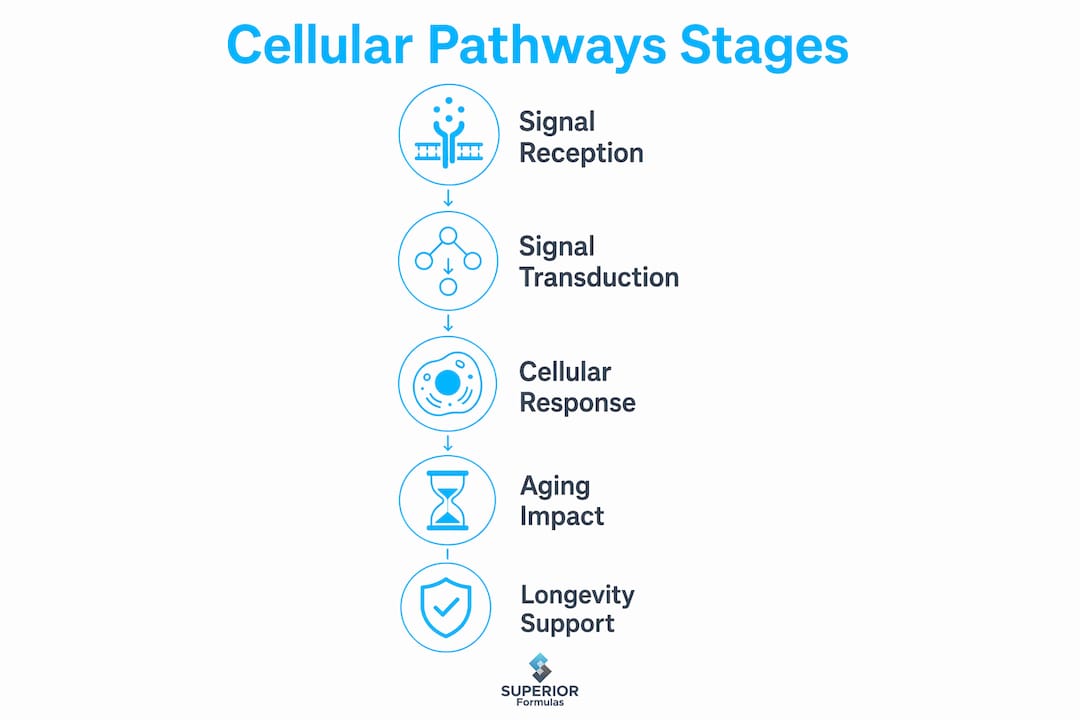
Signal transduction pathways control cell growth and metabolism through cascades involving receptors, kinases, and second messengers. A receptor on the cell surface detects a signal, such as insulin in the bloodstream. That detection triggers a chain of phosphorylation events inside the cell, activating enzymes that carry the message forward. The result is a coordinated response: glucose transporters move to the cell membrane, and blood sugar drops.
What makes this remarkable is the scale of amplification. A single receptor-ligand interaction can activate millions of downstream molecules through signal amplification. That means a tiny molecular event at the cell surface can produce a body-wide biological effect. This principle explains why targeted, low-dose interventions can have meaningful impacts when the underlying pathways are intact and receptive.
How do cellular pathways regulate metabolism and cellular decisions?
Cells are not passive recipients of nutrients. They are active decision-makers that constantly assess their environment and allocate resources accordingly.
Mammalian cells default to apoptosis/01%3A_Readings/1.14%3A_New_Page) without extracellular stimulation from growth factors. That is a striking fact. It means survival is not the default state. Cells require active signaling to stay alive and functional. Growth factors bind to receptors, trigger intracellular cascades, and suppress the apoptosis program. Remove those signals, and the cell begins to shut itself down.
Metabolic pathways manage energy and resources through interconnected enzyme-catalyzed reactions. These pathways do not simply respond to abundance. Cells switch off biosynthesis pathways/01%3A_Readings/1.14%3A_New_Page) when resources are plentiful, saving energy and redirecting precursors to where they are needed most. This frugal resource management is a feature, not a flaw. It means flooding your system with more of a single nutrient does not automatically produce better outcomes.
Key metabolic and signaling decisions your cells make every moment include:
- Survival vs. apoptosis: Cells assess growth factor signals and decide whether to continue functioning or initiate programmed cell death.
- Biosynthesis vs. conservation: Pathways detect nutrient abundance and toggle between building new molecules and conserving resources.
- Repair vs. proliferation: Cellular stress signals direct resources toward DNA repair before allowing cell division to proceed.
- Inflammation vs. resolution: Immune signaling pathways balance the inflammatory response and its resolution to prevent chronic activation.
Pro Tip: Supporting the signaling environment around your cells, through diet, phytonutrients, and stress management, is more effective than simply adding more of a single nutrient. Pathways respond to context, not just quantity.
Why is understanding cellular pathways critical for healthy aging?
Aging is not simply the accumulation of time. It is the gradual breakdown of pathway coordination. When signaling networks lose precision, cells make worse decisions, and disease risk rises.
Pathway rewiring contributes to drug resistance and disease progression. Cancer is the clearest example. A cell with a mutated signaling pathway ignores the normal “stop dividing” signal and proliferates without restraint. Metabolic disorders like type 2 diabetes arise when insulin signaling pathways become desensitized, and glucose uptake fails despite normal insulin levels. These are not failures of a single molecule. They are failures of pathway coordination.
Systems-level modeling identifies oxidative stress and inflammation pathways as biomarkers of aging. This means researchers can now measure how well your cellular pathways are functioning by looking at markers like C-reactive protein, glutathione levels, and Nrf2 activity. These markers reflect the health of entire signaling networks, not just individual molecules.
“Chronic health issues often arise from pathway rewiring rather than the absence of molecules. Effective health strategies must address the network, not just the nutrient.”
The table below summarizes how specific pathway categories connect to aging and disease outcomes:
| Pathway category | Primary function | When disrupted |
|---|---|---|
| Oxidative stress (Nrf2) | Antioxidant defense and cellular repair | Accelerated aging, tissue damage |
| Inflammation (NF-kB) | Immune activation and resolution | Chronic inflammation, metabolic disease |
| Insulin/IGF-1 signaling | Glucose uptake and growth regulation | Insulin resistance, type 2 diabetes |
| Apoptosis (p53, Bcl-2) | Programmed cell death and tumor suppression | Cancer, cellular senescence |
| mTOR pathway | Nutrient sensing and cell growth | Accelerated aging, impaired autophagy |
Understanding longevity pathways at this systems level is what separates a targeted wellness strategy from generic health advice. When you know which pathways govern aging, you can make choices that support them directly.
What are the complexities of cellular pathways that affect health outcomes?
Cellular pathways are not simple linear switches. They are dynamic networks with noise, delays, feedback loops, and crosstalk between systems. This complexity is why single-target approaches often produce disappointing results.
Altering one pathway node can trigger compensatory mechanisms that redirect cellular responses. Block one enzyme in a signaling cascade, and the cell may activate an alternative route to achieve the same outcome. This is pathway crosstalk in action. It is also why pharmaceutical drugs targeting a single protein often lose effectiveness over time. The network adapts.
Context matters enormously in cellular signaling. Low doses of bioactive compounds can have significant effects if pathways are receptive and functional. The same compound at the same dose can produce different outcomes depending on the metabolic state of the cell. A cell under oxidative stress responds differently to a polyphenol than a well-nourished, low-stress cell. This explains the variability people experience with supplements and why cellular health is the prerequisite, not the afterthought.
The following factors shape how pathways respond to any intervention:
- Metabolic state: A cell in energy deficit activates AMPK and shifts toward conservation, changing how it processes incoming signals.
- Oxidative load: High reactive oxygen species levels can distort signaling cascades, causing proteins to misfold or receptors to desensitize.
- Feedback timing: Many pathways include delayed negative feedback, meaning a signal’s effect peaks and then reverses. Timing of interventions matters.
- Pathway crosstalk: Activating one pathway often suppresses or amplifies another. The mTOR and AMPK pathways, for example, are mutually inhibitory.
- Receptor availability: Chronic overstimulation of a receptor leads to downregulation. Cells reduce receptor numbers to protect against excessive signaling.
Pro Tip: When evaluating any supplement or dietary strategy, ask whether it supports the signaling environment or simply adds more of a molecule. Pathway-aware approaches produce more consistent results.
Cellular context in signaling is the reason that plant-based supplement benefits are best realized when the underlying cellular environment is already supported through diet and lifestyle. Compounds like resveratrol, quercetin, and sulforaphane work by activating specific pathway sensors, not by flooding the system.
How can you support your cellular pathways for better health and longevity?
Supporting cellular pathways is not about taking more. It is about giving your cells what they need to maintain signaling precision and network integrity.
Phytonutrients are among the most studied pathway modulators available through diet. Compounds like polyphenols, flavonoids, and isothiocyanates activate regulatory sensors such as Nrf2, which governs the antioxidant pathway. Learning what the antioxidant pathway does and how to support it is one of the most practical steps you can take for long-term cellular health. Sulforaphane from broccoli sprouts, curcumin from turmeric, and EGCG from green tea all activate Nrf2 at low, food-achievable concentrations.
Lifestyle factors shape pathway function as much as any supplement. Regular aerobic exercise activates AMPK, the cellular energy sensor that promotes mitochondrial biogenesis and metabolic flexibility. Caloric moderation and intermittent fasting activate autophagy pathways that clear damaged cellular components. Chronic psychological stress elevates cortisol, which suppresses immune signaling pathways and accelerates cellular aging. Managing stress is not optional for cellular health. It is a direct pathway intervention.
Key strategies for supporting cellular pathway integrity include:
- Eat a phytonutrient-rich diet: Cruciferous vegetables, berries, and green tea provide compounds that activate antioxidant and anti-inflammatory pathways. Explore wellness-supporting botanicals for additional options.
- Exercise consistently: Both aerobic and resistance training activate distinct signaling pathways that support metabolic health and cellular repair.
- Prioritize sleep: Growth hormone and cellular repair pathways are most active during deep sleep. Chronic sleep deprivation impairs pathway recovery.
- Reduce chronic stressors: Sustained cortisol exposure dysregulates immune and metabolic signaling networks.
- Use targeted supplementation: Physician-formulated supplements that activate specific pathway sensors, such as Nrf2 activators or adaptogens, provide support that diet alone may not fully deliver.
Cellular renewal after 30 becomes progressively more dependent on deliberate pathway support. The natural decline in Nrf2 activity, mitochondrial efficiency, and autophagy that begins in the fourth decade of life means passive approaches are no longer sufficient.
Key Takeaways
Cellular pathways are the organized molecular networks that determine how your cells survive, repair, and age. Supporting these networks through diet, lifestyle, and targeted supplementation is the most direct path to lasting health.
| Point | Details |
|---|---|
| Pathways govern all cellular decisions | Every metabolic, repair, and survival response depends on intact signaling networks. |
| Disruption drives chronic disease | Cancer, diabetes, and accelerated aging all trace back to pathway dysregulation. |
| Context shapes pathway response | Cellular metabolic state determines whether a signal or compound produces benefit or stress. |
| Single-target approaches have limits | Network feedback and crosstalk mean one-molecule fixes rarely produce lasting results. |
| Practical support is achievable | Phytonutrients, exercise, sleep, and targeted supplements all modulate pathways directly. |
The grammar of biology: why I think most people miss the point
Most wellness conversations focus on nutrients in isolation. Take more vitamin D. Add more omega-3s. The biology does not work that way, and after years of studying how cellular signaling actually functions, I find that framing genuinely misleading.
Pathways are the grammar of biological function. A word without grammar is noise. A nutrient without a functional pathway to act on is, at best, inert. The real question is never “how much?” It is “are the pathways receptive?”
What I have seen consistently is that people who focus on the signaling environment, through phytonutrient-rich diets, consistent movement, and stress reduction, get more from every supplement they take. The compounds work because the pathways are primed to respond. That is not a coincidence. It is signal amplification working as designed.
The uncomfortable truth about cellular health is that it requires patience and consistency, not heroic doses of any single compound. Pathway rewiring, whether toward disease or toward resilience, happens gradually. The choices you make daily are the inputs. The pathways are the processing system. Get the system right, and the outcomes follow.
— cristopher
Superiorformulas and the science of cellular pathway support
Superiorformulas was founded on a straightforward premise: supplements should work with your biology, not around it.

Every formulation in the Superiorformulas line is built around specific pathway targets, including Nrf2 activation, antioxidant defense, and metabolic signaling. The physician-scientist behind the brand designed these products to support the regulatory sensors your cells rely on, not to flood the system with isolated nutrients. Products are manufactured in GMP-certified facilities and third-party tested for purity. If you want to go deeper on the science, the Superiorformulas blog covers cellular defense strategies, phytonutrient research, and longevity science in plain language. Visit Superiorformulas to see the full product line and find formulations matched to your cellular health goals.
FAQ
What is a cellular pathway, exactly?
A cellular pathway is a series of molecular interactions inside a cell that produces a specific biological outcome, such as energy production, cell division, or apoptosis. These sequences are tightly regulated and respond to signals from inside and outside the cell.
How do cellular pathways influence aging?
Pathway dysregulation, particularly in oxidative stress and inflammation networks, is a primary driver of biological aging. Systems biology research identifies Nrf2 and NF-kB pathway activity as measurable biomarkers of how well a person is aging at the cellular level.
Why doesn’t taking more of a nutrient always help?
Cells manage resources through regulatory sensors that respond to context, not just quantity. When pathways are already saturated or dysregulated, adding more of a single nutrient produces diminishing returns or no effect at all.
Can lifestyle changes actually affect cellular signaling?
Exercise activates AMPK and promotes mitochondrial biogenesis. Sleep supports growth hormone and repair pathways. Stress reduction lowers cortisol, which otherwise suppresses immune signaling. Each of these is a direct, measurable pathway intervention.
What role do phytonutrients play in pathway support?
Phytonutrients like sulforaphane, curcumin, and quercetin activate pathway sensors such as Nrf2 at low concentrations. They work by signaling the cell to upregulate its own defenses, which is why they are more effective than antioxidants that simply neutralize free radicals directly.


