


Longevity pathways are conserved nutrient, energy, and damage-sensing cell-signaling networks that shift cellular priority from growth to maintenance, repair, and stress resistance. The four core pathways identified by geroscience research are the insulin/IGF-1 signaling axis, mechanistic target of rapamycin (mTOR), AMP-activated protein kinase (AMPK), and the NAD±dependent sirtuins. These are not abstract biology concepts. For anyone over 30, understanding what are longevity pathways means understanding the molecular switches that determine how fast your cells age, how well they repair themselves, and how resilient they remain under stress. Research published in Nature Aging and Science in 2026 has sharpened the picture considerably, and the practical implications are real.
What are the key molecular longevity pathways and how do they work?
Longevity pathways are conserved signaling networks that translate environmental inputs, primarily nutrient availability, energy status, and cellular damage, into long-term programs favoring cellular maintenance over growth. When nutrients are abundant and energy is high, these pathways tip toward anabolism: cells grow, divide, and synthesize proteins. When resources are scarce or stress is detected, the same networks activate autophagy, proteostasis, and mitochondrial repair. That shift is the biological definition of a longevity response.
Insulin/IGF-1 and the PI3K/AKT axis
The insulin and insulin-like growth factor 1 (IGF-1) pathway is the most studied longevity signaling axis in biology. When insulin or IGF-1 binds its receptor, it activates PI3K and then AKT, which promotes cell growth and suppresses stress-resistance programs. Reduced signaling through this axis, as seen in long-lived C. elegans mutants and in centenarian studies, extends lifespan by freeing up cellular resources for repair. The implication for humans is not to eliminate insulin signaling but to avoid chronic overactivation through sustained caloric excess.
mTOR: the master integrator
mTOR regulates protein synthesis, autophagy, and mitochondrial function, making it the central hub of aging biology. It integrates signals from amino acids, growth factors, and cellular energy to balance anabolic and catabolic processes. Critically, mTOR regulation is nonlinear. Complex feedback mechanisms prevent prolonged overactivation, which means therapeutic strategies focus on rebalancing pathway nodes rather than full suppression. Chronic mTOR activation accelerates aging phenotypes; periodic downregulation, through fasting or caloric restriction, restores autophagy and cellular housekeeping.

AMPK and NAD+/sirtuin pathways
AMPK is the cellular energy sensor. When the AMP-to-ATP ratio rises, signaling low energy, AMPK activates maintenance programs including mitochondrial biogenesis and autophagy while suppressing mTOR. The NAD+/sirtuin axis works in parallel. Sirtuins are NAD±dependent deacetylases that regulate gene expression, DNA repair, and metabolic adaptation. NAD+ levels decline with age, which blunts sirtuin activity and reduces cellular stress resistance. NAD±dependent sirtuin research has become one of the most active areas in longevity biology precisely because restoring NAD+ availability appears to reactivate these maintenance programs.
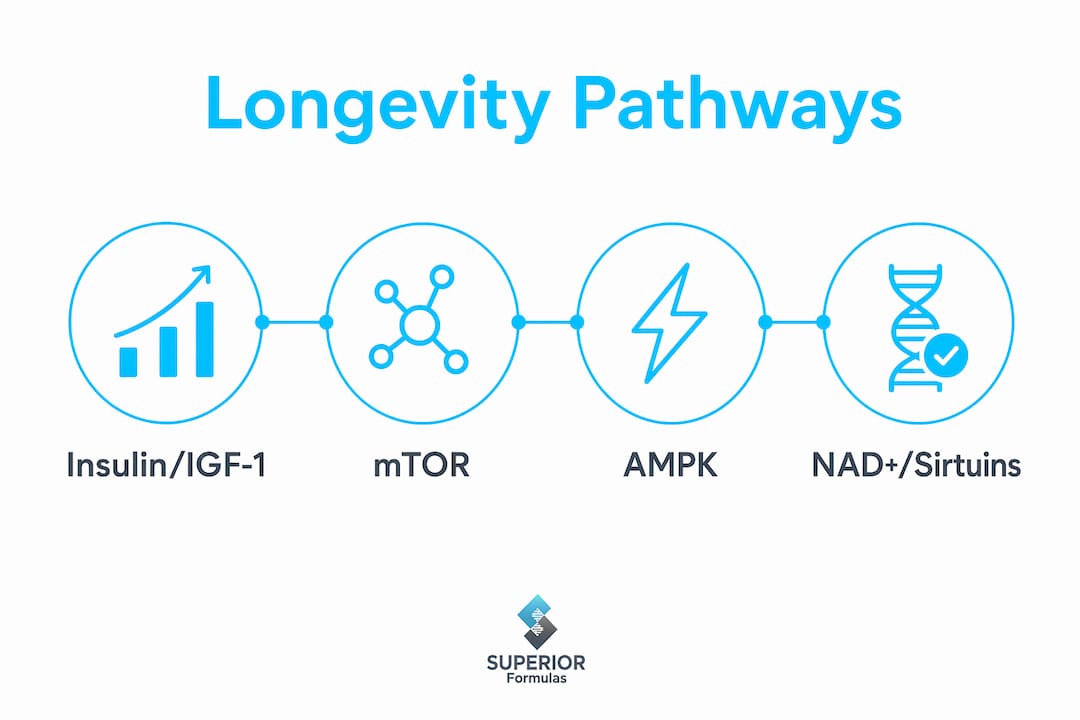
Pro Tip: These four pathways do not operate in isolation. AMPK activates SIRT1 by raising NAD+ levels, and both suppress mTOR. Think of them as an integrated maintenance network, not four separate switches.
Key pathway functions at a glance:
- Insulin/IGF-1: Promotes growth when active; reduced signaling extends lifespan in multiple species
- mTOR: Integrates nutrient and growth signals; inhibition activates autophagy and cellular cleanup
- AMPK: Detects low energy; activates mitochondrial biogenesis and suppresses anabolic programs
- Sirtuins: Require NAD+; regulate stress resistance, DNA repair, and metabolic gene expression
How does dietary restriction influence these longevity pathways?
Dietary restriction (DR) is the most reproducible intervention for extending healthspan across species, from yeast to primates. Its power comes from acting as a system-level input that simultaneously modulates all four core longevity pathways. DR is not simply eating less. It is a coordinated molecular signal that shifts the entire cellular economy from growth to maintenance.
Here is how that shift unfolds at the molecular level:
- Nutrient sensing suppression. Reduced caloric and amino acid intake lowers insulin and IGF-1 signaling, decreasing PI3K/AKT activity and releasing the brake on stress-resistance gene programs.
- mTOR inhibition. Lower amino acid availability, particularly leucine, directly inhibits mTORC1, triggering autophagy and proteostasis pathways that clear damaged proteins and organelles.
- AMPK activation. Reduced caloric intake lowers cellular ATP, raising the AMP/ATP ratio and activating AMPK, which then stimulates mitochondrial biogenesis and NAD+ production.
- Sirtuin upregulation. Rising NAD+ levels activate sirtuins, which modulate inflammatory gene expression, improve mitochondrial efficiency, and enhance DNA repair capacity.
Dietary restriction triggers molecular shifts from anabolic growth to maintenance, promoting autophagy and proteostasis. This is why DR consistently reduces markers of inflammation, improves mitochondrial function, and extends healthspan even when started in midlife. However, the same research identifies real safety tradeoffs: increased vulnerability to infections and impaired wound healing are documented downsides, particularly in older adults or those with low body weight.
Timing matters as much as magnitude. Short-term restriction during key life windows creates lasting pathway and physiological memory effects, suggesting that even periodic dietary interventions can produce durable benefits. The microbiome also plays a role. Gut microbial composition modulates how efficiently nutrient signals reach longevity pathway nodes, which partly explains individual variation in DR response.
Pro Tip: You do not need to practice severe caloric restriction to engage these pathways. Time-restricted eating, protein cycling, and polyphenol-rich diets each activate overlapping pathway responses with a more manageable safety profile. Explore longevity-supporting nutrients that work alongside these dietary strategies.
What is the genetic contribution to longevity pathways?
Genetics shapes both the baseline activity of longevity pathways and the sensitivity of those pathways to environmental inputs. Heritability of intrinsic human lifespan exceeds 50% when deaths from extrinsic causes such as accidents and infections are removed from the analysis. This figure, drawn from Scandinavian twin cohort data, means that roughly half of the variation in how long people live under safe conditions is attributable to inherited factors. That is a substantial genetic signal, but it is not determinism.
Key points on genetics and longevity pathways:
- Pathway sensitivity variants. Genetic variants in the IGF-1 receptor gene (IGF1R) and in FOXO transcription factors alter how strongly cells respond to reduced insulin/IGF-1 signaling. Centenarian populations show enrichment of protective variants in these genes.
- Epigenetic regulation. Longevity genes are not simply on or off. DNA methylation patterns, histone modifications, and non-coding RNAs regulate pathway activity in a tissue-specific and age-dependent manner. Epigenetic clocks like the Horvath clock measure biological age partly by tracking these modifications.
- Gene-environment interaction. The same genetic variant can produce different aging outcomes depending on diet, activity level, and stress exposure. A person with a protective FOXO3 variant who lives a sedentary, high-calorie lifestyle will not necessarily outlive someone with average genetics who consistently activates their longevity pathways through lifestyle.
- Longevity genes as targets. Genes like SIRT1, SIRT3, and AMPK-related kinases are both longevity genes in the biological sense and direct targets of nutritional and pharmacological interventions.
High heritability should be read as evidence for a structured aging trajectory, not a fixed ceiling. It means the pathways to longevity have a genetic architecture that lifestyle interventions can work with or against. Genetic testing for longevity prediction remains limited in clinical utility because most longevity-associated variants have small individual effect sizes. The practical takeaway is that lifestyle interventions remain the most reliable tool for activating longevity pathways regardless of genetic background. For adults 35 and older, healthy aging nutrients that support pathway function are relevant regardless of genetic profile.
How do longevity pathways impact cellular resilience and age-related diseases?
Longevity pathways do not simply slow aging in the abstract. They control specific biological programs that determine whether cells remain functional, become senescent, or trigger inflammation. Understanding these downstream effects explains why pathway modulation is central to preventing age-related diseases including cardiovascular disease, neurodegeneration, and metabolic dysfunction.
| Pathway | Primary cellular effect | Age-related disease connection |
|---|---|---|
| Insulin/IGF-1 | Regulates cell growth and survival | Type 2 diabetes, cancer, neurodegeneration |
| mTOR | Controls autophagy and protein synthesis | Sarcopenia, Alzheimer’s disease, atherosclerosis |
| AMPK | Activates mitochondrial biogenesis | Metabolic syndrome, cardiac aging, muscle loss |
| NAD+/Sirtuins | Modulates inflammation and DNA repair | Inflammatory diseases, genomic instability, aging |
Transcriptomic network analysis reveals distinct co-regulated gene modules associated with longevity, including inflammatory and mitochondrial pathways. Age-related inflammation, sometimes called “inflammaging,” is driven partly by chronic low-level mTOR activation and declining sirtuin activity. Mitochondrial electron transport programs also shift measurably with aging and respond to longevity interventions. This means that biomarkers of mitochondrial function and inflammatory gene expression can serve as indirect readouts of longevity pathway activity.
Cellular senescence is another critical intersection. Senescent cells accumulate with age and secrete pro-inflammatory signals through the senescence-associated secretory phenotype (SASP). However, precision management of cellular senescence requires preventing harmful subsets while preserving beneficial roles. Broad senescent cell clearance, the approach taken by early senolytics research, risks eliminating cells that contribute to wound healing and tissue remodeling. The current scientific consensus favors preventive and precision interventions that modulate pathway activity upstream rather than eliminating senescent cells indiscriminately.
Longevity pathway activity is assessed indirectly via autophagy flux, proteostasis markers, and mitochondrial redox control because equivalent upstream signals yield different aging phenotypes depending on tissue type, sex, and timing. This context dependence is why no single biomarker captures overall longevity pathway status. Clinicians and researchers use panels of markers, including p62 for autophagy, NAD+/NADH ratios, and inflammatory cytokine profiles, to build a more complete picture.
Key takeaways
Longevity pathways are the molecular foundation of healthy aging, and activating them through diet, lifestyle, and targeted nutrition is the most evidence-based strategy available for extending healthspan.
| Point | Details |
|---|---|
| Four core pathways | Insulin/IGF-1, mTOR, AMPK, and NAD+/sirtuins form an integrated maintenance network. |
| Diet is a system-level input | Dietary restriction simultaneously modulates all four pathways, shifting cells from growth to repair. |
| Genetics sets the trajectory | Intrinsic lifespan heritability exceeds 50%, but lifestyle interventions remain the primary lever. |
| Senescence requires precision | Broad senescent cell clearance is less effective than targeted upstream pathway modulation. |
| Context determines outcomes | The same pathway signal produces different aging effects depending on tissue, sex, and timing. |
Why I think most people are approaching longevity pathways backward
Most longevity content focuses on suppressing things: suppress mTOR, suppress IGF-1, suppress senescent cells. That framing is understandable because the research often highlights what happens when these pathways are overactive. But chronic suppression of any longevity pathway node creates its own problems. Permanently blunted mTOR impairs muscle protein synthesis and immune function. Chronically low IGF-1 increases fracture risk. The biology is not about suppression. It is about oscillation.
What actually works, based on the research and clinical evidence, is creating rhythmic variation. Periods of pathway activation followed by periods of downregulation. Fasting followed by adequate protein intake. Stress followed by recovery. This is why time-restricted eating outperforms continuous caloric restriction in many metabolic outcomes. The pathway gets activated and then released, which is closer to how these systems evolved to function.
The genetic contribution data reinforces this. A heritability above 50% for intrinsic lifespan does not mean you are locked in. It means these pathways have a genetic architecture that responds to inputs in a structured way. You are not overriding your biology. You are working with it. The practical implication is to focus less on finding the one intervention that suppresses aging and more on building a lifestyle that creates the right rhythms. Quality nutrients, timed dietary strategies, and research-backed supplements are tools for that rhythm, not replacements for it. I would encourage anyone serious about this to work with a healthcare provider who understands pathway biology rather than chasing single-target interventions.
— cristopher
Support your longevity pathways with Superiorformulas

Superiorformulas develops physician-formulated supplements designed specifically to support the cellular pathways that matter most for healthy aging. Every formulation targets nutrient sensing, mitochondrial function, and cellular resilience using clinically studied ingredients including polyphenols, NAD+ precursors, and Nrf2-activating phytonutrients. Products are manufactured in GMP-certified facilities and third-party tested for purity and consistency, with no unnecessary fillers. If you are ready to support your longevity pathways with science-backed nutrition, explore the full product line at Superiorformulas and find formulations built on the same geroscience principles covered in this article. You can also learn how to identify research-backed supplements before you buy.
FAQ
What are longevity pathways in simple terms?
Longevity pathways are cellular signaling networks, primarily insulin/IGF-1, mTOR, AMPK, and NAD+/sirtuins, that detect nutrient and energy status and shift cells toward repair and maintenance rather than growth. Activating these pathways is associated with longer healthspan across multiple species.
Can lifestyle changes actually activate longevity pathways?
Yes. Dietary restriction, time-restricted eating, and exercise each modulate longevity pathway activity by altering nutrient sensing, energy status, and NAD+ availability. Research confirms these inputs trigger autophagy, reduce inflammation, and improve mitochondrial function through the same molecular mechanisms.
How do longevity genes relate to these pathways?
Longevity genes such as FOXO3, SIRT1, and IGF1R encode proteins that are direct components or regulators of longevity pathways. Genetic variants in these genes alter pathway sensitivity, but lifestyle factors remain the primary determinant of how actively these pathways function throughout life.
Is it possible to measure longevity pathway activity?
Direct measurement is not yet clinically practical because pathway activity varies by tissue, sex, and timing. Researchers use indirect biomarkers including autophagy flux markers, NAD+/NADH ratios, and inflammatory cytokine panels to estimate overall pathway status.
What is the risk of over-suppressing pathways like mTOR?
Chronic mTOR suppression impairs muscle protein synthesis, immune response, and wound healing. The evidence supports periodic modulation through fasting or dietary cycling rather than sustained pharmacological inhibition, which preserves the oscillatory nature these pathways require to function correctly.
Recommended
- Longevity Nutrients: Science-Backed Choices for Cellular Health - SUPERIOR Formulas
- What Are Premium Supplements? A Science-Backed Longevity Guide - SUPERIOR Formulas
- How to identify research-backed supplements for longevity - SUPERIOR Formulas
- Why choose science-driven supplements for longevity gains - SUPERIOR Formulas


