


Most people assume that adding more supplements to their routine automatically strengthens cellular health. The reality is more precise. Zinc, selenium, and vitamin C play key, targeted roles in cellular defense through antioxidant mechanisms, immune cell function, and oxidative stress modulation, but only when used strategically. For health-conscious adults over 35, understanding the difference between indiscriminate supplementation and evidence-based, targeted support is what separates genuine cellular resilience from expensive guesswork. This guide provides that clarity.
Table of Contents
- Understanding cellular defense: What actually protects your cells
- Key nutrients: Targeted roles of zinc, selenium, and vitamin C
- Phytochemicals and advanced antioxidant strategies
- Benefits, risks, and best practices in supplementing for cellular defense
- Applying supplement strategies: Personalized steps for health-conscious adults
- Rethinking supplement routines: What most guides overlook
- Explore advanced supplement solutions for cellular defense
- Frequently asked questions
Key Takeaways
| Point | Details |
|---|---|
| Correct deficiencies first | Targeted supplementation to fix specific nutrient gaps is more effective for cellular defense than indiscriminate use. |
| Synergy matters | Combining certain nutrients like vitamin C, zinc, and selenium can enhance cellular protection more than using single supplements. |
| Personalized strategies | Testing for deficiencies and tailoring dosages reduces risk and maximizes benefits for healthy aging. |
| Risks of excess | High-dose supplements can be harmful, especially with nutrients like selenium and antioxidants during cancer therapy. |
| Phytochemical support | Plant-derived compounds like quercetin and resveratrol modulate key pathways for cardiovascular and cellular health. |
Understanding cellular defense: What actually protects your cells
Every day, your cells face a relentless barrage of reactive oxygen species, commonly called ROS. These are chemically reactive molecules generated naturally through metabolism, environmental exposures, UV radiation, pollution, and even moderate exercise. In controlled amounts, ROS serve important signaling functions. When they accumulate faster than the body can neutralize them, oxidative stress occurs, damaging DNA, proteins, and cell membranes in ways directly linked to accelerated aging.
Your body operates two overlapping defense systems to manage this:
- Enzymatic antioxidants: Superoxide dismutase (SOD), catalase (CAT), and glutathione peroxidase (GPx) are proteins your body produces internally. They work as your first line of cellular protection.
- Non-enzymatic antioxidants: These include vitamins A, C, and E, glutathione (GSH), and coenzyme Q10 (CoQ10). They are obtained through diet or supplementation and act as reinforcements.
Research confirms that antioxidants neutralize ROS through both enzymatic and non-enzymatic pathways, and supplements become most relevant when natural defenses are overwhelmed or depleted. That nuance matters enormously. A 38-year-old with a nutrient-rich diet faces very different cellular needs than a 62-year-old managing chronic inflammation, poor sleep, or high environmental exposures.
Key insight: Cellular defense is not a single mechanism. It is a layered, dynamic network. Effective supplementation works within that network, not around it.
As we age, enzymatic antioxidant activity declines, mitochondrial efficiency decreases, and the cumulative burden of oxidative damage accelerates. This is why targeted antioxidant supplements science becomes more relevant after 35, not less. The goal is to reinforce a system that is gradually losing ground, not to flood the body with high-dose compounds that may actually disrupt natural regulatory balance.
Key nutrients: Targeted roles of zinc, selenium, and vitamin C
These three micronutrients are among the most studied for cellular defense. Each plays a distinct, irreplaceable role. Understanding what they actually do, and under what conditions they help most, is essential before reaching for any supplement bottle.
Zinc
Zinc supports T-lymphocyte maturation, macrophage and neutrophil function, and cytokine production. In practical terms, it is central to how your immune cells identify, respond to, and clear cellular threats. Crucially, the immune-boosting benefits of zinc supplementation are most pronounced in individuals who are actually deficient. For those with adequate zinc levels, adding more does not meaningfully amplify immune response.
Selenium
Selenium, via selenoproteins like glutathione peroxidase, bolsters antioxidant defense and cell-mediated immunity. Selenium has one of the narrowest therapeutic windows of any micronutrient. The difference between a beneficial daily intake and a toxic one can be as small as 200 to 400 micrograms. Brazil nuts, for example, can vary so widely in selenium content that eating just two or three per day can push you beyond the upper limit. This is a nutrient that genuinely demands testing before supplementing.
Vitamin C
Vitamin C maintains epithelial barriers, aids leukocyte chemotaxis, and helps modulate oxidative stress. It also regenerates vitamin E after it has neutralized a free radical, creating a synergistic cycle. High-dose vitamin C, however, shows limited additional benefits in people who are already sufficient. Excess is largely excreted, but very high intakes can increase kidney stone risk in susceptible individuals.
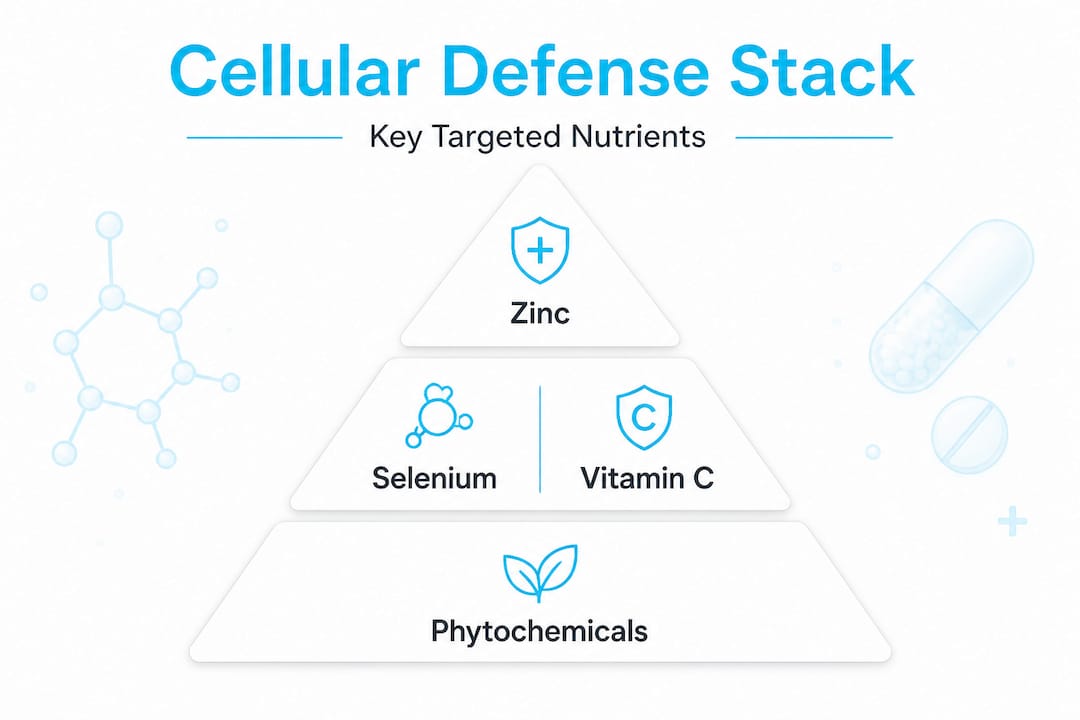
| Nutrient | Primary cellular role | Deficiency risk | Toxicity risk |
|---|---|---|---|
| Zinc | Immune cell maturation, cytokine regulation | Moderate (plant-based diets) | Low to moderate |
| Selenium | Antioxidant enzyme (GPx), cell immunity | Moderate (soil-dependent) | High (narrow range) |
| Vitamin C | Barrier integrity, leukocyte support | Low (varied diet) | Low (water-soluble) |
Key points to remember:
- Supplementation works best when correcting confirmed deficiencies
- Selenium toxicity can cause hair loss, nerve damage, and fatigue at excess doses
- Vitamin C and zinc together may enhance epithelial and immune defense more effectively than either alone
- Test serum levels for zinc and selenium before starting supplementation
Pro Tip: Ask your physician for a comprehensive micronutrient panel before selecting any supplement stack. Results will tell you precisely where your cellular defense gaps actually exist, not where you assume they might be.
Reviewing current supplementation guidelines can also help you identify evidence-based dosing ranges that match your age, health status, and lifestyle factors.
Phytochemicals and advanced antioxidant strategies
Beyond vitamins and minerals, a powerful class of compounds found in plants offers sophisticated support for cellular defense. Phytochemicals do not simply neutralize ROS. Many of them activate internal defense programs, most notably through a pathway called Nrf2.
Nrf2 (nuclear factor erythroid 2-related factor 2) acts as the body’s master regulator of antioxidant response. When activated, it switches on the production of the body’s own antioxidant enzymes, essentially amplifying your internal defense network from within. This is why Nrf2 activation is sometimes called “the body’s inner switch for resilience.”
Phytochemicals like quercetin, resveratrol, and curcumin modulate the Nrf2 pathway, reduce oxidative stress, and lower systemic inflammation, with demonstrated cardiovascular and cellular protective effects. Here is how the leading compounds compare:
| Phytochemical | Primary mechanism | Cellular benefit | Evidence strength |
|---|---|---|---|
| Quercetin | Nrf2 activation, senolytic | Clears damaged cells, reduces inflammation | Strong (human + in vitro) |
| Resveratrol | Sirtuin activation, Nrf2 | Mitochondrial health, anti-aging pathways | Moderate (human) |
| Curcumin | NF-kB inhibition, Nrf2 | Anti-inflammatory, oxidative stress reduction | Moderate (bioavailability is limiting factor) |
| Fisetin | Senolytic, Nrf2 | Clears senescent cells, cellular renewal | Emerging (promising) |
When to consider phytochemical supplementation:
- You are over 40 and want to support healthy aging pathways proactively
- Your diet is consistently low in colorful vegetables, berries, and polyphenol-rich foods
- You are seeking compounds that work upstream, activating the body’s own defense systems
- You want to complement zinc, selenium, and vitamin C with Nrf2-activating compounds
Pro Tip: Curcumin has notoriously poor absorption on its own. Look for formulations that include piperine (from black pepper) or use phospholipid-based delivery systems to ensure the compound actually reaches circulation where it can exert cellular effects.
For those ready to act on this science, exploring Nrf2 activation supplements and targeted fisetin and quercetin supplement formulas offers a practical starting point grounded in this research.
Benefits, risks, and best practices in supplementing for cellular defense
Science strongly supports targeted supplementation for cellular defense. It does not universally support high-dose, broad-spectrum supplementation for everyone. This distinction is often lost in mainstream wellness messaging.
Practical steps to supplement safely and effectively:
- Identify your personal risk profile. Age, diet quality, existing conditions, and medication use all affect which nutrients your cells actually need more of.
- Test before you supplement. Blood testing for zinc, selenium, vitamin D, and vitamin C provides objective data rather than assumptions.
- Start with clinically supported doses. Avoid “mega-dosing” without a clinical rationale. More is not always better and is sometimes harmful.
- Monitor effects over 60 to 90 days. Track energy, recovery, inflammation markers, or any relevant biomarkers.
- Reassess periodically. Your cellular needs at 45 are different from your needs at 60. Supplementation strategies should evolve.
Clinical caution: High-dose antioxidants during chemotherapy may actually reduce treatment efficacy by neutralizing the ROS that chemotherapy relies upon to destroy cancer cells. This is a critical reminder that ROS are not purely harmful. They serve essential biological functions, including killing abnormal cells.
The USPSTF has been explicit: supplementation most effectively corrects deficiencies. Indiscriminate use carries real risks and lacks broad support for cardiovascular disease prevention in the general population. This is not an argument against supplements. It is an argument for using them with precision.
For deeper guidance on evidence-based cellular defense strategies, including the latest research on antioxidant pathways, Superior Formulas provides physician-reviewed resources. For broader anti-aging insights across complementary wellness approaches, additional tools and therapies exist worth exploring.
Applying supplement strategies: Personalized steps for health-conscious adults
Knowing the science is one thing. Translating it into a practical, sustainable routine is where most people either succeed or stall. Here is how to close that gap.
Step-by-step personalized approach:
- Start with a micronutrient panel. Prioritize testing for deficiencies in zinc, selenium, vitamin C, and vitamin D before supplementing. This single step prevents both under-supplementation and dangerous over-supplementation.
- Choose multi-nutrient blends over isolated megadoses. Synergies between vitamin C and zinc or selenium have demonstrated meaningful benefits in immune resilience studies, and polytherapy approaches reduce the risks associated with single high-dose nutrients.
- Select products with transparent labeling and GMP certification. Third-party tested, physician-formulated supplements reduce the guesswork around potency and purity. What is printed on the label should match what is in the capsule.
- Introduce phytochemicals strategically. If your micronutrient panel shows adequacy across key nutrients, adding Nrf2-activating compounds like quercetin or resveratrol may offer the next layer of cellular support.
- Track your progress with objective markers. Repeat your lab panel every six to twelve months. Monitor how you feel physically: energy levels, recovery time, immune resilience during seasonal stress.
Pro Tip: A well-designed multi-nutrient supplement that includes clinically relevant doses of zinc, selenium, vitamin C, and complementary phytochemicals can simplify your routine significantly while delivering more coherent cellular support than a pile of individual bottles.
The key is consistency paired with monitoring. Supplements are not a single intervention. They are an ongoing, adaptive practice that should evolve as your health, age, and lifestyle change.
Rethinking supplement routines: What most guides overlook
Most supplement guides focus on what to take. Very few explain when to stop, when to reduce, or why the concept of more is fundamentally at odds with how cellular defense actually works.
The biological concept of hormesis is worth understanding here. Many of the same compounds that protect cells at moderate doses become stressors or even toxic at high doses. This applies to antioxidants, including vitamin C, vitamin E, and selenium. Your body’s antioxidant network is a finely calibrated system that responds to dose, timing, and context. Disrupting that calibration with excess supplementation does not amplify resilience. It can undermine it.
We also see an uncomfortable truth in longevity research: people with the best outcomes tend not to be those who take the most supplements. They tend to be those who eat varied whole food diets, maintain physical activity, manage stress, and use supplements to fill specific, verified gaps. That is a harder message to sell than “take this and feel better,” but it is the one supported by the evidence.
Another overlooked factor is periodic assessment. Most people start a supplement routine and continue it indefinitely, regardless of whether their levels have normalized or whether their life circumstances have changed. If you corrected a selenium deficiency six months ago, continuing at the same dose may now push you into excess. Periodic retesting is not optional. It is essential.
Finally, the appeal of polypharmacy, or stacking many supplements in hopes of additive benefit, is largely unsupported outside of carefully designed combinations. Some synergies are real, as with vitamin C and zinc. Others are speculative or even counterproductive. A clinician-guided approach to advanced supplement strategies is always preferable to self-assembled mega-stacks built from wellness trends.
Explore advanced supplement solutions for cellular defense
If this guide has clarified one thing, it is that effective cellular defense requires more than good intentions. It requires targeted, evidence-informed choices backed by testing, transparency, and clinically validated formulations.
Superior Formulas was built precisely for this moment in your health journey. Our physician-formulated daily multi-nutrient blend delivers the zinc, selenium, vitamin C, and supporting nutrients your cells need, at clinically relevant doses and in GMP-certified, third-party tested form. For those ready to activate the body’s own defense network, our Nrf2 activator supplement targets the master antioxidant pathway directly. And for cellular renewal at the senescent cell level, our senolytic supplement brings together fisetin and quercetin in a research-aligned formulation. Shop Now and take the guesswork out of aging well.
Frequently asked questions
How do supplements enhance cellular defense?
Zinc, selenium, and vitamin C support antioxidant mechanisms and immune cell function, helping cells counteract oxidative stress and age-related decline when used to correct real deficiencies.
Is high-dose supplementation safe for healthy adults?
High doses may not offer added benefits and carry real toxicity risks, particularly with selenium’s narrow therapeutic window. Targeted, tested dosing is always the safer approach.
What are the best supplements for aging-related cellular protection?
Zinc, selenium, vitamin C, and phytochemicals like quercetin and resveratrol all offer cellular protection, but Nrf2-modulating phytochemicals combined with corrected micronutrient deficiencies tend to deliver the most coherent benefit.
Can antioxidants interfere with cancer treatment?
High-dose antioxidants during chemotherapy may reduce treatment efficacy by neutralizing the ROS that some therapies depend on to destroy cancer cells. Always consult your oncologist before supplementing during treatment.
Should I get tested for deficiencies before starting supplements?
Yes. Testing for deficiencies in zinc, selenium, and vitamin C before supplementing makes your strategy more effective and significantly reduces the risk of accumulating excess.
Recommended
- Explore the Science - SUPERIOR Formulas
- Formula 9 — Superior Multi+ Daily (with AREDS2 nutrients) - SUPERIOR Formulas
- Formula 3 — Superior Senolytic+ (Fisetin + Quercetin) - SUPERIOR Formulas
- Formula 1 — LONGEVITY Daily Nrf2 Activate+ - SUPERIOR Formulas
- BodyBoost: Ultimate Immune Support – SuperNatural
- Why advanced supplements boost cognition without stimulants – CP-1


