


Nutritional research is the scientific investigation of how nutrients and dietary patterns affect human health and disease. Known formally as nutritional science, this field draws on biochemistry, epidemiology, clinical medicine, and public health to generate the evidence behind every dietary guideline you have ever read. Understanding what is nutritional research means understanding how scientists move from a hypothesis about food to a recommendation your doctor might give you. The field spans everything from cellular metabolism to national food policy, and the quality of its methods determines how much you can trust its conclusions.
What types of studies are used in nutritional research?
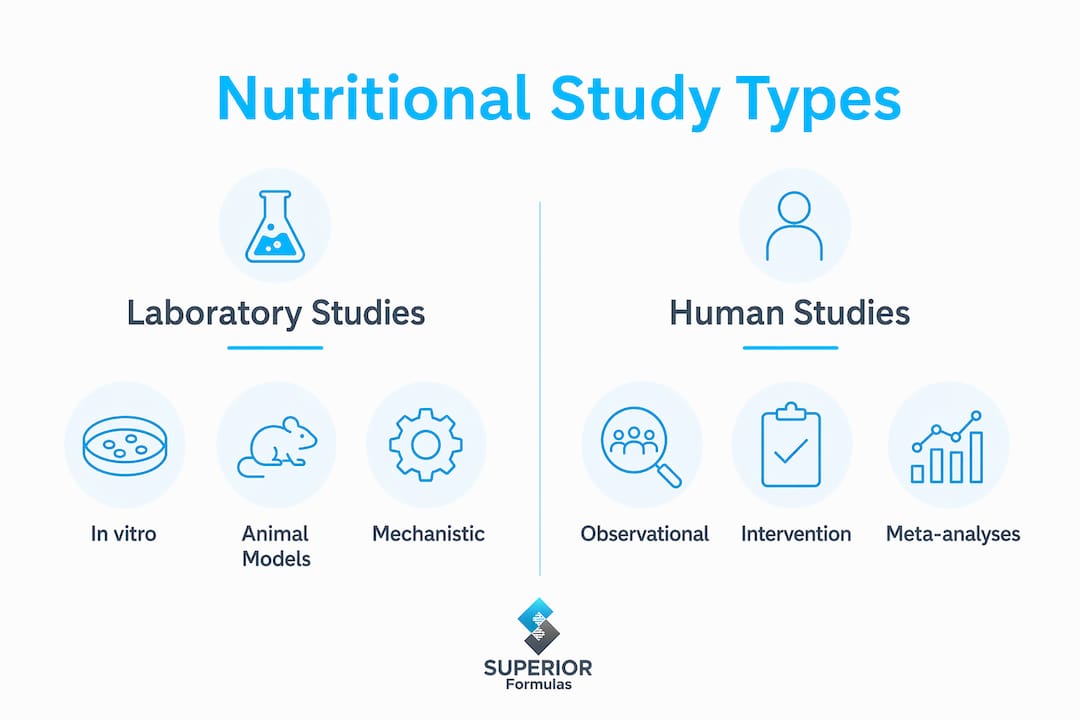
Nutrition research is categorized by study design, ranging from laboratory experiments to large population trials. Each design answers a different kind of question, and each carries a different level of reliability.
In vitro studies test nutrient effects on cells or tissues in a lab setting. They generate mechanistic insights, meaning they show how a nutrient interacts with a biological pathway at the molecular level. Their limitation is direct: what happens in a petri dish does not always happen in a living human body.

Observational studies track what people eat and what happens to their health over time, without the researcher controlling the diet. Cohort studies, case-control studies, and cross-sectional surveys all fall here. They are powerful for identifying correlations across large populations, but they cannot prove that diet X caused outcome Y.
Intervention studies, including randomized controlled trials (RCTs), assign participants to specific dietary conditions and measure outcomes. RCTs are the gold standard for causality because random assignment reduces the influence of confounding variables. At the top of the evidence hierarchy sit systematic reviews and meta-analyses, which pool results from multiple RCTs or observational studies to reach higher-level conclusions.
| Study type | What it measures | Evidence strength |
|---|---|---|
| In vitro | Cellular and molecular mechanisms | Low (not human) |
| Cross-sectional | Associations at one point in time | Low to moderate |
| Case-control | Past exposures in disease vs. healthy groups | Moderate |
| Cohort study | Diet and outcomes tracked over time | Moderate to high |
| Randomized controlled trial | Causal effect of a dietary intervention | High |
| Systematic review / meta-analysis | Synthesized evidence across multiple studies | Highest |
Meta-analyses synthesize results from multiple RCTs or observational studies to resolve inconsistencies and provide the clearest picture available. That synthesis function is why they sit at the top of the hierarchy.
How nutritional research methods measure dietary intake
Measuring what people actually eat is one of the hardest problems in nutritional science. Researchers use two broad categories of dietary assessment: quantitative daily records and retrospective methods.
Quantitative daily records include 24-hour dietary recalls and food diaries. A 24-hour recall asks a person to report everything consumed in the past day, while a food diary records intake in real time. Both methods capture detailed data on portion sizes and food composition. Precision improves with more recording days/03%3A_Food_consumption_of_individuals/3.01%3A_Methods_for_measuring_food_consumption_of_individuals), because a single day may not reflect habitual eating patterns.
Retrospective methods like food frequency questionnaires (FFQs) ask participants to report how often they consumed specific foods over the past month, six months, or year. FFQs are better suited for capturing usual dietary patterns across a population. They sacrifice some precision for practicality, making them the tool of choice in large epidemiological studies.
| Assessment method | Best use case | Key limitation |
|---|---|---|
| 24-hour dietary recall | Detailed short-term intake | Single day may not reflect habits |
| Food diary | Real-time intake tracking | Participant burden; behavior change |
| Food frequency questionnaire | Usual long-term dietary patterns | Recall bias; less precise portions |
| Dietary history interview | Comprehensive habitual intake | Time-intensive; interviewer skill required |
Nutrient classification also shapes how researchers design studies. Nutrients are classified as essential (obtained only through diet) or nonessential (synthesized by the body). Macronutrients provide energy: fat delivers 9 kcal per gram, while protein and carbohydrates each deliver 4 kcal per gram. Micronutrients, needed in far smaller amounts, drive cellular processes including immune function and antioxidant defense. Understanding these categories helps you read a nutrition study and immediately know what biological mechanism is being tested.
Pro Tip: When reading a nutrition study, check how many days of dietary data were collected. A study using a single 24-hour recall has far more measurement error than one using seven-day food diaries. More recording days mean more reliable intake estimates.
Why is nutritional research difficult to conduct and interpret?
Nutrition research is harder to conduct than drug research, and most readers do not realize why. The core problem is that diet is not a single variable. People eat hundreds of foods in complex combinations, and those foods interact with each other, with genetics, and with lifestyle factors in ways that are nearly impossible to isolate.
RCTs face specific structural challenges in dietary studies. Participant compliance and blinding difficulties make nutrition RCTs far more complex than pharmaceutical trials. You cannot give someone a placebo meal. Participants often know what diet they are following, which changes their behavior. Long-term dietary RCTs are also expensive and logistically demanding, which is why most run for months rather than decades.
Observational studies carry their own interpretive risks:
- Confounding variables: A person who eats more vegetables may also exercise more, sleep better, and smoke less. Separating the vegetable effect from everything else requires sophisticated statistical controls.
- Reverse causation: Disease status can influence diet choices, making it appear that a particular diet caused the disease when the disease actually changed the diet. Cross-sectional studies are especially vulnerable to this error.
- Recall bias: People systematically misremember what they ate, particularly for foods they perceive as unhealthy.
- Statistical significance vs. health relevance: A result can be statistically significant and still represent a trivially small effect in the real world.
“Mechanistic research provides valuable biological insights, but epidemiological and clinical trial data are generally more influential in shaping practical dietary guidelines.”
That distinction matters enormously. A laboratory study showing that a compound activates a longevity pathway in cells is not the same as clinical evidence that eating that compound extends human life. Both types of evidence have value, but they answer different questions.
Pro Tip: When a nutrition headline sounds dramatic, check whether the study was in vitro, observational, or a clinical trial. The study type tells you how much weight to give the finding before changing your diet.
How to critically evaluate nutritional research findings
Reading nutrition research well is a skill, and it is one that pays off every time a new dietary headline appears. Evaluating nutrition literature requires assessing three things: methodological quality, the magnitude and precision of the effect, and whether the findings apply to you.
-
Check the study design first. An RCT or systematic review carries more weight than a single observational study. If the headline is based on a cross-sectional survey, treat the finding as preliminary.
-
Look at effect size, not just p-values. A statistically significant result with a tiny effect size may have no practical meaning for your health. Ask: how large was the difference between groups, and how precisely was it measured?
-
Assess the population studied. A study conducted in elderly men with metabolic disease may not apply to healthy adults in their 30s. Population differences in age, genetics, baseline health, and diet culture all affect how results translate.
-
Prioritize systematic reviews and meta-analyses. Synthesized evidence across multiple studies resolves the inconsistencies that single studies inevitably produce. One study showing a benefit means far less than ten studies consistently showing the same benefit.
-
Consider funding and conflicts of interest. Industry-funded studies are not automatically invalid, but they warrant extra scrutiny. Look for independent replication of key findings.
The applications of nutritional research span physical sciences, medicine, public health, and policy. That breadth means findings must be interpreted within context. A result relevant to national dietary guidelines may not be the right framework for an individual making personal supplement decisions. Consulting a guide to supplement quality alongside primary research helps you apply findings practically.
Pro Tip: Search for the systematic review on any nutrition topic before reading individual studies. The Cochrane Library and PubMed both index systematic reviews, and they will save you from being misled by a single outlier study.
Key takeaways
Nutritional research is most useful when you understand the study design behind every finding, because the design determines how much trust the evidence deserves.
| Point | Details |
|---|---|
| Study design determines evidence strength | Systematic reviews and RCTs outrank observational studies and in vitro experiments. |
| Dietary assessment method matters | FFQs capture usual patterns; food diaries capture detail. Match the method to the research question. |
| RCTs have real limits in nutrition | Blinding and compliance challenges make dietary RCTs harder to conduct than drug trials. |
| Effect size beats statistical significance | A significant p-value with a tiny effect size rarely translates to meaningful health impact. |
| Reverse causation is a hidden risk | Disease can change diet, making it appear that diet caused the disease in observational data. |
Nutrition research is more nuanced than most headlines suggest
I have spent years reading nutrition studies, and the single biggest mistake I see people make is treating all research as equal. A viral headline citing a mouse study or a single observational survey gets the same social media attention as a decade-long RCT. They are not the same thing, and treating them as equivalent leads to constant dietary whiplash.
The rapidly evolving nature of nutrition science makes critical thinking non-negotiable. Recommendations on dietary fat, sodium, and even red meat have shifted significantly over the past 30 years, not because scientists were wrong, but because better methods produced better evidence. That is how science is supposed to work. The problem is that each shift gets reported as a scandal rather than as progress.
What I find genuinely useful is anchoring decisions in systematic reviews rather than individual studies, and in healthy aging nutrients with consistent mechanistic and clinical support. The nutrients that show up repeatedly across multiple study types, in multiple populations, with plausible biological mechanisms, are the ones worth paying attention to. Everything else deserves a wait-and-see approach.
The uncomfortable truth is that most nutrition advice you encounter online is based on the weakest tier of evidence. Learning to read a study’s methods section is the single most protective skill you can develop as a health-conscious adult.
— cristopher
Superiorformulas: science-backed supplements for informed choices
Nutritional science is only as useful as the products built on it. Superiorformulas was founded by a physician-scientist with one goal: to create supplements that reflect the actual state of the evidence, not marketing trends.
Every formulation at Superiorformulas uses clinically studied ingredients selected for their mechanistic and clinical support, manufactured in GMP-certified facilities with third-party testing for purity. If you have spent time learning how nutrition research works, you deserve supplements held to the same standard. Visit Superiorformulas to see the full product line, built for longevity, cellular health, and evidence-based wellness.
FAQ
What is nutritional research in simple terms?
Nutritional research is the scientific study of how nutrients and dietary patterns affect human health and disease. It uses methods ranging from laboratory experiments to large population trials to generate evidence for dietary guidelines.
What is the strongest type of nutritional study?
Systematic reviews and meta-analyses sit at the top of the evidence hierarchy because they synthesize results from multiple studies. Randomized controlled trials are the gold standard for establishing causality within a single study.
Why do nutrition recommendations keep changing?
Recommendations change as better study designs and larger datasets replace earlier, weaker evidence. This reflects scientific progress, not inconsistency. Findings from observational studies are often revised when RCTs or meta-analyses test the same question more rigorously.
What is a food frequency questionnaire?
A food frequency questionnaire (FFQ) is a dietary assessment tool that asks participants how often they consumed specific foods over a defined period, typically months to a year. FFQs are widely used in large epidemiological studies to capture usual dietary patterns.
How do I know if a nutrition study applies to me?
Check the study population for age, health status, and dietary background. A study conducted in one demographic group may not translate directly to another. Systematic reviews that pool data across diverse populations offer broader applicability than single-population trials.


