


A clinical formulation is a concise, theory-informed, collaborative explanation of why a specific person is experiencing a specific problem at a specific point in time, and what that means for their care. Also called case formulation or case conceptualization, it links clinical assessment directly to a treatment roadmap. Where a diagnosis labels a condition, a formulation explains it. Most formulations organize evidence around four core factors:
- Predisposing factors: biological, psychological, or social vulnerabilities present before the problem emerged
- Precipitating factors: the triggers or stressors that activated the problem
- Perpetuating factors: what keeps the problem going despite attempts to resolve it
- Protective factors: strengths and resources that support recovery
Table of Contents
- What is clinical formulation in healthcare practice?
- How formulation practice has shifted toward collaboration
- What ‘clinical formulation’ means for physician-formulated supplements
- Limits and best practices every clinician should know
- How to evaluate a physician-formulated supplement
- U.S. regulatory context: what ‘clinical’ can and cannot mean on a label
- How Superiorformulas operationalizes clinical formulation
- Key Takeaways
- Why clinical formulation matters more than most practitioners realize
- Superiorformulas: physician-formulated supplements with a documented clinical rationale
- Recommended sources and further reading
What is clinical formulation in healthcare practice?
A clinical formulation is a hypothesis-driven explanation of a patient’s presenting problems that guides every decision that follows, from treatment targets to outcome measures. Research describes it as a dynamic, context-sensitive model of client functioning that connects assessment to intervention and evaluation. The Division of Clinical Psychology’s good-practice guidelines frame it as a collaborative, compassionate hypothesis that should be understandable to the patient, not just the clinician.
The standard components a clinician expects to see include the presenting problem, the predisposing and precipitating history, the factors maintaining the problem, protective resources, a formulation hypothesis that ties those elements together, and clear treatment targets. Formulation differs from diagnosis in a fundamental way: a diagnosis tells you what a patient has; a formulation tells you why they have it, what sustains it, and how to address it. Contemporary psychiatry literature warns that relying on diagnosis alone risks fragmenting care by missing the causal and contextual picture.
Pro Tip: Keep your formulation to one page. A formulation that requires three pages to read is too complex to guide real-time clinical decisions. Parsimony is a feature, not a shortcut.
How formulation practice has shifted toward collaboration
Contemporary practice treats formulation as an evolving roadmap co-constructed with the patient, not an expert pronouncement handed down from above. Research tracking the evolution of formulation practice shows a clear shift from clinician-led models toward multidisciplinary, patient-inclusive approaches that increase ownership and treatment compliance.
The benefits of this shift are well-documented:
- Patients report reduced feelings of powerlessness when formulation is used collaboratively rather than diagnosis alone
- Clearer treatment targets emerge when multiple disciplines contribute their perspective
- Patients who understand their own formulation show stronger adherence to agreed interventions
- Collaborative methods, including timelines, genograms, and simple diagrams, reduce distress when revisiting adverse experiences
Research note: Studies report decreased feelings of powerlessness and worthlessness when formulation is used collaboratively, a finding that supports patient-centered models across specialties, not just mental health.
What ‘clinical formulation’ means for physician-formulated supplements
In the nutraceutical context, a clinical formulation means a documented, physician-led process that maps a clinical question to ingredient selection, dose rationale, mechanism evidence, and quality controls. It is not a marketing phrase. The clinical supplement workflow at Superiorformulas illustrates what this looks like in practice:
- Clinical question: What biological problem or aging pathway is the product addressing?
- Mechanism mapping: Which cellular or biochemical pathways are relevant (e.g., Nrf2 activation, senolytic activity, mitochondrial support)?
- Ingredient selection: Which compounds have peer-reviewed evidence for that mechanism at a specific dose?
- Dose and safety review: Are the selected doses within studied ranges and free of known interactions?
- GMP manufacturing and stability: Is the product made in a certified facility with documented stability data?
- Third-party testing: Are purity and potency independently verified?
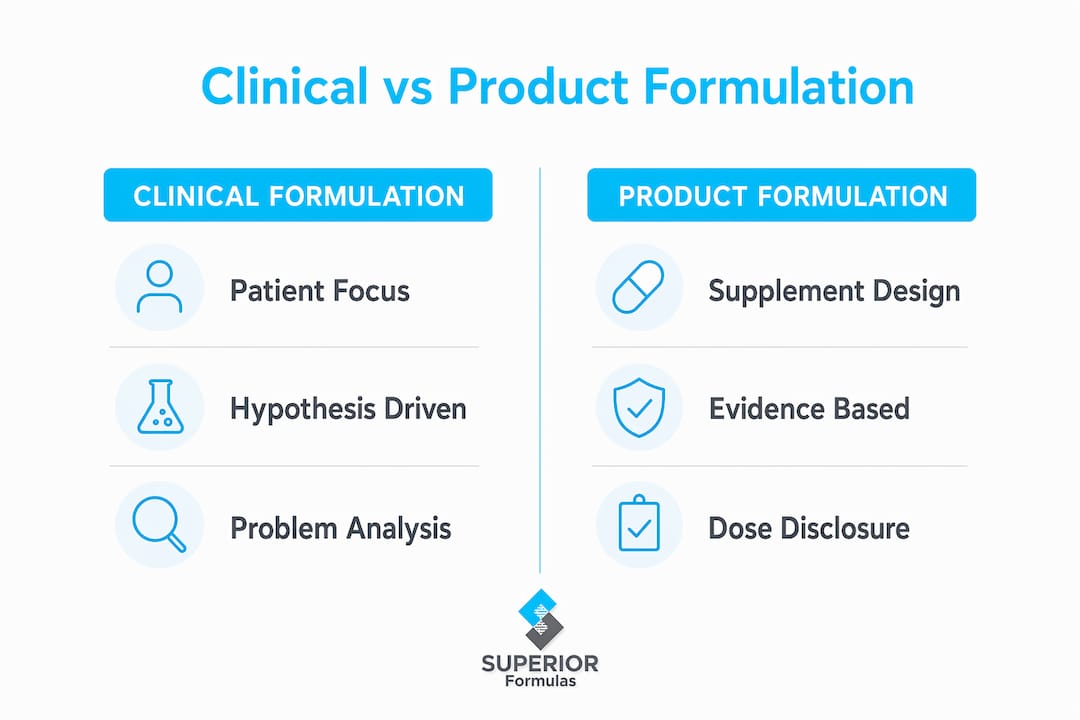
Patient-level clinical formulation and product-level formulation share the same logic: both start with a specific problem, identify the mechanism, and select an intervention with a documented rationale. The difference is scale. Patient formulation is individualized; product formulation targets a population-level biological need. Trust signals that indicate a supplement used genuine clinical formulation include physician or clinician involvement in design, mechanistic rationale tied to published research, full-dose disclosure with no proprietary blends, and independent testing certificates. You can explore nutraceutical formulation examples to see how this plays out across different product categories.
Limits and best practices every clinician should know
A formulation is a hypothesis, and every hypothesis has limits. Its reliability depends on the quality of the assessment, the diversity of the team contributing to it, and how consistently it is revised as new information emerges. Consensus research identifies several common pitfalls: overly complex formulations that clinicians cannot use in real time, top-down approaches that exclude the patient’s own account, and omission of sociocultural factors that are often central to why a problem persists.
Best-practice rules of thumb:
- Keep it concise and written in language the patient can read
- Link every element directly to at least one treatment target
- Include measurable outcomes so progress can be tracked
- Update the formulation when new clinical information changes the picture
- Integrate sociocultural context, not just biological and psychological factors
One caution worth stating plainly: revisiting adverse experiences during formulation work can cause distress. Using collaborative, “doing with” methods, where the patient edits, agrees to, and helps build the formulation, reduces that risk considerably.
How to evaluate a physician-formulated supplement
The fastest way to assess a physician-formulated supplement is to check four things: who designed it, what evidence supports the ingredients and doses, how it was manufactured, and how transparently it is labeled. Here is a practical numbered checklist:
- Verify clinician involvement. Is a named physician-scientist or clinical researcher credited with the formulation? A vague “developed with experts” claim is not the same thing.
- Check for mechanistic and clinical references. Does the product page or accompanying guide cite peer-reviewed research for each key ingredient at the dose used?
- Confirm full-dose disclosure. Every ingredient amount should be listed. Proprietary blends that hide individual doses make independent dose verification impossible.
- Review GMP certification. The manufacturing facility should hold current Good Manufacturing Practice certification from an FDA-recognized body.
- Look for third-party testing certificates. Independent purity and potency testing by an accredited laboratory is the strongest quality signal available to a consumer.
- Evaluate the product workflow or published guide. A company that publishes its evidence-based formulation process is demonstrating accountability, not just making claims.
When to hold back: if the dose is below the studied range, the mechanism is unsupported by human data, or there is a plausible interaction with a patient’s current medications, seek more evidence before recommending the product.
Pro Tip: Document your supplement recommendations the same way you document a clinical decision: note the rationale, the dose, the expected outcome, and a review date. Revise based on patient response.
U.S. regulatory context: what ‘clinical’ can and cannot mean on a label
Under U.S. law, dietary supplements occupy a distinct regulatory category. The FDA does not approve supplements before they reach market, and manufacturers cannot lawfully claim their products treat, cure, or prevent any disease without going through the drug approval pathway.
Practical implications for label language and advertising:
- Structure/function claims (e.g., “supports cellular health,” “promotes healthy aging”) are permitted with a required disclaimer that the FDA has not evaluated the claim
- Health claims linking a nutrient to a disease require FDA authorization and specific scientific agreement
- Drug claims (e.g., “treats oxidative stress-related disease”) are prohibited on supplement labels
- The word “clinical” on a label is not regulated as a specific legal term; it is a marketing descriptor, not a guarantee of clinical trial evidence
Regulatory note: The FDA’s dietary supplement framework places the burden of safety and truthfulness on the manufacturer, not on pre-market review. Third-party testing and published evidence dossiers are the practical substitutes for pre-market approval.
Clinicians should treat the word “clinical” on a supplement label as a starting point for inquiry, not a conclusion. Ask for the evidence dossier, the testing certificates, and the formulation rationale before recommending a product to a patient.
How Superiorformulas operationalizes clinical formulation
Superiorformulas uses a physician-scientist-led workflow that begins with a clinical question and ends with a tested, transparently labeled product. The process maps directly to the formulation logic described above.

| Workflow Stage | What It Involves |
|---|---|
| Clinical rationale | Physician-scientist identifies the biological target (e.g., Nrf2 pathway, senolytic activity) |
| Ingredient evidence | Each compound is selected based on peer-reviewed mechanistic and human data |
| Dose rationale | Amounts are set within studied ranges, disclosed in full on the label |
| GMP manufacturing | Production in certified facilities with documented stability and quality controls |
| Third-party testing | Independent laboratory verification of purity and potency |
| Post-market monitoring | Ongoing review of emerging research to update formulations as evidence evolves |
The trust signals Superiorformulas provides include a named physician-scientist founder, a published clinical supplement workflow guide for clinicians, GMP-certified manufacturing, third-party testing certificates, and fully disclosed ingredient amounts with no proprietary blends. These are the same criteria the evaluation checklist above asks you to verify.
Key Takeaways
A clinical formulation is a hypothesis, not a verdict, and the same evidence-forward logic that makes it useful in patient care is what separates a genuinely physician-formulated supplement from a marketing claim.
| Point | Details |
|---|---|
| Formulation vs. diagnosis | Formulation explains why and how a problem persists; diagnosis only labels it. |
| Collaborative models work | Patient-involved formulation reduces powerlessness and improves treatment adherence. |
| Supplement evaluation checklist | Verify clinician involvement, full-dose disclosure, GMP manufacturing, and third-party testing. |
| Regulatory caveat | “Clinical” on a supplement label is unregulated marketing language; ask for the evidence dossier. |
| Superiorformulas standard | Physician-scientist-led workflow with GMP certification, third-party testing, and transparent labeling. |
Why clinical formulation matters more than most practitioners realize
The gap between a diagnosis and a treatment plan is where patients get lost. Formulation fills that gap, and when it is done collaboratively, it gives patients a coherent account of their own experience rather than a label they cannot act on. That shift from passive recipient to active participant is not a soft benefit. It changes adherence, engagement, and outcomes in measurable ways.
The same principle applies to supplement design. A product built on a documented clinical rationale, with disclosed doses and independent verification, gives clinicians something they can actually evaluate and patients something they can actually trust. The ethical responsibility in both contexts is the same: do with, not to. Use the evaluation checklist in this article before you recommend any physician-formulated product, and update your assessment as the evidence and your patient’s response evolve.
Superiorformulas: physician-formulated supplements with a documented clinical rationale
Superiorformulas offers physician-formulated dietary supplements built on the same evidence-forward logic this article describes: a named physician-scientist founder, GMP-certified manufacturing, independent third-party testing, and fully disclosed ingredient amounts across every product.
If you are a clinician looking for supplements you can evaluate and recommend with confidence, or a health-conscious adult who wants to know exactly what is in your longevity stack and why, Superiorformulas publishes its formulation workflow and evidence rationale so you can verify the claims yourself. This article is general information, not medical advice; consult a qualified clinician before starting any new supplement regimen. Visit Superiorformulas to review the product line, access the clinical guides, and confirm whether a specific formulation fits your health goals.
Recommended sources and further reading
Academic and clinical sources:
- Clinical formulation: where it came from, what it is and why it matters — BJPsych Advances
- Case conceptualization in clinical practice and training — PMC review
- The key components of a clinical psychology formulation: A consensus study — British Journal of Clinical Psychology
- Good Practice Guidelines on the use of psychological formulation — Division of Clinical Psychology
- What is formulation in psychiatry? — Psychological Medicine
- Formulation and patient outcomes — PMC
Superiorformulas clinical guides:
- Clinical Supplement Workflow: A Guide for Clinicians
- Defining Evidence-Based Formulations: A 2026 Guide
- What is clinical evidence in supplements?
- How to assess dietary supplements for real wellness gains


