


Clean formulations are dietary supplements built around three non-negotiable standards: ingredient safety backed by toxicological data, full transparency in what goes into every capsule, and deliberate exclusion of substances that raise health concerns. The term “clean” has no universal legal definition in the United States, as the FDA does not regulate it as a formal category. What separates a genuinely clean supplement from a marketing claim is the science behind each ingredient choice, not the label on the bottle.
The core principles of clean formulations include:
- Ingredient safety first: Every compound is selected based on its toxicological profile and biocompatibility, not simply its origin.
- Full transparency: Complete ingredient disclosure, including sourcing and functional purpose, is standard practice.
- Exclusion of harmful substances: Endocrine-disrupting chemicals like phthalates and parabens are avoided because cumulative exposure links to reproductive, metabolic, and hormonal disruption.
- Evidence-based efficacy: Ingredients are chosen because clinical data supports their function, not because they photograph well on a label.
- No unnecessary fillers: Binders, artificial colors, and synthetic flow agents with no therapeutic role have no place in a clean formula.
Table of Contents
- Key principles that define a truly clean supplement
- Why “natural” does not automatically mean clean or safe
- The scientific mindset behind clean formulation
- How to identify clean formulations built for cellular health and longevity
- Superiorformulas: physician-formulated supplements for cellular health
- Key Takeaways
Key principles that define a truly clean supplement
Clean formulations operate on a set of principles that go well beyond a “free-from” checklist. Understanding them helps you evaluate any supplement with confidence.
- Toxicological rigor: Ingredients must have well-characterized safety profiles, including data on long-term exposure, not just acute toxicity.
- Biocompatibility: A compound should work with the body’s cellular environment, supporting rather than disrupting normal physiological function.
- Regulatory foresight: Formulations designed for global markets anticipate future regulatory shifts rather than reacting to them after the fact.
- Performance without compromise: A clean formula still needs to deliver measurable results. Safety and efficacy are not competing priorities.
- Sourcing accountability: Responsible sourcing, including traceability and ethical supply chains, is part of the formulation standard, not an afterthought.
Pro Tip: When evaluating a supplement’s clean credentials, ask for the specific safety data behind each ingredient, not just a list of what the formula excludes. A brand that can cite toxicological studies and clinical research is operating at a different level than one offering only a “free-from” list.
Why “natural” does not automatically mean clean or safe
One of the most persistent misconceptions in supplement science is that natural ingredients are inherently safer than synthetic ones. The science does not support that assumption. As cosmetic chemists note, the perception that natural is always better is inaccurate. Formulators must balance stability, safety, and efficacy regardless of ingredient origin.
- Stability challenges: Many plant-derived compounds degrade quickly, losing potency before they reach the consumer.
- Contamination risk: Natural botanical extracts can carry pesticide residues, heavy metals, or microbial contaminants if sourcing is not tightly controlled.
- Allergen potential: Essential oils, certain plant proteins, and botanical extracts can trigger immune responses in sensitive individuals.
- Synthetic advantages: Lab-created ingredients often offer superior purity, consistent dosing, and extensively documented safety records.
- Preservative necessity: Preservative-free claims are a safety risk, not a selling point. Without effective preservation, products become breeding grounds for bacteria, mold, and yeast.
The clean formulation standard cuts through the natural-versus-synthetic debate entirely. What matters is whether an ingredient is safe, stable, and effective at the dose used.
The scientific mindset behind clean formulation
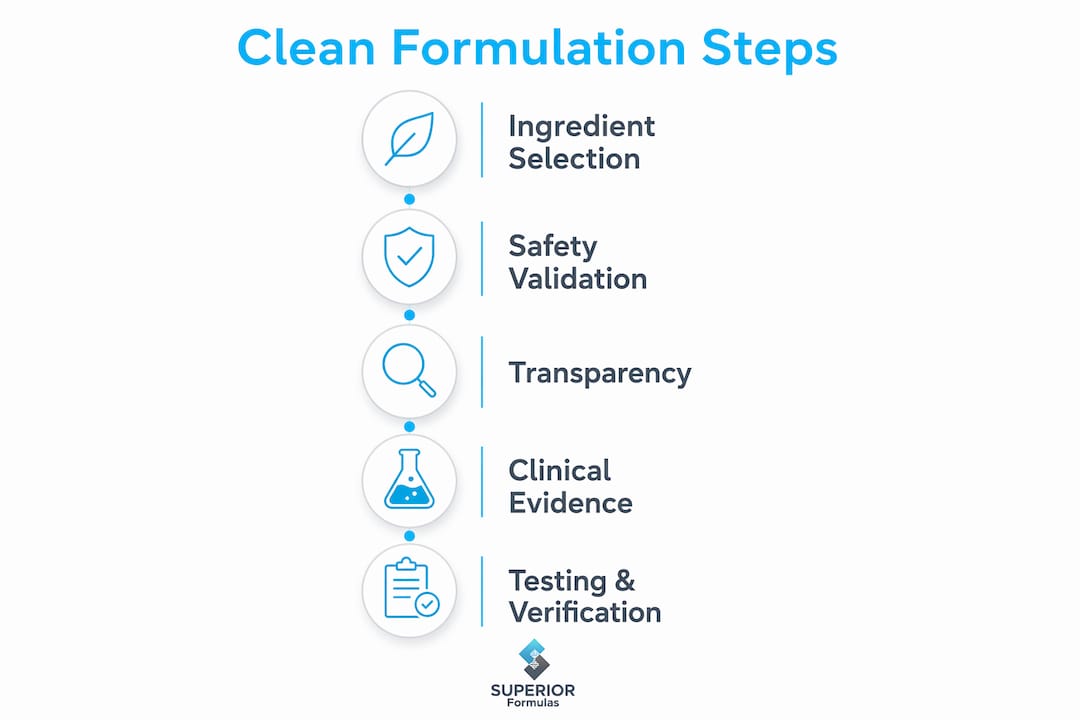
Clean formulation is less a checklist and more a philosophy of long-term accountability. Science-led standards are replacing fear-based marketing as the foundation of consumer trust, with measurable criteria like biodegradability, renewable sourcing, and clinical validation now driving ingredient selection.
- Long-term safety perspective: Formulators evaluate cumulative exposure, not just single-dose safety.
- Sophisticated chemistry: Some of the safest, most stable ingredients in supplement science are lab-created and extensively studied, precisely because they can be engineered to a defined specification.
- Regulatory accountability: Because “clean” carries no legal definition in the U.S., brands that take it seriously build their own rigorous internal standards grounded in global regulatory frameworks.
- Sustainability integration: Biodegradability and responsible sourcing are now embedded at the ingredient level, not treated as a separate marketing layer.
- Consumer scrutiny: Educated consumers increasingly scrutinize ingredient standards rather than accepting label claims at face value.
Pro Tip: Look for brands that publish their formulation philosophy in detail, including which safety assessment frameworks they follow. Vague language like “we only use the best ingredients” is a signal that the science may not be there.
Superiorformulas manufactures in GMP-certified facilities and uses third-party testing to verify purity and potency at every production run. That level of quality assurance is what separates a clean formulation claim from a clean formulation reality.

How to identify clean formulations built for cellular health and longevity
Choosing a supplement for cellular health and longevity requires a more specific lens than general clean beauty criteria. The quality checklist for longevity-focused supplements goes deeper than ingredient exclusions.
- Full ingredient transparency: Every compound, including excipients, should be disclosed with its functional purpose explained.
- Clinically studied actives: Ingredients like polyphenols, adaptogens, and Nrf2 activators should appear in the scientific literature at the doses used in the formula.
- GMP-certified manufacturing: Good Manufacturing Practice certification means the facility meets federal standards for consistency, cleanliness, and quality control.
- Third-party testing: Independent lab verification of purity and potency is the only way to confirm that what is on the label is actually in the bottle.
- Physician or scientist formulation: Supplements developed by clinicians with expertise in biochemistry and aging reflect a different standard of ingredient selection than those assembled by marketing teams.
- Toxicological data availability: Brands committed to clean standards can point to toxicology testing and safety assessments for their key ingredients.
- No proprietary blend hiding: Proprietary blends that obscure individual ingredient doses make it impossible to evaluate whether actives are present at clinically relevant levels.
Pro Tip: Cross-reference a supplement’s key ingredients against published clinical studies. If the dose in the formula is far below what research used to demonstrate an effect, the ingredient is present for label appeal, not therapeutic function.
Superiorformulas applies these standards across its product line, with formulations targeting antioxidant support, cellular resilience, and Nrf2 activation developed by a physician-scientist with clinical expertise in nutrition and biochemistry.
Superiorformulas: physician-formulated supplements for cellular health
Choosing a clean supplement for longevity is not just about what a product excludes. It is about what a brand is willing to stand behind scientifically.
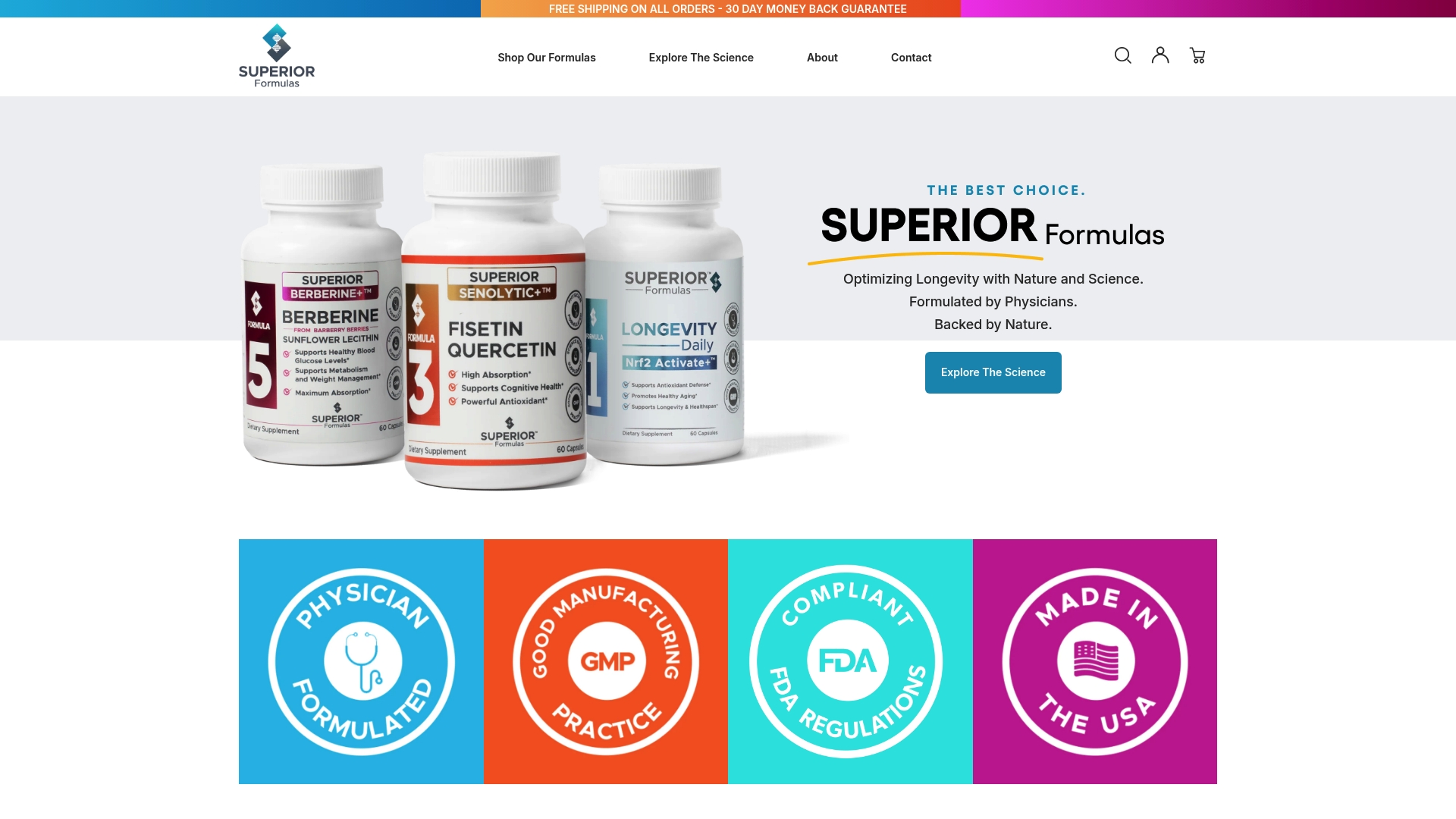
Superiorformulas was founded by a physician-scientist whose background in nutrition and biochemistry shapes every formulation decision. The product line targets cellular health and longevity through clinically studied ingredients, including polyphenols, phytonutrients, and adaptogens selected for their documented mechanisms in healthy aging pathways. Every formula is manufactured in a GMP-certified facility and verified through third-party testing for purity and potency, with no unnecessary fillers included.
For consumers who want supplements grounded in real clinical science rather than marketing language, explore the science behind Superiorformulas’ approach to clean, evidence-based formulation.
Key Takeaways
Clean formulations in dietary supplements prioritize toxicologically validated ingredients, full transparency, and evidence-based efficacy over ingredient origin or marketing claims.
| Point | Details |
|---|---|
| Clean formulations defined | Supplements built on ingredient safety data, full disclosure, and exclusion of harmful substances like phthalates and parabens. |
| Natural does not mean safe | Synthetic ingredients can be safer and more stable than natural ones; origin alone does not determine safety. |
| No legal definition exists | The FDA does not define “clean,” so brand-specific standards and third-party verification matter more than labels. |
| Key trust signals | GMP certification, third-party testing, clinically studied actives, and physician formulation are the markers to look for. |
| Superiorformulas | Physician-founded, GMP-manufactured, and third-party tested, with formulations targeting Nrf2 activation and cellular resilience. |


