


Evidence-based formulations are scientifically designed supplement compositions built on validated research, clinical expertise, and product-specific parameters to guarantee functional effectiveness and safety. Defining evidence-based formulations requires more than selecting popular ingredients. The process follows a 5-step evidence cycle that includes asking focused clinical questions, acquiring and appraising the literature, applying findings to formulation design, and assessing outcomes. Regulatory bodies like the FDA and research networks like the Cochrane Collaboration set the evidentiary bar that separates substantiated health claims from marketing language. Superiorformulas builds every product on this foundation, integrating physician expertise with peer-reviewed science to support longevity, cellular health, and healthy aging.
What is evidence-based formulation development?
Evidence-based formulation development is a structured methodology that places scientific rigor before ingredient selection, market trends, or anecdotal reasoning. The industry term for this approach is Evidence-First Functional Formulation Design, or EFFFD. EFFFD emphasizes problem definition and hypothesis-driven design, meaning formulators start with a specific physiological target and work backward to the ingredients that address it. This separation of functional intent from trend-driven choices is what makes a formulation scientifically defensible.
The EFFFD framework produces two concrete advantages. First, it increases reproducibility. When the design logic is explicit and documented, another scientist can evaluate, replicate, or challenge the rationale. Second, it creates scientific defensibility. Regulatory reviewers and healthcare professionals can trace every ingredient choice back to a documented evidence base.

Modern evidence aggregation in formulation development also incorporates AI-assisted literature review and expert panel screening. These tools accelerate the appraisal step of the evidence cycle without replacing clinical judgment. The goal is to surface the strongest available evidence quickly, then apply expert interpretation to determine whether that evidence is relevant to the specific formulation context.
Key elements of an evidence-first formulation workflow include:
- Problem definition: Identify the specific physiological mechanism or health outcome the formulation targets.
- Hypothesis formation: State a testable claim about how selected ingredients will affect that mechanism.
- Evidence acquisition: Conduct systematic literature searches using databases like PubMed and Cochrane Library.
- Evidence appraisal: Evaluate study quality, population relevance, and dosage applicability.
- Risk screening: Assess ingredient interactions, contraindications, and regulatory status before finalizing the formula.
Pro Tip: When appraising a study for formulation relevance, check whether the study population matches your target consumer. A trial conducted in elderly patients with deficiency states does not automatically validate a supplement claim for healthy adults.
How does clinical evidence translate into substantiated supplement claims?
Clinical evidence translates into a valid supplement claim only when the evidence matches the actual parameters of the finished product. This is the most common failure point in formulation development, and it is frequently overlooked.
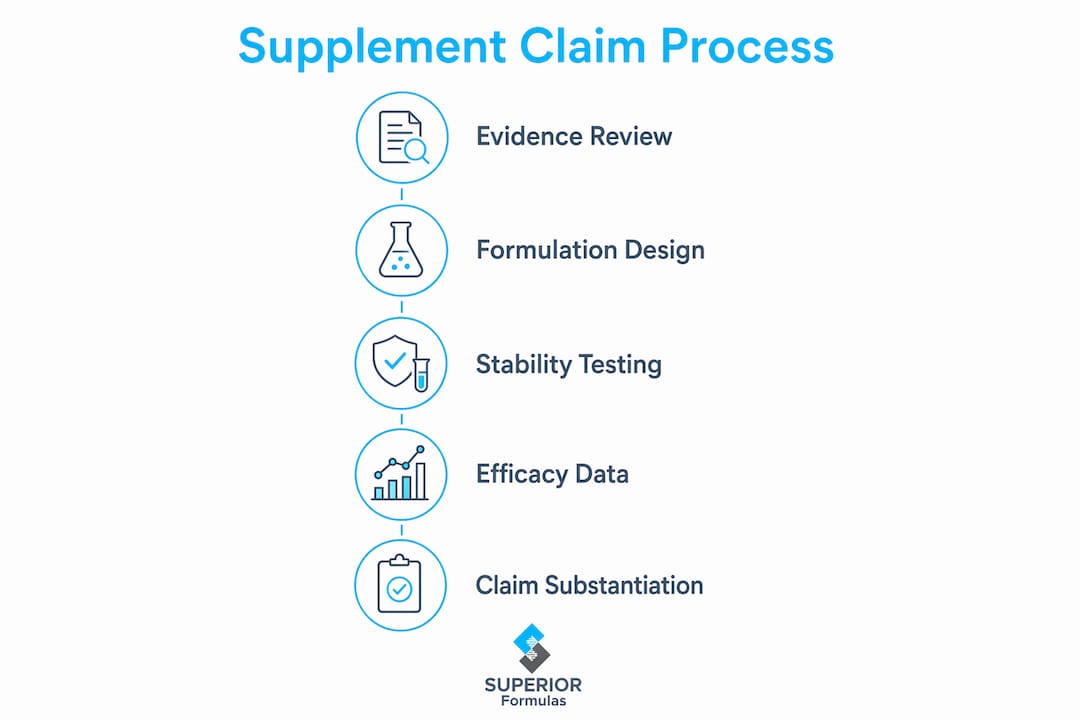
The core problem is concentration mismatch. Efficacy data tied to a 5% ingredient concentration cannot be assumed valid when the finished product contains 0.5% of that same ingredient. Supplier raw material data is generated under controlled laboratory conditions using isolated compounds at specific concentrations. Those conditions rarely reflect the complexity of a multi-ingredient finished product. Formulators who rely solely on supplier data to substantiate claims are building on an incomplete foundation.
Substantiated claims require evidence across three dimensions:
- Ingredient stability: The active compound must remain chemically intact at its intended concentration throughout the product’s shelf life.
- Bioavailability: The ingredient must be absorbed and reach the target tissue at a concentration sufficient to produce the claimed effect.
- Delivery context: The formulation matrix, whether capsule, softgel, or liquid, affects how an ingredient is released and absorbed.
Claim substantiation is a continuous R&D process that integrates formulation records, stability testing, and efficacy data with full traceability from inception through final product. This means documentation begins at the formulation stage, not after the product launches. Regulatory defensibility depends on that traceability chain being unbroken.
Pro Tip: Build your claim substantiation file before you finalize the formula. Retroactive documentation is harder to defend and often reveals gaps that require reformulation.
The clinical supplement workflow used by physician formulators at Superiorformulas follows this exact sequence: evidence discovery, dosage setting, stability testing, and claim planning occur in parallel, not sequentially. That integration reduces the risk of launching a product whose claims cannot survive regulatory or scientific scrutiny.
Ingredient-level vs. formulation-level evidence: what researchers need to know
The distinction between ingredient-level evidence and formulation-level evidence is the most consequential gap in supplement science. Conflating the two leads to overclaimed products and eroded consumer trust.
Compound-level evidence links specific molecules to physiological mechanisms without implying that a finished product containing those molecules will produce the same effect. A polyphenol like resveratrol may have well-documented effects on sirtuin pathways in cell culture studies. That evidence does not automatically extend to a capsule containing resveratrol alongside five other ingredients, a specific excipient blend, and a particular coating.
| Evidence type | What it shows | What it does not show |
|---|---|---|
| Isolated compound studies | Mechanism of action at the molecular level | Efficacy in a finished multi-ingredient product |
| Raw material supplier data | Performance at supplier-tested concentrations | Performance at finished-product concentrations |
| Formulation-level clinical trials | Efficacy of the complete product as consumed | Mechanism attribution to individual ingredients |
| Delivery system research | How a matrix affects absorption and release | Whether the active compound retains potency post-formulation |
Conducting independent clinical trials on complex multi-ingredient blends is genuinely difficult. Trial costs are high, blinding is complicated when ingredients have detectable tastes or colors, and isolating the contribution of individual components requires factorial designs that most supplement companies cannot fund. This is why compound-level evidence remains the most rigorous available for many complex products, provided formulators are transparent about that limitation.
The strongest formulation claims arise from evidence showing how a delivery system modifies a key biological step relevant to the health outcome. Delivery system evidence must demonstrate impact on a biological mechanism, not simply assert that a proprietary technology improves absorption. When Superiorformulas selects a delivery format, the choice is grounded in published data on bioavailability outcomes for that specific compound class.
Researchers evaluating supplement evidence should apply the same critical lens they use for pharmaceutical literature. Ask whether the study used the same ingredient form, concentration, and delivery route as the finished product. If the answer is no, the evidence is suggestive, not confirmatory.
Practical implications of applying evidence-based formulation principles
Applying evidence-based formulation principles to supplement development changes how every stage of the product lifecycle is managed. The benefits extend beyond regulatory compliance to clinical credibility and consumer trust.
A well-structured formulation workflow integrates four parallel tracks:
- Evidence discovery: Systematic literature review identifies the strongest available science for each target mechanism, drawing from databases like PubMed, Cochrane, and clinical trial registries.
- Dosage setting: Doses are anchored to the concentrations used in the most relevant human clinical trials, adjusted for bioavailability data specific to the delivery format.
- Stability and compatibility testing: Ingredients are tested in combination under real-world storage conditions to confirm that active compounds remain potent at the claimed concentration.
- Claim planning: Health claims are drafted only after the evidence file confirms that the finished product parameters match the supporting literature.
Transparent validation through double-blind, placebo-controlled trials integrating both objective biomarkers and subjective patient-reported outcomes is becoming the standard for credible supplement evidence. This design prevents misleading promotions and produces data that healthcare professionals can actually use in clinical conversations.
Evidence-based medicine requires tailoring evidence to each patient’s unique values, including cost, risk tolerance, and personal health beliefs. The same principle applies to formulation design. A supplement targeting cellular resilience in a 60-year-old with metabolic concerns requires different evidence thresholds than a general wellness product for healthy adults. Aligning formulations with patient values, as described in patient-centered evidence frameworks, is not optional. It is what separates a clinically useful product from a well-marketed one.
Documentation and ongoing validation are the final pillars. A formulation’s evidence file should be a living document, updated as new research emerges and as post-market data accumulates. Superiorformulas applies this standard through GMP-certified manufacturing and third-party testing, creating a traceability chain that supports both regulatory review and transparent communication with healthcare professionals.
Key Takeaways
Evidence-based formulation development is the only scientifically defensible path to supplement claims that hold up under regulatory and clinical scrutiny.
| Point | Details |
|---|---|
| Evidence-first design | Start with a defined physiological target and select ingredients based on documented mechanisms, not market trends. |
| Concentration relevance | Supplier raw material data is not valid at finished-product concentrations; test efficacy at actual formulation levels. |
| Claim substantiation | Build the evidence file from the formulation stage, integrating stability, bioavailability, and efficacy data with full traceability. |
| Ingredient vs. formulation evidence | Compound-level studies show mechanism; only formulation-level trials confirm finished-product efficacy. |
| Patient alignment | Tailor evidence thresholds and formulation parameters to the specific population and clinical context the product serves. |
The shift I keep watching in supplement science
The supplement industry spent decades leading with ingredient hype. A molecule would show promise in a cell culture study, and within months it appeared in dozens of products with claims that far outpaced the evidence. That era is not over, but the pressure is shifting.
What I find genuinely encouraging is the growing adoption of structured frameworks like EFFFD. When formulators are required to state a hypothesis before selecting an ingredient, the conversation changes. The question stops being “what does this ingredient do?” and starts being “does this ingredient, at this concentration, in this delivery format, affect this specific mechanism in this population?” That is a harder question. It is also the right one.
The integration of AI in evidence aggregation is real and useful, but it is not a shortcut. AI can surface relevant literature faster than any human team. It cannot determine whether a study’s population, dosage, or endpoint is relevant to your formulation. That judgment still requires clinical expertise. The formulators who understand this will build better products. Those who treat AI as a validation tool rather than a research accelerator will produce the same overclaimed products the industry has always struggled with.
Regulatory scrutiny is increasing, and that is a good thing for researchers and healthcare professionals who rely on supplement evidence. The FDA’s continued attention to claim substantiation, combined with growing consumer demand for transparency, creates real incentives for science-led formulation. The brands that invest in rigorous evidence now will be the ones that earn lasting clinical credibility.
— cristopher
Superiorformulas and the science behind every formula
Superiorformulas was founded on the principle that a supplement claim is only as strong as the evidence behind it. Every formulation begins with a defined clinical target, a systematic review of the relevant literature, and a dosage anchored to human trial data.
Researchers and healthcare professionals looking for transparency in supplement science can review the scientific approach that guides every Superiorformulas product. The science page details the evidence standards, ingredient selection criteria, and quality controls applied across the product line. For a deeper look at how clinical evidence applies to specific supplement categories, the clinical evidence guide provides a structured starting point for evaluating any supplement’s evidentiary foundation.
FAQ
What is evidence-based formulation in dietary supplements?
Evidence-based formulation is the practice of designing dietary supplements by integrating the best available clinical research, formulation science, and patient-relevant considerations into every ingredient and dosage decision. The 5-step evidence cycle provides the structural framework for this process.
Why can’t formulators rely on supplier ingredient data alone?
Supplier data is generated at specific concentrations under controlled conditions that rarely match the finished product. Efficacy at one concentration cannot be assumed valid at a lower concentration in a complex multi-ingredient matrix.
What is the difference between ingredient-level and formulation-level evidence?
Ingredient-level evidence documents a compound’s mechanism of action in isolation. Formulation-level evidence confirms that the complete finished product, at its actual concentrations and in its specific delivery format, produces the claimed health outcome.
How does claim substantiation work in practice?
Claim substantiation is a continuous process that begins at the formulation stage and runs through stability testing and efficacy evaluation, with full documentation traceability. Claims drafted before this process is complete are not scientifically defensible.
What role does delivery system evidence play in supplement claims?
The strongest claims show how a delivery system affects a specific biological mechanism relevant to the health outcome. Delivery system evidence must be grounded in published bioavailability data, not proprietary technology assertions alone.


