


Rhodiola rosea’s best-supported benefits are stress resilience, reduced fatigue, and modest gains in mood and exercise performance, with endurance effects strongest at daily doses above 600 mg. The evidence base is real but uneven: some outcomes rest on solid randomized trials, others on smaller studies that need replication. Talk to a healthcare provider before starting, especially if you take other medications.
TL;DR:
- Doses above 600 mg daily may offer the strongest endurance and antioxidant effects, but lower doses (200-400 mg) reliably support stress resilience and fatigue reduction.
- Most human studies are short-term with small samples, so treat initial benefits as preliminary and monitor your response over the first month.
- Standardized Rhodiola rosea extracts with approximately 3% rosavins and 1% salidroside are essential for replicating study results, as species and potency vary widely across products.
- Rhodiola’s primary hormonal mechanism involves modulating cortisol response, reducing exaggerated stress reactions, and supporting recovery.
- Due to variable quality, select supplements with verified species, standardized extract ratios, third-party testing, and GMP certification to ensure clinical efficacy.
Table of Contents
- What Are Rhodiola Rosea’s Stress-Relief Benefits?
- Can Rhodiola Reduce Fatigue and Boost Daily Energy?
- Does Rhodiola Improve Mood and Help With Depression Symptoms?
- Rhodiola and Brain Function: Focus, Memory, and Mental Clarity
- What Does Research Say About Rhodiola and Exercise Performance?
- Other Ways Rhodiola May Support the Body
- Does Rhodiola Support Immune System Function?
- How Does Rhodiola Affect Cortisol and Hormone Balance?
- Do Different Rhodiola Species and Extracts Work the Same Way?
- How to Take Rhodiola: Dosing, Timing, and Practical Tips
- What Are Rhodiola’s Side Effects and Drug Interactions?
- How to Choose a Quality Rhodiola Supplement
- How Strong Is the Current Evidence on Rhodiola, Really?
- A Physician-Formulated Take on Rhodiola’s Real-World Value
- Where to Find Physician-Formulated Rhodiola Support
- Sources
What Are Rhodiola Rosea’s Stress-Relief Benefits?
Rhodiola belongs to a category researchers call adaptogens, plants that help the body normalize its stress response rather than simply sedate or stimulate it. A 2022 review in Molecules labeled Rhodiola rosea a “second-generation adaptogen,” distinguishing it from older adaptogens by its capacity to restore homeostatic balance disrupted by chronic stress rather than just blunt the stress reaction in the moment.
That distinction matters for how you think about the supplement. Rhodiola doesn’t act like a sedative or an anti-anxiety drug that dampens arousal directly. It appears to work upstream, adjusting how your hypothalamic-pituitary-adrenal (HPA) axis responds to a stressor in the first place. The HPA axis is the signaling loop that releases cortisol when your brain perceives a threat, whether that threat is a work deadline or a genuine physical danger. Rhodiola’s active compounds, rosavins and salidroside, seem to modulate this loop so the cortisol spike is less exaggerated and resolves faster.
Researchers have also traced effects on neuropeptide Y, a brain signaling molecule tied to resilience under chronic stress, along with modest influences on serotonin and dopamine activity. None of these mechanisms alone explains rhodiola’s effects, but together they sketch a plausible biological story for why people report feeling steadier, not wired, after taking it.
Human trials back this up, though the sample sizes are often small by pharmaceutical standards. Several controlled studies using standardized rhodiola extracts have found measurable drops in stress and burnout questionnaire scores over two to four weeks of daily use, alongside improvements in self-rated mental fatigue. The effect size in most trials is moderate rather than dramatic, which fits the adaptogen framing: rhodiola nudges your baseline stress tolerance rather than eliminating stress outright.
- Lower scores on standardized burnout and stress-symptom questionnaires after 2 to 4 weeks of daily use
- Improved self-reported sleep quality in some stressed populations, likely downstream of lower evening cortisol
- Better subjective coping under sustained mental workload, such as exam periods or high-demand work stretches
- Faster physiological recovery after acute stress exposure in a handful of lab-based challenge studies
Most stress-focused trials used doses in the 200 mg to 400 mg per day range, split once or twice daily, for extracts standardized to roughly 3% rosavins and 1% salidroside. That standardization ratio shows up again and again in the literature and is worth remembering when you’re comparing products later.
The honest caveat: most rhodiola stress trials run four to twelve weeks with fewer than 100 participants. That’s enough to establish a signal, not enough to call the effect settled science. If you’re using rhodiola for stress, treat the first month as a trial period and track how you actually feel, not just whether you expect it to work.
Can Rhodiola Reduce Fatigue and Boost Daily Energy?
Fatigue reduction is arguably rhodiola’s most consistently replicated benefit, and it’s also the benefit with the clearest historical roots. Rhodiola has been used for generations in Russian and Scandinavian traditional medicine specifically to combat exhaustion during demanding physical conditions, and modern trials have largely confirmed that use case holds up.
The classic study design here involves stressed or fatigued populations, often night-shift workers, students during exam periods, or people recovering from prolonged mental strain, tracked over two to four weeks on a standardized extract. Outcomes typically include the Pines Burnout Scale, the Multidimensional Fatigue Inventory, or attention and coordination tests administered before and after a stressful shift.
Results across these trials point the same direction: participants taking rhodiola report less mental fatigue, better sustained attention on cognitive tasks, and improved coordination under time pressure compared to a placebo group. One frequently cited effect is faster recovery of psychomotor performance after a night without sleep, which matters if you’re comparing rhodiola against caffeine or other short-term energy fixes.
Here’s where dosing gets interesting: fatigue-focused protocols tend to split into two camps.
- Low, steady maintenance dosing around 50 mg daily, used continuously to build cumulative resilience against everyday tiredness
- Moderate daily dosing in the 200 mg to 400 mg range, used in most of the fatigue trials that showed measurable benefit
- Cycling patterns, where some users take rhodiola for two to three weeks, then pause for a week, based on the theory that adaptogens work best without constant, uninterrupted exposure
- Morning or early-afternoon timing, since rhodiola has mild stimulating properties for some people and can interfere with sleep if taken late
Set realistic expectations. Rhodiola isn’t a caffeine substitute that hits within the hour. Most fatigue benefits build over one to three weeks of consistent use, and the effect is subtler than a stimulant: less “wired,” more “able to keep going without crashing.” If you’re not noticing any difference after a month at a reasonable dose, it’s a fair signal to reassess whether rhodiola is the right tool for your particular fatigue, which might have causes rhodiola simply doesn’t touch, like poor sleep architecture or an underlying thyroid issue worth ruling out with a clinician.
Monitoring matters too. Track your energy, sleep quality, and any jitteriness for the first two weeks. If you feel overstimulated or notice trouble falling asleep, that’s usually a dosing or timing issue rather than a reason to abandon rhodiola altogether.
Does Rhodiola Improve Mood and Help With Depression Symptoms?
Rhodiola shows a genuine but modest mood benefit, and the clearest data point comes from a head-to-head comparison most people never hear about. A 12-week randomized trial pitted rhodiola directly against sertraline, a standard SSRI antidepressant, in adults with mild-to-moderate depression. Rhodiola improved depression scores and produced meaningfully fewer adverse effects than sertraline, though sertraline outperformed it on some symptom measures.
That result deserves an honest reading rather than a marketing spin. Rhodiola wasn’t the better antidepressant in that trial. It was the better-tolerated option, with a smaller but real effect on mood symptoms and a much cleaner side-effect profile than the pharmaceutical comparator. For someone with mild depressive symptoms who’s hesitant about SSRI side effects, or who wants an adjunct alongside other lifestyle changes, that tolerability tradeoff is meaningful. For someone with major depressive disorder, it’s a different conversation entirely.
A few points worth holding onto:
- Rhodiola’s mood effects show up most clearly in mild-to-moderate symptom ranges, not severe depression
- Reported side effects in the sertraline comparison trial were notably lower in the rhodiola group
- The trial had 57 participants, a meaningful but modest sample that calls for larger replication
- Mood improvements often track alongside the stress and fatigue benefits, suggesting overlapping mechanisms rather than a separate “antidepressant pathway”
The mechanism likely mirrors what’s happening with stress and fatigue: HPA-axis normalization and modest support for serotonin and dopamine signaling, rather than the receptor-level action of a pharmaceutical antidepressant. That’s a fundamentally different kind of tool.
The clinical caution here is not optional. Rhodiola should not replace prescribed treatment for major depressive disorder, and it shouldn’t be started or stopped as a substitute for professional care if you’re already being treated for clinical depression. Where it may fit is as a well-tolerated option for situational low mood, mild stress-related mood dips, or as something to discuss with a clinician as a complement, never a replacement, to an existing treatment plan.
Rhodiola and Brain Function: Focus, Memory, and Mental Clarity
Cognitive benefits are where rhodiola’s evidence gets genuinely interesting, because the effects split cleanly into two different use cases that people often confuse.
The first is acute, “pre-event” use: taking a single moderate-to-higher dose before a mentally demanding task, like an exam, a big presentation, or a long shift. Trials in this category have measured improvements in sustained attention, reaction time, and error rates on tasks like proofreading and pattern recognition, particularly under conditions of stress, sleep deprivation, or fatigue. The effect tends to show up fastest in people who are already taxed, which lines up with rhodiola’s adaptogenic identity. It’s less impressive as a cognitive enhancer for someone who’s already well-rested and sharp.
The second is chronic, daily-support use, where lower doses taken consistently over weeks are associated with better subjective mental clarity and reduced brain fog, likely as a downstream effect of improved stress tolerance and sleep rather than a direct nootropic action.
Where this benefit comes from mechanistically:
- Modulation of serotonin, dopamine, and norepinephrine activity, which influence attention and processing speed
- Antioxidant effects that may protect neurons from stress-related oxidative damage over time
- Indirect support through better sleep and lower cortisol, both of which independently improve next-day cognitive performance
- Possible mild cholinergic support, though this mechanism has weaker human evidence than the others
Pro Tip: If you’re testing rhodiola for mental performance, try it on a low-stakes day first. The biggest gains show up under cognitive load, so a calm Tuesday afternoon won’t tell you much. Save your real assessment for a demanding week.
Don’t expect rhodiola to work like a stimulant for focus. It’s closer to raising your ceiling for mental performance under pressure than raising your baseline on an ordinary day. If your goal is razor focus during a specific high-stakes event, timing matters more than most people assume, and testing your response ahead of time beats guessing on the day that counts.
What Does Research Say About Rhodiola and Exercise Performance?
Rhodiola’s endurance benefits are the best-quantified in the entire supplement’s research portfolio, thanks to a large 2025 systematic review that pooled data across 26 randomized controlled trials.
That review, covering 668 participants, found Rhodiola rosea supplementation significantly improved VO2max, time to exhaustion, and time-trial performance, with the largest VO2max gains occurring at daily doses above 600 mg.
The reported effect sizes were modest in absolute terms (VO2max effect size of 0.32, time to exhaustion 0.38, time trial performance improved by an effect size of 0.40), but consistent across a genuinely large pool of trials, which is rare in the supplement world. This consistency is what makes this particular benefit stand out from rhodiola’s other claims.
A separate systematic review adds the biochemical side of the story. It found rhodiola increased total antioxidant capacity and superoxide dismutase activity while reducing creatine kinase, a blood marker of muscle damage, alongside reductions in malondialdehyde, a marker of oxidative stress from lipid breakdown. In practical terms: less oxidative damage during hard training, and faster clearance of the muscle-damage signals that make you feel wrecked the day after a tough session.
What the exercise research supports:
- Meaningful improvements in VO2max, time to exhaustion, and time-trial performance across a large pooled dataset
- Reduced creatine kinase and malondialdehyde, suggesting less muscle damage and oxidative stress during exertion
- Increased antioxidant enzyme activity (SOD, total antioxidant capacity), which plausibly explains the recovery-marker improvements
- Stronger VO2max effects specifically at daily doses exceeding 600 mg, well above typical stress or mood dosing
That dose threshold is worth underlining. If you’re using rhodiola specifically for endurance performance, the 200 mg to 400 mg range common in mood and stress protocols may not be enough. The endurance-specific data points toward higher intake, and that’s a meaningfully different protocol than what you’d use for daily stress support, which is one reason “just take rhodiola” is bad advice without specifying the goal. For a deeper look at what VO2max actually measures and why athletes chase it, this guide to VO2 max breaks down the physiology.
Other Ways Rhodiola May Support the Body
Beyond stress, fatigue, mood, and performance, rhodiola has generated a cluster of secondary findings that are promising but rest on thinner human evidence than the benefits above.
The antioxidant story is the strongest of this group and echoes what shows up in the exercise research: rhodiola supplementation is associated with higher superoxide dismutase activity, greater total antioxidant capacity, and lower malondialdehyde, the marker of lipid peroxidation. This antioxidant activity is one reason rhodiola gets grouped with other polyphenol-rich botanicals in discussions of cellular resilience, alongside compounds that support the body’s own antioxidant defense systems through hormetic pathways.
Inflammatory markers tell a messier story. Some small trials report reductions in inflammatory signals like IL-6 and CRP after rhodiola supplementation, but findings are inconsistent across studies, and sample sizes are generally too small to draw firm conclusions. Treat any anti-inflammatory claim about rhodiola as a hypothesis in progress, not an established benefit.
Cardioprotective signals exist mainly in animal and cell-based research. Preclinical studies suggest rhodiola compounds may support heart tissue under stress conditions like oxygen deprivation, but this hasn’t been meaningfully tested in human cardiovascular trials. It’s an interesting research direction, not a reason to take rhodiola for heart health today.
A short honest list of where the evidence currently stands:
- Antioxidant enzyme increases (SOD, total antioxidant capacity): solid signal across multiple human trials
- Reduced oxidative stress markers (MDA): consistent finding, mainly in exercise-context studies
- Inflammatory marker changes (IL-6, CRP): mixed results, underpowered studies
- Cardioprotective effects: preclinical only, no meaningful human trial data yet
Does Rhodiola Support Immune System Function?
Rhodiola’s relationship to immune function is more inferential than directly proven, and it’s worth being upfront about that. Most of the supporting logic comes from rhodiola’s stress-modulating effects rather than dedicated immune trials.
Chronic stress is well established as a suppressor of immune function, largely through sustained cortisol elevation, which dampens the activity of certain white blood cells over time. Since rhodiola appears to help normalize cortisol response during stress, researchers have proposed that this indirect pathway could translate into better immune resilience during high-stress periods, like exam season, intense training blocks, or demanding work stretches.
Some early and small studies have looked at markers of immune activity alongside rhodiola supplementation and reported modest favorable shifts, but this remains one of the least-studied areas in the rhodiola research portfolio, especially compared to the exercise and stress data. There’s no large randomized trial establishing rhodiola as an immune booster in the way that’s sometimes implied in marketing.
The fair summary: rhodiola’s antioxidant activity and stress-normalizing effects give a plausible mechanism for supporting immune resilience during stressful periods, but the direct clinical evidence isn’t there yet. If immune support is your primary goal, rhodiola is reasonable as part of a broader stress-management approach, not a targeted immune intervention on its own.
How Does Rhodiola Affect Cortisol and Hormone Balance?
Cortisol is where rhodiola’s mechanism of action is best documented, and it’s the thread connecting nearly every benefit discussed so far.
Rhodiola’s active compounds appear to modulate HPA-axis signaling, the feedback loop between your brain and adrenal glands that governs how much cortisol gets released and how quickly that release resolves after a stressor passes. In several controlled studies, participants taking rhodiola showed blunted cortisol spikes during acute stress challenges and, in some cases, lower baseline cortisol after weeks of regular use, compared to a placebo group.
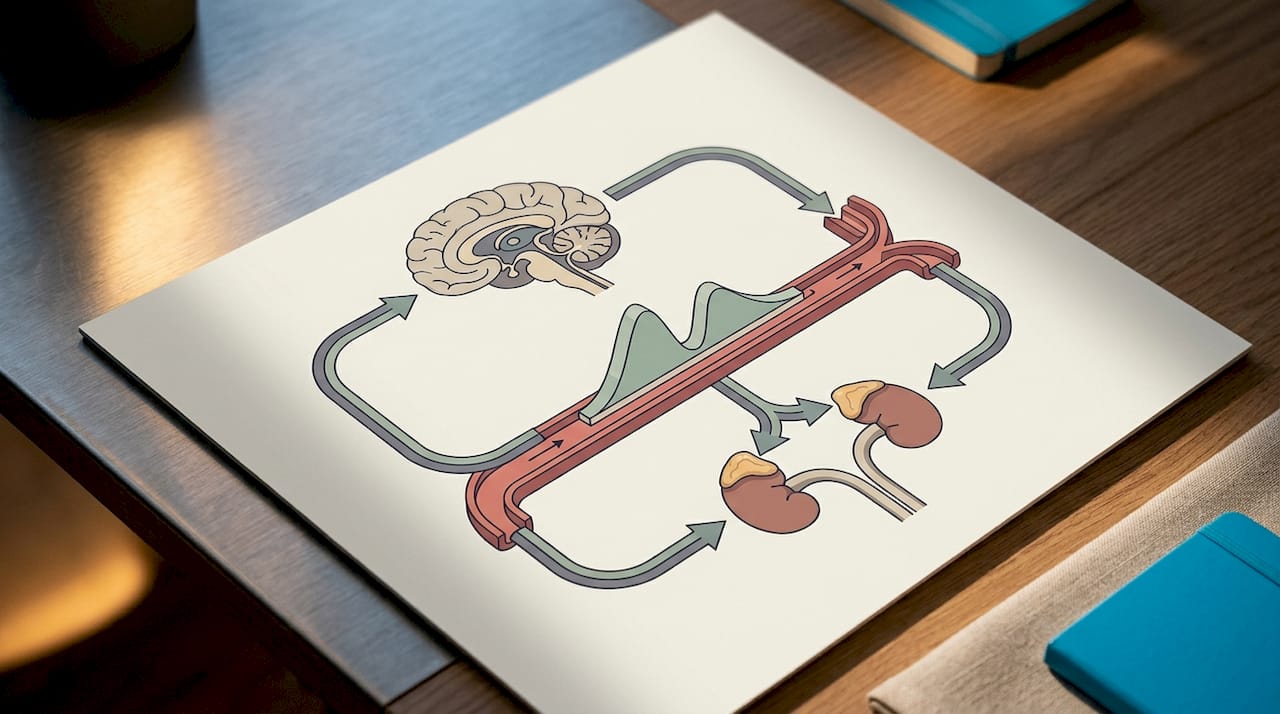
This matters because chronically elevated cortisol is linked to a long list of downstream problems: disrupted sleep, impaired glucose regulation, suppressed immune activity, and mood disturbances. Rhodiola’s proposed value isn’t crashing cortisol to zero, which would be counterproductive since cortisol serves essential functions, but tightening the stress response so it doesn’t linger or overshoot.
Beyond cortisol, rhodiola’s hormonal research is thinner. Some animal studies suggest interactions with thyroid hormone activity and modest influences on catecholamines like norepinephrine, but human data confirming clinically meaningful effects on these systems is limited. If you’re on thyroid medication or another hormone-regulating prescription, that’s a conversation for your prescriber before adding rhodiola, not a decision to make from a supplement label alone.
The cortisol-normalization story is rhodiola’s clearest hormonal mechanism, and it’s the biological thread that ties together the stress, fatigue, mood, and even immune-support conversations into one coherent picture rather than a list of unrelated claims.
Do Different Rhodiola Species and Extracts Work the Same Way?
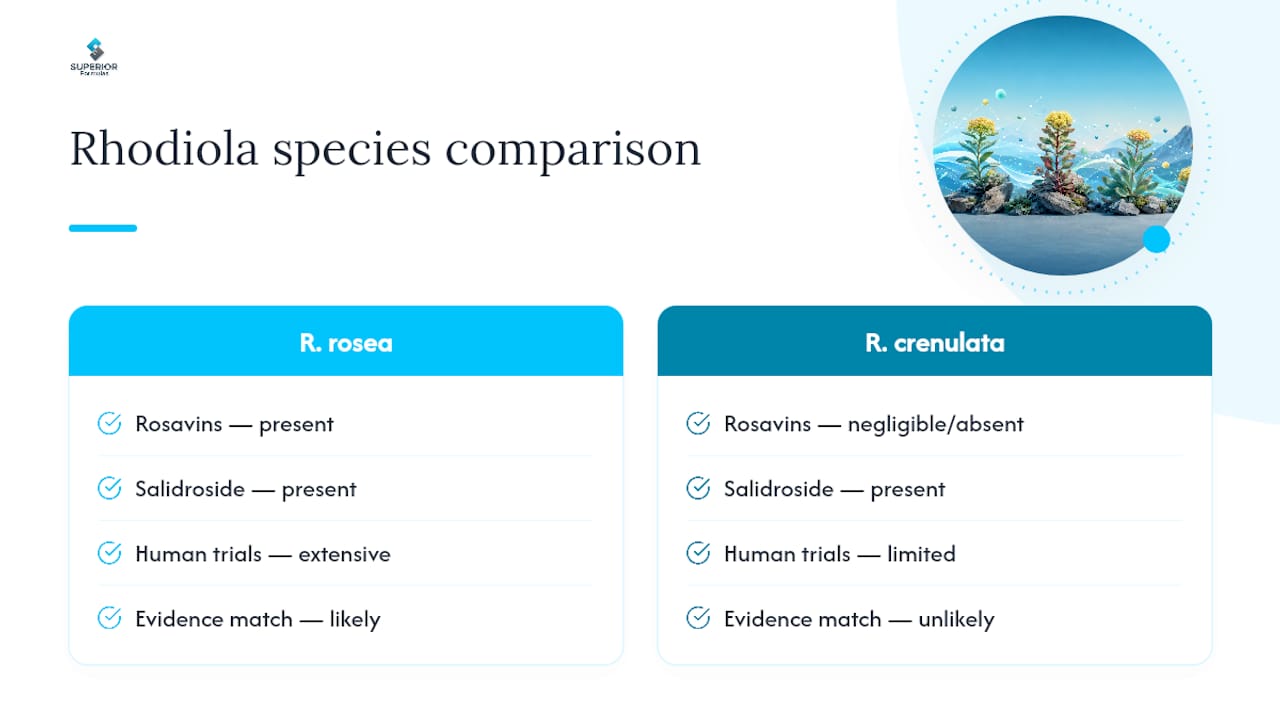
Not all rhodiola is created equal, and this is one of the most overlooked issues in the entire supplement category. Nearly all of the clinical research covered so far used Rhodiola rosea specifically, standardized to a defined ratio of rosavins and salidroside, usually around 3% rosavins to 1% salidroside.
That standardization detail matters more than it sounds. Rosavins are found almost exclusively in Rhodiola rosea, which makes them a useful marker for confirming you’re actually getting the studied species. Salidroside, by contrast, appears in several other rhodiola species too, including Rhodiola crenulata, which is sometimes substituted in cheaper products because it’s easier to source at scale.
The problem: Rhodiola crenulata and other non-rosea species haven’t been studied nearly as extensively in human trials, and their rosavin content is typically negligible or absent. A product listing “rhodiola extract” without specifying the species, or standardizing only to salidroside without mentioning rosavins, may not deliver the same effects reported in the trials discussed throughout this article.
Extract concentration also varies widely between products, from mild teas and tinctures to highly concentrated standardized capsules. Given that the endurance research specifically ties stronger effects to daily doses above 600 mg of standardized extract, a poorly concentrated product could require an impractical number of capsules to hit an effective dose, or simply underdeliver regardless of how many you take.
How to Take Rhodiola: Dosing, Timing, and Practical Tips
Getting rhodiola’s benefits depends heavily on matching your dose and format to your actual goal, rather than grabbing whatever bottle says “rhodiola” on the label.
This ratio is the closest thing the rhodiola world has to a quality benchmark, and it’s worth checking for on any label before you buy.
Dosing breaks down clearly by goal:
- Maintenance and general resilience: around 50 mg daily, taken consistently, for people using rhodiola as a low-key everyday support rather than targeting a specific outcome.
- Mood, fatigue, and stress support: 200 mg to 400 mg daily, typically split into one or two doses, matching most of the trials behind the stress and mood benefits discussed earlier.
- Endurance and athletic performance: above 600 mg daily, aligned with the dose range showing the strongest VO2max and time-to-exhaustion improvements in the 2025 endurance meta-analysis.
- Acute pre-event cognitive or physical use: a single moderate-to-higher dose taken 30 to 60 minutes before the demanding task, rather than daily dosing.
Timing generally favors morning or early afternoon, since rhodiola has mild stimulating properties in some people and can interfere with falling asleep if taken in the evening. Some users cycle rhodiola, taking it for two to three weeks followed by a short break, based on the theory that adaptogens work best without constant uninterrupted exposure, though the clinical evidence for cycling specifically is thinner than the evidence for the supplement itself.
Pro Tip: Start at the low end of whichever dose range matches your goal, and give it two full weeks before judging whether it’s working. Rhodiola’s benefits build gradually for most people, and jumping straight to a high dose mainly increases your odds of side effects without speeding up results.
Monitor how you respond in the first two weeks, paying attention to sleep quality, any jitteriness, and digestive comfort, and adjust dose or timing based on what you notice rather than sticking rigidly to a plan that isn’t working for your body.
What Are Rhodiola’s Side Effects and Drug Interactions?
Rhodiola is generally well tolerated in the doses used across clinical trials, and serious adverse events are rare in the published research. That said, “well tolerated” doesn’t mean risk-free, and a few groups need real caution.
The most commonly reported side effects are mild: some people experience jitteriness or overstimulation, particularly at higher doses or when taken later in the day, along with occasional dizziness, dry mouth, or mild digestive upset. These tend to resolve with a lower dose or earlier timing rather than requiring discontinuation.
Drug interactions deserve genuine attention:
- Antidepressants: rhodiola’s effects on serotonin and dopamine signaling raise a theoretical concern about combining it with SSRIs or other antidepressants without medical guidance, given the comparative trial against sertraline showing real neurochemical activity.
- Stimulants: combining rhodiola with caffeine or other stimulants may amplify jitteriness or overstimulation in sensitive individuals.
- Blood pressure medications: rhodiola’s mild effects on catecholamine activity mean it could theoretically interact with medications managing blood pressure, warranting a conversation with your prescriber.
- Other hormone-related supplements: anyone using hormone-support products alongside rhodiola should watch for cumulative effects on cortisol and related pathways rather than assuming they work independently.
Pregnancy and lactation are areas of genuine unknown, not established safety. There simply isn’t enough quality human data to confirm rhodiola is safe during pregnancy or breastfeeding, so the responsible default is avoidance unless a physician specifically advises otherwise.
The National Center for Complementary and Integrative Health notes that current rhodiola evidence remains low to moderate quality and recommends discussing any adaptogen with your healthcare provider before starting, particularly if you take prescription medications. If you notice an unexpected reaction, report it to your clinician and consider filing a report through the FDA’s MedWatch program, since supplement safety data depends heavily on real-world reporting.
How to Choose a Quality Rhodiola Supplement
Supplement quality is where rhodiola’s real-world benefit often lives or dies, and it’s a bigger issue than most buyers realize. The FDA does not approve dietary supplements for safety or effectiveness before they reach shelves; manufacturers bear that responsibility themselves, which means label accuracy varies enormously across the market.
Adulteration and species substitution are documented, recurring problems in the botanical supplement industry. Research on quality issues in botanical supplements has found instances of mislabeled species, understated or absent active-compound content, and inconsistent potency between batches of the same product. Given that nearly all the meaningful clinical evidence discussed in this article used standardized Rhodiola rosea extract, a mislabeled or under-dosed product isn’t a minor inconvenience. It’s the difference between getting the studied benefit and getting nothing.
A practical checklist before you buy:
- Confirm the label specifies Rhodiola rosea, not a generic “rhodiola” or a substituted species like crenulata
- Look for a standardization claim, ideally close to the 3% rosavins to 1% salidroside ratio used in most trials
- Ask whether the manufacturer provides a third-party Certificate of Analysis (COA) confirming raw-material identity and screening for heavy metals and pesticides
- Verify manufacturing happens in a GMP-certified facility, which signals consistent quality-control processes batch to batch
- Check that the dose per serving actually matches the range appropriate for your goal, rather than a token amount
Pro Tip: If a rhodiola product’s label doesn’t mention the species or the rosavin percentage, treat that as a red flag rather than an oversight. Companies that test and standardize their extracts almost always say so, because it’s a genuine selling point.
For readers who want to apply this same standardization and testing logic across their broader supplement routine, Superiorformulas’s antioxidant support checklist walks through the same verification principles in more depth, and the comparison of ashwagandha’s evidence base is worth reading if you’re deciding between adaptogens.
How Strong Is the Current Evidence on Rhodiola, Really?
Rhodiola’s research base is genuinely encouraging but far from complete, and honest readers deserve that nuance instead of either extreme.
The strongest evidence sits in exercise performance, thanks to a 2025 systematic review pooling 668 participants across 26 trials, a sample size large enough to trust the general direction of the finding even if individual effect sizes are modest. Mood evidence rests on a smaller but well-designed 12-week trial with a meaningful pharmaceutical comparator. Stress and fatigue evidence comes from multiple smaller trials that agree with each other but rarely exceed 100 participants each.
The weaknesses are consistent across the literature: trial durations rarely exceed 12 weeks, so long-term safety and efficacy beyond three months remain largely untested. Many trials use different extract standardizations, making direct comparison harder. And several outcome measures rely on subjective questionnaires rather than objective biomarkers, which introduces measurement noise.
The NCCIH’s own assessment lands squarely in this territory: current evidence is low to moderate quality overall, with more high-quality human trials needed before rhodiola’s benefits can be called definitively established. That’s not a dismissal. It’s an honest snapshot of where a genuinely promising botanical sits on the long road from traditional use to fully validated medicine.
A Physician-Formulated Take on Rhodiola’s Real-World Value
Rhodiola earns its reputation, but not for the reasons most marketing implies. The evidence doesn’t support treating it as a cure-all or a stimulant substitute. What it supports is something more modest and, frankly, more useful: a botanical that helps normalize how your body handles chronic stress, with measurable knock-on effects for fatigue, mood, and endurance performance when the dose matches the goal.
What gets underemphasized in most consumer content is how much the standardization matters compared to the raw ingredient name on a label. Two products both listing “rhodiola” can deliver meaningfully different results if one uses verified Rhodiola rosea standardized to rosavins and salidroside and the other doesn’t specify species or potency at all. That’s not a minor technicality. It’s the line between replicating what happened in the clinical trials and taking a placebo with a rhodiola sticker on it.
Formulating supplements around clinically studied ratios and verifying them through third-party testing isn’t a marketing flourish. It’s the baseline for making a botanical’s clinical evidence mean anything once it’s in a bottle on a shelf. Before buying any rhodiola product, run it through the checklist in this article: species, standardization, a real Certificate of Analysis, and GMP manufacturing. That five-minute check matters more than any single dosing decision you’ll make afterward.
— cristopher
Where to Find Physician-Formulated Rhodiola Support
Superiorformulas builds its formulations the same way this article evaluates rhodiola itself: by starting with the standardization ratios and third-party verification that separate a clinically meaningful product from a bottle that just says “rhodiola” on the front.
That means checking for verified Rhodiola rosea species, confirming rosavin and salidroside content against a real Certificate of Analysis, and manufacturing in GMP-certified facilities rather than cutting corners on potency testing. If the checklist in this article made you rethink what’s actually in your supplement cabinet, that’s the right instinct. Visit Superiorformulas to see how physician-formulated standards translate into products built for stress resilience, cellular health, and healthy aging, and browse the current lineup to find a formulation that matches your specific goal.
This article is general information, not a substitute for advice from a qualified doctor. Consult a qualified healthcare professional about your own circumstances before acting on anything here.
Sources
- Frontiers/ systematic review (2025) - endurance meta-analysis
- Mao et al. RCT comparing Rhodiola vs sertraline (RCT)
- Molecules review (2022) on adaptogen mechanisms
- Frontiers/Nutrition systematic review (2022) on RR and exercise
- National Center for Complementary and Integrative Health - Rhodiola


