


Mitochondria are defined as the primary organelles responsible for cellular energy production, redox regulation, and metabolic signaling, making them central to longevity and healthy aging. Scientists now recognize that mitochondrial function and aging are deeply intertwined. When these organelles work efficiently, they sustain the energy demands of every cell in your body. When they decline, the consequences ripple outward into organ dysfunction, chronic inflammation, and accelerated aging. Understanding the role of mitochondria in longevity is no longer just academic. For health-conscious adults over 30, it is one of the most practical frameworks for protecting long-term cellular health.
How do mitochondria influence aging and longevity at the cellular level?
Mitochondria produce adenosine triphosphate (ATP), the molecule that powers virtually every biological process. This energy production happens through the electron transport chain, a series of protein complexes embedded in the inner mitochondrial membrane. When this chain runs efficiently, cells thrive. When it falters, energy deficits accumulate and cellular stress mounts.
Reactive oxygen species (ROS) are a natural byproduct of ATP production. At low levels, ROS act as signaling molecules that trigger protective stress responses, a process called hormesis. At high levels, they damage mitochondrial DNA, proteins, and lipid membranes. The distinction matters enormously for how you approach supplementation and lifestyle choices.
Mitochondria also govern their own quality through two key processes:
- Mitophagy: The selective removal of damaged mitochondria. Think of it as the cell’s internal recycling program. When mitophagy fails, dysfunctional mitochondria accumulate and chronic inflammation rises.
- Fusion and fission dynamics: Mitochondria constantly merge and divide to redistribute resources, repair damage, and respond to metabolic demand. Disruption of this balance accelerates cellular aging.
- Mitochondrial biogenesis: New mitochondria are generated in response to exercise and caloric restriction, replenishing the pool of healthy organelles.
Pro Tip: Exercise is one of the most reliable triggers for mitochondrial biogenesis. Even moderate aerobic activity, done consistently, stimulates the creation of new, functional mitochondria.
Maintaining redox homeostasis rather than simply eliminating ROS is the goal. Cells need a controlled level of oxidative signaling to stay resilient. Wiping it out entirely with high-dose antioxidants can backfire.

What are the age-related changes in mitochondrial function?
Mitochondrial decline follows a predictable pattern as you age. The changes are measurable, clinically significant, and now linked directly to mortality risk.
| Age-Related Change | Biological Consequence | Clinical Impact |
|---|---|---|
| Decline in mitochondrial DNA copy number | Reduced energy production capacity | Higher all-cause and cardiovascular mortality risk |
| Accumulation of mtDNA mutations | Impaired electron transport chain function | Accelerated cellular aging and organ decline |
| Decreased phosphatidylcholine synthesis | Loss of mitochondrial membrane integrity | Reduced metabolic flexibility and plasticity |
| Mitophagy failure | Buildup of dysfunctional mitochondria | Systemic inflammation and multimorbidity |
| Chronic low-grade inflammation | Disrupted mitochondrial signaling | Sarcopenia, neurodegeneration, and metabolic disease |
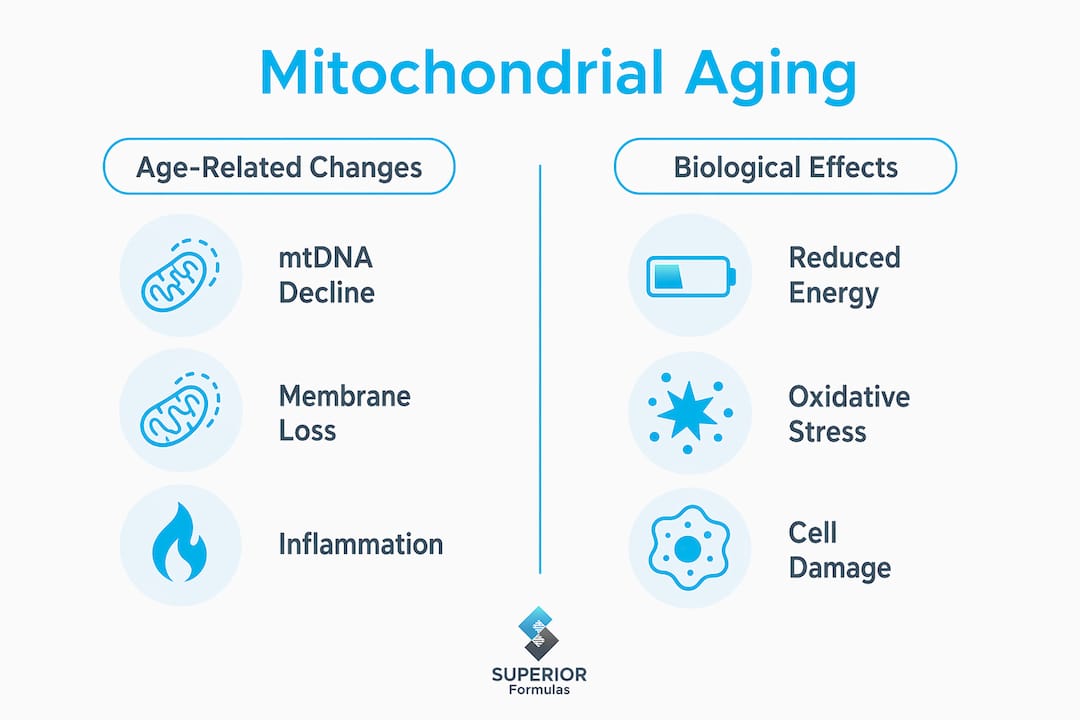
Adults with decreased mitochondrial DNA copy number combined with elevated systemic inflammation face significantly higher risk of all-cause and cardiovascular mortality over a 13.5-year follow-up period. That finding reframes mitochondrial health from a theoretical concern into a measurable, trackable biomarker of longevity.
The decline in phosphatidylcholine synthesis is a conserved driver of mitochondrial aging seen across species, from C. elegans to human cells. Phosphatidylcholine is a structural lipid that maintains the integrity of mitochondrial membranes. Without it, membranes become leaky, electron transport efficiency drops, and metabolic plasticity narrows.
Age-related mtDNA mutations accumulate through a process amplified by clonal hematopoiesis, where a single mutated blood stem cell expands and skews the apparent mutation burden in blood samples. This means some mitochondrial aging signals detected in blood reflect hematopoietic cell dynamics as much as pure mitochondrial failure. The biology is more nuanced than early models suggested.
Chronic inflammation, often called inflammaging, feeds back into mitochondrial dysfunction in a damaging cycle. Damaged mitochondria release signals that trigger immune activation. That immune activation further stresses mitochondria. Breaking this cycle is one of the central challenges in longevity medicine.
How do mitochondrial supercomplexes reduce oxidative stress?
Mitochondria do not operate as isolated machines. They organize their respiratory chain proteins into higher-order structures called supercomplexes. These arrangements optimize electron transfer between complexes, reducing the chance that electrons escape and react with oxygen to form damaging ROS.
The efficiency gain from supercomplex organization is significant. When electrons move directly from one complex to the next within a tightly organized structure, fewer escape to generate free radicals. This is fundamentally different from simply adding antioxidants after the fact. It is a structural solution to oxidative stress built into the mitochondria themselves.
Key points about supercomplex function and longevity:
- Supercomplex assembly correlates with mitochondrial efficiency and cellular lifespan in multiple model systems.
- Disruption of supercomplex organization increases electron leak and ROS production.
- Mitochondria also regulate apoptosis, the controlled process of cell death. Healthy mitochondria maintain this balance, preventing both premature cell death and the survival of damaged cells.
Redox homeostasis, the balance between oxidative and reductive processes, is the actual target. Oversimplified antioxidant supplementation that floods cells with reducing agents can suppress the very ROS signals that trigger mitophagy, stress adaptation, and cellular repair. The goal is not zero oxidative stress. The goal is controlled, well-regulated oxidative signaling.
What lifestyle and dietary interventions support mitochondrial health?
Mitochondrial health responds directly to what you eat, how you move, and the state of your gut microbiome. The science now points to several specific, evidence-based strategies.
-
Prioritize phosphatidylcholine-rich foods. Eggs, liver, and soybeans are among the richest dietary sources. Restoring phosphatidylcholine levels supports mitochondrial membrane integrity and metabolic flexibility, particularly relevant after age 40 when endogenous synthesis declines.
-
Support your gut microbiome. The gut-mitochondria axis is real and measurable. In mouse models with systemic mitochondrial deficiency, butyrate supplementation and fecal microbiota transfer delayed aging signs and extended lifespan by restoring intestinal barrier function. Butyrate, produced by gut bacteria fermenting dietary fiber, directly supports mitochondrial energy metabolism in colonocytes and beyond.
-
Exercise consistently. Aerobic exercise is the most well-validated trigger for mitochondrial biogenesis. Resistance training preserves mitochondrial density in muscle tissue with age. Both forms of exercise induce hormetic ROS bursts that strengthen mitochondrial quality control systems.
-
Be selective with antioxidant supplements. Not all antioxidants are equal in their effects on mitochondria. Targeted compounds like CoQ10 and alpha-lipoic acid work within the mitochondrial electron transport chain. Broad-spectrum, high-dose antioxidant regimens can interfere with beneficial ROS signaling. You can review antioxidant supplementation evidence to make more informed choices.
-
Consider dietary patterns that support mitophagy. Intermittent fasting and caloric restriction activate AMPK and SIRT1 pathways, both of which stimulate mitophagy and mitochondrial biogenesis. These are not fringe interventions. They are among the most replicated findings in aging biology.
Pro Tip: Fermented foods like sauerkraut, kimchi, and kefir naturally increase butyrate-producing bacteria in the gut. Adding them consistently to your diet is one of the lowest-effort ways to support the gut-mitochondria axis.
For adults over 30 looking at nutraceuticals for aging support, the evidence increasingly points toward compounds that work with mitochondrial signaling pathways rather than against them. The distinction between supportive and disruptive supplementation is one of the most important concepts in this space.
Key Takeaways
Mitochondrial health drives longevity through energy efficiency, redox balance, and quality control, making it the most measurable cellular target for healthy aging after 30.
| Point | Details |
|---|---|
| Mitochondrial DNA decline predicts mortality | Decreased mtDNA copy number combined with high inflammation significantly raises all-cause mortality risk. |
| Phosphatidylcholine synthesis matters | Its age-related decline disrupts mitochondrial membranes; dietary sources and targeted supplementation can restore function. |
| Gut microbiome supports mitochondria | Butyrate from gut bacteria restores mitochondrial integrity and has extended lifespan in preclinical models. |
| Antioxidants require precision | Broad-spectrum antioxidant use can suppress beneficial ROS signaling; targeted compounds are more effective. |
| Exercise remains the top intervention | Consistent aerobic and resistance training triggers mitochondrial biogenesis and strengthens quality control systems. |
What the research actually tells us about mitochondrial interventions
The science on mitochondria and longevity is genuinely exciting. It is also frequently oversimplified in ways that lead people toward interventions that do not work as advertised.
The most important nuance I keep returning to is the ROS paradox. Mitochondria produce ROS as a byproduct of energy metabolism, and those ROS are not simply waste products. They are signals. They tell cells to activate repair pathways, clear damaged proteins, and strengthen stress defenses. When you take high-dose antioxidants to “neutralize” them, you may be silencing exactly the signals your cells need to stay resilient. The translational gap between animal models and humans makes this even more complicated. Mitochondrial proteomes differ significantly between species, which is why interventions that extend lifespan in C. elegans or mice often fail to replicate in human trials.
What I find most credible in the current literature is the gut-mitochondria connection. The idea that intestinal microbiota-derived metabolites like butyrate can meaningfully influence mitochondrial function across tissues is a relatively new insight with strong mechanistic backing. It also points toward interventions that are accessible, low-risk, and consistent with broader health goals. You do not need a prescription to eat more fiber or fermented foods.
My honest view is that mitochondrial health is best approached as a system, not a single target. Redox balance, mitophagy, membrane integrity, and microbiome support all interact. Focusing on one while ignoring the others is how people end up disappointed with results. The fatigue and cellular resilience strategies that hold up over time are the ones that address this system-level complexity rather than chasing a single molecule.
— cristopher
Superiorformulas and science-backed mitochondrial support
Superiorformulas was founded on the principle that supplements should match the complexity of the biology they target.

The Superiorformulas product line focuses on clinically studied ingredients that work with mitochondrial signaling pathways, including compounds that support Nrf2 activation, redox balance, and cellular resilience. Every formulation is physician-developed, manufactured in GMP-certified facilities, and third-party tested for purity. For adults who want to move beyond generic wellness advice and into evidence-based cellular support, the science behind the formulations is fully documented and accessible. This is where research meets a real product strategy built for longevity.
FAQ
What is the role of mitochondria in longevity?
Mitochondria regulate ATP production, redox balance, and cellular quality control, all of which directly determine how well cells function with age. Their efficiency is one of the strongest biological predictors of healthy lifespan.
How does mitochondrial DNA decline affect aging?
Decreased mitochondrial DNA copy number combined with elevated systemic inflammation significantly raises the risk of all-cause and cardiovascular mortality, based on a 13.5-year longitudinal study.
Can diet improve mitochondrial function?
Yes. Phosphatidylcholine-rich foods restore mitochondrial membrane integrity, and butyrate from dietary fiber supports the gut-mitochondria axis. Both have demonstrated effects on mitochondrial health in human and preclinical research.
Are antioxidant supplements good for mitochondrial health?
Targeted antioxidants like CoQ10 and alpha-lipoic acid support mitochondrial function. Broad-spectrum, high-dose antioxidant supplementation can interfere with beneficial ROS signaling and should be approached with care.
Does exercise support mitochondrial health after 30?
Exercise is the most validated intervention for mitochondrial biogenesis and quality control. Both aerobic and resistance training preserve mitochondrial density and function in aging muscle tissue.
Recommended
- What Are Longevity Pathways? A Science-Based Guide | SUPERIOR Formulas
- The Role of Nutrition in Longevity After 35 | SUPERIOR Formulas
- How Dietary Supplements Support Longevity and Cellular Health - SUPERIOR Formulas
- Longevity Nutrients: Science-Backed Choices for Cellular Health - SUPERIOR Formulas


