


Many people assume that taking antioxidant supplements is a reliable shortcut to better health, slower aging, and disease prevention. The supplement industry has done an excellent job reinforcing that belief, but the science tells a more complicated story. Antioxidants neutralize free radicals to protect cells from oxidative damage, which genuinely supports cellular health and potentially longevity. However, that biological reality does not automatically mean that swallowing antioxidant capsules delivers the same benefits as getting those compounds through food. This article separates the science from the marketing so you can make truly informed decisions about your cellular health.
Table of Contents
- What are antioxidants and how do they work?
- Are dietary antioxidants or supplements more effective?
- When does antioxidant supplementation make sense?
- Potential risks and pitfalls of antioxidant supplements
- The real key to longevity: Food synergy and smart supplementation
- Explore science-driven antioxidant solutions for your wellness goals
- Frequently asked questions
Key Takeaways
| Point | Details |
|---|---|
| Whole foods first | Eating a colorful variety of plant-based foods delivers proven antioxidant and longevity benefits. |
| Supplements need context | Antioxidant supplements are helpful only in specific, evidence-based situations—not for everyone, every day. |
| Know the risks | High-dose or unnecessary supplements can cause harm and even increase mortality risks. |
| Consult professionals | Always talk to your healthcare provider before starting any antioxidant supplement, especially for medical reasons. |
What are antioxidants and how do they work?
To understand why the supplement debate matters, you first need a clear picture of what antioxidants do inside your cells. Free radicals are unstable molecules produced during normal metabolism, as well as by environmental exposures like pollution, ultraviolet radiation, and cigarette smoke. They carry an unpaired electron, which drives them to “steal” electrons from nearby molecules, damaging DNA, proteins, and lipid membranes in the process. Left unchecked, this oxidative stress accumulates and accelerates the cellular breakdown associated with aging and chronic disease.
Antioxidants counteract free radicals by donating electrons without becoming dangerously unstable themselves. Your body produces some antioxidants endogenously, meaning it manufactures them internally. Glutathione, superoxide dismutase, and catalase are prominent examples. You also obtain exogenous antioxidants through diet and supplementation, including Vitamin C, Vitamin E, polyphenols, carotenoids, and flavonoids.
Beyond simple electron donation, antioxidants engage sophisticated cellular pathways that amplify their protective effects:
- Nrf2 activation: The Nrf2 transcription factor functions like a master regulatory switch, triggering the production of hundreds of protective enzymes and endogenous antioxidants when activated by compounds such as sulforaphane and curcumin.
- AMPK signaling: Activated by caloric restriction and certain phytonutrients, AMPK promotes energy efficiency and cellular cleanup processes like autophagy.
- SIRT1 and sirtuins: These longevity-associated proteins regulate gene expression, DNA repair, and mitochondrial function in response to antioxidant compounds found in foods.
- Endogenous vs. exogenous balance: Your body dynamically adjusts its own antioxidant production based on cellular stress signals; flooding the system with isolated supplements can disrupt this balance.
“Antioxidants work as part of a tightly coordinated cellular defense network. Isolating single molecules and expecting them to replicate the effects of that entire network is one of the core errors in antioxidant supplement research.”
Not all antioxidants behave the same way, and synergy matters enormously. Whole foods contain networks of interacting compounds that enhance each other’s bioavailability and potency, a complexity no single-ingredient pill can replicate.
Are dietary antioxidants or supplements more effective?
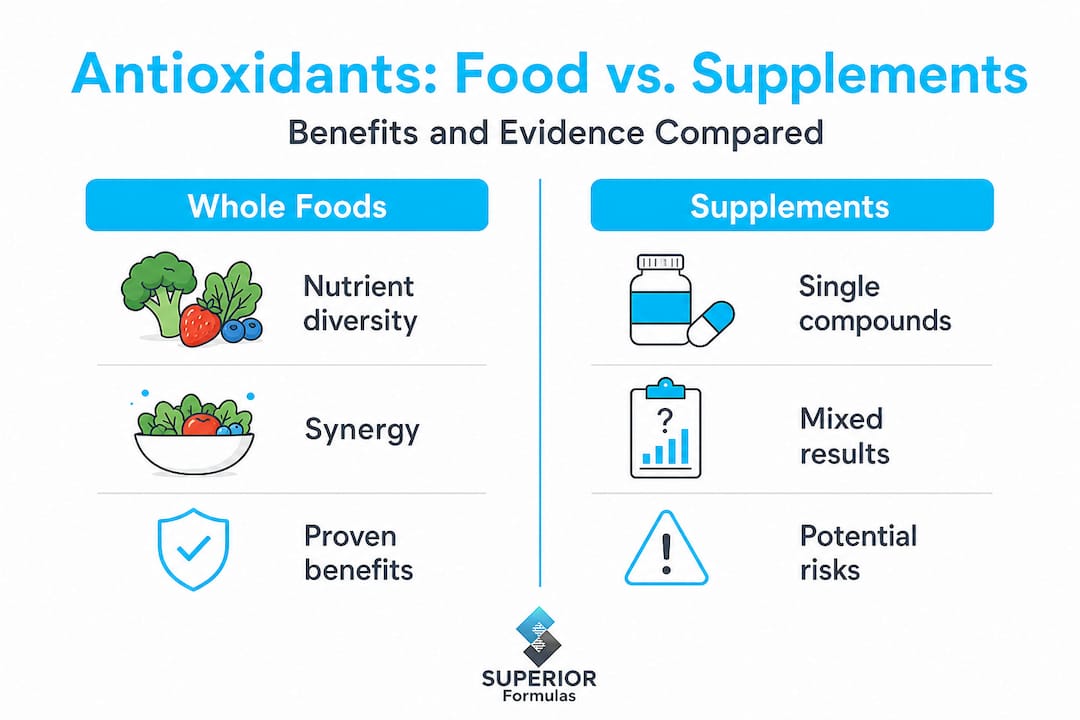
This is the question at the heart of the antioxidant debate, and the evidence leans decisively in one direction. Polyphenol-rich foods from fruits, vegetables, legumes, and whole grains reduce risks of heart disease, cancer, and inflammation while supporting healthier aging. Supplements, despite enormous investment in clinical trials, consistently fail to replicate those outcomes.
Why the disconnect? Whole foods contain thousands of bioactive compounds working together. Blueberries, for example, contain anthocyanins, quercetin, resveratrol, fiber, Vitamin C, manganese, and dozens of additional phytonutrients, all interacting in ways that change how each compound is absorbed and utilized. A Vitamin C supplement delivers one isolated molecule at a standardized dose with none of that supporting matrix.
Top antioxidant-rich foods to prioritize:
- Wild blueberries — among the highest anthocyanin concentrations of any fruit, with documented cardiovascular and cognitive benefits
- Dark leafy greens (spinach, kale, Swiss chard) — rich in lutein, zeaxanthin, and Vitamin K, supporting eye and cardiovascular health
- Walnuts and pecans — exceptional sources of ellagic acid and polyphenolic compounds with anti-inflammatory properties
- Green tea — concentrated source of EGCG (epigallocatechin gallate), one of the most studied polyphenols for metabolic and cellular health
- Dark chocolate (70%+ cacao) — flavanol-rich and shown in studies to support endothelial function and blood pressure
- Pomegranate — punicalagins and punicic acid offer potent anti-inflammatory and Nrf2-activating properties
- Cruciferous vegetables (broccoli, Brussels sprouts) — glucosinolates convert to sulforaphane, a powerful Nrf2 pathway activator
Large randomized controlled trials (RCTs) show that antioxidant supplements fail to prevent cancer, cardiovascular disease, or extend lifespan the way food-based antioxidants appear to. This is not a minor discrepancy; it is a consistent finding across decades of high-quality research.
| Health area | Food-based antioxidants | Antioxidant supplements |
|---|---|---|
| Cardiovascular disease | Significant risk reduction (Harvard data) | No consistent benefit in RCTs |
| Cancer prevention | Associated with lower risk | No benefit; potential harm in some groups |
| All-cause mortality | Inverse association with high intake | Neutral to increased risk in trials |
| Eye health (AMD) | Supportive, especially carotenoids | Specific formula (AREDS) shows benefit |
| Cognitive aging | Strong positive associations | Inconclusive trial results |
| Inflammation markers | Measurable reduction | Mixed results, context-dependent |
Understanding the difference between dietary supplements and longevity outcomes is essential before choosing any antioxidant strategy. The goal is strengthening your cells’ natural defense mechanisms, not overriding them.
Pro Tip: Eat the rainbow intentionally. Each color in plants signals different antioxidant compounds. Red (lycopene), orange (beta-carotene), purple (anthocyanins), green (chlorophyll and lutein), and white (quercetin and allicin) all offer distinct cellular benefits. Diversity in color means diversity in antioxidant coverage.
When does antioxidant supplementation make sense?
Given the evidence, routine antioxidant supplementation for otherwise healthy adults is not supported by science. That said, there are specific, well-defined scenarios where supplements provide genuine, clinically validated benefit.
Evidence-based scenarios for supplementation:
- Age-related macular degeneration (AMD): The AREDS and AREDS2 clinical trials demonstrated convincingly that a specific combination of nutrients, including Vitamins C and E, beta-carotene (or lutein/zeaxanthin), and zinc, significantly slow AMD progression in patients with intermediate to advanced disease. This is one of the strongest cases for targeted antioxidant supplementation in clinical practice.
- Diagnosed micronutrient deficiencies: If blood work confirms a deficiency in Vitamin C, Vitamin E, or zinc, supplementation is appropriate and medically warranted. Deficiency states create genuine oxidative vulnerability that dietary changes alone may not resolve quickly.
- Elderly adults with reduced dietary intake: Aging reduces appetite, absorption efficiency, and nutrient utilization. Older adults eating limited diets may not achieve adequate antioxidant status through food alone.
- Highly restrictive diets: Vegans, individuals with food allergies, or those following very low-calorie diets may have gaps that targeted supplementation can address appropriately.
- Pre- and post-surgical contexts: Some clinical protocols use targeted antioxidants to support tissue recovery, though this should always be physician-supervised.
| Supplement use | Evidence level | Recommendation |
|---|---|---|
| AREDS formula for AMD | Strong (Phase III RCT) | Clinically recommended for at-risk patients |
| Vitamin C for confirmed deficiency | Strong | Appropriate with medical guidance |
| Vitamin E for general longevity | Weak | Not recommended; potential harm |
| Beta-carotene for cancer prevention | Negative | Contraindicated in smokers |
| Zinc for immune support (elderly) | Moderate | Consider with dietitian input |
| General antioxidant “cocktails” | Insufficient | Not supported for healthy adults |
You can explore AREDS nutrients for AMD as part of a targeted approach for eye health support.
For those committed to research-backed supplements, the key principle is clarity of purpose. Supplements should fill documented gaps, not hypothetical ones.
Potential risks and pitfalls of antioxidant supplements
Here is where the “more is better” assumption becomes genuinely dangerous. The same molecules that protect cells at physiological concentrations can cause serious harm at pharmacological (high-dose supplement) levels.
The evidence on harm is robust and consistent. High-dose supplements carry real risks: beta-carotene supplementation increases lung cancer risk in smokers by approximately 18%, and Vitamin E supplementation has been linked to increased all-cause mortality and elevated prostate cancer risk in multiple trials. These are not rare side effects. They are outcomes from some of the largest antioxidant RCTs ever conducted.
“Antioxidant supplements do not reduce mortality and may increase it. Beta-carotene and Vitamin E supplementation were both associated with higher mortality rates in systematic reviews of randomized trials.” — Cochrane Collaboration
Beyond cancer and mortality risk, antioxidant supplements carry additional concerns:
- Blunting exercise adaptations: Intense exercise produces reactive oxygen species that serve as signals for muscle adaptation, mitochondrial biogenesis, and improved insulin sensitivity. High-dose antioxidant supplements taken around training can suppress those signals, reducing the fitness gains you work for.
- Interference with cancer treatment: Certain chemotherapy and radiation therapies deliberately generate oxidative stress to destroy cancer cells. Antioxidant supplements may shield cancer cells from treatment, potentially reducing therapeutic efficacy.
- Pro-oxidant effects: In high concentrations or the wrong redox environment, Vitamin C and other antioxidants can actually generate free radicals rather than neutralize them, creating the opposite of the intended effect.
- Drug interactions: Vitamin E can thin blood and interact with anticoagulant medications. Vitamin C in high doses affects iron absorption and kidney stone risk in susceptible individuals.
Who should exercise particular caution or avoid antioxidant supplements entirely:
- Current or former smokers (especially beta-carotene)
- Individuals undergoing chemotherapy or radiation treatment
- Athletes taking supplements during or immediately around training blocks
- People on blood-thinning medications
- Those with kidney disease or a history of calcium oxalate kidney stones
Always approach assessing supplement safety with the same diligence you would apply to any medication. Understanding what supplements in preventive health actually accomplish, versus what marketing claims, is foundational to protecting your health. When considering any new antioxidant regimen, working with a physician-formulated approach, as outlined in resources on physician-formulated supplements, significantly reduces your risk of harm.
Pro Tip: Before adding any antioxidant supplement to your routine, get baseline bloodwork. Knowing your actual Vitamin C, Vitamin E, zinc, and oxidative stress markers tells you whether you have a real gap to fill or whether you are simply adding risk for no measurable benefit.
The real key to longevity: Food synergy and smart supplementation
Here is the perspective that most supplement articles avoid stating plainly: for the overwhelming majority of healthy adults aged 35 and older, no antioxidant supplement will do what a genuinely diverse, plant-rich diet already accomplishes safely and effectively. That is not a pessimistic statement about supplementation. It is an honest acknowledgment of how biological complexity works.
The food matrix is not just a delivery vehicle for isolated nutrients. It is a living, interacting system. When you eat a handful of walnuts, you are delivering ellagic acid, omega-3 fatty acids, melatonin, Vitamin E, and dozens of polyphenols simultaneously, in proportions shaped by millions of years of co-evolution with human metabolism. A pill cannot replicate that architecture. The synergy is not just additive; it is multiplicative in ways that reductionist supplement design has consistently failed to capture.
That said, dismissing all supplementation as unnecessary or wasteful misses the nuance. The real question is never “should I supplement?” in the abstract. It is always “do I have a specific, documented reason to supplement this particular compound at this particular dose?” When the answer is yes, such as with AMD, a confirmed deficiency, or advanced age with compromised absorption, then carefully chosen, clinically guided supplementation is a genuinely valuable tool.
Longevity is built through daily habits compounded over decades, not through any single intervention. Nutrient diversity, consistent physical activity, quality sleep, stress resilience, and metabolic health all interact with antioxidant status in ways that no supplement can replicate in isolation. The emerging science around science-driven supplements is moving toward pathway activation, particularly Nrf2, AMPK, and sirtuin signaling, rather than simple antioxidant loading. This represents a more sophisticated and clinically sound approach than the “take more Vitamin C” paradigm that defined earlier decades of supplement research.
The most empowering position is also the most evidence-based one: build your antioxidant foundation on food, know your biomarkers, and use supplements strategically and sparingly when science genuinely supports doing so.
Explore science-driven antioxidant solutions for your wellness goals
If you have reached this point, you now understand that smart antioxidant support is not about taking more; it is about targeting the right pathways with the right tools at the right time.
For those who have identified specific gaps or are looking to strategically support Nrf2 activation and cellular resilience beyond diet alone, Superior Formulas offers physician-formulated options designed with exactly that clinical precision. The LONGEVITY Daily Nrf2 Activate+ is built around compounds that activate your body’s own protective pathways rather than simply flooding cells with isolated antioxidants. Explore the full evidence base and product rationale when you explore the science behind each formulation. Every ingredient decision is grounded in clinical research, not marketing trends.
Frequently asked questions
Can antioxidant supplements slow aging or prevent disease?
There is no strong clinical evidence that antioxidant supplements prevent aging or chronic disease; whole food sources consistently outperform supplements in large trials measuring these outcomes.
Are there any risks to taking high-dose antioxidant supplements?
Yes, high-dose antioxidant supplements increase mortality risk and are associated with elevated cancer risk in specific populations, including a documented 18% increase in lung cancer among smokers taking beta-carotene.
Who should consider antioxidant supplementation?
Supplementation is most justified in specific clinical cases, particularly for slowing AMD progression using the AREDS formula, or for correcting diagnosed micronutrient deficiencies under physician supervision.
Is it safe to combine multiple antioxidant supplements?
Combining high-dose antioxidants can compound risks, create pro-oxidant effects, and interact with medications, making physician oversight essential before combining multiple antioxidant products.
Can a regular healthy diet provide enough antioxidants?
For most healthy adults, a plant-rich diverse diet provides all necessary antioxidants safely and effectively, with the complex food matrix offering benefits that isolated supplements cannot match.
Recommended
- Enhance Cellular Defense: Effective Supplement Strategies - SUPERIOR Formulas
- Supplements in preventive health: What really works? - SUPERIOR Formulas
- How Dietary Supplements Support Longevity and Cellular Health - SUPERIOR Formulas
- Why choose science-driven supplements for longevity gains - SUPERIOR Formulas


