


You pick up a supplement, flip it over, and scan the label. The active ingredients look solid. Then you hit a list of twelve other substances you cannot pronounce, and a small doubt forms. Understanding why avoid unnecessary fillers in your daily supplements is not about fear. It is about making a genuinely informed decision for your long-term wellness. Some of those extra ingredients are functional and defensible. Others add nothing to your health while introducing variables you did not sign up for. This article clarifies the difference, explains the real consequences of non-essential fillers, and gives you a practical framework for choosing better.
Table of Contents
- Key takeaways
- What supplement fillers actually are
- Why avoid unnecessary fillers: health and quality implications
- Clean label vs. traditional filler approaches
- How to identify supplements that skip unnecessary fillers
- My take on what the filler conversation gets wrong
- Clean supplements from Superiorformulas
- FAQ
Key takeaways
| Point | Details |
|---|---|
| Not all fillers are equal | Some excipients are required for dosing accuracy and product stability; others serve no health function. |
| Unnecessary fillers carry real risks | Non-essential additives can trigger hypersensitivity reactions and introduce chemical impurities. |
| “No fillers” claims can mislead | Marketing language often obscures functional excipients listed under different names. |
| Clean label is about transparency | Third-party testing and full disclosure matter more than avoiding scientific ingredient names. |
| You can read labels effectively | Knowing a few key terms lets you distinguish between necessary excipients and padding. |
What supplement fillers actually are
To make a sound judgment about any ingredient, you first need to know what it does. In the supplement industry, the term “filler” is often used loosely to describe any ingredient that is not the active compound. The more precise term is excipient, which covers every inactive substance added during manufacturing.
Excipients fall into several functional categories:
- Flow agents (such as silicon dioxide and magnesium stearate) prevent powder from clumping during production, which keeps machines running and dosing consistent.
- Bulking agents (such as microcrystalline cellulose) add physical mass to a capsule or tablet so a tiny dose of active ingredient fills the capsule properly.
- Binders hold compressed tablets together so they do not crumble before you swallow them.
- Lubricants reduce friction between powder and machinery, protecting both the equipment and the uniformity of each tablet.
- Disintegrants help tablets break apart in your digestive tract so the active ingredients can actually be absorbed.
Functional excipients like silicon dioxide and magnesium stearate solve real problems in manufacturing: powder flow, compression, disintegration, and dose uniformity. Without them, you risk inconsistent fills and tablets that either crumble in shipping or fail to dissolve properly in your gut.
What makes a filler “unnecessary” is the absence of any functional role. Some manufacturers add colorants, artificial flavors, sweeteners, or bulking agents that exist purely to cut costs or improve aesthetics with no benefit to you and no requirement of the formulation itself.
Pro Tip: When you see an ingredient and cannot identify a functional reason for it, search the label for a corresponding benefit. If none exists, that is your signal to ask why it is there.
Why avoid unnecessary fillers: health and quality implications
The real concern around non-essential additives goes beyond ingredient minimalism. There are documented health and safety reasons why the health-conscious consumer over 30 should pay attention to what is in the “other ingredients” section.
Here is where the consequences of filler use become concrete:
- Hypersensitivity and immune reactions. Common excipient culprits in hypersensitivity cases include polyethylene glycol, methylcelluloses, gelatin, povidone, and mannitol. For someone with sensitivities, these are not neutral passengers in a capsule.
- Nitrosamine formation. Changes in excipient composition can directly affect chemical risk profiles. Level 2 excipient changes have been shown to increase nitrosamine impurities in tablets. Nitrosamines are probable human carcinogens, and their presence in a supplement you take daily is a non-trivial concern.
- Cumulative additive exposure. You may take three, four, or five supplements daily. Each product carries its own excipient load. Unnecessary fillers across multiple products compound your total exposure to substances that offer you nothing in return.
- Reduced absorption potential. Certain synthetic coatings and binders can interfere with how quickly or completely active compounds are released in the digestive tract.
“No additives or no fillers claims often function more as marketing than reflections of true ingredient simplification.” — PricePlow Supplement Research
The marketing dimension matters here. Brands focused on transparency publish testing results and list all ingredients clearly, while marketing-focused brands may hide excipients behind natural synonyms. A product labeled “no fillers” may still contain silicon dioxide listed as “silica” and stearic acid listed as “vegetable stearate.” The name changes. The ingredient does not.
Understanding the unnecessary filler effects that can accumulate over months of daily use is one of the most underappreciated aspects of supplement selection. For someone investing in their long-term wellness, that precision matters.

Clean label vs. traditional filler approaches
The clean label movement in supplements is not a fringe consumer preference. Consumers actively prefer shorter ingredient lists with recognizable, natural components, and retailers increasingly require certifications that restrict synthetic excipients. This has pushed manufacturers to find legitimate filler alternatives.
The comparison below gives you a practical reference for evaluating what you see on labels:
| Excipient type | Function | Source | Health consideration |
|---|---|---|---|
| Magnesium stearate | Lubricant | Synthetic or vegetable-derived | Generally recognized as safe; some sensitivity cases |
| Microcrystalline cellulose | Bulking agent | Plant cellulose | Well-tolerated; natural origin |
| Polyethylene glycol (PEG) | Coating, binder | Synthetic | Linked to hypersensitivity reactions |
| Silicon dioxide (silica) | Flow agent | Mineral or synthetic | Low risk; widely used |
| Arabinogalactan | Flow agent + prebiotic | Larch tree (natural) | Adds gut health benefit; functional advantage |
| Glyceryl behenate | Lubricant | Plant-derived | Natural alternative to synthetic lubricants |
| Artificial colorants | Aesthetics only | Synthetic | No functional benefit; potential sensitivity trigger |
Natural-derived alternatives like arabinogalactans and glyceryl behenate can improve powder flow and offer secondary health benefits, but full substitutions require careful testing to preserve mechanical tablet integrity. This is why the science-driven approach to formulation matters. Removing a synthetic filler is not simply a swap. It requires validation that the final product still delivers the dose accurately and consistently.
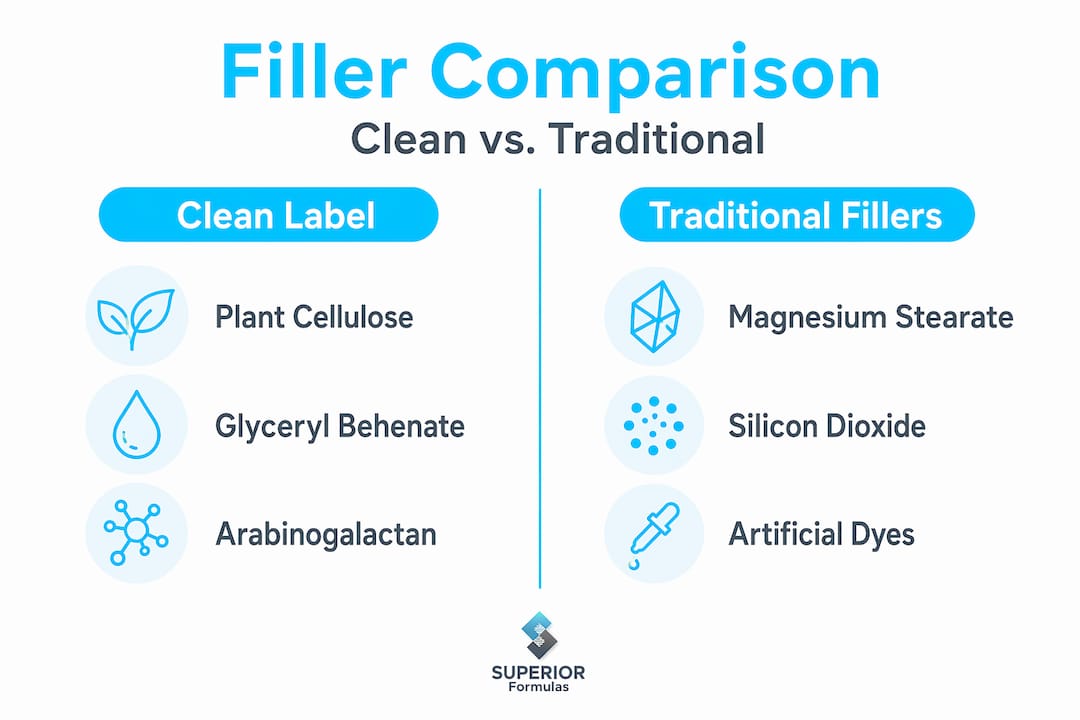
The honest picture is this: excipients require rigorous testing for purity and heavy metals and add real manufacturing complexity. Responsible formulators use the minimum necessary, choose natural-derived options where quality is preserved, and test every batch. That combination, rather than a blanket “no fillers” claim, is the actual mark of quality.
Pro Tip: Look for GMP-certified and third-party tested products. These designations confirm that what is on the label is actually in the capsule, and nothing unlisted got in.
How to identify supplements that skip unnecessary fillers
Knowing why skip fillers matters is one thing. Knowing how to actually find cleaner products on a shelf is where understanding becomes practice. Use this sequence when you evaluate a supplement:
- Read the “other ingredients” section first. Active ingredients get the spotlight, but the other ingredients section reveals the formulator’s actual priorities. Count them. A product with fifteen non-active ingredients warrants scrutiny.
- Identify functional roles. For each listed excipient, ask what manufacturing problem it solves. Flow agent? Acceptable. Artificial color FD&C Red 40? No function for your health.
- Check for synthetic vs. natural-derived excipients. Prefer plant-derived cellulose over petroleum-derived polyethylene glycol. The functional outcome may be similar, but the benefits of natural ingredients extend to lower sensitivity risk and cleaner sourcing.
- Prioritize third-party testing disclosure. A supplement label transparency commitment backed by published Certificates of Analysis tells you the product has been independently verified for purity and potency.
- Look for physician or scientist involvement in formulation. Products developed by clinicians with published rationale for each ingredient, including excipient choices, reflect a higher standard of care than products assembled by contract manufacturers optimizing for cost.
- Research the brand’s communication. Brands that explain their formulation choices in accessible language demonstrate confidence in their decisions. Brands that use vague marketing terms like “all natural” without ingredient specifics are often hiding something in the fine print.
Assessing supplements for real wellness value means treating the inactive ingredient list with the same critical eye you give the active compounds. Your body processes everything in that capsule, not just the polyphenols.
My take on what the filler conversation gets wrong
I have read hundreds of supplement labels, reviewed formulation rationales from clinical teams, and spoken with formulators who have spent careers solving the exact problems excipients are designed to address. Here is what I have learned that most articles on this topic miss entirely.
The conversation about avoiding harmful additives gets polarized fast. On one side, you have fear-driven consumers rejecting any ingredient with a scientific name. On the other, you have manufacturers hiding behind the technical necessity argument to justify ingredient lists that could genuinely be shorter. Both positions miss the point.
What I have found actually matters is not whether a filler exists in a product. It is whether the formulator can justify every single ingredient with a specific, defensible reason rooted in product quality. When I review a supplement from a brand that publishes its formulation rationale, I see that justification clearly. When I review a product from a brand that relies on “clean” marketing without substance, the ingredient list tells a different story.
The transparency issue is the real one. Functional excipients are necessary, and omitting them without a validated alternative leads to poor dosing accuracy. But padding a formula with synthetic colorants, unnecessary sweeteners, or redundant bulking agents because they are cheap? That is a formulator choosing cost efficiency over your health. I have seen this pattern repeatedly, and it is the specific behavior that warrants your skepticism.
My advice: stop reacting to the word “filler” and start asking for justification. The best brands welcome that question. The ones that do not are the ones worth avoiding.
— cristopher
Clean supplements from Superiorformulas
At Superiorformulas, the commitment to avoiding unnecessary fillers is not a marketing position. It is a formulation standard built into every product from the design stage forward. Founded by a physician-scientist, the brand applies the same rigor a clinician uses when evaluating drug formulations to every supplement it develops. Formula 9, the Superior Multi+ Daily, reflects this approach directly. It delivers clinically studied active ingredients, including AREDS2 nutrients for eye health and comprehensive micronutrient support, with a minimal excipient profile verified through third-party testing. If you have been looking for a daily supplement where every ingredient earns its place, this is where to start.
FAQ
What makes a filler “unnecessary” in a supplement?
A filler is unnecessary when it serves no functional role in manufacturing or product stability. Excipients required for flow, dosing accuracy, or tablet integrity are defensible. Colorants, artificial flavors, and excess bulking agents added purely for cost or aesthetics are not.
Can unnecessary fillers cause health problems?
Yes, in some cases. Excipient hypersensitivity involving compounds like polyethylene glycol, povidone, and mannitol is documented. Additionally, certain excipient changes have been linked to increased nitrosamine impurity levels, which are potential carcinogens.
Are “no filler” supplement claims trustworthy?
Not always. “No fillers” claims frequently function as marketing rather than accurate descriptions. Functional excipients may still be present under different names. Third-party testing and full label disclosure are more reliable quality indicators than marketing phrases.
What are the best filler alternatives in clean supplements?
Natural-derived options like arabinogalactans, glyceryl behenate, and plant-based cellulose can replace synthetic excipients in many formulations. Some, like arabinogalactans, provide secondary benefits such as prebiotic support while still fulfilling their manufacturing role.
How do I read a supplement label to spot unnecessary ingredients?
Go directly to the “other ingredients” section. Identify each excipient’s functional category. If you find synthetic colorants, artificial flavors, or multiple redundant bulking agents without a clear formulation rationale, those are candidates for unnecessary filler effects. Prioritize products with short, explained ingredient lists and published third-party test results.
Recommended
- Supplement fillers explained: what they are and why they matter - SUPERIOR Formulas
- Why Transparency in Supplements Matters for You | SUPERIOR Formulas
- How to assess dietary supplements for real wellness gains - SUPERIOR Formulas
- Supplements in preventive health: What really works? - SUPERIOR Formulas


