


Antioxidants can either support hormesis by activating stress-response signaling or blunt it when given at high doses or at the wrong time. The distinction hinges on mechanism: many dietary phytochemicals work by nudging the Nrf2 pathway and preserving glutathione reserves, not by mopping up free radicals directly. Superiorformulas builds its formulations around this signaling model, favoring compounds that train your cells to defend themselves over raw antioxidant mass.
Here’s the practical read: your body needs a certain amount of oxidative stress to trigger its own repair machinery. Flood the system with high-dose antioxidant supplements right before or after that stress, and you can mute the very adaptation you were trying to build. Whole-food hormetins, taken as part of a normal diet rather than as a pre-workout mega-dose, tend to support the process instead of interfering with it.
- Dietary phytochemicals like sulforaphane, resveratrol, and quercetin often act as signaling molecules, not scavengers.
- Large single doses of vitamin C or E around intense exercise have been shown to blunt training adaptations in some studies.
- Timing matters as much as the compound. What works in the morning may work against you an hour before a hard workout.
- Food-first patterns beat isolated megadoses for most healthy adults.
Key Takeaways
Antioxidants support hormesis when they activate Nrf2 signaling at low, food-based doses, and they blunt it when taken as high-dose supplements around planned physical stressors.
| Point | Details |
|---|---|
| Mechanism over scavenging | Most dietary antioxidants work by activating Nrf2 and boosting glutathione, not by directly neutralizing free radicals. |
| Modest effect sizes | Hormetic benefits typically run 30 to 60 percent above control, not dramatic transformations. |
| Timing matters | Avoid high-dose antioxidant supplements right before or after intense exercise to protect mitohormesis. |
| Food beats megadose | Sulforaphane, resveratrol, and quercetin work best as regular dietary intake, not concentrated isolates. |
| Isolated compounds carry risk | High-dose beta-carotene trials in smokers showed harm, reinforcing the need for context-aware dosing. |
Table of Contents
- Hormesis and Antioxidants: The Biphasic Response Behind It All
- Para-Hormesis: How Dietary Antioxidants Really Work in Your Body
- When Exercise and Diet Reveal Hormesis in Action
- Practical Guidance for Supporting Hormesis Through Diet and Timing
- Where the Antioxidant Research Still Falls Short
- Superiorformulas’ Approach to Nrf2-Focused Formulation
- Ready to Support Your Cellular Resilience?
- An Editorial Take on Mechanism Over Neutralization
- Sources
Hormesis and Antioxidants: The Biphasic Response Behind It All
Hormesis describes a biphasic dose response: a low dose of a stressor triggers an adaptive, protective response, while a high dose of the same stressor causes damage. The curve looks like an upside-down U, or sometimes a J, and it shows up across an enormous range of biological systems, from single cells exposed to heat to whole organisms exposed to exercise, calorie restriction, or plant chemicals.
The effect size is usually modest. Reviews of hormetic responses across biology put the typical maximum stimulation at roughly 30 to 60 percent above control, not the dramatic swings marketing copy sometimes implies. That modesty is actually a feature, not a bug. Hormesis is a fine-tuning mechanism, not a sledgehammer. Understanding this scale helps calibrate expectations: a supplement or exercise habit that nudges cellular resilience by a third is doing real work, even if it never produces a headline-grabbing transformation.
Reactive oxygen species act as signals, not just damage
Reactive oxygen species, or ROS, have a reputation problem. Decades of “free radical” messaging cast them as pure villains, but at low concentrations they function as signaling molecules that switch on protective genes. At high concentrations, the same molecules oxidize lipids, proteins, and DNA. The dose, not the molecule itself, decides whether ROS help or hurt.
Mitohormesis is the version of this that happens inside your mitochondria. A burst of ROS from exercise or intermittent fasting signals the mitochondrial network to build more capacity, upregulate its own antioxidant enzymes, and improve efficiency. Give the same cell a much larger ROS load, or give it that load at the wrong point in its repair cycle, and you get mitochondrial dysfunction instead. Timing and dose together determine the outcome, which is why the “more stress equals more adaptation” logic breaks down quickly in practice.
Quick fact: hormetic responses generalize across an unusually wide range of biological systems and stressors, but they almost always require dose-time-response study designs (multiple doses, multiple timepoints) to detect and confirm, according to the review in Dose-Response.
The four pathways that mediate most hormetic adaptation
- Nrf2/Keap1 signaling. Under normal conditions, the protein Keap1 holds Nrf2 in check. Certain electrophilic compounds modify Keap1’s cysteine residues, releasing Nrf2 to enter the nucleus and switch on hundreds of cytoprotective genes, including those for glutathione synthesis and detoxification enzymes.
- NF-κB signaling. This pathway governs inflammatory and stress responses; mild activation can prime tissue for repair, while chronic overactivation drives inflammatory damage.
- Sirtuins. These NAD-dependent enzymes link cellular energy status to stress resistance and are activated by several dietary polyphenols and by caloric restriction.
- Autophagy. The cell’s recycling system clears damaged proteins and organelles; mild stress upregulates it, while both too little and too much impair cellular housekeeping.
These pathways don’t operate in isolation. Nrf2 activation often runs alongside a modest autophagy boost, and both can intersect with the heat shock protein response that helps refold or clear damaged proteins after a stressor. Hormesis in health outcomes usually reflects several of these systems firing together, not a single switch.
Para-Hormesis: How Dietary Antioxidants Really Work in Your Body
Here’s the mechanism most people misunderstand: in vivo, dietary antioxidants rarely work the way a test tube experiment suggests. The kinetics don’t hold up. A polyphenol circulating in plasma at nanomolar to low micromolar concentrations, largely as metabolized conjugates, simply cannot outcompete the sheer volume of ROS-generating reactions happening inside a cell through direct scavenging. The math doesn’t work.
What actually happens instead is para-hormesis: these compounds act as mild electrophilic stressors that activate your endogenous defense systems. Researchers describe this as maintaining “nucleophilic tone,” a baseline capacity of your cells’ own antioxidant machinery, primarily glutathione and enzymes like glutathione peroxidase and superoxide dismutase, kept topped up and ready. The phytochemical isn’t neutralizing radicals on contact. It’s training the factory that makes the neutralizers.
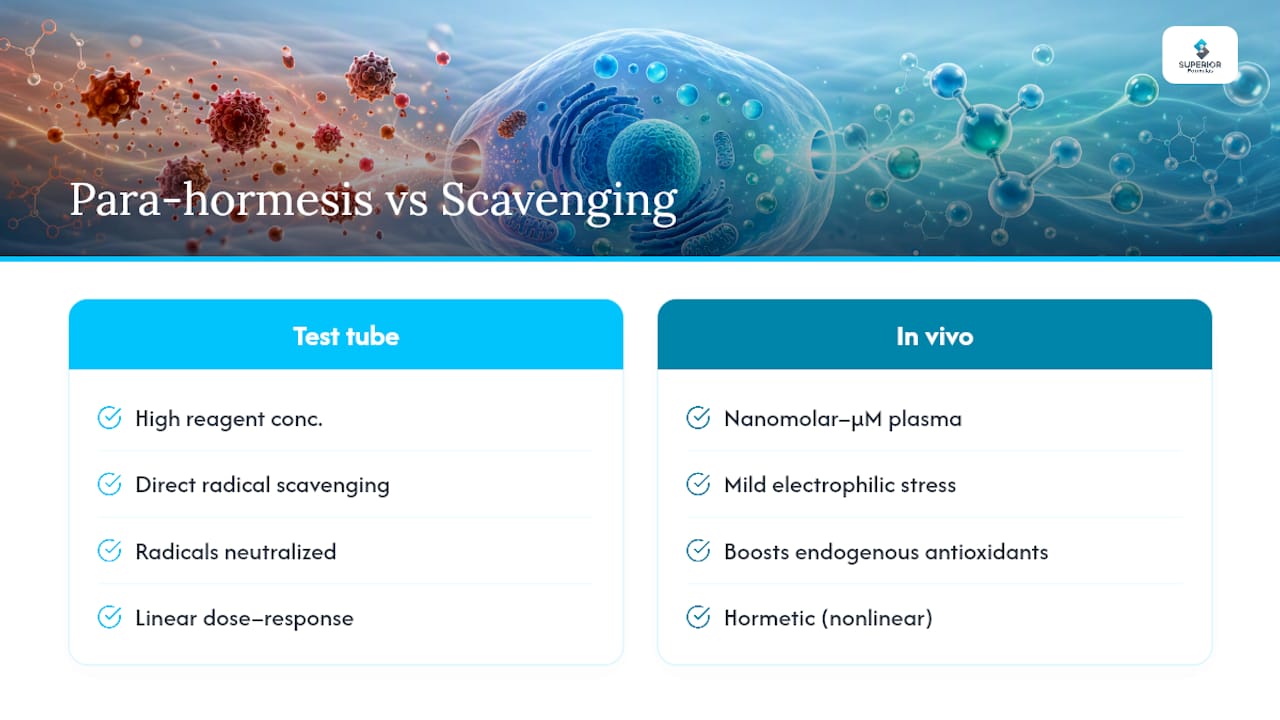
This reframing matters because it explains something that puzzled researchers for years: why isolated antioxidant supplements often fail in clinical trials while diets rich in the same compounds correlate with better outcomes. If the mechanism were direct scavenging, dose should predict effect in a straightforward way. It doesn’t, because the real mechanism is signaling, and signaling pathways follow the hormetic curve rather than a linear dose-response.
Compounds that work as hormetins, not scavengers
- Sulforaphane, found in broccoli and other crucifers, is one of the most potent known activators of the Nrf2/Keap1 pathway, modifying specific cysteine residues on Keap1 to release Nrf2 and switch on more than 500 cytoprotective genes.
- Resveratrol, found in grapes and berries, activates sirtuin signaling alongside modest Nrf2 induction, linking energy metabolism to stress resistance.
- Quercetin, common in onions, apples, and tea, exhibits a biphasic effect itself: it acts as a mild pro-oxidant at physiological concentrations, which is precisely what triggers the adaptive Nrf2 response, while very high doses can tip toward pro-oxidant harm rather than benefit.
Each of these compounds behaves less like a fire extinguisher and more like a fire drill. Endogenous defenses are what actually put out oxidative fires; the plant compound’s role is to run the drill often enough that those defenses stay sharp.
Pro Tip: If a supplement label emphasizes “ORAC score” or raw antioxidant capacity as its main selling point, treat that as a yellow flag rather than a green light. In vivo evidence increasingly favors compounds selected for their signaling activity on Nrf2 and related pathways, not their test-tube scavenging numbers.
Practically, this means the smarter formulation strategy is choosing phytonutrients documented for Keap1/Nrf2 modification (sulforaphane, certain polyphenols) over stacking massive doses of vitamin C or E as standalone scavengers. Phytonutrients and antioxidants are related concepts but not interchangeable ones, and the difference shapes how a formulation should be built.
When Exercise and Diet Reveal Hormesis in Action
Exercise is the clearest real-world demonstration of mitohormesis available to a healthy adult, and it’s also where the antioxidant-blunting problem has been studied most directly. A hard workout generates a burst of ROS in working muscle. That burst is the actual signal your body uses to upregulate mitochondrial biogenesis, antioxidant enzyme expression, and insulin sensitivity. Suppress it, and you suppress part of the adaptation.
Several studies have tested exactly this by giving subjects high-dose vitamin C and vitamin E around training sessions. The pattern that emerges, summarized in a review on how exercise, oxidants, and antioxidants reshape the hormesis curve, is that megadose antioxidant supplementation taken close to the exercise bout can blunt some of the expected gains in mitochondrial density and insulin sensitivity compared to exercise alone. The effect isn’t universal across every study or every outcome measure, but it shows up often enough that exercise physiologists now flag antioxidant timing as a real variable, not a footnote.
Diet tells a more encouraging story, at least for whole-food patterns. Populations eating polyphenol-rich diets, heavy on vegetables, fruit, tea, and fermented foods, consistently show better markers of oxidative balance and lower rates of several chronic conditions. The emerging dietary hormesis framework treats this as expected: plant metabolites, fermentation byproducts, and even some cooking-generated compounds act as low-dose hormetic signals delivered in the amounts a normal diet provides, which is a very different exposure profile than a concentrated capsule.
Isolated-compound trials, by contrast, have produced some of the most sobering results in nutrition science. The table below summarizes how the picture diverges depending on whether the antioxidant exposure came from food or from an isolated supplement.
| Antioxidant approach | Typical study finding |
|---|---|
| Polyphenol-rich dietary pattern | Associated with better redox markers and lower chronic disease risk |
| Exercise-induced ROS (no antioxidant blocking) | Drives expected mitochondrial and insulin-sensitivity adaptations |
| High-dose vitamin C/E around exercise | Can blunt mitochondrial and insulin-sensitivity gains in some trials |
| Isolated beta-carotene, high dose | Associated with harm in specific high-risk populations (see below) |
The heterogeneity here is the real headline. Two studies using the same antioxidant can produce opposite conclusions depending on dose, timing relative to the stressor, baseline nutrient status of participants, and which outcome they measured. That’s not a flaw in the research; it’s what you’d expect from a biphasic mechanism that a linear dose-response study design isn’t built to capture. Reviews of hormesis as a general biological principle have flagged this repeatedly, noting that detecting a hormetic curve requires dose-time-response designs rather than the single-dose comparisons most nutrition trials still default to.
Practical Guidance for Supporting Hormesis Through Diet and Timing
Getting the benefits of hormesis without accidentally blunting them comes down to a short list of habits, most of which favor food over pills as the default source.
- Build meals around hormetin-rich whole foods. Crucifers (broccoli, kale, brussels sprouts), berries, green tea, and fermented foods like kimchi and sauerkraut deliver phytochemicals in the low, intermittent doses that favor signaling over overload.
- Separate antioxidant supplement timing from planned stressors. Avoid taking large doses of vitamin C, vitamin E, or concentrated polyphenol extracts in the hours immediately before or after intense exercise, since that’s the exact window mitohormesis needs the ROS signal intact.
- Reserve high-dose supplementation for documented deficiency or clinician guidance. If bloodwork shows low vitamin C, low glutathione precursors, or another specific gap, targeted correction under medical supervision is appropriate. Blanket megadosing without a documented need is not the same thing.
- Favor formulations built around Nrf2 and endogenous enzyme support rather than raw scavenging capacity. Ingredients selected for documented Keap1/Nrf2 activity tend to align better with how the body actually processes oxidative signals.
- Check the formulation label for transparency markers, including third-party testing, clear dosing per ingredient, and GMP-certified manufacturing, before assuming a product does what its marketing claims.
Pro Tip: Think of your antioxidant intake on a weekly rhythm rather than a daily maximum. A diet that regularly rotates through crucifers, berries, tea, and fermented foods gives your Nrf2 system frequent, low-dose reminders to stay switched on, which does more for long-term resilience than any single high-dose supplement day.
For readers who want a deeper look at which specific compounds show the strongest research backing, Superiorformulas has published a breakdown of polyphenols for longevity and a companion piece on how phytonutrients shape aging for adults over 35, both of which expand on the food-first logic above.
Where the Antioxidant Research Still Falls Short
Not every antioxidant story ends well, and pretending otherwise would do readers a disservice. The most cited cautionary example involves beta-carotene supplementation in smokers. Large trials testing high-dose beta-carotene as a lung cancer preventive found the opposite of the intended effect in that specific population, a result that reshaped how nutrition researchers think about isolated antioxidant megadosing in people with elevated baseline oxidative or carcinogenic risk.
The lesson from these trials isn’t that antioxidants are dangerous. It’s that a compound’s effect depends entirely on dose, baseline physiology, and the biological context it’s delivered into, exactly what a biphasic, hormetic model predicts and a simple “more is better” model cannot explain.
Several open questions remain unresolved. Human dose-time-response curves for most dietary hormetins are still sparse. Long-term safety data for high-dose isolated compounds, taken for years rather than weeks, is limited. And responses likely vary by population, genetic background, baseline nutrient status, and age, variables that most existing trials weren’t designed to separate out.
- Beta-carotene megadosing in smokers: harm, not benefit, in landmark trials.
- Dose-time-response curves in humans: still incomplete for most phytochemicals.
- Population-specific responses: understudied, especially by age and genetic background.
- Study design gaps: researchers increasingly call for multiple doses, multiple timepoints, and functional hormetic biomarkers rather than single-dose toxicity testing.
Superiorformulas’ Approach to Nrf2-Focused Formulation
Superiorformulas was founded by a physician-scientist, and that clinical background shapes how the company approaches antioxidant formulation: as a signaling problem, not a scavenging contest. The formulations prioritize phytonutrients with documented activity on the Nrf2 pathway and related cellular resilience mechanisms, the same mechanism this article has walked through in detail.
That approach shows up in a few concrete commitments:
- Physician-formulated blends built around ingredients with published mechanistic data, rather than proprietary blends chosen for marketing appeal.
- GMP-certified manufacturing, meaning production follows the FDA’s Good Manufacturing Practice standards for dietary supplements.
- Third-party testing for purity and potency, so label claims can be independently verified rather than taken on faith.
- Clean formulation standards, avoiding unnecessary fillers that add bulk without biological purpose.
Readers who want more background on how cellular antioxidant systems support long-term health can review Superiorformulas’ explainer on cellular antioxidants and longevity, which expands on several of the enzyme systems discussed above.
Ready to Support Your Cellular Resilience?
If the mechanism-first case above resonates, the next step is straightforward: look for a formulation built around Nrf2 activation and endogenous antioxidant enzyme support rather than raw scavenging capacity. Superiorformulas designs its longevity and cellular-health lineup around exactly that principle, using phytonutrients selected for documented signaling activity and manufactured under GMP-certified, third-party-tested standards. Explore the Superiorformulas product line to see how physician-formulated, Nrf2-targeted blends translate the science in this article into a daily formulation.
An Editorial Take on Mechanism Over Neutralization
The conventional antioxidant pitch, buy a supplement, neutralize free radicals, feel better, gets the biology backward. Free radicals aren’t simply enemies to be mopped up; at physiological doses they’re the signal your cells use to build their own defenses. Treating every ROS molecule as something to eliminate is like sealing off a fire drill because you don’t like the noise of the alarm.
What the evidence in this article actually supports is a shift in emphasis: from scavenging capacity to signaling capacity. Sulforaphane, resveratrol, and quercetin earn their reputations not because they mop up radicals in a test tube, but because they nudge Keap1, free Nrf2, and put your own enzyme systems to work. That’s a fundamentally different value proposition than the one printed on most supplement labels.
I’d argue the biggest thing readers should prioritize first is timing discipline, not compound selection. Get the timing wrong, megadosing right before a hard workout or a fasting window, and even a well-chosen hormetin can work against you. Get it right, and modest, food-based exposure does more for long-term resilience than most people expect from something so unglamorous.
— cristopher
Sources
For readers who want to go deeper into the mechanisms covered here, start with the foundational review defining hormesis as a biphasic response and the broader survey of hormesis as a fundamental biological concept. For the antioxidant-specific mechanism, read the paper on nucleophilic tone and para-hormesis and the review of oxidative distress and redox modulation. The exercise-specific evidence appears in the Redox Biology review on exercise and the hormesis curve, and the dietary framework is laid out in the npj Science of Food paper on dietary hormesis.
This article is general information, not a substitute for advice from a qualified doctor. Consult a qualified healthcare professional about your own circumstances before acting on anything here.
- Hormesis defined (Johns Hopkins)
- Hormesis: a fundamental concept in biology (PMC)
- Dietary hormesis: beyond nutrition and energy supply (npj Science of Food)


