


For most people trying to raise intracellular glutathione and support liver antioxidant function, NAC is the practical starting point. It’s cheaper, better studied for chronic use, and works with your body’s own synthesis machinery. Direct glutathione formulations, particularly liposomal or sublingual versions, earn their place when rapid repletion or impaired synthesis is the actual problem. The sections below break down the mechanisms, the trial data, and how to choose between them.
TL;DR:
- Oral glutathione has limited absorption due to digestion, making formulations like liposomal or sublingual versions more effective for rapid repletion.
- NAC reliably raises intracellular glutathione by providing cysteine, the bottleneck amino acid in glutathione synthesis, especially beneficial for oxidative stress support.
- Combining NAC with glycine (GlyNAC) enhances synthesis capacity, particularly in older adults with declining natural glutathione production.
- Short-term trials show sublingual glutathione can improve oxidative biomarkers more than standard capsules, emphasizing delivery format importance.
- Long-term benefits and comparisons remain inconclusive due to small study sizes and formulation variability, reinforcing the need for personalized, clinically guided choices.
Table of Contents
- Glutathione vs NAC: A Quick Comparison
- Why NAC Raises Glutathione While Oral Glutathione Struggles to Absorb
- What Do Clinical Trials Actually Show?
- Who Should Start With NAC vs. Direct Glutathione?
- Dosing Ranges, Timing, and Safety Notes
- Reading Labels: How to Choose a Formulation
- How to Decide: A Simple Checklist
- Why the “Which One Wins” Framing Misses the Point
- An Evidence-First Approach to Antioxidant Support
- Formulations Built Around the Science, Not the Trend
- Sources
Glutathione vs NAC: A Quick Comparison
The two supplements solve the same problem from opposite directions. NAC (N-acetylcysteine) is a stabilized precursor. It hands your cells cysteine, the rate-limiting amino acid your body needs to manufacture glutathione on its own. Glutathione, by contrast, is the finished tripeptide, already built from cysteine, glutamate, and glycine. Taking it directly means trying to deliver the end product rather than the raw material.
That distinction drives almost every practical difference between them.
- Mechanism: NAC feeds synthesis; glutathione supplies the finished molecule (if it survives digestion).
- Typical trial dosing: NAC studies commonly use moderate daily doses typical of clinical protocols, split into two or three doses; liposomal glutathione trials tend to use doses within a moderate range per available trials.
- Evidence base: NAC has decades of clinical use, including as an established treatment for acetaminophen toxicity. Direct oral glutathione has a thinner, more formulation-dependent evidence base.
- Cost: NAC is generally less expensive per effective dose. Liposomal and sublingual glutathione products cost more to manufacture and to buy.
- Absorption: NAC absorbs reliably through standard oral dosing. Plain oral glutathione is vulnerable to degradation before it reaches circulation, which is why delivery format matters so much for the direct route.
Who should consider which: if you’re managing general oxidative stress, want broad antioxidant and respiratory support, or you’re just starting out, NAC is the more defensible first move. If you need faster repletion, have documented synthesis problems, or you’re working under a clinician’s supervision for a specific condition, direct glutathione (in an absorption-optimized form) becomes worth the extra cost.
Why NAC Raises Glutathione While Oral Glutathione Struggles to Absorb
Glutathione is a tripeptide made from three amino acids: cysteine, glutamate, and glycine. Your cells synthesize it constantly, using it to neutralize reactive oxygen species, recycle other antioxidants like vitamin C and E, and support phase II liver detoxification pathways that clear toxins and drug metabolites. The bottleneck in that synthesis process is almost always cysteine. Your body can usually source enough glutamate and glycine from a normal diet, but cysteine availability limits how much glutathione you can actually build.
NAC solves that bottleneck directly. Once swallowed, it absorbs through the small intestine and gets deacetylated, mostly in the liver, releasing free cysteine that feeds straight into the synthesis pathway. This is why NAC reliably raises intracellular glutathione in multiple review analyses across a wide range of contexts, from respiratory support to liver protection.
Plain oral glutathione runs into a different problem entirely. Peptidases in your gut break the tripeptide apart before much of it reaches the bloodstream intact. Swallow a glutathione capsule, and your digestive system often treats it like any other protein source, dismantling it into individual amino acids rather than delivering it whole.
That’s the gap liposomal, sublingual, and S-acetyl formulations try to close. Liposomal versions wrap the molecule in a phospholipid shell that resists enzymatic breakdown until it’s absorbed. Sublingual formats skip the gut altogether, letting the compound enter circulation through tissue under the tongue and bypassing first-pass metabolism. S-acetyl glutathione is chemically modified to resist degradation and cross cell membranes more efficiently.
There’s a third player worth knowing about: glycine. NAC supplies cysteine, but not the glycine and glutamate your cells also need for synthesis. This is where the GlyNAC concept comes in, pairing NAC with supplemental glycine. It has particular relevance for older adults, whose natural glutathione synthesis capacity tends to decline with age, making the combined approach potentially more effective than NAC alone for that population.
Pro Tip: If you’re over 60 and NAC alone doesn’t seem to be moving the needle on how you feel, adding glycine rather than switching to direct glutathione may address the actual gap in your synthesis pathway.
What Do Clinical Trials Actually Show?
The evidence comparing NAC and glutathione head-to-head is limited, but it’s not nonexistent, and what exists tells a fairly consistent story.
A 2015 randomized crossover trial tested NAC, standard oral glutathione, and a sublingual glutathione formulation in 20 volunteers with metabolic syndrome over three weeks. The sublingual form raised plasma glutathione and improved the GSH/GSSG ratio (a key marker of oxidative balance) more than standard oral glutathione did, and it outperformed NAC on some short-term biomarkers. That’s a meaningful finding: it suggests delivery format matters more than which molecule you start with, at least for rapid biomarker changes.
Small trial, real signal: In that 20-person crossover study, sublingual glutathione produced statistically significant improvements in the GSH/GSSG ratio compared with standard oral glutathione, a difference that plain capsules and tablets don’t reliably achieve.
Separately, randomized trials of liposomal glutathione have shown increases in body glutathione stores and certain immune function markers compared with baseline measurements. That’s encouraging for the liposomal delivery route specifically, though it doesn’t tell you how liposomal glutathione stacks up against NAC over the long term.
On the metabolic side, a 2021 trial reported by Harvard Health found oral glutathione supplementation improved insulin resistance in a group of men with obesity. That’s a real result, but it’s a single trial in a specific population, and broader metabolic or longevity claims built on it remain an active research question rather than settled clinical fact.
There’s also an important distinction between acute and chronic use. IV NAC has an established, well-documented role in acetaminophen overdose treatment, where rapid glutathione repletion can be lifesaving. That’s a different context entirely from someone taking oral NAC daily for general antioxidant support, and it’s worth not conflating the two when you read claims about either compound.
A few limitations run through nearly all of this research:
- Sample sizes tend to be small, often fewer than 30 participants.
- Formulations vary widely between studies, making direct comparisons difficult.
- Most trials run for weeks, not months or years, so long-term outcomes remain largely unstudied.
None of this means the supplements don’t work. It means the science is real but still developing, and anyone promising definitive long-term benefits from either compound is getting ahead of the data.
Who Should Start With NAC vs. Direct Glutathione?
Matching the supplement to your actual situation matters more than picking whichever one has better marketing.
- Chronic oxidative stress or general antioxidant support. NAC is the sensible starting point here. It’s affordable, well-tolerated, and has the broadest evidence base for supporting intracellular glutathione over time.
- Respiratory support. NAC’s mucolytic properties and long clinical history in respiratory contexts make it the more logical first choice over direct glutathione.
- Severe liver impairment or documented synthesis problems. This is where direct glutathione, particularly liposomal or sublingual forms, becomes worth considering, ideally under clinical supervision rather than as a self-directed experiment.
- Older adults with declining synthesis capacity. GlyNAC (NAC plus glycine) has research support specifically for this population, addressing the raw-material gap that NAC alone doesn’t cover.
- Kidney impairment, pregnancy, or lactation. These situations call for a conversation with a clinician before starting either compound, since dosing and safety data for these groups are limited.
If you’re unsure where you fall, lab markers like GGT (a liver enzyme) and, in specialized settings, direct glutathione measurements can help a clinician decide whether repletion or synthesis support makes more sense for you. Superiorformulas’s guide to evaluating antioxidant needs for cellular longevity walks through that assessment in more detail.
Dosing Ranges, Timing, and Safety Notes
Trial-based dosing gives you a reasonable starting framework, though individual products vary in their label directions. NAC studies commonly use doses in the 600 to 1,800 mg per day range, typically split into two or three servings to smooth out absorption. Liposomal glutathione trials have generally used 250 to 500 mg daily, taken as a single dose or split depending on the product.
Timing considerations that actually matter:
- NAC has a relatively short half-life, which is part of why divided dosing is common in trial protocols rather than one large daily dose.
- Taking NAC on an empty stomach may improve absorption for some people, though taking it with food reduces the mild gastrointestinal upset some people experience.
- Sublingual glutathione needs to stay under the tongue long enough to absorb through oral tissue rather than being swallowed immediately.
Safety notes worth taking seriously:
- NAC’s most common side effects are gastrointestinal (nausea, mild stomach upset), particularly at higher doses.
- NAC can interact with nitroglycerin, potentially amplifying blood-pressure-lowering effects, so anyone on nitrate medications should talk to a clinician first.
- People with impaired kidney function should approach either compound cautiously, since renal clearance plays a role in how these are processed, and the same caution applies to anyone with reduced kidney function considering glutathione, not just NAC.
- IV NAC and IV glutathione are used in supervised clinical settings, including emergency treatment for acetaminophen overdose. That’s a fundamentally different risk and monitoring context than routine oral supplementation, and it isn’t something to replicate at home.
Regulatory and supply conditions shift over time, particularly around NAC’s status as a dietary ingredient in the United States, so checking current guidance before starting a new regimen is a reasonable habit rather than an overcautious one.
Reading Labels: How to Choose a Formulation
Not all products labeled “glutathione” or “NAC” deliver what the front of the bottle implies. A few label details separate a formulation likely to perform from one that’s mostly marketing.
- Reduced (GSH) vs. oxidized (GSSG) glutathione: you want the reduced form, since that’s the biologically active version your cells use.
- Serving size and total elemental dose: compare the actual milligrams per serving against the ranges used in trials, not just the product’s marketing claims.
- Companion ingredients: glycine, selenium, or vitamin C alongside glutathione can support the broader antioxidant recycling system rather than working in isolation.
- Phospholipid source (for liposomal products): sunflower or soy-derived phosphatidylcholine are common; the source affects both cost and, for some people, allergen considerations.
- Storage instructions: glutathione and NAC are both sensitive to heat and light, so packaging and storage guidance on the label are a real quality signal, not boilerplate.
Quality signals beyond the ingredient list:
- Third-party testing for purity and potency.
- Manufacturing in a GMP-certified facility.
- Transparent, specific dosing rather than proprietary blends that hide actual amounts.
Understanding how bioavailability works for dietary supplements generally helps explain why two products with identical ingredient lists can perform very differently once inside your body.
Pro Tip: If a glutathione product doesn’t specify “reduced glutathione” or “L-glutathione” on the label and instead just says “glutathione,” treat that as a red flag, not a technicality.
Higher-cost formats like liposomal or sublingual glutathione are justified when you have a specific reason for needing better absorption, not as a default upgrade over NAC for everyone.
How to Decide: A Simple Checklist
- Define your goal. General antioxidant support points toward NAC; documented liver impairment or a need for fast repletion points toward direct glutathione.
- Check relevant labs if available. GGT and clinician-ordered glutathione markers help clarify whether synthesis or repletion is the actual gap.
- Consider age and health status. Adults over 60 or those with chronic conditions may benefit from GlyNAC over NAC alone.
- Review current medications. Flag nitrate use or kidney impairment before starting either supplement.
- Start with NAC for 6 to 8 weeks, then reassess symptoms or relevant labs before considering a switch or an addition.
- Escalate only with reason. Move to liposomal, sublingual, or glycine-added protocols if NAC alone isn’t meeting a clearly defined goal, and stop or seek clinical review if new symptoms appear.
Why the “Which One Wins” Framing Misses the Point
Most of the content comparing these two supplements treats it as a competition with a single winner. That framing doesn’t hold up against the actual biochemistry. NAC and glutathione aren’t rivals; they’re different tools addressing different bottlenecks, and treating the question as binary leads people toward the wrong choice for their situation.
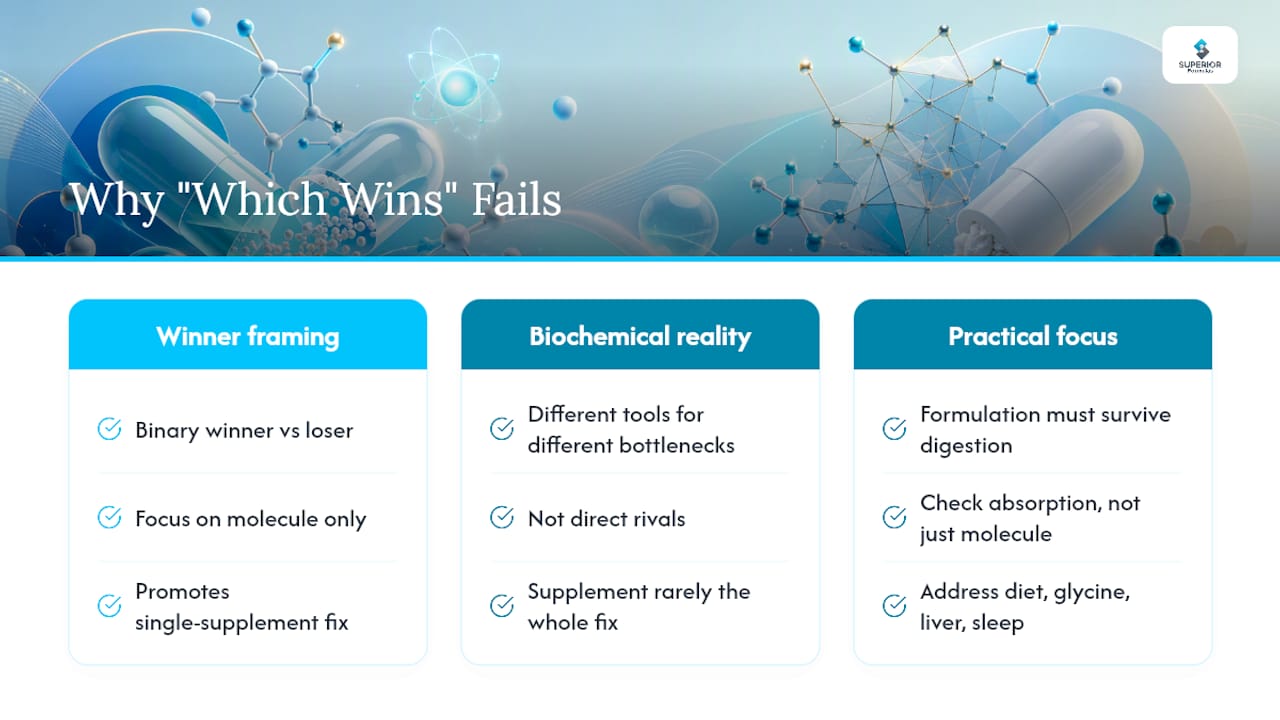
The bigger blind spot is dosage form. People fixate on which molecule to buy and pay far less attention to whether the formulation can survive digestion or absorption at all. A person taking plain oral glutathione capsules and getting no results isn’t necessarily learning that glutathione “doesn’t work.” They may be learning that plain oral glutathione doesn’t work, which is a completely different and more useful conclusion.
The most overlooked piece, though, is that glutathione status is rarely a single-supplement problem. Diet, glycine availability, underlying liver or metabolic function, and sleep all shape how much glutathione your body actually maintains. A supplement can support that system, but it’s rarely the whole fix on its own, and treating NAC or glutathione as a standalone solution sets people up for disappointment when other pieces of the puzzle stay unaddressed.
— cristopher
An Evidence-First Approach to Antioxidant Support
The brand approaches formulation with clinical grounding, focusing on physician-formulated products, manufactured in GMP-certified facilities, and verified through third-party testing for purity and consistency. The goal is straightforward, evidence-aligned antioxidant support built on ingredients with real research behind them. None of this replaces a conversation with your own clinician, especially for liver-specific or medication-related decisions.
Formulations Built Around the Science, Not the Trend
Choosing between NAC and glutathione ultimately comes down to matching the formulation to your actual biology, a principle reflected in some brands’ approaches to antioxidant support formulas. Rather than chasing whichever ingredient is trending, some formulation processes prioritize clinically studied compounds dosed at levels reflected in real research, not proprietary blends that obscure the actual amounts.
That transparency matters because, as this article has shown, absorption and formulation quality often determine results more than the ingredient label alone. Superiorformulas approaches Nrf2 activation and cellular antioxidant support with the same standard: GMP-certified manufacturing, third-party purity testing, and formulations designed around published research rather than marketing trends. If you want to see how that approach translates into a specific product lineup, visit the Superiorformulas landing page to review current formulations and their supporting research.
This article is general information, not a substitute for advice from a qualified doctor. Consult a qualified healthcare professional about your own circumstances before acting on anything here.


