


Phytonutrients are defined as plant-derived bioactive compounds that directly influence core biological aging mechanisms, including oxidative stress, chronic inflammation, and cellular senescence. These compounds, formally studied under the umbrella of phytochemicals, go well beyond basic nutrition. Flavonoids, polyphenols, and carotenoids each interact with aging pathways at the molecular level, making the role of phytonutrients in aging one of the most clinically relevant areas of nutritional science today. Recent research from 2025 and 2026 has moved this field from promising theory to measurable human outcomes.
What biological aging pathways do phytonutrients target?
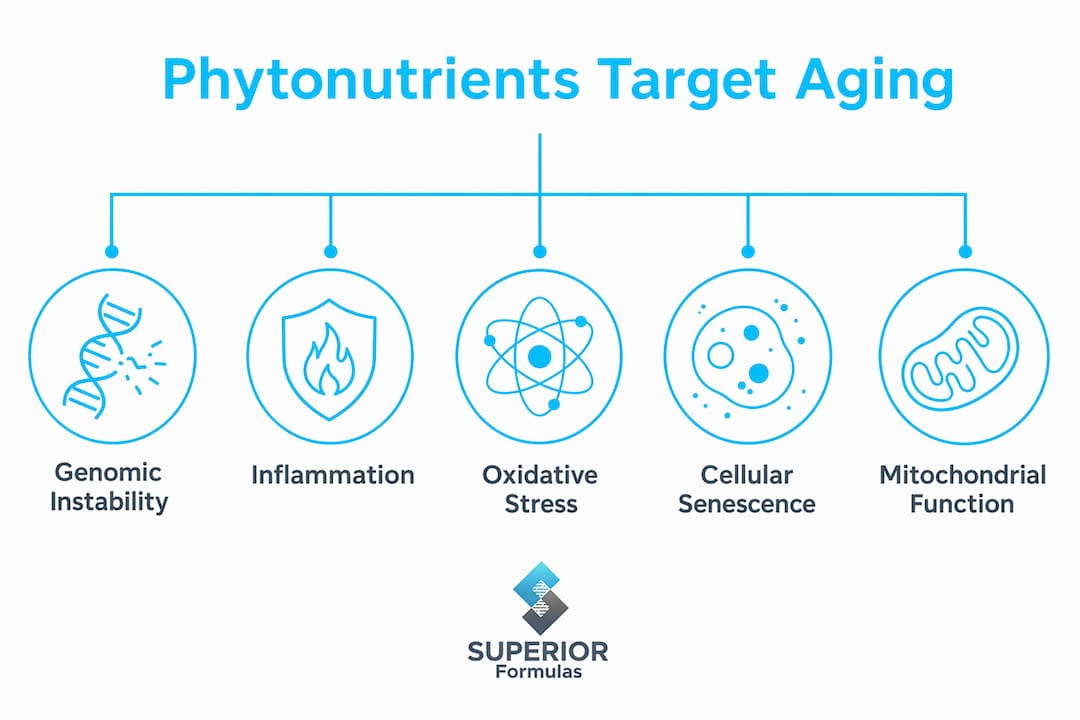
Aging is not a single process. Scientists now recognize a set of overlapping biological events, collectively called the hallmarks of aging, that drive age-related decline. These include genomic instability, telomere shortening, mitochondrial dysfunction, chronic low-grade inflammation, and cellular senescence. Phytocomplexes target multiple hallmarks simultaneously, which is precisely what makes them so relevant to healthy aging strategies.
Oxidative stress sits at the center of this picture. ROS accumulation damages mtDNA and proteins, creating a self-reinforcing feedback loop that accelerates cellular aging. This means that every year of unchecked oxidative stress compounds the biological damage already present. Phytonutrients interrupt this cycle by neutralizing free radicals and upregulating the body’s own antioxidant defense systems, including the Nrf2 pathway.
The anti-inflammatory dimension is equally significant. Polyphenols such as resveratrol and curcumin suppress NF-κB and inhibit NLRP3 inflammasome activity, two of the primary molecular drivers of inflammaging. Inflammaging refers to the chronic, low-level systemic inflammation that accumulates with age and underlies conditions from cardiovascular disease to cognitive decline. Reducing it through diet is not a minor benefit. It addresses one of aging’s most damaging undercurrents.
Key pathways phytonutrients modulate include:
- Genomic protection: Flavonoids reduce oxidative DNA damage and support DNA repair mechanisms.
- Mitochondrial function: Terpenoids and phenolic compounds help stabilize mitochondrial membrane integrity.
- Cellular senescence: Polyphenols show early evidence of senolytic and senomorphic activity, clearing or quieting dysfunctional cells.
- Lymphatic and proteostasis support: Phytocomplexes containing flavonoids and phenolics support lymphatic transport homeostasis, which is critical for clearing cellular debris.
Pro Tip: Think of phytonutrient intake as pathway coverage, not single-compound targeting. Rotating between berries, cruciferous vegetables, green tea, and turmeric across the week addresses more aging mechanisms than any single supplement can.
What does the latest human research say about phytonutrients and healthy aging?
Population-level evidence now provides some of the strongest data on how phytonutrients affect age-related outcomes. A landmark study published in Nature Medicine found that participants in the highest AHEI quintile had 86% greater odds of healthy aging by age 70, and 2.24 times greater odds by age 75, compared to those with the lowest adherence. The Alternative Healthy Eating Index heavily weights plant-based foods rich in polyphenols and carotenoids. This finding, drawn from 30 years of follow-up data, is not a correlation to dismiss lightly.
Clinical trials targeting specific phytonutrients are also producing meaningful results. A 42-month trial of glucoraphanin supplementation, a compound found in broccoli sprouts, showed significant improvement in Memory Performance Index in adults at elevated dementia risk, with no serious adverse events reported. Glucoraphanin activates the Nrf2 pathway and reduces neuroinflammation, which may explain the cognitive benefit. This is one of the longest phytonutrient supplementation trials in a cognitively at-risk population to date.
The picture is not uniformly positive, however. A 30-day greens-based supplement trial in obese older adults showed mixed effects on epigenetic aging markers, with the Horvath epigenetic clock actually increasing during supplementation. This does not mean greens supplements are harmful. It means biological age markers respond to dose, metabolic state, and formulation in ways that are not yet fully understood.
| Study | Population | Key Finding |
|---|---|---|
| AHEI dietary pattern (Nature Medicine, 2025) | Large prospective cohort, 30-year follow-up | 86% greater odds of healthy aging at 70 with highest plant-diet adherence |
| Glucoraphanin trial (Frontiers in Nutrition, 2026) | Adults at elevated dementia risk, 42 months | Significant Memory Performance Index improvement, no serious adverse events |
| Greens supplement trial (Frontiers in Nutrition, 2026) | Obese older adults, 30 days | Mixed epigenetic clock responses; Horvath age increased during supplementation |
| Mediterranean diet research (NIH) | Cardiovascular and aging populations | Reduced lipid peroxidation and pro-inflammatory gut bacteria via olive oil polyphenols |
The consistent thread across this research is that long-term dietary patterns outperform short-term supplementation bursts. Phytonutrients work through cumulative biological exposure, not acute pharmacological doses.
How do phytonutrients differ from antioxidants, and why does it matter?
Antioxidants are defined by a single function: neutralizing reactive oxygen species. Phytonutrients are defined by their plant origin and encompass a far broader range of biological activities. Every dietary antioxidant from a plant source is technically a phytonutrient, but not every phytonutrient acts primarily as an antioxidant. This distinction matters enormously when you are evaluating supplements or designing a diet for healthy aging.
Curcumin, for example, modulates gene expression through epigenetic mechanisms. Resveratrol activates SIRT1, a longevity-associated protein in the sirtuin family. Sulforaphane, derived from glucoraphanin, triggers Nrf2-mediated transcription of over 200 cytoprotective genes. These are signaling actions, not simply free-radical scavenging. The role of antioxidants in aging is real and well-documented, but treating phytonutrients as interchangeable with antioxidant supplements misses most of their biological value.
The gut microbiome adds another layer of complexity. Many phytonutrients are not absorbed intact. They are metabolized by gut bacteria into secondary compounds, such as urolithins from ellagitannins in pomegranates, that carry distinct biological activities. Mediterranean diet polyphenols shift gut microbiota toward anti-inflammatory bacterial populations, which then produce metabolites that further reduce systemic inflammation. This means the benefit of eating polyphenol-rich foods depends partly on your microbiome composition, which varies significantly between individuals.
Caution is warranted with isolated antioxidant supplements at high doses. Some trials have shown that supplemental beta-carotene increases lung cancer risk in smokers, and high-dose vitamin E has shown no benefit in cardiovascular prevention. The complexity of phytonutrient biology argues for food-first strategies and carefully formulated, evidence-based supplements rather than single-compound megadosing.
Pro Tip: When evaluating a phytonutrient supplement, look for products that combine multiple compound classes, such as polyphenols alongside carotenoids and glucosinolates, rather than isolated extracts at extreme doses. Synergy between compound classes is where the real biological coverage lies.
How can adults 35+ practically use phytonutrients to support healthy aging?
Translating phytonutrient science into daily practice does not require a complete dietary overhaul. It requires strategic consistency over time. The following approach reflects what the current evidence actually supports for adults in the 35 to 65 age range who want to build cellular resilience through diet and targeted supplementation.
-
Build your dietary foundation first. Prioritize fruits, vegetables, whole grains, legumes, nuts, and polyphenol-rich beverages like green tea and moderate red wine. The AHEI and Mediterranean dietary patterns both deliver broad phytonutrient coverage across flavonoids, carotenoids, glucosinolates, and phenolic acids. These phytonutrient-rich foods form the non-negotiable base.
-
Rotate your plant sources weekly. Blueberries supply anthocyanins. Broccoli sprouts deliver glucoraphanin. Turmeric provides curcumin. Green tea contains EGCG. Walnuts offer ellagitannins. No single food covers every pathway, so diversity across the week is the practical strategy for comprehensive coverage.
-
Consider targeted supplementation when dietary gaps exist. Glucoraphanin supplementation has demonstrated cognitive benefits over 42 months in at-risk populations. Curcumin and resveratrol have clinical trial support for anti-inflammatory effects. When choosing supplements, look for GMP-certified manufacturing, third-party testing, and formulations that specify the active compound and dose. Learn more about supplement support for longevity to understand what the evidence actually supports.
-
Avoid the short-term fix mindset. The 30-day greens supplement trial showing mixed epigenetic results is a useful reminder that biological aging markers do not respond predictably to brief interventions. Phytonutrients work through cumulative pathway modulation, not acute correction.
-
Match your approach to your health status. Adults managing metabolic conditions, cognitive risk factors, or cardiovascular concerns may benefit from specific phytonutrient classes at studied doses. A physician-formulated supplement designed around your health profile is more likely to deliver results than a generic greens powder.
-
Evaluate supplements critically. Check for clinical evidence behind the specific compound and dose, not just the ingredient category. Formulations that combine polyphenols, adaptogens, and carotenoids with documented bioavailability are meaningfully different from products that list plant extracts without specifying active compound concentrations.
Key takeaways
Phytonutrients support healthy aging most effectively when consumed consistently through diverse, plant-rich dietary patterns combined with evidence-based supplementation targeted to specific biological pathways.
| Point | Details |
|---|---|
| Multi-pathway targeting | Phytonutrients address genomic instability, inflammation, mitochondrial dysfunction, and senescence simultaneously. |
| Diet outperforms short-term supplements | 30-year data shows plant-rich dietary patterns deliver 86% greater odds of healthy aging at 70. |
| Antioxidant activity is one mechanism | Phytonutrients also modulate epigenetics, immune signaling, and gut microbiome composition. |
| Supplement nuance matters | Some epigenetic clocks increased during greens supplementation, highlighting the importance of dose and formulation. |
| Consistency is the active ingredient | Long-term dietary exposure to diverse phytonutrient classes produces the cumulative biological benefit the research supports. |
Why I think most people are approaching phytonutrients backward
After years of working at the intersection of clinical nutrition and aging biology, the pattern I see most often is this: someone reads about resveratrol or curcumin, buys a high-dose supplement, takes it for a month, notices nothing dramatic, and concludes that phytonutrients are overhyped. That conclusion is wrong, but the experience is understandable.
The science does not support expecting a phytonutrient supplement to produce noticeable short-term effects. What the science does support is that decades of consistent exposure to diverse plant compounds meaningfully shifts your biological aging trajectory. The glucoraphanin cognitive trial ran for 42 months. The dietary pattern data spans 30 years. These are not timelines that fit into a supplement trial period.
What I find genuinely underappreciated is the gut microbiome dimension. Your ability to convert ellagitannins into urolithins, or to metabolize resveratrol into its active forms, depends on which bacteria populate your gut. Two people eating identical diets can have meaningfully different phytonutrient bioavailability. This is why I consistently recommend building the dietary foundation first, supporting microbiome diversity through fermented foods and fiber, and then layering in targeted supplements where the clinical evidence is strongest.
The other thing worth saying plainly: no supplement replaces a poor diet. Phytonutrient supplements are most effective as additions to an already plant-rich dietary pattern, not substitutes for one. The adults who age best in the research are not the ones taking the most supplements. They are the ones who have eaten well, consistently, for decades.
— cristopher
Support your cellular health with Superiorformulas
Superiorformulas develops physician-formulated supplements built around the same phytonutrient science covered in this article. Every formulation is grounded in clinical research, manufactured in GMP-certified facilities, and third-party tested for purity and potency.
If you want to understand the specific compounds and mechanisms behind the products, the science behind the formulations is documented in detail on the Superiorformulas website. This is not a catalog of generic plant extracts. These are targeted formulations designed around Nrf2 activation, polyphenol bioavailability, and longevity pathways that the current research actually supports. Explore the evidence and find the formulation that fits your health goals.
FAQ
What are phytonutrients and how do they affect aging?
Phytonutrients are bioactive plant compounds, including flavonoids, polyphenols, and carotenoids, that modulate core aging mechanisms such as oxidative stress, chronic inflammation, and cellular senescence. Their multi-pathway biological activity makes them distinct from single-function antioxidants.
Do phytonutrients actually slow aging in humans?
Population studies show that adults with the highest adherence to phytonutrient-rich dietary patterns have 86% greater odds of healthy aging by age 70 compared to those with the lowest adherence, based on 30 years of follow-up data.
What are the best food sources of phytonutrients for adults over 35?
The strongest dietary sources include blueberries and other dark berries for anthocyanins, broccoli sprouts for glucoraphanin, turmeric for curcumin, green tea for EGCG, and walnuts and pomegranates for ellagitannins. Rotating these foods weekly provides broad coverage across multiple aging pathways.
Are phytonutrient supplements safe and effective for healthy aging?
Specific supplements like glucoraphanin have shown cognitive benefits over 42 months in clinical trials with no serious adverse events. However, some greens-based supplements have shown mixed epigenetic responses, so formulation quality, dose, and individual health status all influence outcomes.
How are phytonutrients different from antioxidants?
All plant-derived antioxidants are phytonutrients, but phytonutrients also include compounds that regulate gene expression, modulate immune signaling, and reshape gut microbiome composition. The role of antioxidants in aging is one part of a broader biological picture that phytonutrients address more completely.
For a formulation built specifically around these phytonutrient pathways, see our Formula 1 — LONGEVITY Daily Nrf2 Activate+, which was designed with exactly this clinical rationale in mind. Explore the science behind the formulation to see how it applies to your own routine.
Recommended
- How Dietary Supplements Support Longevity and Cellular Health - SUPERIOR Formulas
- Examples of Healthy Aging Nutrients for Adults 35+ | SUPERIOR Formulas
- Antioxidant Support: Evidence-Based Steps for Healthy Aging - SUPERIOR Formulas
- How to Boost Antioxidant Levels After 30 Naturally | SUPERIOR Formulas


