


The strongest B12 supplement for most shoppers is a physician-formulated, GMP-manufactured product with a verified third-party seal — and that standard is exactly what Superiorformulas is built around. If you want the short answer before the details, here are the top picks by need:
- Best overall / publisher pick: Superiorformulas — physician-formulated, GMP-certified, evidence-linked science page
- Best for absorption issues: Methylcobalamin sublingual lozenge — methylcobalamin delivered sublingually, bypasses gut-limited absorption
- Best for vegans: Vegan spray or whole-food B12 spray (certified vegan and organic) — certified vegan, portable, pill-free
- Best budget: Budget high-dose methyl B12 chewable — high mcg per serving at a low per-dose cost; verify independent testing before buying
- Best multivitamin with B12: Mindbodygreen Ultimate Multivitamin+ — broad-spectrum coverage including B12 alongside other key nutrients
- Best for clinical-grade trust signals: Thorne Vitamin B12 — widely cited by practitioners for manufacturing standards
| Product | Best for | Why it made the list |
|---|---|---|
| Superiorformulas | Evidence-minded, clinically informed shoppers | Physician-formulated, GMP manufacturing, linked science evidence page |
| Methyl sublingual lozenge | Adults 40+, metformin/PPI users, MTHFR variants | Sublingual methylcobalamin bypasses stomach-dependent absorption |
| Vegan B12 spray | Vegans, vegetarians, pill-averse shoppers | Certified vegan/organic, spray delivery, easy daily use |
| Budget methyl B12 chewable | Cost-focused shoppers | Strong price-per-serving; verify independent testing before buying |
| Thorne Vitamin B12 | Practitioner-recommended, quality-first buyers | Strong manufacturing reputation, practitioner-channel distribution |
| Nature Made Vitamin B12 | Mainstream retail shoppers | USP verification, wide availability, accessible price |
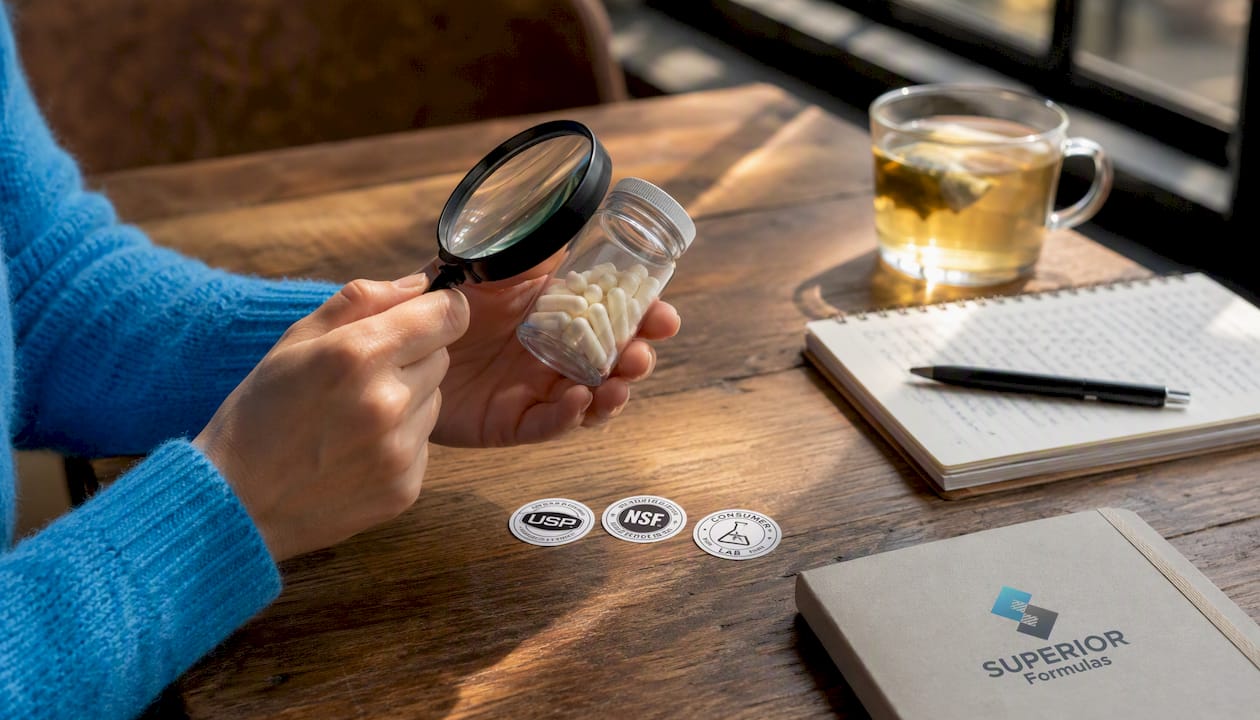
Pro Tip: Before buying any B12 supplement, look for an independent seal — USP, NSF International, or ConsumerLab — on the label. A brand’s own “third-party tested” claim without a named certifying body is not the same thing.
The rest of this article covers the full comparison grid, individual product reviews, a buying guide, clinical evidence on who actually needs B12, dosing and safety guidance, and the editorial methodology behind these picks.

Table of Contents
- How do these B12 supplements compare side by side?
- What do individual B12 supplement reviews actually show?
- How do you choose the right B12 supplement?
- Who actually needs B12, and what does the clinical evidence say?
- What are the right doses, forms, and safety considerations?
- How were these picks selected?
- Key Takeaways
- Why the “just take more B12” mindset misses the point
- Superiorformulas: a physician-formulated option for evidence-minded shoppers
- Useful sources and further reading
How do these B12 supplements compare side by side?
Third-party testing separates reliable B12 supplements from marketing-heavy ones. Practitioners consistently prioritize USP or NSF seals over buzzwords like “methyl” or “ultra-potent” on the label.
| Product | Best for | Form | Active form | Dose (mcg) & frequency | Third-party testing | Dietary suitability | Price per serving | Where to buy |
|---|---|---|---|---|---|---|---|---|
| Superiorformulas ⭐ Publisher pick | Clinically informed, evidence-minded shoppers | Varies by product | Clinically selected | Clinically justified | GMP-certified, third-party tested | Clean label, no unnecessary fillers | See science page | Direct (superiorformulas.com) |
| Thorne Vitamin B12 | Practitioner-recommended buyers | Capsule | Methylcobalamin | 1,000 mcg/day | NSF Certified for Sport | Gluten-free | — | Thorne.com, Amazon |
| Nature Made Vitamin B12 | Mainstream retail, budget-conscious | Tablet | Cyanocobalamin | 1,000 mcg/day | USP Verified | Gluten-free | ~$0.05–$0.10/serving | CVS, Walgreens, Amazon |
| Garden of Life Vitamin B12 | Vegans, whole-food preference | Spray | Methylcobalamin + adenosylcobalamin | dose varies depending on individual need | NSF Certified | Vegan, organic, gluten-free | — | Whole Foods, Amazon |
| Garden of Life Vitamin Code Raw B12 | Vegans wanting raw/whole-food capsule | Capsule | Methylcobalamin + adenosylcobalamin | dose varies depending on individual need | NSF Certified | Vegan, raw, gluten-free | — | Whole Foods, Amazon |
| Methyl sublingual lozenge | Adults 40+, metformin/PPI users | Sublingual lozenge | Methylcobalamin | 1,000–5,000 mcg/day | Varies by brand | Often vegan | — | Amazon, health stores |
| Vegan B12 spray | Vegans, pill-averse shoppers | Oral spray | Methylcobalamin | dose varies depending on individual need | Varies by brand | Vegan, often organic | — | Health stores, Amazon |
| Budget methyl B12 chewable | Cost-focused shoppers | Chewable tablet | Methylcobalamin | 1,000–5,000 mcg/day | Verify independently | Often vegan | — | Amazon, discount retailers |
| HUM Nutrition B12 / B12 Turbo | Beauty-wellness crossover shoppers | Capsule | Methylcobalamin | 1,000 mcg/day | Third-party tested | Vegan, gluten-free | — | HUM website, Sephora |
| Mindbodygreen Ultimate Multivitamin+ | Shoppers wanting B12 in a full multi | Capsule | Methylcobalamin | 1,000 mcg/day (within multi) | Third-party tested | Gluten-free | — | Mindbodygreen.com |
| Pure Encapsulations B12 Liquid | Practitioners, liquid-preferred users | Liquid | Methylcobalamin | 1,000 mcg/day | Third-party tested | Hypoallergenic, vegan | — | Amazon, practitioner channels |
| OLLY Daily Energy Gummies | Gummy-preferred, casual users | Gummy | Cyanocobalamin | dose varies depending on individual need | Limited independent data | Gluten-free | — | Target, Walmart, Amazon |
| BetterYou Boost 1200mcg B12 Oral Spray | Spray-preferred, UK-origin brand | Oral spray | Methylcobalamin | 1,200 mcg/day | Certified | Vegan | — | Amazon, health stores |
| Viridian High Potency B12 Capsules | Clean-label, UK-origin preference | Capsule | Methylcobalamin | 1,000 mcg/day | Certified | Vegan, organic | — | Health stores, Amazon |
| Wild Nutrition Food Grown B12 Plus | Whole-food matrix preference | Capsule | Food-grown B12 | Varies | Certified | Vegan | — | Wild Nutrition website |
| Zooki Vitamin B12 Capsules / Sachets | Liposomal/sachet-format preference | Liposomal sachet | Methylcobalamin | 1,000 mcg/day | Certified | Vegan | — | Zooki website, Amazon |
| ZipVit B12 1000mcg | Value, no-frills tablet | Tablet | Cyanocobalamin | 1,000 mcg/day | Limited data | Vegetarian | ~$0.05/serving | ZipVit website |
| Vitabright Dual Active B12 1000mcg | Dual-form preference | Capsule | Methyl + adenosylcobalamin | 1,000 mcg/day | Limited data | Vegan | — | Amazon |
| Holland & Barrett Slow-Release B12 | Slow-release preference | Slow-release tablet | Cyanocobalamin | 1,000 mcg/day | Limited data | Vegetarian | — | Holland & Barrett |
| Viridian Liquid B12 50ml | Liquid-preferred, flexible dosing | Liquid | Methylcobalamin | Flexible | Certified | Vegan | — | Health stores |
| Zooki B12 Strawberry sachets | Taste-sensitive, on-the-go users | Liposomal sachet | Methylcobalamin | 1,000 mcg/day | Certified | Vegan | — | Zooki website |
| Dr Vegan Vitamin B12 | Vegan-specific, UK-origin | Capsule | Methylcobalamin | 1,000 mcg/day | Certified | Vegan | — | Dr Vegan website |
Statistic callout: NIH Office of Dietary Supplements confirms that excess oral B12 is excreted in urine — meaning a higher mcg count on the label does not translate to a health advantage for people who are already replete. Dose appropriateness matters more than headline numbers.
What do individual B12 supplement reviews actually show?
Superiorformulas (publisher pick)
Superiorformulas is formulated by a physician-scientist and manufactured in a GMP-certified facility, with a publicly linked science and evidence page that lets you verify the clinical rationale behind each formulation. That level of transparency is rare in the supplement category. For shoppers who want to know why a dose was chosen, not just what it is, this is the clearest starting point.
Pros: Physician-formulated rationale; GMP manufacturing; third-party tested; clean label; evidence page publicly accessible Cons: Direct-to-consumer only; premium positioning means higher per-serving cost than mass-market options
Thorne Vitamin B12
Thorne is one of the most consistently cited brands in practitioner channels. Its B12 uses methylcobalamin in a capsule format, carries NSF Certified for Sport status, and is gluten-free. The NSF seal means an independent body has verified label accuracy and screened for banned substances.
Pros: NSF Certified for Sport; practitioner-trusted; clean formulation Cons: Higher price per serving than drugstore alternatives; capsule only
Nature Made Vitamin B12
Nature Made holds a USP Verified mark, one of the most rigorous independent seals available in U.S. retail. The cyanocobalamin form is the most stable and well-studied cobalamin, and research confirms it works effectively for most people. At roughly $0.05–$0.10 per serving, it is the clearest value pick for healthy adults who simply need reliable maintenance dosing.
Pros: USP Verified; widely available; very low cost per serving; cyanocobalamin is stable and effective Cons: Cyanocobalamin requires conversion in the body; not ideal for MTHFR variants or severe absorption issues
Garden of Life Vitamin B12 and Vitamin Code Raw B12
Garden of Life offers two strong vegan options. The spray delivers both methylcobalamin and adenosylcobalamin — the two coenzyme forms of B12 — in a certified organic, NSF-certified format. The Vitamin Code Raw B12 capsule uses the same dual-form approach in a whole-food matrix. Both are certified vegan and gluten-free, making them the clearest picks for plant-based shoppers who want an independent seal.
Pros (both): NSF Certified; dual active forms; certified vegan and organic; spray option is pill-free Cons: Mid-range price; spray requires careful dosing to hit the target mcg
Methylcobalamin sublingual lozenge
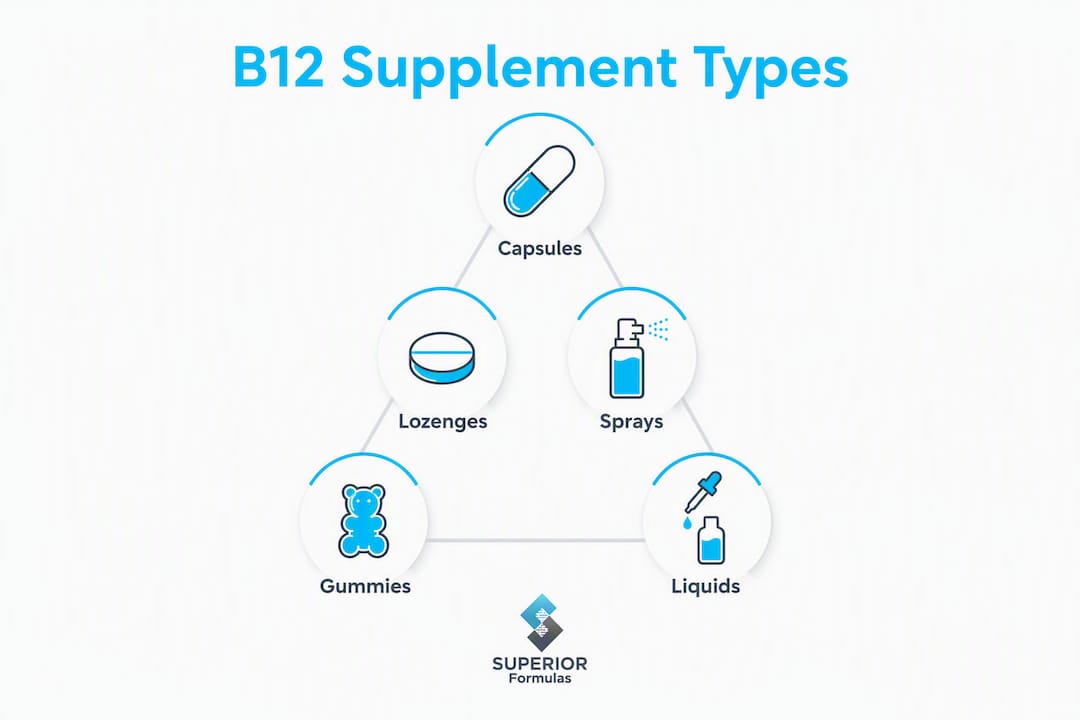
Sublingual delivery bypasses the stomach-dependent absorption steps that become less reliable after age 40 or with metformin and PPI use. A methylcobalamin sublingual lozenge dissolves under the tongue and absorbs through the oral mucosa, making it the most clinically logical format for adults with absorption concerns. Dose ranges typically run 1,000–5,000 mcg per lozenge.
Pros: Bypasses gut absorption; methylcobalamin ready-to-use form; useful for MTHFR variants Cons: Brand quality varies widely; always verify independent testing on the specific product you buy
Vegan spray or whole-food B12 spray (certified vegan and organic)
Spray formats suit shoppers who dislike swallowing pills and want a certified vegan option. Delivery is through the oral mucosa, similar to sublingual lozenges. Look for certified organic or certified vegan labeling and a named independent testing body.
Pros: Pill-free; portable; vegan-certified options available; easy to adjust dose Cons: Harder to confirm exact mcg absorbed per spray; quality varies by brand
Budget high-dose methyl B12 chewable
The value case here is straightforward: high mcg per serving at a fraction of the cost of premium brands. The trade-off is that independent testing verification is inconsistent across budget brands. Before buying, check whether the specific product has a ConsumerLab, USP, or NSF listing.
Pros: Very low cost per serving; high-dose methylcobalamin; chewable format Cons: Independent testing often unverified; label accuracy less reliable without a named seal
HUM Nutrition B12 and B12 Turbo
HUM positions B12 in a beauty-wellness context, with third-party testing and a vegan, gluten-free capsule. The B12 Turbo is a higher-dose variant. Both are available through HUM’s website and Sephora, which makes them accessible to shoppers already in the beauty supplement space.
Pros: Third-party tested; vegan; available at Sephora Cons: Premium price; beauty-wellness framing may not appeal to clinical-minded buyers
Mindbodygreen Ultimate Multivitamin+
For shoppers who want B12 folded into a comprehensive daily multi, Mindbodygreen’s Ultimate Multivitamin+ includes 1,000 mcg methylcobalamin alongside a broad nutrient panel. Third-party tested and sold direct. The per-serving cost is high relative to standalone B12 products, but the value proposition is the full formulation.
Pros: B12 within a full multi; third-party tested; methylcobalamin form Cons: Highest per-serving cost on this list; overkill if you only need B12
Pure Encapsulations B12 Liquid
Pure Encapsulations is a practitioner-channel brand known for hypoallergenic, minimal-excipient formulations. The liquid B12 uses methylcobalamin and is third-party tested. Useful for people with multiple sensitivities who cannot tolerate capsule fillers.
Pros: Hypoallergenic; liquid format; practitioner-trusted; third-party tested Cons: Higher cost; liquid format requires refrigeration after opening
OLLY Daily Energy Gummies
OLLY’s gummies use cyanocobalamin at a lower per-serving dose than most standalone B12 products. They are widely available at Target and Walmart. The gummy format suits casual users, but the dose and independent testing data are thinner than clinical-grade options.
Pros: Widely available; gummy format; low cost Cons: Lower dose per serving; limited independent testing data; added sugars
BetterYou Boost 1200mcg B12 Daily Oral Spray
BetterYou is a UK-origin brand with strong spray-format expertise. The 1,200 mcg methylcobalamin spray is certified and vegan. Available on Amazon in the U.S., though it is not a domestic brand.
Pros: Certified; vegan; spray format; 1,200 mcg methylcobalamin Cons: UK-origin brand; verify U.S. availability and lot-specific testing
Viridian High Potency B12 Capsules and Viridian Liquid B12
Viridian is a UK-origin clean-label brand. Both the capsule and the 50ml liquid use methylcobalamin and carry vegan and organic certifications. The liquid format allows flexible dosing. U.S. availability is limited to online channels.
Pros: Certified vegan and organic; clean label; flexible liquid option Cons: UK-origin; limited U.S. retail presence; verify import lot testing
Wild Nutrition Food Grown Vitamin B12 Plus
Wild Nutrition uses a food-grown matrix approach, meaning B12 is cultured in a whole-food base rather than isolated. Certified vegan. The food-grown format appeals to shoppers who prefer nutrients in a whole-food context, though the mcg per serving varies and should be checked on the label.
Pros: Food-grown matrix; certified vegan; clean formulation Cons: Lower mcg per serving than high-potency options; UK-origin brand
Zooki Vitamin B12 Capsules and Strawberry Sachets
Zooki uses a liposomal delivery format, which the brand claims improves absorption. The strawberry sachet format is taste-friendly and portable. Both are certified vegan. Per-serving cost is among the highest on this list.
Pros: Liposomal format; certified vegan; taste-friendly sachet option Cons: Highest per-serving cost; liposomal B12 absorption advantage is not as well-established as for fat-soluble nutrients
ZipVit B12 1000mcg
ZipVit is a no-frills, value-priced tablet using cyanocobalamin at 1,000 mcg. Independent testing data is limited. Suitable for shoppers who want a basic, low-cost option and are comfortable verifying the brand’s testing claims directly.
Pros: Very low cost; 1,000 mcg dose; simple formulation Cons: Limited independent testing data; UK-origin
Vitabright Dual Active B12 1000mcg
Vitabright combines methylcobalamin and adenosylcobalamin in a single capsule at 1,000 mcg. The dual-form approach mirrors Garden of Life’s strategy. Vegan and available on Amazon, though independent testing data is limited.
Pros: Dual active forms; vegan; Amazon availability Cons: Limited independent testing verification; UK-origin brand
Holland & Barrett Slow-Release Vitamin B12 1000mcg
The slow-release tablet format is designed to extend absorption over several hours. Uses cyanocobalamin. Holland & Barrett is a UK-origin retailer; U.S. availability is primarily through Amazon.
Pros: Slow-release format; 1,000 mcg dose; widely available in UK Cons: Cyanocobalamin only; limited U.S. retail presence; independent testing data not prominently listed
Dr Vegan Vitamin B12
Dr Vegan is a UK-origin vegan-specific supplement brand. The B12 capsule uses methylcobalamin and carries vegan certification. Available online in the U.S. through Amazon.
Pros: Certified vegan; methylcobalamin; clean formulation Cons: UK-origin; limited U.S. retail; verify lot-specific testing
Pro Tip: For any UK-origin brand purchased in the U.S., check whether the specific lot sold on Amazon carries the same certification as the brand’s domestic product. Import lots are not always tested to the same standard.
How do you choose the right B12 supplement?
Non-negotiable criteria
- Independent third-party seal. USP Verified, NSF International, or ConsumerLab certification means an outside body confirmed label accuracy and screened for contaminants. A brand’s own “third-party tested” claim without naming the certifying body is not equivalent.
- Clear mcg labeling. The label must state the exact mcg of B12 per serving, not just a B-complex blend total.
- Active form identified. Methylcobalamin, cyanocobalamin, or adenosylcobalamin should be named explicitly.
- Dose aligned to your need. Maintenance for at-risk adults typically runs 250–1,000 mcg/day; repletion doses are higher and ideally supervised.
- Allergen and dietary suitability confirmed. Vegan, gluten-free, and allergen-free claims should be backed by certification, not just a label statement.
Use this supplement quality checklist to evaluate any product before you buy.
Red flags to avoid
- Vague dosing language (“proprietary B-complex blend” with no mcg breakdown)
- “Third-party tested” with no named certifying organization
- Megadose claims without clinical rationale (doses far above 1,000 mcg/day for maintenance)
- No GMP manufacturing statement
- No named active form of B12
Questions to ask before buying
- Is there a named independent seal (USP, NSF, ConsumerLab) on the label?
- What is the active form — methylcobalamin, cyanocobalamin, or adenosylcobalamin?
- How many mcg per serving, and how many servings per day does the label suggest?
- Are other B-vitamins present, and are their doses disclosed?
- Is the manufacturing facility GMP-certified?
Why seals matter more than label claims: Independent audits and consumer-watchdog testing have historically found that a meaningful subset of supplements fail to meet their own label claims or contain contaminants. A USP or NSF seal means an independent laboratory — not the brand itself — confirmed what is in the bottle. That distinction is the single most reliable trust signal in the supplement category, and it is the primary criterion in this article’s selection methodology.
Who actually needs B12, and what does the clinical evidence say?
Most healthy adults with a varied diet do not need routine B12 supplementation. The clinical case for supplementation is strongest when you belong to a defined risk group or have confirmed low serum B12 on a lab test.
Clinical risk groups
- Vegans and strict vegetarians. B12 is found almost exclusively in animal-sourced foods; plant-based eaters have no reliable dietary source without fortified foods or supplements.
- Adults over 50. Gastric acid production declines with age, reducing the release of B12 from food proteins. Absorption of crystalline B12 (the form in supplements) is less affected, making supplementation more effective than dietary increases alone.
- People on metformin or PPIs. Both metformin and proton pump inhibitors are independently associated with B12 deficiency, and their combination compounds the risk. Anyone on long-term metformin or PPI therapy should discuss B12 monitoring with their clinician.
- People with malabsorption conditions. Crohn’s disease, celiac disease, atrophic gastritis, and post-bariatric surgery all reduce B12 absorption through gut-dependent pathways.
- People with pernicious anemia. This autoimmune condition destroys intrinsic factor, the protein required for B12 absorption in the gut. High-dose oral or intramuscular B12 is typically required.
Important: B12 supplementation does not boost energy or athletic performance in people who are not deficient. Excess oral B12 is excreted in urine. If your levels are normal, a higher-dose supplement will not increase your energy — it will increase your urine B12.
Pro Tip: Ask your clinician to check serum B12 and, if borderline, methylmalonic acid (MMA). MMA is a more sensitive functional marker of B12 status than serum B12 alone and can identify functional deficiency even when serum levels appear normal.
For a deeper look at how supplements fit into a broader longevity strategy, the evidence-based supplements resource from Superiorformulas is worth reading.
What are the right doses, forms, and safety considerations?
Dosing: maintenance vs. repletion
| Scenario | Typical dose range | Notes |
|---|---|---|
| Dietary maintenance (at-risk adults) | 250–1,000 mcg/day | Oral tablet, capsule, or spray; cyanocobalamin or methylcobalamin |
| Repletion (confirmed deficiency) | varies depending on individual need | Short course; oral high-dose can match intramuscular for most people |
| Food supplement threshold | ≤20 mcg/day | Unlikely to produce pharmacological effects |
| Pharmacological dosing | ≥200 mcg/day | Effectively pharmacological; typically used for repletion under clinical supervision |
Oral and intramuscular B12 supplementation are equivalent for normalizing serum B12 levels after one to four months in most deficiency cases, which means high-dose oral repletion is a clinically supported alternative to injections for most people.
Form trade-offs
Cyanocobalamin is the most stable and well-studied form, and it works effectively for the vast majority of people. Methylcobalamin is the active coenzyme form and may be preferable for people with MTHFR gene variants or significant absorption issues, but it is not categorically superior for the general population. Adenosylcobalamin is the mitochondrial coenzyme form; some products combine it with methylcobalamin for broader coverage.
Delivery routes
- Oral swallowed (tablet/capsule): Standard route; effective for most people when stomach acid and intrinsic factor are intact.
- Sublingual lozenge: Particularly useful for adults over 40 and people on metformin or PPIs, as absorption occurs through the oral mucosa rather than the gut.
- Oral spray: Similar mechanism to sublingual; convenient and pill-free.
- Intramuscular injection: Reserved for severe deficiency, pernicious anemia, or confirmed malabsorption; administered by a clinician.
Safety, side effects, and interactions
- B12 has a strong safety profile at typical supplement doses; no established tolerable upper intake level has been set by the NIH.
- Metformin and PPIs reduce B12 absorption; people on these medications should monitor B12 levels.
- Folate pairing: High-dose B12 supplementation in the context of folate deficiency can mask megaloblastic anemia symptoms; address both nutrients together.
- Leber’s hereditary optic neuropathy: Cyanocobalamin is contraindicated in this rare genetic condition; methylcobalamin or hydroxocobalamin is preferred.
- When to see a clinician: Neurological symptoms (tingling, numbness, balance issues), persistent fatigue, or confirmed low serum B12 all warrant clinical evaluation before self-supplementing.
Statistic callout: A scholarly review in Current Nutrition Reports proposes that food supplements providing ≤20 mcg/day of B12 are unlikely to cause pharmacological effects, while doses of ≥200 mcg/day cross into pharmacological territory. Most retail B12 supplements are dosed well above 20 mcg — meaning they are effectively pharmacological products, not simple dietary top-ups.
For a practical safety overview, the supplement safety guide from Superiorformulas covers what to check before starting any new supplement.
How were these picks selected?
The selection process for these B12 reviews prioritized verifiable, objective criteria over brand reputation or marketing spend. Here is how each product was evaluated:
- Active form: Methylcobalamin, cyanocobalamin, and adenosylcobalamin were all considered; no form was automatically disqualified, but the rationale for the chosen form was weighted.
- Dose appropriateness: Products were assessed against clinical guidance for maintenance and repletion; megadoses without stated rationale were flagged.
- Third-party testing: USP Verified, NSF International certification, and ConsumerLab listings were treated as the primary trust signal. A brand’s own “third-party tested” claim without a named certifying body was not counted as verified.
- Price per serving: Evaluated as a tie-breaker after quality criteria were met; budget options were included only when independent testing could be confirmed.
- Dietary suitability: Vegan, gluten-free, and allergen-free claims were weighted only when backed by certification.
- Label transparency: Products with clear mcg disclosure, named active forms, and GMP manufacturing statements scored higher.
Editorial note: Superiorformulas publishes this article and is one of the featured products. The selection criteria above were applied consistently across all entrants. Products were included based on their presence in the B12 supplement category and their relevance to the use cases covered. No product paid for placement. The editorial emphasis on third-party testing and clinical evidence is the same standard applied to the publisher’s own product. This list is reviewed and updated as new products enter the market or testing data changes.
Independent scoring frameworks consistently reward the same criteria: verified testing, dose appropriateness, and transparent labeling. That alignment with external scoring methodology is intentional.
Key Takeaways
The most important decision in buying a B12 supplement is not which brand to choose — it is whether you need one at all, and if so, which form and dose match your specific absorption risk.
| Point | Details |
|---|---|
| Test before you supplement | Confirm low serum B12 or methylmalonic acid with a clinician before buying; most healthy adults with varied diets do not need routine supplementation. |
| Third-party seal is the top trust signal | USP Verified, NSF International, or ConsumerLab certification confirms label accuracy; a brand’s own “tested” claim is not equivalent. |
| Match form to absorption risk | Sublingual or spray methylcobalamin suits adults 40+, metformin/PPI users, and MTHFR variants; cyanocobalamin works for most others. |
| Dose for your purpose | Maintenance for at-risk adults: 250–1,000 mcg/day; repletion of confirmed deficiency: dose varies depending on individual need, ideally with clinical guidance. |
| Superiorformulas for evidence-minded shoppers | Physician-formulated, GMP-certified, with a publicly linked science page — the clearest starting point for shoppers who want clinical transparency. |
Why the “just take more B12” mindset misses the point
The supplement industry has built a profitable narrative around B12 as an energy vitamin. Walk into any pharmacy and you will find products marketed with phrases like “energy support” and “mental clarity” at doses of 5,000 mcg or more. The clinical evidence does not support that framing for people who are not deficient. What B12 actually does is correct a deficiency that, left unaddressed, causes serious neurological and hematological damage. That is a meaningful benefit — but it is not the same as a performance enhancer.
The more interesting and underappreciated question is not “which B12 is best?” but “do I actually need one?” The answer depends on your diet, your age, your medications, and your lab values. A vegan in their 30s who has never checked their B12 level is a genuinely high-risk person who should supplement. A 45-year-old omnivore with no GI conditions and a recent normal lab result probably does not need a 5,000 mcg lozenge every morning.
Form matters less than the supplement industry suggests, too. Cyanocobalamin is stable, well-studied, and effective for the overwhelming majority of people. The methylcobalamin premium is justified in specific clinical scenarios — MTHFR variants, significant absorption impairment, older adults with reduced gastric acid — but not as a universal upgrade. Choosing methylcobalamin because it sounds more “natural” or “bioavailable” without a clinical reason is paying more for a marketing story.
What does matter, consistently, is the independent seal. That single criterion separates products where you know what you are getting from products where you are trusting the brand’s own word. For a nutrient where deficiency has real consequences, that distinction is worth the extra few cents per serving.
Superiorformulas: a physician-formulated option for evidence-minded shoppers
For shoppers who have read this far and want a supplement built on the same criteria used to evaluate this list, Superiorformulas is the direct answer. The brand was founded by a physician-scientist and manufactures in a GMP-certified facility, with a publicly accessible science and evidence page that explains the clinical rationale behind each formulation. That transparency is the standard this article applied to every product reviewed.
The Formula 9 Superior Multi+ Daily includes B-vitamin coverage within a comprehensive, clinically informed multivitamin formulation — a practical option for shoppers who want B12 alongside broader cellular health support rather than a standalone product. GMP manufacturing, third-party testing, and a clean label free from unnecessary fillers are the baseline, not the selling point. Visit the science page to review the evidence and decide whether it fits your needs.
Useful sources and further reading
The clinical and regulatory sources behind this article’s recommendations are listed below. Each is briefly annotated for what it contributes.
- Vitamin B12 — NIH Office of Dietary Supplements (Consumer) — Primary U.S. government reference for B12 functions, dietary sources, recommended intakes, and deficiency risk groups. The most authoritative starting point for any B12 question.
- Vitamin B12 — NIH Office of Dietary Supplements (Health Professional) — The clinical-depth version of the above; covers absorption mechanisms, drug interactions, and evidence on supplementation outcomes.
- Vitamin B12 — Cleveland Clinic — Patient-facing clinical guidance on who needs supplementation, what symptoms suggest deficiency, and when to test.
- Vitamin B12 Deficiency Associated with Metformin and PPIs — PubMed — Peer-reviewed disproportionality analysis confirming the combined deficiency risk of metformin and PPI co-prescription.
- Vitamin B-12 — Mayo Clinic — Accessible clinical overview of B12 functions, food sources, supplement forms, and safety considerations.
- Oral vs. Intramuscular Vitamin B12 — American Family Physician — Evidence-based clinical review confirming equivalence of oral and intramuscular B12 for normalizing serum levels after one to four months.
- Sublingual and oral B12 vs. intramuscular — Europe PMC systematic review — Systematic review and meta-analysis on sublingual and oral B12 efficacy relative to injection; supports the recommendation for sublingual delivery in absorption-impaired populations.
- Upper threshold framework for crystalline B12 — Current Nutrition Reports (Springer) — Scholarly review proposing dose thresholds that distinguish food-supplement from pharmacological B12 dosing; the basis for the dosing table in this article.
- How to evaluate supplement quality — Superiorformulas — Practical guidance on assessing third-party testing, label transparency, and GMP manufacturing when choosing any supplement.
- Step-by-step supplement selection for adults 35+ — Superiorformulas — Audience-aligned guide for the age group most likely to benefit from B12 supplementation.
This article is general information, not medical advice. Confirm your B12 status with a qualified clinician and review current NIH or Mayo Clinic guidance before starting supplementation.


