


Apigenin shows real antioxidant and anti-inflammatory activity in cells and animals, and chamomile extracts containing it have modest human evidence for sleep and anxiety. But isolated apigenin supplements have not been tested in large randomized trials, so claims about longevity, cognition, and cellular repair still rest mostly on lab and rodent data. The compound is promising. It is not yet proven in the way marketing copy sometimes implies.
TL;DR:
- Human evidence for apigenin’s sleep and anxiety benefits is limited to chamomile extract studies, which contain multiple bioactives, not isolated apigenin supplements.
- The strongest preclinical data demonstrate apigenin’s antioxidant, anti-inflammatory, and neuroprotective effects in cells and animals, but bioavailability issues limit human impact.
- Animal studies suggest potential for NAD+ preservation and longevity through CD38 inhibition, but human trials confirming this are still absent.
- Poor water solubility, rapid metabolism, and the lack of standardized dosing mean typical supplement doses likely provide much less active compound than effective in lab conditions.
- Effective use requires selecting high-quality formulations with enhanced delivery technology and short-term trials with careful monitoring, especially for those on sedatives or blood thinners.
Table of Contents
- Apigenin Benefits: The Evidence Level Behind Each Claim
- How Apigenin Works Inside the Body
- Preclinical Promise vs. Human Clinical Reality
- Apigenin Safety, Dosage, and Interaction Concerns
- Where Apigenin Comes From in Everyday Foods
- Why Absorption Is Apigenin’s Biggest Obstacle
- A Practical Framework for Trying Apigenin
- How Superiorformulas Approaches Emerging Ingredients Like Apigenin
- The Real Gap Between Apigenin’s Reputation and Its Proof
- Choosing an Evidence-Based Formulation
- Sources
Apigenin Benefits: The Evidence Level Behind Each Claim
Apigenin belongs to a class of plant compounds called flavones, found in chamomile, parsley, and celery. Its reputation as a longevity and sleep ingredient has grown fast, partly because it hits several biological targets at once. Here is where the science actually stands on each major claim.
Sleep and anxiety support. This is apigenin’s most publicly recognized benefit, largely because chamomile tea has been used for sleep for centuries. Clinical trials on chamomile extract show modest improvements in anxiety symptoms and some sleep measures. The catch: those trials tested whole chamomile extract, a mixture of dozens of compounds, not isolated apigenin in capsule form. Extrapolating extract results to a purified apigenin supplement is not something the current research supports directly, since chamomile trials tested multiple bioactives together, and apigenin was likely just one contributor among several.
Antioxidant and anti-inflammatory activity. This is where the preclinical evidence is strongest. Cell and animal studies consistently show apigenin reducing oxidative stress markers and dampening inflammatory signaling. A widely cited 2019 review in PMC summarized dozens of in vitro and in vivo studies confirming these effects, while flagging that poor bioavailability limits how much of this activity likely translates to humans at typical intake levels.
Neuroprotective and cognitive effects. Animal models, particularly rodent studies on neurodegeneration and cognitive decline, show apigenin reducing markers of neural damage and oxidative stress in brain tissue. These findings are consistent across multiple studies but have not been replicated in human cognitive trials.
Cardiometabolic effects. Rodent studies link apigenin supplementation to improved lipid profiles and better glucose handling. The mechanisms look plausible (reduced inflammation and oxidative stress both affect metabolic health), but no human trials have confirmed these outcomes in people managing cholesterol or blood sugar.
NAD+ preservation and longevity. This is the claim generating the most buzz, and also the one with the thinnest human backing. Apigenin appears to inhibit an enzyme called CD38, which normally depletes NAD+, a molecule central to cellular energy and aging biology. Preclinical and animal research suggests this CD38 inhibition could support healthier aging pathways. The idea is mechanistically sound but entirely unverified in large-scale human trials.
Cancer-related signals. Cell and animal studies show apigenin interfering with cancer cell proliferation pathways in specific model systems. This is laboratory-stage science, not a therapeutic claim, and should never be interpreted as evidence apigenin treats or prevents cancer in humans.
Summarized by evidence strength, the picture looks like this:
- Strong preclinical, weak human data: antioxidant/anti-inflammatory activity, neuroprotection, cardiometabolic effects
- Modest human data, but for a different product: sleep and anxiety (chamomile extract, not isolated apigenin)
- Mechanistically plausible, unproven in people: NAD+ preservation, longevity pathways
- Early-stage lab findings only: cancer-related cellular effects
The consistent thread: apigenin does things in a petri dish and a mouse that look genuinely useful. Whether those effects hold at achievable human doses is the open question.
How Apigenin Works Inside the Body
Apigenin’s structure lets it interact with several biological systems simultaneously, which explains why one compound gets credit for effects on sleep, inflammation, and aging biology all at once.
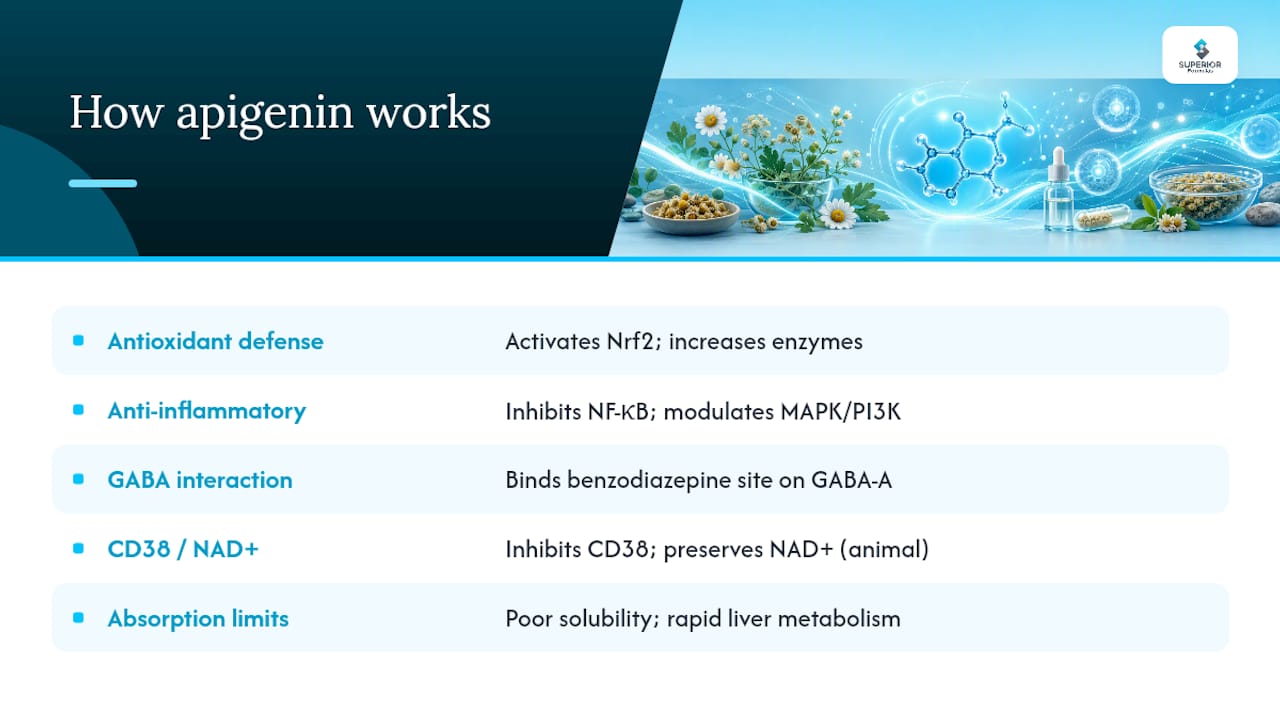
Antioxidant defense activation. Apigenin triggers a cellular pathway called Nrf2, which acts like a master switch for the body’s own antioxidant enzymes, including superoxide dismutase, catalase, and glutathione. Rather than acting as a direct antioxidant itself, apigenin appears to prompt cells to produce more of their own protective enzymes, a more durable strategy than simply flooding tissue with an external antioxidant.
Anti-inflammatory signaling. Apigenin inhibits NF-κB, a protein complex that switches on inflammatory gene expression when activated. It also modulates MAPK and PI3K/Akt pathways, two signaling networks involved in cell survival, growth, and inflammatory response. In combination, these actions in lab and animal studies reduce markers of chronic low-grade inflammation, the kind linked to aging and metabolic disease.
GABA receptor interaction. This mechanism explains the sedative and anxiety-reducing effects tied to chamomile. Apigenin binds to the benzodiazepine site on GABA-A receptors, the same receptor family targeted by prescription anti-anxiety medications, though far more weakly. This binding is rooted in apigenin’s flavone structure, which allows it to interact with receptor sites that regulate calming neurotransmission.
CD38 inhibition and NAD+ biology. CD38 is an enzyme that consumes NAD+, and NAD+ levels decline naturally with age. By inhibiting CD38 in cell and animal models, apigenin theoretically helps preserve NAD+ availability, a molecule tied to mitochondrial function and cellular repair. This is the mechanistic backbone of apigenin’s longevity reputation, and it is genuinely interesting science. It is also, so far, animal-stage science.
Absorption and metabolism limits. Apigenin has poor water solubility, meaning much of an oral dose never fully dissolves in the digestive tract before passing through. What does get absorbed faces rapid first-pass metabolism in the liver, which converts a large share of it into inactive metabolites before it ever reaches target tissues. This single limitation, more than any other factor, explains the gap between apigenin’s impressive lab results and its uncertain real-world impact.
Preclinical Promise vs. Human Clinical Reality
The apigenin research landscape splits cleanly into two categories: an enormous body of laboratory and animal evidence, and a nearly empty file of human trials testing the isolated compound.
What the preclinical evidence shows. Animal and cell-culture studies document neuroprotective effects, reduced markers of oxidative stress, improved lipid and glucose measures in rodent models, and CD38 inhibition tied to NAD+ preservation. The 2019 PMC review catalogs this breadth well, covering antioxidant, anti-inflammatory, neuroprotective, and anticancer activity across dozens of studies. The consistency across different research groups and model systems is genuinely notable. Multiple labs, working independently, keep finding similar effects.
What human evidence actually exists. Here the picture narrows considerably. Chamomile-extract trials, testing the whole plant extract rather than purified apigenin, show modest benefits for anxiety symptoms and some sleep quality measures. These are real, published, randomized trials. But they tested a multi-compound extract, and apigenin was one of several active constituents in that mixture, not the isolated ingredient sold in most supplement capsules today. No published randomized controlled trial has tested isolated apigenin alone against a placebo for sleep, anxiety, longevity, or any other outcome in humans at scale.
This matters more than it might seem. A supplement industry has grown around a compound whose human trial evidence is essentially borrowed from a different product. Evidence summaries note plainly that isolated apigenin lacks the randomized trial base needed to establish an optimal dose, confirm safety at various intake levels, or verify any specific health claim in people.
The dose-translation problem. Even setting aside the extract-versus-isolate issue, animal study doses rarely translate cleanly to humans. Rodent studies often use doses calculated per kilogram of body weight that, when scaled up, would require gram-level daily intake in a human, far beyond what any commercial supplement provides. Combine that with apigenin’s poor bioavailability, and the actual exposure a person gets from a standard capsule may be a small fraction of what produced results in a mouse model.
Grading the claims honestly. Laid out by evidence tier, the claims break down this way:
| Claimed benefit | Preclinical evidence | Human RCT evidence | Practical takeaway |
|---|---|---|---|
| Antioxidant/anti-inflammatory activity | Strong, consistent | None for isolated apigenin | Plausible mechanism, unconfirmed magnitude in people |
| Sleep and anxiety support | Strong (animal models) | Modest, but from chamomile extract | Benefit likely tied to whole extract, not apigenin alone |
| Neuroprotection/cognition | Strong (rodent studies) | None | Early-stage signal only |
| Cardiometabolic improvement | Moderate (rodent studies) | None | Not established in human trials |
| NAD+/longevity pathway support | Mechanistically plausible | None | Experimental, unproven claim |
| Cancer-related cellular effects | Early-stage, cell/animal only | None (not a treatment) | Laboratory finding, not a therapy |
This does not mean apigenin is a dead end. It means the compound sits exactly where a lot of promising natural compounds sit early in their research life cycle: strong mechanistic rationale, animal-stage confirmation, and a human evidence gap that only large, well-designed trials can close. Readers comparing apigenin to a flavonoid with a similar profile might find it useful to look at how quercetin’s supplement evidence has developed, since it faced comparable bioavailability hurdles before delivery science caught up.
Apigenin Safety, Dosage, and Interaction Concerns
There is no established, standardized human dose for isolated apigenin. That single fact should shape how anyone approaches supplementing with it. Evidence reviews confirm that the lack of randomized controlled trials leaves open questions about optimal amounts, side effect patterns, and long-term safety in humans.
That said, a rough consumer pattern has emerged in the supplement market, largely built on anecdotal use rather than clinical trial data. A commonly seen amount in commercial products is often cited in the range of a moderate supplement dose per day, though exact amounts vary and no validated dose-response studies exist.
Key interaction and safety considerations:
- Apigenin may amplify the sedative effect of benzodiazepines or other GABA-acting sedatives, given its own weak binding at the same receptor site.
- Flavonoids as a class can influence certain liver CYP enzymes involved in drug metabolism, raising a theoretical concern for interaction with anticoagulants and other narrow-margin medications.
- People taking blood thinners should treat apigenin as a supplement worth discussing with a physician before starting, given the CYP-related uncertainty.
- Pregnant and breastfeeding individuals should avoid apigenin supplements, since no safety data exists for these groups.
- Practitioner-level cautions point out that flavonoid metabolism varies significantly between individuals, meaning the same dose can produce different blood levels in different people.
Estimated dietary intake: Most adults consume roughly 0.45 mg to 5 mg of apigenin daily through normal foods, mainly parsley, celery, and chamomile tea. A typical 50 mg supplement dose delivers ten to over a hundred times that amount, a scale-up with no dedicated human safety trials behind it.
Anyone considering a trial period should monitor for drowsiness, digestive changes, or unusual fatigue, and consider cycling off after several weeks rather than treating it as an indefinite daily habit. Clinical oversight matters more here than with better-studied compounds, precisely because the human dose-response curve has never been mapped.
Where Apigenin Comes From in Everyday Foods
Apigenin occurs naturally across a surprising number of common foods, which means most people already consume some amount without trying.
Foods highest in apigenin:
- Chamomile tea, the most concentrated common dietary source
- Fresh parsley, particularly the leaves
- Celery and celery seed
- Artichokes
- Certain citrus fruits, in smaller amounts
- Oregano and other Mediterranean herbs
The estimated range of 0.45 mg to 5 mg daily reflects how much a typical diet delivers, depending heavily on how much parsley, celery, or chamomile tea someone actually consumes. Someone who drinks two cups of chamomile tea daily and cooks regularly with fresh herbs sits at the higher end of that range. Someone eating a standard diet with little fresh produce sits near the bottom.
Boosting dietary intake is straightforward: add fresh parsley as a garnish rather than a dried afterthought, snack on celery, and swap an evening cup of chamomile tea in for something less calming. None of this approaches supplement-level doses, but it does close some of the gap, and it comes with the added benefit of whatever else those foods deliver nutritionally. Readers interested in how other plant compounds stack up across a typical diet might find polyphenol-rich food strategies a useful complement to this approach.

Why Absorption Is Apigenin’s Biggest Obstacle
Apigenin’s poor water solubility is the single biggest reason its impressive lab results do not automatically translate to real-world benefit. A compound that will not dissolve well in the digestive tract cannot be absorbed efficiently, no matter how promising it looks in a test tube.
This is not a minor technical detail. The 2019 PMC review specifically flagged low water solubility and poor bioavailability as major barriers standing between apigenin’s laboratory activity and any confirmed human benefit, and called for better delivery systems as a research priority.
Delivery strategies being tested to solve this:
- Liposomal encapsulation, which wraps apigenin in a fat-based shell that mimics cell membrane structure, helping it pass through the gut wall more efficiently
- Polymeric micelles, tiny carrier structures that keep the compound suspended and available for absorption rather than clumping and passing through unabsorbed
- Nanoemulsions and nanosuspensions, which reduce particle size dramatically to increase the surface area available for absorption
- Bioavailability enhancers like piperine, the black pepper extract compound known to slow the metabolic breakdown of various plant compounds, extending their time in circulation
Preclinical delivery-system research has tested several of these approaches directly against plain apigenin and found meaningfully better stability and absorption markers with encapsulated or nanoparticle forms. Separate formulation research reinforces that plain aglycone apigenin, the form found in most low-cost capsules, is often poorly absorbed without some kind of delivery enhancement.
Pro Tip: When comparing supplement labels, look past the milligram number on the front of the bottle. A 50 mg dose of plain, unenhanced apigenin may deliver less usable compound than a smaller dose paired with a liposomal or micellized delivery system. The formulation matters as much as the amount.
Taking apigenin with a meal that contains some fat can also help, since flavones like apigenin tend to absorb better in the presence of dietary fat compared to an empty stomach.
A Practical Framework for Trying Apigenin
Anyone weighing whether to try apigenin should start by being honest about what they are chasing, since the evidence quality differs sharply depending on the goal.
- Clarify the goal. If the target is sleep or anxiety relief, know that the strongest human data comes from chamomile extract, not isolated apigenin. If the target is longevity or NAD+ support, understand that human trials simply do not exist yet, and any benefit is a reasoned bet, not a confirmed outcome.
- Set a short trial window. A four to six week trial with a consistent dose, taken with a meal containing some fat, gives enough time to notice subjective changes in sleep quality or general well-being without committing to an indefinite habit.
- Keep a simple log. Track sleep quality, mood, and any digestive or energy changes on a basic 1 to 10 scale each day. Without a personal baseline, it is easy to mistake normal week-to-week variation for a supplement effect.
- Choose formulation over flashy claims. Favor products that disclose delivery technology (liposomal, micellized, or paired with an absorption enhancer) over ones that only advertise a milligram count.
- Know when to stop. Discontinue and consult a physician if new sedation, unusual fatigue, or digestive upset appears, particularly for anyone also taking sedatives or blood thinners.
Pro Tip: Treat apigenin the way researchers treat it in animal studies: as one input in a broader system, not a standalone fix. Pairing it with proven sleep habits or established antioxidant strategies gives it a fairer test than expecting it to work in isolation.
Anyone with a diagnosed sleep disorder, anxiety condition requiring medication, or a chronic health condition managed with prescription drugs should loop in a clinician before starting, given the CYP interaction uncertainty and the complete absence of human dosing trials.
How Superiorformulas Approaches Emerging Ingredients Like Apigenin
The clinical background shaping how ingredients like apigenin are weighed before formulation is a key part of careful evaluation. Preclinical promise gets taken seriously, but it gets labeled honestly, as animal-stage or mechanistic evidence rather than proven human benefit.
Formulations are produced under standards to confirm that capsule contents match labels, including manufacturing and testing protocols. When evaluating a compound with a bioavailability challenge like apigenin’s, the priority sits on delivery science and ingredient purity, not just headline milligram counts. This evaluation approach applies to formulations focused on Nrf2 activation and cellular resilience, pathways that apigenin appears to engage.
The Real Gap Between Apigenin’s Reputation and Its Proof
The apigenin conversation has a credibility problem, and it is not really about the compound itself. It is about how confidently people talk about NAD+ preservation and longevity benefits that exist almost entirely in mouse studies and cell cultures. The mechanistic story, CD38 inhibition protecting NAD+, is elegant enough that it is easy to forget nobody has run the human trial that would confirm it matters at achievable doses.
The sleep and anxiety claims have a subtler problem: they borrow credibility from chamomile trials that never actually isolated apigenin as the tested variable. That distinction gets lost in most marketing copy, and it should not.
None of this means skip apigenin entirely. It means treat it as an experimental, short-term addition rather than a settled longevity tool, and prioritize formulation quality over dose size, since absorption is the real bottleneck. Readers who want a compound with a similar mechanistic profile but a firmer human trial base might look at glycine’s sleep research for comparison. The honest answer to “does apigenin work” is: probably, for some things, at a scale nobody has confirmed yet.
— cristopher
Choosing an Evidence-Based Formulation
The supplements are built around the standard of distinguishing preclinical research suggestions from human trial confirmations, and formulating accordingly. Products are manufactured following good manufacturing practices and undergo independent testing to help ensure label accuracy.
For adults weighing cellular health and healthy aging support, that clinician-formulated standard matters more than a trendy ingredient list. Explore the nutraceuticals for aging support lineup to see how Superiorformulas approaches antioxidant and cellular resilience formulations with that same evidence-first discipline, and compare options before adding anything new to your routine.
This article is general information, not a substitute for advice from a qualified doctor. Consult a qualified healthcare professional about your own circumstances before acting on anything here.


