


Panax ginseng most reliably supports fatigue reduction, certain metabolic markers in people with prediabetes or type 2 diabetes, and some aspects of sexual function. Evidence for broad memory improvement and athletic performance is mixed or inconclusive. Here is what the clinical record shows, organized by how strong the evidence actually is:
- Fatigue and energy: Moderate evidence from pooled analyses and randomized trials
- Metabolic markers (fasting glucose, cholesterol): Limited to moderate, with inconsistent results across studies
- Sexual function / erectile dysfunction: Limited evidence, with some positive signals in small trials
- Immune support (respiratory infection incidence): Limited and mixed
- Cognition (attention, reaction time): Limited, age-specific effects; general memory improvement is inconclusive
- Exercise performance: Conflicting; not reliably supported
The 2023 umbrella review published in Frontiers in Pharmacology found ginseng associated with improvements across several of these outcomes, but rated overall methodological quality as low to critically low. That context matters before you spend money on a supplement.
Safety note: Panax ginseng interacts with anticoagulants (warfarin), antiplatelet drugs, diabetes medications, and MAOIs. If you take any of these, or have surgery scheduled, talk to your clinician before starting ginseng.
Key Takeaways
Panax ginseng has moderate clinical support for fatigue reduction and modest metabolic effects, limited support for sexual function and immune outcomes, and inconclusive evidence for broad cognitive enhancement or athletic performance.
| Point | Details |
|---|---|
| Strongest evidence: fatigue | Moderate evidence from pooled analyses supports fatigue reduction; this is the most consistent clinical signal. |
| Metabolic support is real but modest | Small improvements in fasting glucose and cholesterol appear in prediabetes and type 2 diabetes trials, but results are inconsistent. |
| Safety requires clinician review | Ginseng interacts with warfarin, diabetes drugs, and MAOIs; stop at least 24 hours before surgery. |
| Standardization determines efficacy | Choose products standardized to 4–8% ginsenosides with a third-party COA confirming potency and heavy metal limits. |
| Superiorformulas | Physician-formulated, GMP-manufactured, and third-party tested; a quality-verified option for adults targeting fatigue or metabolic support. |
Table of Contents
- What is Panax ginseng, and how does it differ from other ginsengs?
- What does the clinical evidence say about Panax ginseng benefits?
- How does Panax ginseng work in the body?
- What dose of Panax ginseng do clinical trials actually use?
- What are the side effects and drug interactions you should know about?
- Where does the evidence actually stand? A quick reference
- How do you choose a quality Panax ginseng product?
- Is Panax ginseng right for you? A practical decision guide
- A physician-scientist’s perspective on Panax ginseng in a longevity stack
- Physician-formulated Panax ginseng from Superiorformulas
- Sources
What is Panax ginseng, and how does it differ from other ginsengs?
Panax ginseng, also called Asian ginseng or Korean ginseng, is a slow-growing perennial root native to the mountains of Korea, northeastern China, and far-eastern Russia. It is the most studied member of the Panax genus and the plant behind the majority of clinical ginseng research. This distinction matters because “ginseng” is a marketing term applied to several unrelated plants, including Siberian ginseng (Eleutherococcus senticosus) and American ginseng (Panax quinquefolius), which have different chemical profiles and different evidence bases.
Ginsenosides: the active compounds
The primary bioactive compounds in Panax ginseng are ginsenosides (also called panaxosides), a class of steroidal saponins. More than 100 individual ginsenosides have been identified, grouped broadly into protopanaxadiol (PPD) and protopanaxatriol (PPT) types. These compounds drive most of the pharmacological activity documented in clinical and preclinical research, including antioxidant, anti-inflammatory, and neuromodulatory effects.

Standardization to a defined ginsenoside percentage is what separates a reproducible supplement from a random root powder. Without it, two products labeled “ginseng extract” can differ dramatically in potency.
Red ginseng vs. white ginseng
White ginseng is simply dried and peeled root. Red ginseng undergoes steam-heating before drying, a process that transforms the ginsenoside profile and generally increases certain bioactive components. Research comparing the two shows that red ginseng often demonstrates stronger pharmacological activity, which is why processing history is a meaningful variable when choosing a product.
A product that lists only “ginseng root powder” with no standardization claim gives you no reliable way to know what dose of active compounds you are actually getting.*
What does the clinical evidence say about Panax ginseng benefits?
The honest answer is: it depends heavily on which outcome you are asking about. The evidence is not uniform, and the quality of trials varies widely. Below is an outcome by outcome breakdown.
Cognition: attention and reaction time vs. memory
Small trials suggest Panax ginseng may improve abstract thinking, attention, and reaction time in healthy middle-aged adults, but these effects are less consistent in younger adults. MedlinePlus notes that benefits for general memory are more reliably seen when ginseng is combined with ginkgo leaf extract rather than used alone. Taken as a single ingredient, the cognitive signal is modest and age-dependent. Evidence grade: Limited.
Fatigue and energy
This is the area with the most consistent positive signal. Multiple randomized trials and the 2023 Frontiers umbrella review found ginseng associated with reductions in fatigue, including cancer-related fatigue and general chronic fatigue. Effect sizes are modest but reproducible across different populations. Evidence grade: Moderate.
Immune support and respiratory infections
Some trials report that specific Panax ginseng extracts may reduce the incidence of respiratory infections during the intervention period, though MedlinePlus notes that reductions in illness duration or severity are not consistent across studies. The immune signal exists but is narrow. Evidence grade: Limited.
Metabolic effects: blood glucose and lipids
Pooled analyses show small beneficial effects on fasting blood glucose and total cholesterol in people with prediabetes and type 2 diabetes. The effects are real but modest, and results are inconsistent enough that ginseng should not substitute for established metabolic therapies. Evidence grade: Limited to moderate.
Sexual function and erectile dysfunction
Several small trials report improvements in erectile function scores with Panax ginseng supplementation. The 2023 umbrella review included sexual function among its positive-signal outcomes. Effect sizes are small, trials are short, and placebo effects in this category are notoriously large. Evidence grade: Limited.
Exercise performance
This is the weakest area. Results across trials are conflicting, with some showing no meaningful improvement in VO2 max, strength, or endurance. The umbrella review’s physical function signal did not translate cleanly to athletic performance endpoints. Evidence grade: Conflicting / not reliably supported.
Evidence summary table
Typical trial doses used across these outcomes:
- 200 mg standardized extract (4–7% ginsenosides) once or twice daily
- Extracts standardized to a moderate ginsenoside percentage are commonly dosed once daily
- Higher amounts of dry root powder are used, with extracts correspondingly concentrated, depending on formulation
- Moderate root powder doses taken multiple times daily have been studied in sexual function trials
How does Panax ginseng work in the body?
The pharmacological review published in PMC documents several distinct biological activities tied to ginsenosides, including antioxidative, anti-inflammatory, vasorelaxation, antidiabetic, and neuromodulatory effects. No single mechanism explains all the observed clinical outcomes; ginsenosides appear to work through multiple overlapping pathways.
Key proposed mechanisms include:
- Antioxidant activity: Ginsenosides scavenge reactive oxygen species and upregulate endogenous antioxidant enzymes, which may contribute to cellular resilience and reduced oxidative stress. This connects to the broader antioxidant support pathway relevant to healthy aging.
- Anti-inflammatory signaling: Several ginsenosides inhibit NF-κB and reduce pro-inflammatory cytokines, offering a plausible mechanism for immune modulation and fatigue reduction.
- Nitric oxide (NO) modulation: Ginsenosides stimulate endothelial nitric oxide synthase (eNOS), increasing NO production and promoting vasodilation. This is the most plausible mechanism behind the sexual function and cardiovascular effects. For context on how NO-related pathways connect to vascular health, see the discussion of L-arginine and L-lysine, which share this pathway.
- Neuromodulatory effects: Some ginsenosides interact with neurotransmitter systems (acetylcholine, dopamine, serotonin), which may underlie the attention and fatigue-related cognitive effects.
Mechanism summary: Ginsenosides act on multiple biological targets simultaneously. The NO-release pathway plausibly explains sexual function benefits; antioxidant and anti-inflammatory activity explains some immune and metabolic signals; neuromodulation explains the modest cognitive effects. No single mechanism dominates, which is part of why clinical results vary by outcome and individual.
The adaptogen concept and its limits
Panax ginseng is classified as an adaptogen, a term describing substances proposed to help the body resist physical and psychological stress. The NCCIH notes that while marketed uses are broad, high-quality clinical evidence is often limited or inconclusive for many common claims. The adaptogen label is a useful shorthand for the multi-target pharmacology, but it is not a clinical guarantee.
Pharmacokinetics and why responses vary
StatPearls reports that Panax ginseng reaches peak plasma concentration roughly 4 hours after oral ingestion. Elimination half-lives vary considerably across individual ginsenoside compounds, ranging from under 1 hour to approximately 19–21 hours for longer-acting components. This variability partly explains inconsistent clinical responses between people.
A particularly important factor is Compound K, a gut-microbiota-derived metabolite of ginsenosides. Because individual gut microbiome composition differs substantially between people, the conversion of ginsenosides to Compound K, which may mediate several key effects, varies from person to person. Two people taking the same dose may experience meaningfully different outcomes.
What dose of Panax ginseng do clinical trials actually use?
Dosing in ginseng research is complicated by the lack of standardization across products and the difference between dry root and concentrated extracts. Here is how to read the numbers:
- Dry root powder: Typically a small daily amount of dry root powder is used in trials, divided into multiple doses
- Standardized extract (5:1 to 10:1): Typically 200–400 mg per day, standardized to 4–8% total ginsenosides
- Red ginseng extract: Similar dose ranges, but the altered ginsenoside profile from heat processing may produce different effects at equivalent doses
Dose and form reference
| Form | Typical Daily Dose | Ginsenoside Standardization | Common Trial Duration |
|---|---|---|---|
| Dry root powder | 1–3 g | Not standardized | 8–12 weeks |
| Standardized extract (5:1) | 200–400 mg | 4–7% ginsenosides | 4–12 weeks |
| Standardized extract (10:1) | 100–200 mg | 5–8% ginsenosides | 4–12 weeks |
| Red ginseng extract | 200–400 mg | Variable; often higher bioactives | 8–12 weeks |
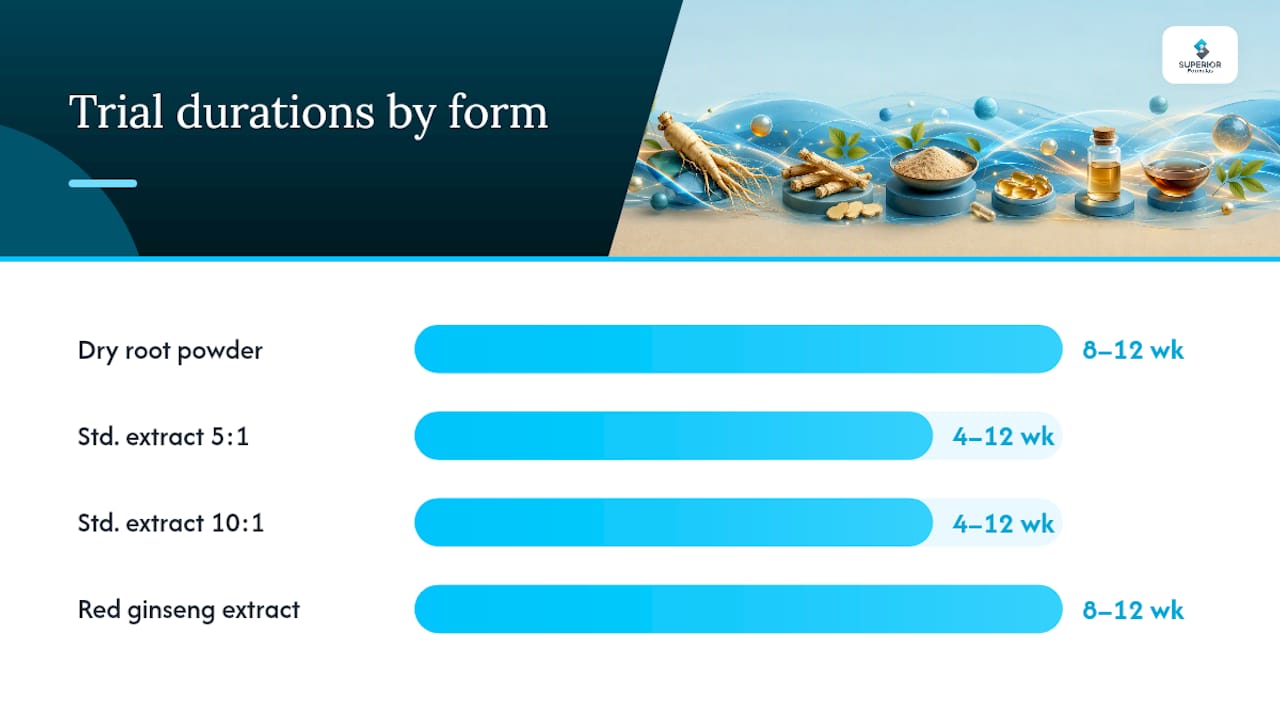
Short-term use (4–12 weeks) covers most of the positive trial outcomes. Long-term use beyond 3 months has less clinical data, and some practitioners suggest cycling (e.g., 8 weeks on, 4 weeks off) to avoid tolerance, though this is based on clinical convention rather than controlled trial evidence.
Pro Tip: Ask for a Certificate of Analysis (COA) before buying any ginseng extract. A legitimate COA from a third-party lab will confirm the ginsenoside percentage, verify the absence of heavy metals (lead, arsenic, cadmium), and show microbial limits. If a brand cannot produce one on request, that is a meaningful red flag about product quality.
Because the FDA classifies dietary supplements as food rather than drugs, manufacturers face less premarket scrutiny than pharmaceutical companies. Third-party testing is the primary quality safeguard available to you as a consumer.
What are the side effects and drug interactions you should know about?
Panax ginseng has a generally favorable safety profile in short-term trials, with no serious adverse events reported in major reviews. That said, several clinically meaningful risks deserve attention.
Common side effects
- Gastrointestinal upset (nausea, diarrhea, stomach discomfort)
- Insomnia or sleep disturbance, particularly with higher doses or evening use
- Headache
- Elevated blood pressure at high doses in some individuals
Drug interactions: the ones that matter most
- Anticoagulants and antiplatelets (warfarin, aspirin, clopidogrel): Panax ginseng may increase bleeding risk by inhibiting platelet aggregation. Combining it with warfarin can alter INR values unpredictably.
- Diabetes medications (insulin, metformin, sulfonylureas): Ginseng can lower blood glucose independently. Combined use raises the risk of hypoglycemia, requiring glucose monitoring and possible dose adjustment.
- MAOIs: Potential for stimulant-type interactions, including agitation and insomnia.
- CYP450 substrates: Some ginsenosides inhibit or induce CYP3A4 and CYP2C9 enzymes, which can alter plasma levels of medications metabolized by these pathways.
For a broader framework on managing supplement interactions safely, the supplement safety guide covers the key principles.
Who should avoid Panax ginseng
- Pregnant or breastfeeding women: Safety data is insufficient; avoid use.
- People with bleeding disorders: Increased bleeding risk is documented.
- Anyone scheduled for surgery: StatPearls recommends stopping Panax ginseng at least 24 hours before surgery due to pharmacokinetic variability and potential bleeding and anesthetic interactions.
- People with hormone-sensitive conditions: Ginseng has mild estrogenic activity; use with caution in estrogen-receptor-positive conditions.
Pre-use checklist
Before starting Panax ginseng, confirm the following:
- You are not taking warfarin, clopidogrel, or other anticoagulants/antiplatelets
- You are not on insulin or oral hypoglycemic agents without clinician awareness
- You are not taking MAOIs or stimulant medications
- No surgery is scheduled within the next week
- You are not pregnant or breastfeeding
- You do not have a known bleeding disorder or hormone-sensitive condition
If any of these apply, consult your clinician before starting. This is not optional caution; it reflects real pharmacological risk documented in clinical literature.
Where does the evidence actually stand? A quick reference
The 2023 Frontiers umbrella review is the most comprehensive recent synthesis of ginseng meta-analyses, and its conclusion is worth stating plainly: positive signals exist across multiple outcomes, but methodological quality across the underlying trials is low to critically low. That does not mean ginseng does not work. It means the evidence base is not yet strong enough to make confident, unqualified claims.
- Moderate evidence: Fatigue reduction, some metabolic markers (fasting glucose, cholesterol) in people with prediabetes or type 2 diabetes
- Limited evidence: Sexual function and erectile dysfunction, immune support (respiratory infection incidence), age-specific cognitive effects (attention, reaction time in middle-aged adults)
- Inconclusive: Broad memory improvement in healthy adults, general cognitive enhancement across all ages
- Not reliably supported: Athletic performance, VO2 max, strength gains
The highest-confidence outcome is fatigue. The lowest-confidence claim is athletic performance enhancement. For cognition, the evidence is real but narrow: attention and reaction time in middle-aged adults, not general memory across all ages.
How do you choose a quality Panax ginseng product?
Product quality determines whether the clinical evidence applies to what you are actually taking. A poorly standardized product can render the entire evidence base irrelevant to your experience.
Buyer checklist
- Species verification: The label must say Panax ginseng (not Siberian ginseng or American ginseng, which are different plants with different evidence profiles)
- Standardized ginsenoside content: Look for 4–8% total ginsenosides stated on the label
- Extract ratio: A 5:1 or 10:1 extract ratio indicates concentration; pair this with the ginsenoside percentage for a complete picture
- Third-party COA: Confirms potency, heavy metal limits (lead, arsenic, cadmium, mercury), and microbial safety
- GMP-certified manufacturing: Indicates the facility meets FDA Good Manufacturing Practice standards
- Transparent sourcing: Country of origin for the root matters; Korean-grown Panax ginseng has the longest cultivation history and most clinical precedent
How processing affects what you get
Red ginseng’s heat-processing converts certain ginsenosides into more bioavailable forms and creates new compounds not present in white ginseng. If you are choosing between the two, red ginseng generally offers a more potent and altered ginsenoside profile. White ginseng is milder and may suit people sensitive to stimulant-adjacent effects.
Pro Tip: When reviewing a COA, pay specific attention to the heavy metals panel. The USP (United States Pharmacopeia) sets limits of 10 mcg/day for lead and 15 mcg/day for arsenic from dietary supplements. A COA that does not include a heavy metals panel, or that lists results without reference limits, is incomplete. Reject it and request a full panel.
For a practical framework on evaluating dietary supplements more broadly, the evaluation criteria apply directly to ginseng product selection.
Is Panax ginseng right for you? A practical decision guide
Not everyone is a good candidate for ginseng supplementation, and the decision is not purely about whether the evidence supports a given outcome. It also depends on your health status and current medications.
Step-by-step trial plan
- Complete the pre-use checklist above. If any red flags apply, get clinician sign-off first.
- Start at the lower end of the clinical dose range: 200 mg of a standardized extract (5% ginsenosides) once daily with food.
- Run a defined trial period of 4–8 weeks. Shorter trials do not give most outcomes time to manifest.
- Track objective measures before and during the trial: a validated fatigue scale (e.g., the Multidimensional Fatigue Inventory), fasting glucose if metabolic support is your goal, or a simple energy log.
- Assess at week 4 and week 8. If no meaningful change is apparent by week 8, the supplement is unlikely to be working for you at that dose.
- Consider cycling: 8 weeks on, 4 weeks off, based on clinical convention for adaptogen use.
Red flags: stop immediately if you notice
- New or unusual bruising or bleeding
- Dizziness, sweating, or shakiness (possible hypoglycemia if you take diabetes medications)
- Significant sleep disruption persisting beyond the first week
- Palpitations or a notable increase in resting heart rate
For readers integrating ginseng into a broader longevity strategy, the healthy aging clinical plan provides useful context on how adaptogens fit alongside other evidence-backed interventions.
A physician-scientist’s perspective on Panax ginseng in a longevity stack
Panax ginseng occupies a specific and somewhat narrow role in a well-designed supplement regimen. The evidence supports it most clearly for fatigue and modest metabolic support, which makes it a reasonable consideration for adults in their 40s and 50s managing energy levels alongside metabolic health goals. It is not a cognitive enhancer in the broad sense that marketing often implies, and it is not a performance supplement.
What makes ginseng genuinely interesting from a longevity science perspective is its multi-target pharmacology. The antioxidant, anti-inflammatory, and NO-modulating activities documented in the PMC pharmacological review align with several pathways relevant to cellular resilience and healthy aging. When combined with other actives, such as ginkgo for cognitive support or compounds targeting the Nrf2 pathway for antioxidant defense, the mechanistic rationale becomes more compelling than for single-ingredient use. That said, combination products introduce their own complexity: efficacy data from single-ingredient trials does not automatically transfer to multi-ingredient formulas, and the interaction effects between actives are rarely studied directly.
The practical guidance is straightforward. Use a standardized, third-party tested product. Match your dose to the clinical trial range for your target outcome. Set a defined trial window and measure something objective. And if you are on medications that interact with ginseng, the conversation with your clinician is not a formality; it is a clinical necessity. For readers exploring how dietary supplements fit into longevity and cellular health more broadly, the same evidence-first framework applies across the category.
Physician-formulated Panax ginseng from Superiorformulas
Superiorformulas develops its supplement formulations under physician-scientist oversight, with every ingredient selected based on clinical evidence and manufactured in GMP-certified facilities with third-party testing for purity and potency. For adults seeking metabolic support, fatigue reduction, or a ginseng-containing adaptogen formula grounded in the evidence reviewed here, Superiorformulas offers a vetted option built to the quality standards this article describes: species-verified Panax ginseng, standardized ginsenoside content, and a transparent COA available on request.
Disclosure: this article is published by Superiorformulas. Product recommendations reflect the brand’s own formulations.
Visit Superiorformulas to review the current product line and find the formulation that fits your health goals.
Sources
The sources below represent systematic reviews, government health databases, and authoritative clinical references used in preparing this article. Priority was given to umbrella reviews, NCBI Bookshelf entries, and government-affiliated health databases over single small trials or commercial sources.
- Pharmacological and medical applications of Panax ginseng and ginsenosides: a review
- Ginseng and health outcomes: an umbrella review (Frontiers, 2023)
- Panax Ginseng: MedlinePlus Supplements
- Processing and pharmacology differences between red and white ginseng (NCBI Bookshelf)
This article provides general health information and is not a substitute for professional medical advice. Confirm current guidance and your personal suitability with a qualified clinician before starting any new supplement.


