


You reach for an antioxidant supplement expecting protection. The bottles promise cellular defense, reduced oxidative stress, and a shield against aging itself. But Cochrane evidence does not support routine antioxidant supplementation for disease or mortality prevention, which leaves millions of health-conscious adults over 35 making decisions built on incomplete information. This guide cuts through that noise. You’ll find a clear, evidence-grounded framework for understanding what antioxidant support actually means, when supplements are appropriate, and how to build a strategy that genuinely serves your long-term health.
Table of Contents
- What is antioxidant support, really?
- Requirements and benchmarks: Food, supplements, and clinical needs
- Step-by-step: How to approach antioxidant support for healthy aging
- How to know it’s working: Verifying your approach and avoiding pitfalls
- Why the ‘more is better’ myth misleads most adults over 35
- Evidence-based next steps for antioxidant support
- Frequently asked questions
Key Takeaways
| Point | Details |
|---|---|
| Food first, supplements second | Prioritize getting antioxidants from whole foods unless a clinician recommends otherwise. |
| Supplements not always safer | Some antioxidants in excess may raise health risks, especially for smokers. |
| Personalization is key | Your age, health status, and risk profile should drive supplement choices. |
| Not all formulas are alike | Specific antioxidant blends have benefits in narrowly defined medical situations, not for routine use. |
| Verify, then adjust | Track outcomes and consult your physician to review if your approach is working as intended. |
What is antioxidant support, really?
Antioxidant support refers to the body’s ability to counter oxidative stress, a process in which unstable molecules called free radicals damage cells, proteins, and DNA. The body produces its own antioxidant defenses through enzymes like superoxide dismutase and catalase, but dietary compounds also contribute meaningfully. Nutrients such as vitamin C play a role in regenerating other antioxidants and supporting immune function, yet supplementing for disease prevention has not consistently shown benefit in large clinical trials.
That gap between biological plausibility and clinical proof is exactly where confusion enters the picture. Laboratory studies show antioxidants neutralizing free radicals in a test tube. Supplement marketing takes that mechanism and implies it translates directly into disease prevention or longevity. But that’s not what controlled human trials have demonstrated, and it’s a distinction that matters enormously to your health decisions.
Here are common misconceptions worth correcting:
- “More antioxidants are always better.” The body tightly regulates oxidative balance. Flooding it with high-dose supplements can actually interfere with protective signaling pathways.
- “Antioxidant supplements equal antioxidant-rich foods.” Whole foods contain thousands of phytonutrients that interact synergistically. Isolated supplements do not replicate that complexity.
- “If it’s natural, it’s safe at any dose.” Beta-carotene, vitamin E, and selenium all carry documented risks at high supplemental doses.
- “Antioxidant support is loosely defined in media,” often conflicting with what evidence-based reviews actually support.
| Antioxidant source | Key compounds | Evidence strength |
|---|---|---|
| Colorful vegetables | Carotenoids, flavonoids, vitamin C | Strong for overall health |
| Berries and citrus | Polyphenols, vitamin C, quercetin | Strong, food-based data |
| Nuts and seeds | Vitamin E, selenium, polyphenols | Moderate, context-dependent |
| Isolated supplements | Single nutrients at high doses | Weak to neutral, some risks |
| Clinically studied formulas | Targeted combinations (e.g., AREDS2) | Beneficial in specific populations |
Pro Tip: Think of your diet’s antioxidant capacity as a foundation, not a ceiling. Food-first strategies support cellular defense strategies in ways no single-ingredient supplement can fully replicate.
Understanding antioxidant support means accepting its biological complexity. Free radical biology is real, and oxidative stress does contribute to aging and disease. But the pathway from mechanism to meaningful clinical outcome is longer and more nuanced than most supplement labels suggest.
Requirements and benchmarks: Food, supplements, and clinical needs
With a grounded definition of antioxidant support, let’s see how to determine if, when, and what kind of support you might actually require.
Most adults 35+ without a deficiency or clinical indication should prioritize food-based antioxidants, with selective supplementation in specific circumstances. That guidance from the NIH is direct and evidence-based. The real question is: what counts as a specific circumstance?
Groups who may benefit from targeted supplementation include:
- Individuals with confirmed nutrient deficiencies (e.g., low serum selenium or vitamin C)
- People with specific diagnosed conditions such as intermediate age-related macular degeneration (AMD)
- Those with poor dietary variety or malabsorption conditions
- Older adults with reduced caloric intake, where nutrient density from food becomes harder to achieve
For everyone else, the priority is dietary variety. A plate built around dark leafy greens, legumes, whole grains, berries, and colorful vegetables provides a complex array of antioxidant compounds working in concert with fiber, minerals, and other phytonutrients.
It’s also important to recognize that Cochrane evidence does not support routine supplement use for general prevention and signals possible harm for certain antioxidants at supplemental doses. This is not a minor caveat. It represents the conclusions of systematic reviews aggregating data from thousands of participants across multiple controlled trials.
| Feature | Food-based antioxidants | Supplement-based antioxidants |
|---|---|---|
| Nutrient complexity | High (synergistic compounds) | Low (isolated or limited combination) |
| Bioavailability | Variable, often optimized by food matrix | Variable, dose-dependent |
| Evidence for prevention | Strong (dietary patterns) | Weak to neutral for most, harmful in some |
| Risk of excess | Very low | Moderate to high at high doses |
| Best use case | Daily foundational health | Deficiency correction or clinical indication |
| Cost-effectiveness | High | Moderate to low depending on need |
Making research-backed supplement selection decisions starts with honest self-assessment. Have you had your levels checked? Are you getting five to nine servings of produce daily? Do you have a diagnosis that genuinely calls for targeted nutrient support?
These questions matter more than which antioxidant is currently trending. Learning what actually qualifies as evidence in preventive health supplements helps you spend wisely and protect your health at the same time.
Step-by-step: How to approach antioxidant support for healthy aging
With requirements clear, here’s a stepwise guide to developing your own effective antioxidant support routine.
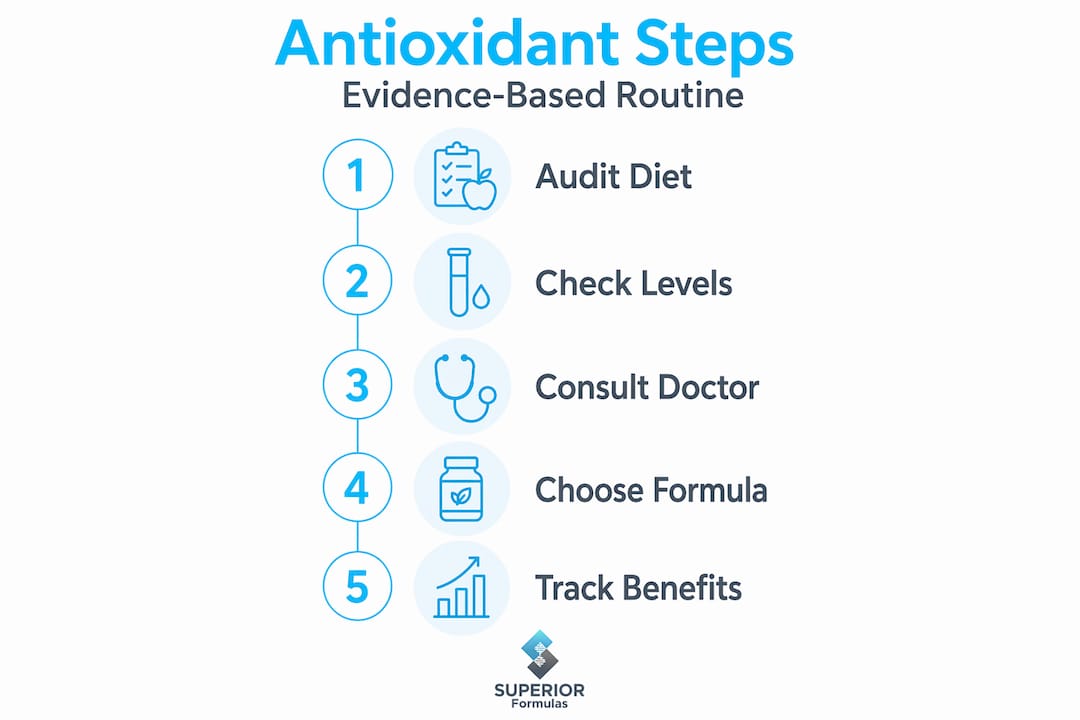
1. Audit your diet first. Before any supplement enters the picture, spend two to three weeks honestly tracking your fruit and vegetable intake. Most Americans fall well below recommended levels. This is your baseline, and it matters more than any capsule.
2. Identify any confirmed deficiencies or clinical conditions. A routine blood panel can detect low levels of selenium, vitamin C, vitamin E, or vitamin A. If your physician confirms a deficiency, targeted supplementation makes clinical sense. Without that confirmation, supplementing is guesswork.
3. Consult your physician before starting any antioxidant supplement. This is not a formality. Evidence shows that certain antioxidants, including beta-carotene and vitamin E, can increase mortality in some populations. Your physician needs to know your full health picture, including medications and personal risk factors, before recommending any supplement.
4. If supplementation is indicated, choose clinically studied formulas. General multivitamins blended with antioxidant “stacks” are not equivalent to formulations tested in clinical trials. Specific formulas, such as the AREDS2 combination, have shown real benefit in targeted, well-defined populations with advanced AMD. Context is everything.
5. Avoid high-dose single-antioxidant supplements without expert guidance. The instinct to take more of a good thing is understandable. The evidence does not support it. Excess vitamin E supplementation has been linked to increased all-cause mortality risk in large trials. Excess beta-carotene increases lung cancer risk in smokers. The dose, your health status, and your risk factors all matter.
6. Reassess every six to twelve months. Your nutritional needs, health status, and medications change over time. What was appropriate two years ago may not be now. Build regular reassessment into your health routine alongside supplements and longevity planning conversations with your care team.
“The best antioxidant strategy is not the most aggressive one. It is the one calibrated to your actual needs, your diet, and your clinical profile.”
Pro Tip: When assessing supplement safety, look specifically for products manufactured in GMP-certified facilities with third-party testing. Purity and accurate labeling are prerequisites, not premium features.
High-dose antioxidant stacks marketed as “cellular protection” or “anti-aging megadoses” often have no randomized controlled trial support for their specific combination or dose. This matters deeply when you consider that the human antioxidant defense system is not a linear input-output machine. It is a tightly regulated network that responds poorly to blunt, high-volume interventions.
How to know it’s working: Verifying your approach and avoiding pitfalls
Once your support strategy is in place, let’s cover how to recognize benefits, verify results, and avoid the most common traps.
Measurable outcomes from a well-executed antioxidant strategy are subtle and systemic rather than immediate and dramatic. What you can realistically expect includes improved energy and vitality over weeks to months, better recovery from physical exertion, and maintenance of healthy skin and immune function. These outcomes reflect good nutritional status, not a single supplement working in isolation.
Signs your approach is working:
- Consistent energy without major afternoon crashes
- Improved resilience during illness seasons
- Stable or improved lab markers for inflammatory status (if monitored)
- Absence of supplement-related side effects
- Positive clinical feedback from your physician at routine checkups
Research does not support the idea that taking vitamin C or selenium supplements will produce measurable disease prevention in well-nourished adults. The absence of deficiency symptoms combined with a nutrient-rich diet is itself a meaningful and valid health outcome.
“Progress in antioxidant health looks like consistency, not transformation. A stable, resilient baseline is the goal.”
Pitfalls vs. best practices:
| Common pitfall | Evidence-based best practice |
|---|---|
| Taking more = better protection | Match dose to clinical need; higher is not safer |
| Relying only on supplements | Build a diet rich in whole-food antioxidants first |
| Skipping physician consultation | Always review supplements with your healthcare provider |
| Ignoring your personal risk profile | Beta-carotene increases lung cancer risk and mortality in smokers |
| Chasing the latest “superfood” antioxidant | Focus on proven dietary patterns and validated formulas |
| Continuing without reassessment | Reassess every 6 to 12 months with your care team |
Red flags that signal your current approach needs review include gastrointestinal discomfort, unexpected fatigue, changes in lab values your physician flags, or any known interaction between your supplements and prescription medications. These signals should prompt an immediate conversation with your healthcare provider rather than a simple dose adjustment on your own.
Developing a science-driven supplementation mindset means staying honest about what evidence supports and what it does not. Antioxidant support works best as part of an integrated approach to wellness, not as a shortcut past the fundamentals of good nutrition, sleep, stress management, and physical activity.
Why the ‘more is better’ myth misleads most adults over 35
Here is something that even well-intentioned health enthusiasts get wrong: reading positive lab science as a clinical green light for aggressive supplementation.
The reasoning goes like this. Studies show antioxidants neutralize free radicals. Free radicals contribute to aging and disease. Therefore, more antioxidants equal less aging and disease. It’s a clean logical chain, and it is exactly where the evidence breaks down. Large trials consistently show that antioxidant biology suggests theoretical benefit, but actual outcomes are neutral or harmful depending on nutrient, dose, and individual context.
We call this the mechanism-to-mortality gap. Just because a compound does something measurable in a cell does not mean supplementing it at high doses produces the same effect in a living, aging, complex human body. In fact, free radicals are not purely destructive. They serve signaling functions, including triggering the body’s own internal repair and defense systems. Flooding the system with exogenous antioxidants can blunt those very signals.
This is why we at Superior Formulas think the most important shift adults over 35 can make is moving from a “more is better” mindset to a “right tool, right context, right dose” mindset. Supplements are a tool, not a substitute for the metabolic environment created by good food, movement, and sleep. The evidence supports targeted use in specific circumstances, not broad supplementation as insurance.
The safest, most research-consistent path to antioxidant support is still a diet rich in diverse, colorful whole foods. When supplements are warranted, choosing science-driven supplement choices means selecting formulations with real clinical validation at appropriate doses for your specific health profile, not the highest-potency bottle on the shelf.
Evidence-based next steps for antioxidant support
If you’ve confirmed through dietary assessment and clinical guidance that supplementation is appropriate for you, the next step is choosing formulas supported by real clinical evidence.
Superior Formulas offers targeted options designed specifically for adults who have moved past the basics and need physician-formulated precision. Our AREDS2-based antioxidant support formula integrates clinically studied nutrients for those with specific ocular health needs, while our targeted antioxidant options are built around ingredients with meaningful clinical backing, not trending buzzwords. Every formulation is manufactured in a GMP-certified facility with third-party purity testing. For a deeper look at the research behind our ingredient selections, visit our in-depth supplement science resource page and bring that information to your next physician conversation.
Frequently asked questions
Is routine antioxidant supplementation recommended for healthy adults?
No. Cochrane reviews report no evidence of benefit for routine antioxidant supplements in healthy adults and signal potential harm for some specific types, particularly beta-carotene and vitamin E at high doses.
Can antioxidant supplements prevent cancer or heart disease?
No, large meta-analyses do not support this. Antioxidant supplements show no significant reduction in gastrointestinal cancer or mortality, and selenium supplementation shows no cardiovascular benefit in the general population.
Are there risks to taking too many antioxidants?
Yes. Beta-carotene increased lung cancer risk and mortality in male smokers, and high-dose vitamin E has been associated with increased all-cause mortality risk in large controlled trials.
Are any antioxidant supplements proven beneficial?
Yes, in specific high-risk populations. The AREDS formulation reduced the risk of advanced age-related macular degeneration in people with intermediate AMD or advanced disease in one eye, but this benefit does not extend to the general population.
Should I get antioxidant nutrients from food or supplements?
For most adults, food sources should be prioritized, with supplements reserved for confirmed deficiencies or specific clinical indications reviewed by a healthcare provider.
Recommended
- How Dietary Supplements Support Longevity and Cellular Health - SUPERIOR Formulas
- Enhance Cellular Defense: Effective Supplement Strategies - SUPERIOR Formulas
- How to identify research-backed supplements for longevity - SUPERIOR Formulas
- Supplements in preventive health: What really works? - SUPERIOR Formulas


