


If you’ve spent any time shopping for supplements, you’ve seen “clean label” on packaging and wondered what it actually means. The term is everywhere, yet what is clean label supplements is one of the most misunderstood concepts in the wellness space. Here’s what most people don’t realize: “clean label” is a consumer-driven standard, not a regulated FDA category. That distinction changes everything about how you read a bottle, evaluate a brand, and protect your health.
Table of Contents
- Key Takeaways
- What clean label supplements really mean
- The hidden world of excipients
- How certifications verify clean label claims
- Clean label vs. conventional supplements
- How to choose clean supplements that match your goals
- My honest take on the clean label movement
- Why Superiorformulas delivers on clean label principles
- FAQ
Key Takeaways
| Point | Details |
|---|---|
| No official FDA definition | “Clean label” is a consumer-driven standard, not a legal or regulatory classification. |
| Excipients matter as much as actives | Synthetic fillers in the “Other ingredients” list can undermine an otherwise clean formulation. |
| Certifications fill the regulation gap | Third-party programs like NSF and Clean Label Project verify what front-label claims cannot. |
| Plant-based alternatives exist | Food-derived excipients like rice bran and rice hull ash replace synthetic flow agents and lubricants. |
| Contaminant data tells the real story | Independent testing reveals purity gaps across supplement types that marketing never will. |
What clean label supplements really mean
The phrase “clean label” originated in the food industry and crossed over into dietary supplements as consumers began demanding more transparency from brands. In the supplement world, it generally refers to products formulated with simple, recognizable, minimally processed ingredients while avoiding artificial colors, synthetic preservatives, sweeteners, and unnecessary fillers. The industry term used by formulators and researchers is “clean label nutrition,” and understanding it requires looking beyond the front of the package.
There is no official FDA regulatory category called “clean label.” The FDA regulates supplement labeling under 21 CFR 101.36, requiring a Supplement Facts panel and DSHEA disclaimers, but nothing in federal law defines or enforces a clean label standard. That gap means any brand can print “clean” on its label without independent verification.
What a genuinely clean label product typically includes:
- Simple ingredient lists with names you can recognize and pronounce
- Active compounds sourced from natural, minimally processed inputs like botanical extracts, polyphenols, and adaptogens
- No artificial coloring agents, synthetic flavors, or chemical preservatives
- Non-GMO ingredients and, in many cases, gluten-free and allergen-conscious formulations
- Ethical sourcing practices with transparent supply chain documentation
- Third-party testing to verify label accuracy and purity
The emphasis on recognizable ingredients reflects a deeper shift in consumer trust. People want to know what they’re putting into their bodies, and they’re increasingly skeptical of ingredient lists that read like a chemistry textbook. Clean label nutrition, at its core, is about earning that trust through ingredient transparency and honest formulation.
Pro Tip: When evaluating a supplement, search each ingredient name online before purchasing. If you can’t find a clear definition or a credible scientific explanation for an ingredient’s purpose, that’s a signal worth paying attention to.
The hidden world of excipients
Here is where most buyers get tripped up. You can have a supplement with a pristine active ingredient list and still end up with a product that fails the clean label standard because of its excipients. Excipients are the inactive substances used in manufacturing: binders that hold tablets together, flow agents that keep powder moving through production equipment, lubricants that prevent sticking, and coatings that protect capsule integrity.

These components rarely get attention, but they materially affect formulation cleanliness in ways that matter to health-conscious consumers. Common synthetic excipients include silicon dioxide (a flow agent), magnesium stearate (a lubricant), and hydroxypropylcellulose (a binder). None of these are inherently dangerous at typical doses, but they are synthetic, often petroleum-derived or chemically processed, and they conflict with the spirit of a clean formulation.
The good news is that plant-based excipient alternatives now exist at scale. Examples include Nu-FLOW® (made from rice hull ash) as a replacement for silicon dioxide, and Nu-MAG® (made from rice bran) as a replacement for magnesium stearate. These food-derived inputs achieve similar manufacturing functions while keeping the formulation consistent with clean label principles.
Here’s a comparison of conventional versus clean label excipients:
| Function | Conventional excipient | Clean label alternative |
|---|---|---|
| Flow agent | Silicon dioxide | Rice hull ash (Nu-FLOW®) |
| Lubricant | Magnesium stearate | Rice bran (Nu-MAG®) |
| Binder | Hydroxypropylcellulose | Cellulose from plant fiber |
| Coating | Polyethylene glycol | Carnauba wax or shellac |
One important caveat: clean label excipients cannot always match the functional performance of their synthetic counterparts. Manufacturers regularly balance purity goals against shelf life, production efficiency, and stability. A brand committed to genuinely clean formulations needs both the intent and the technical investment to make that balance work.
Pro Tip: Always scroll past the Supplement Facts panel to the “Other ingredients” section. That list tells you everything about the excipients in your supplement. If you see long chemical names or compounds you’d never find in a kitchen, ask the brand to explain them.
You can learn more about how fillers affect your supplement’s quality in this breakdown of supplement fillers from the Superiorformulas blog.
How certifications verify clean label claims
Because “clean label” carries no legal definition, third-party certifications are the most reliable way to validate what a brand claims. These programs fill the accountability gap that regulation leaves open, and they test for things that front-label claims never address.
Three of the most recognized programs are:
- NSF Certified for Sport: Covers contaminant testing, banned substances, and GMP compliance verification under NSF/ANSI 173 standards. Originally designed for athletes, it’s valuable for any consumer who wants rigorous verification.
- Clean Label Project: Uses contaminant screening to detect heavy metals, pesticide residues, and other environmental toxins. Their 2025 protein powder study tested 165 products across 35,862 data points, finding that plant-based powders averaged higher contaminant levels than whey-based options. A result that challenged the common assumption that plant-based automatically means cleaner.
- USP Verified: Confirms that a supplement contains the ingredients listed on the label in the declared amounts, with no harmful levels of contaminants and adherence to FDA current GMP regulations.
“Certifications test for banned substances, label accuracy, and contaminants, adding layers of accountability beyond marketing claims.” — Clean Label Project
These certifications don’t guarantee that a product meets every consumer’s personal definition of clean. But they do provide a documented, reproducible audit trail that marketing copy cannot replicate. Consumer-facing clean label claims can be genuinely misleading without independent testing to back them up. A certification logo on a label is one of the few signals that carries real evidentiary weight.
When you’re evaluating a brand, look for the specific certification logo, not just a vague reference to “third-party tested.” The distinction matters.
Clean label vs. conventional supplements
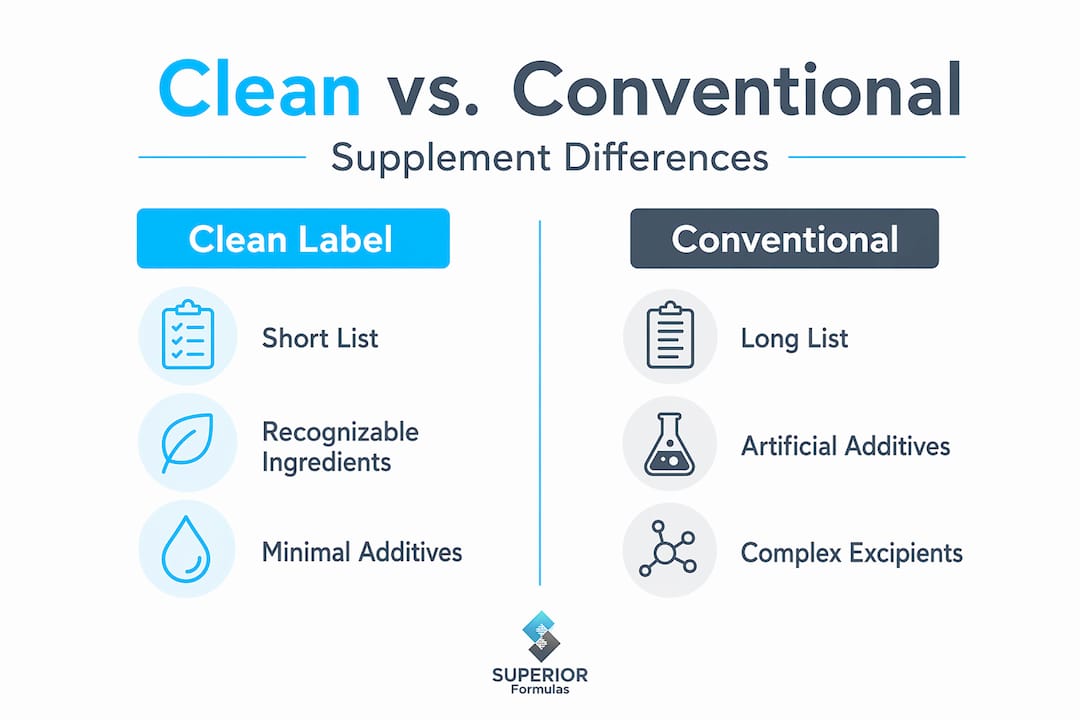
Understanding clean label vs. regular supplements is most useful when you can see the differences side by side. The core contrast comes down to ingredient philosophy and formulation priorities.
| Factor | Clean label supplements | Conventional supplements |
|---|---|---|
| Ingredient list length | Short, recognizable terms | Often long, includes chemical names |
| Excipients | Plant-derived or food-based | Frequently synthetic |
| Additives | No artificial colors or preservatives | May include synthetic additives |
| Sourcing | Ethically sourced, often non-GMO | Variable, less transparency |
| Price point | Typically higher | Generally lower |
| Certification | Often third-party verified | Verification varies widely |
The price premium on clean label products is real. Clean label supplements cost more because of the sourcing, testing, and certification expenses involved. That investment reflects a genuine quality difference in most cases, though not always. Some brands use clean label as a marketing angle without the formulation rigor to support it.
The contaminant data is sobering. The Clean Label Project’s 2025 protein study showed meaningful variability in purity across similar product types. That variability requires looking beyond marketing and seeking documented third-party verification. A supplement that costs more and carries a recognizable certification is generally worth the premium when purity is the priority.
Clean label nutrition also supports broader wellness routines. When every ingredient in your supplement stack has a clear purpose and a verifiable source, you’re building a health practice on a foundation you can trust.
How to choose clean supplements that match your goals
Knowing what clean label means is only useful if you can apply it at the point of purchase. Here’s a practical process for evaluating any supplement before you buy:
- Read the Supplement Facts panel first. Check serving size, active ingredients, and amounts. The FDA requires specific labeling elements including allergen information and DSHEA disclaimers for structure-function claims. Any product missing these elements should be avoided.
- Move immediately to “Other ingredients.” This is where excipients live. Look for plant-derived or food-based terms. Flag anything that sounds synthetic or chemically processed.
- Search for third-party certification logos. NSF, USP, and Clean Label Project are the most credible. Confirm the certification is current by checking the certifying body’s website directly.
- Match the formulation to your specific health goals. A longevity-focused supplement with Nrf2 activators like sulforaphane or quercetin has different ingredient priorities than a basic multivitamin. Understand what each active ingredient is supposed to do before deciding if the formula fits your needs.
- Evaluate the brand’s transparency practices. Does the brand publish certificates of analysis? Do they list their manufacturing facility’s GMP certification? Brands that prioritize supplement transparency make that information easy to find.
- Cross-reference marketing language with verified facts. Terms like “all natural,” “pure,” and “premium” carry no regulatory weight. Only verifiable data and certifications should influence your buying decision.
Pro Tip: Ask brands directly for a certificate of analysis (COA) for the specific batch of the product you’re buying. Reputable companies provide this without hesitation. If a brand can’t produce one, that tells you something important about their quality control.
For a deeper look at why ingredient quality matters for long-term health, Superiorformulas has written extensively about why choosing clean supplements matters for your overall wellness strategy.
My honest take on the clean label movement
I’ve spent years evaluating supplement formulations and talking with consumers who feel genuinely overwhelmed by the options. What I’ve found is that “clean label” has evolved from a useful consumer signal into something brands exploit precisely because it lacks a legal definition.
The thing most buyers miss is the excipient problem. They read the active ingredient list, see recognizable plant compounds, feel confident, and never scroll to “Other ingredients.” That’s exactly where misleading formulations hide. I’ve reviewed products that market themselves as clean while using a half-dozen synthetic excipients that no health-focused consumer would choose knowingly.
What I’ve also learned is that the brands doing this right treat clean formulation as a technical challenge, not just a marketing choice. It takes real investment to source plant-based excipients, achieve manufacturing stability without synthetic shortcuts, and submit to rigorous third-party testing. The price difference you see between genuinely clean supplements and conventional ones reflects that investment.
My honest advice: don’t let clean label marketing be the deciding factor. Let certifications, certificates of analysis, and transparent sourcing documentation guide your decisions. The front of a label tells you what a brand wants you to believe. The back of a label, and the certification logos, tell you what they’ve proven.
— cristopher
Why Superiorformulas delivers on clean label principles
Superiorformulas was founded by a physician-scientist who understood that genuinely clean formulations require more than a marketing commitment. They require clinical expertise, rigorous ingredient sourcing, and the willingness to invest in third-party verification. Every Superiorformulas product is manufactured in a GMP-certified facility, formulated without unnecessary fillers, and designed around clinically studied ingredients selected for their scientific backing in areas like cellular resilience, Nrf2 activation, and healthy aging.
If you’re ready to move from understanding clean label principles to actually applying them, explore the Superiorformulas product line to find formulations built on the transparency and purity standards this article has outlined. You deserve supplements that work as hard as your health goals demand.
FAQ
What does “clean label” mean in supplements?
Clean label refers to supplements formulated with simple, recognizable, minimally processed ingredients and free from artificial additives, synthetic fillers, and unnecessary excipients. The term is consumer-driven and carries no official FDA definition.
Are clean label supplements FDA regulated?
The FDA regulates supplement labeling and manufacturing under DSHEA and 21 CFR 101.36, but it does not define or enforce “clean label” as a regulatory category. Third-party certifications provide the verification that regulation does not.
How do I know if a supplement is truly clean label?
Look for third-party certification logos from programs like NSF, USP, or Clean Label Project, then review the “Other ingredients” section for plant-derived excipients. Brands that publish certificates of analysis offer the highest level of formulation transparency.
Why do clean label supplements cost more?
Clean label products typically carry a price premium because of higher sourcing standards, certification fees, and the cost of using plant-based excipients that may be more expensive or technically challenging than synthetic alternatives.
Are plant-based supplements always cleaner than whey-based ones?
Not necessarily. The Clean Label Project’s 2025 protein powder study found that plant-based powders averaged higher contaminant levels than whey-based products, showing that the type of base ingredient does not automatically determine purity.
As a real-world example of the clean-label standard covered here, our Formula 9 — Superior Multi+ Daily (with AREDS2 nutrients) was designed with exactly this clinical rationale in mind. Explore the science behind the formulation to see how it applies to your own routine.


