


The supplement industry generates over $206 billion globally, yet most of those products reach shelves without any premarket approval or federal product listing requirement. That gap between market scale and regulatory oversight is exactly why transparency in supplements has shifted from a nice-to-have to a genuine health necessity. If you buy supplements to support your wellness, longevity, or cellular health, understanding what transparency actually means, and how to verify it, directly affects whether what you’re taking works, is safe, and is worth your money.
Table of Contents
- Key takeaways
- What supplement transparency actually means
- Why transparency in supplements directly affects your health
- The regulatory landscape and 2026 transparency initiatives
- How to choose supplements with genuine transparency
- My take on what consumers consistently underestimate
- How Superiorformulas puts transparency into practice
- FAQ
Key takeaways
| Point | Details |
|---|---|
| Transparency goes beyond labels | Full disclosure includes ingredient sourcing, manufacturing processes, and third-party testing results. |
| Regulatory gaps shift burden to you | Without premarket approval, consumers must independently verify supplement safety and label accuracy. |
| Label accuracy is lower than expected | Only 11% of supplements tested in a 2023 JAMA study matched their label content exactly. |
| Certifications add real confidence | NSF, USP, and similar third-party programs verify actual product contents beyond what FDA oversight covers. |
| Dose math beats price per pill | Cost per clinically effective daily dose is a smarter metric than price per capsule when comparing supplement value. |
What supplement transparency actually means
Transparency in dietary supplements is not just printing a nutrition facts panel on a bottle. At its core, it means a brand openly discloses what is in its product, where those ingredients come from, how the product was manufactured, and what testing confirms its quality. Each of those elements carries weight.
The clearest markers of supplement transparency include:
- Full ingredient disclosure: Every active and inactive ingredient listed with its exact amount, not hidden inside a proprietary blend that lumps multiple compounds under one weight.
- Sourcing details: Where botanical extracts, amino acids, or minerals originate matters for quality. A polyphenol extract sourced from a certified supplier differs meaningfully from a commodity bulk ingredient.
- Manufacturing transparency: GMP-certified facilities follow documented processes. Brands that disclose their manufacturing standards give you a verifiable quality floor.
- Third-party testing results: Independent lab verification confirms a product actually contains what the label claims. This is not the same as the company testing its own product.
- Accessible science communication: Consumer education is a core part of transparency. If a brand cannot explain the research behind an ingredient in plain language, that is a signal worth noting.
The critical distinction is between transparency and marketing. Phrases like “clinically inspired,” “premium blend,” or “proprietary formula” are not transparency. They are often the opposite. A genuinely transparent brand shows you the dose of each active ingredient because the clinical evidence is tied to specific amounts.
Pro Tip: When a supplement uses a proprietary blend, you cannot confirm whether any individual ingredient reaches a clinically studied dose. Treat proprietary blends as a flag that prompts further research before buying.
Why transparency in supplements directly affects your health
The regulatory structure governing supplements places most of the verification burden on you, the consumer. Under DSHEA, the FDA focuses on post-market surveillance rather than approving products before they reach store shelves. That means a supplement can be sold with inaccurate claims or contaminated ingredients, and action only follows after harm is reported.
The consequences are measurable. Only 11% of supplements tested in a 2023 JAMA study matched their label content precisely. Label discrepancies and undisclosed additives were common findings. For health-conscious consumers taking supplements to support specific biological pathways, including Nrf2 activation, mitochondrial function, or cellular renewal, an inaccurate dose is not just a financial waste. It can undermine the health outcome you are targeting.
“Transparency is now an essential business practice, not optional.” This framing reflects a broader shift in consumer expectations, where brands that cannot demonstrate accountability are increasingly filtered out by informed buyers.
Beyond safety, transparency drives better industry standards. When brands know their testing results are public and their ingredient sourcing is scrutinized, the incentive to cut corners shrinks. That market pressure benefits every consumer, not just the ones reading lab reports. Transparency also supports informed decision-making at a practical level. Knowing the exact form of magnesium in a product, or whether ashwagandha extract is standardized to withanolides, changes whether that product aligns with your health goals.
The importance of supplement transparency compounds when you consider that health-conscious individuals often take multiple supplements. Cumulative exposure to undisclosed fillers, heavy metals from untested botanical sources, or sub-therapeutic doses across several products creates risks that are invisible without full label disclosure.
The regulatory landscape and 2026 transparency initiatives
Supplements in the United States are regulated primarily under the Dietary Supplement Health and Education Act, known as DSHEA. This framework focuses on post-market surveillance, meaning the FDA can act after a problem is identified but does not approve supplements before sale the way it does pharmaceuticals. The practical result is a market where quality varies enormously from brand to brand.
The absence of a federal product registry has been a known gap for years. In 2026, that gap is the subject of direct legislative attention. The Dietary Supplement Listing Act of 2026 would require manufacturers to submit product information and labels to the FDA, creating the first structured federal database of supplements on the market. Industry response has been mixed. Some manufacturers support the accountability it provides. Others raise concerns about regulatory burden for smaller producers.
State-level momentum is also building. California legislation now advances requirements for protein product manufacturers to test for heavy metals including lead and arsenic, and to publicly disclose results. Independent studies finding measurable heavy metals in protein powders prompted this push. It reflects a pattern where state-level transparency laws often set the standard before federal rules catch up.
| Regulatory layer | Current status | Transparency impact |
|---|---|---|
| DSHEA (federal) | Post-market surveillance only | No premarket approval; burden on consumer |
| FDA labeling rules | Requires ingredient listing | Does not verify accuracy or sourcing |
| Dietary Supplement Listing Act 2026 | Proposed, under debate | Would create first federal product registry |
| California protein testing law | Advancing in 2026 | Mandates heavy metal testing and disclosure |
| Third-party certifications (NSF, USP) | Voluntary, not universal | Adds independent verification layer |
Pro Tip: When evaluating a brand’s regulatory claims, ask specifically whether their products are registered with any third-party database AND whether the certifications listed on the label are current. Certifications can lapse, and some brands display outdated logos.
How to choose supplements with genuine transparency
Knowing why transparency matters is useful. Knowing how to find it when you are standing in a supplement aisle or browsing online is where the value becomes practical. Here is a structured approach.
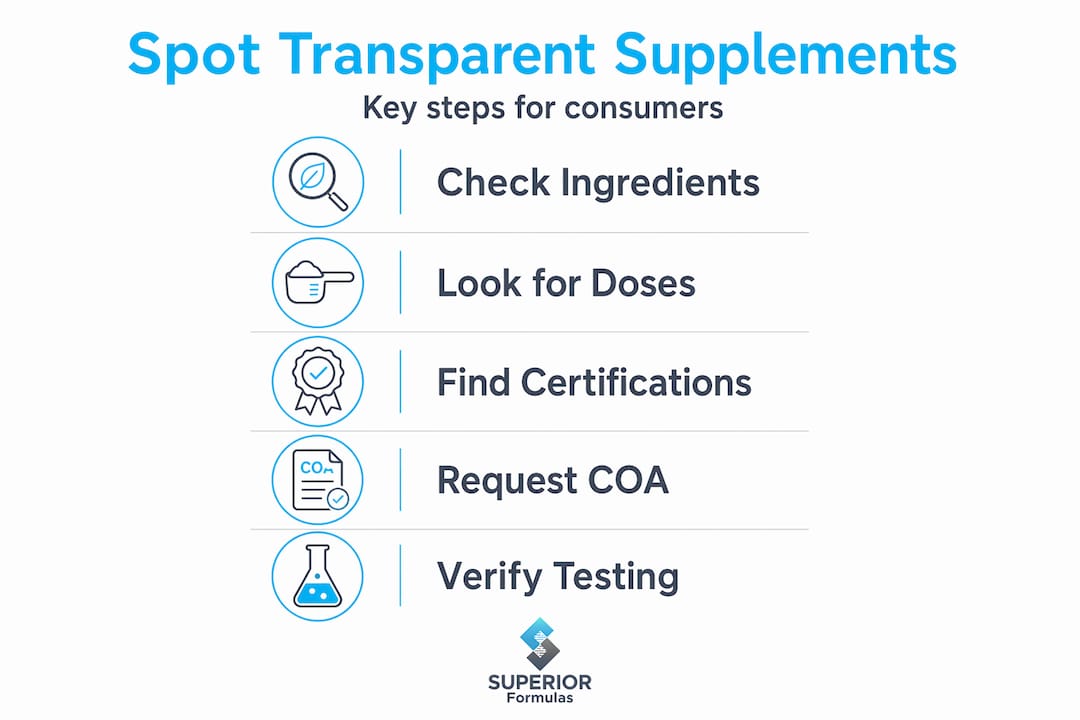
- Check the full ingredient panel. Every active ingredient should list its specific form and exact amount per serving. If you see a blend with a single total weight covering multiple compounds, you cannot confirm any individual dose.
- Look for third-party certification logos. NSF and USP certifications are the most rigorous voluntary programs in the U.S. Their presence signals that an independent lab has verified the product’s contents and purity. Certification programs vary in rigor, so check which body issued the certification.
- Cross-reference with the NIH DSLD. The NIH Dietary Supplement Label Database archives declared label information for thousands of products. It does not independently verify accuracy, but pairing it with third-party certification data fills critical gaps.
- Calculate cost per effective dose, not cost per pill. Many budget supplements contain sub-therapeutic amounts that are clinically ineffective despite a low price point. Identify the dose used in clinical studies for each ingredient, then calculate what you are actually paying for that amount.
- Investigate manufacturing standards. GMP-certified facilities follow documented processes for raw material testing, batch consistency, and contamination prevention. This information should be findable on the brand’s website, not just asserted in marketing copy.
- Read the science, not just the claims. A transparent brand links to or cites the actual studies supporting its formulations. If the only evidence is a vague reference to “research,” look for specifics. Learning to assess dietary supplements by their clinical evidence is a skill that protects your investment and your health.
| What to check | Red flag | Green flag |
|---|---|---|
| Ingredient list | Proprietary blend, no individual doses | Full disclosure with exact amounts per ingredient |
| Testing | Brand self-testing only | Independent NSF, USP, or equivalent certification |
| Manufacturing | No facility info available | GMP-certified, verifiable facility disclosure |
| Science backing | Vague “research shows” claims | Specific citations to peer-reviewed studies |
| Heavy metal testing | Not disclosed | Publicly available results or COA on request |
My take on what consumers consistently underestimate
I have spent considerable time evaluating supplement brands across quality tiers, and the pattern I keep seeing is this: most consumers underestimate how much the label understates the product’s actual risk profile. They read an ingredient name they recognize and assume the dose is adequate. They see a certification logo and assume it covers everything. Neither assumption is reliable without verification.
What I find most telling is how rarely consumers ask for a Certificate of Analysis. A COA is the actual lab document showing tested levels of every declared ingredient plus any screened contaminants. Legitimate brands provide these on request or post them publicly. In my experience, the brands most resistant to sharing COAs are not necessarily hiding major failures. Often they simply have not tested at that level of detail, which is itself a transparency failure.
The other thing that gets missed consistently: understanding supplement ingredients means looking past the active compounds to the inactive ones. Fillers, binders, and flow agents are not neutral. Some interact with absorption. Some are allergens. A brand that discloses every inactive ingredient alongside its purpose is operating at a higher standard than most.
My honest assessment is that transparency in health products is less about any single certification or label claim and more about a brand’s overall culture of accountability. Does the brand publish its science? Does it disclose its supply chain? Does it update its formulations when new research emerges? Those behaviors signal a company that earns trust rather than simply claims it.
— cristopher
How Superiorformulas puts transparency into practice
If you have read this far, you already know more about evaluating supplements than the majority of consumers. The logical next step is applying that knowledge to a brand built on exactly these principles.
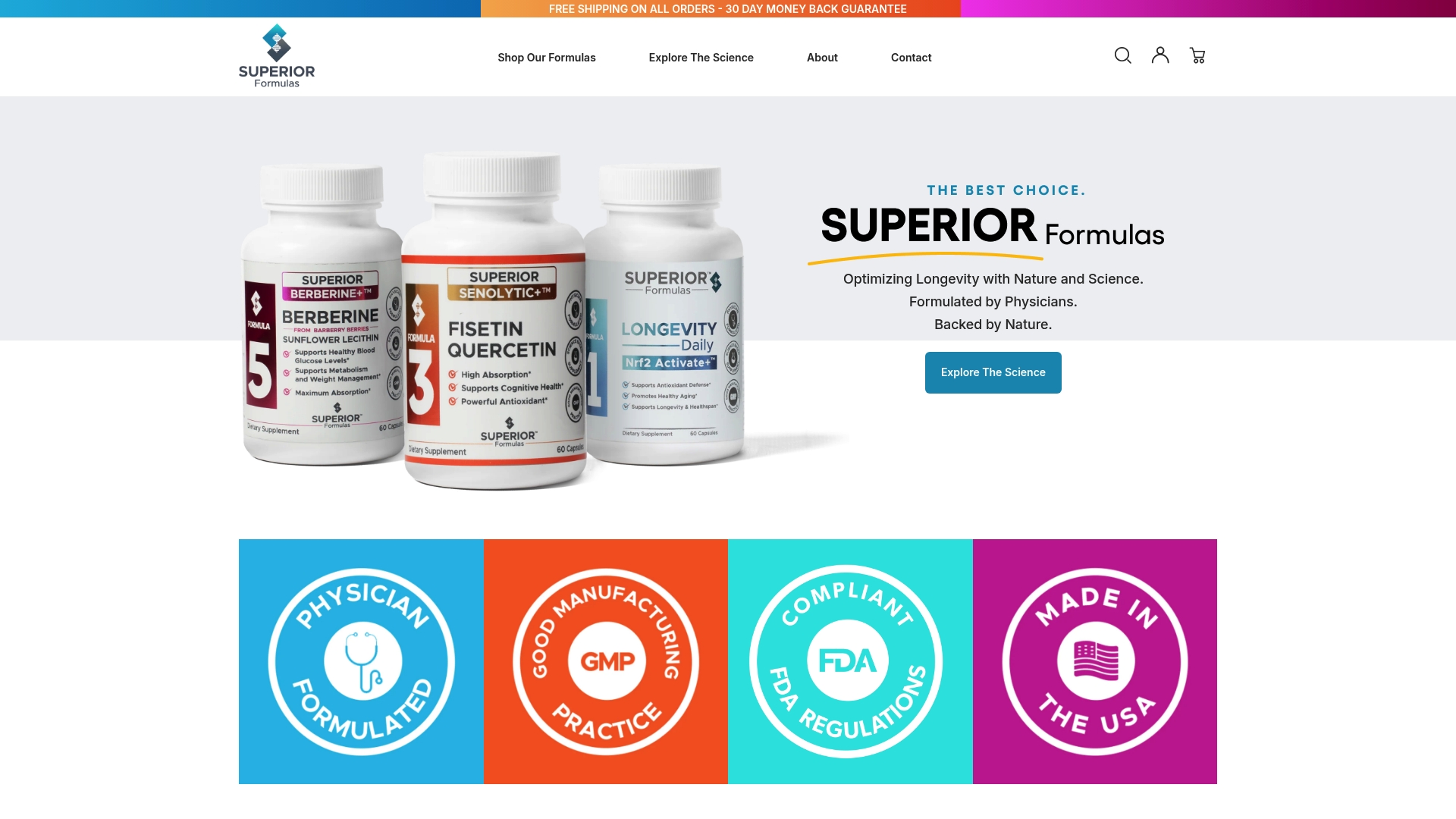
Superiorformulas was founded by a physician-scientist with one core conviction: that supplements should be held to the same standard of evidence and disclosure as clinical-grade formulations. Every product is manufactured in a GMP-certified facility, uses ingredients selected for their peer-reviewed clinical backing, and undergoes third-party testing for purity and potency. There are no unnecessary fillers and no proprietary blends designed to obscure doses. The science behind each formulation is fully accessible. Visit the Explore the Science page to see the clinical evidence, ingredient sourcing details, and testing standards supporting every formula. Transparency is not a feature at Superiorformulas. It is the foundation.
FAQ
What does supplement transparency mean?
Supplement transparency means a brand fully discloses every ingredient with its exact amount, sourcing origin, manufacturing process, and third-party testing results, going beyond basic FDA labeling requirements to give consumers verifiable quality information.
Why does transparency in dietary supplements matter for safety?
Only 11% of supplements tested in a 2023 JAMA study matched their label content, meaning undisclosed additives and incorrect doses are common. Transparent brands with third-party certification reduce that risk significantly.
How do I find transparent supplements?
Look for products with fully disclosed ingredient amounts, current third-party certifications like NSF or USP, GMP-certified manufacturing disclosure, and publicly available Certificates of Analysis or lab testing results.
What is the Dietary Supplement Listing Act of 2026?
The Dietary Supplement Listing Act of 2026 is proposed federal legislation that would require supplement manufacturers to submit product information and labels to the FDA, creating the first comprehensive federal registry of supplements sold in the U.S.
Are proprietary blends a transparency concern?
Yes. Proprietary blends list multiple ingredients under a single combined weight, making it impossible to confirm whether any individual ingredient reaches a clinically studied dose. This is one of the clearest markers of low transparency in supplement labeling.
As an example of the transparent, fully-disclosed labeling described above, our Formula 9 — Superior Multi+ Daily (with AREDS2 nutrients) was designed with exactly this clinical rationale in mind. Explore the science behind the formulation to see how it applies to your own routine.
Recommended
- Why quality supplements matter for longevity and health - SUPERIOR Formulas
- Supplement fillers explained: what they are and why they matter - SUPERIOR Formulas
- How to assess dietary supplements for real wellness gains - SUPERIOR Formulas
- Implement science-driven supplementation for better health - SUPERIOR Formulas


