


Bioavailability enhancers are agents or formulation methods that increase the fraction of an orally taken nutrient that actually reaches your bloodstream. The most practical options fall into three categories: standardized herbal enhancers like piperine, formulation technologies such as liposomes and cyclodextrin complexes, and targeted enzymatic strategies like phytase for minerals. Each works through a different mechanism, and each carries its own safety considerations, particularly around drug metabolism.
TL;DR:
- Lipid-based carriers and cyclodextrin complexes significantly improve absorption of fat-soluble nutrients like curcumin and vitamins D and E, especially when taken with dietary fat.
- Piperine, the active component in black pepper extract, consistently boosts bioavailability of compounds like curcumin by inhibiting glucuronidation and P-gp activity, with strong human trial support.
- Combining bioavailability enhancers with specific nutrients requires matching the delivery method to the compound’s chemistry, such as lipid carriers for fat-soluble vitamins and phytase for minerals.
- Bioavailability inhibitors like piperine can interact with medications metabolized by CYP3A4, making consultation with a healthcare professional essential before regular use.
- Third-party testing and explicit labeling of enhancer ingredients and carrier details are crucial for evaluating supplement quality and efficacy.
Table of Contents
- How Bioavailability Works: The Physiological Barriers Standing in the Way
- Natural and Herbal Enhancers: What the Evidence Actually Shows
- Formulation Technologies That Improve Absorption
- Nutrient-Specific Strategies: Matching the Enhancer to the Nutrient
- Safety, Interactions, and Dosing: What to Check Before You Combine Anything
- How to Choose a Bioavailability-Enhanced Supplement
- The Evidence Behind This: What the Research Actually Supports
- Does Absorption Enhancement Wear Off With Long-Term Use?
- Are Bioavailability Enhancers Regulated Like Drugs?
- Innovation Has to Answer to Safety First
- Where Physician-Formulated Science Meets Practical Absorption
- Sources
- FAQ
How Bioavailability Works: The Physiological Barriers Standing in the Way
Most of what you swallow never makes it into circulation. Absorption is the process by which a compound crosses the gut wall; systemic availability is what’s left after your liver takes its cut through first-pass metabolism. A curcumin capsule, for example, can be almost entirely metabolized and excreted before it ever reaches your tissues, which is why raw turmeric supplements have such a poor reputation among formulators despite curcumin’s well-documented lab activity.
Three physicochemical properties determine how much of a nutrient survives this gauntlet: solubility, permeability, and presystemic metabolism. A compound can be soluble but still fail to cross the intestinal membrane. It can cross the membrane and still get broken down by enzymes before reaching the liver. Fat-soluble vitamins like D and E depend heavily on solubility; water-soluble B vitamins depend more on transport proteins and stability in the gut environment.
This is where transporters and metabolic enzymes come in. P-glycoprotein (P-gp) acts as a pump that ejects compounds back into the gut before they’re absorbed. Cytochrome P450 enzymes, especially CYP3A4, and UGT enzymes handle much of the breakdown that happens in the intestinal wall and liver. Bioavailability enhancers typically target one of these choke points:
- Solubility barriers: addressed by lipid carriers, nanoemulsions, and complexation technologies
- Permeability barriers: addressed by permeation enhancers that temporarily loosen tight junctions between intestinal cells
- Metabolic barriers: addressed by compounds that inhibit P-gp, CYP enzymes, or glucuronidation (UGT) pathways
The Frontiers review on micronutrient bioavailability frames lipid-based carriers, permeation enhancers, encapsulation, and phytase as the leading practical strategies for improving nutrient uptake, each matched to a specific barrier rather than applied indiscriminately.
Natural and Herbal Enhancers: What the Evidence Actually Shows
Piperine, the alkaloid responsible for black pepper’s bite, is the best-studied natural bioavailability enhancer on the market, usually sold under the standardized brand name BioPerine®. Its mechanism is twofold: it inhibits glucuronidation (the UGT pathway that would otherwise tag compounds like curcumin for rapid excretion) and it suppresses P-gp activity, slowing the gut’s efflux pump long enough for more of a compound to be absorbed.
Statistic Callout: Industry and clinical summaries tied to BioPerine’s manufacturer data show that adding standardized piperine to curcumin can produce dramatic relative increases in plasma curcumin levels compared to curcumin taken alone. That’s the single most cited human data point in the piperine supplement category, and it’s a large part of why curcumin with piperine has become the default pairing in joint and inflammation formulas.
Piperine isn’t the only botanical with bioenhancing activity. A 2013 review cataloged several others with documented mechanisms:
- Quercetin: a flavonoid that appears to inhibit certain efflux transporters and metabolic enzymes, though most supporting data remains preclinical
- Glycyrrhizin (from licorice root): shown to alter metabolism of co-administered compounds, with caution warranted given its own effects on blood pressure and potassium
- Nitrile glycosides: less familiar to consumers but documented in bioenhancer research for their transporter effects
- Ginger: modest evidence for improving absorption of certain compounds, generally considered gentler than piperine
The PMC review of herbal bioavailability enhancers is candid about the gap between promising lab findings and confirmed human outcomes. Piperine has the strongest human trial support of the group; several others have real mechanistic plausibility but limited clinical confirmation.
Practically, this means label language matters. Look for a named, standardized extract (BioPerine specifically, rather than generic “black pepper extract”) with a stated percentage of active piperine. Vague botanical blends without standardization numbers are far more likely to reflect marketing than measured dosing.
Formulation Technologies That Improve Absorption
Herbs aren’t the only lever. Modern supplement science increasingly leans on physical and chemical formulation changes that protect an active ingredient and change how it interacts with the gut, independent of any enzyme inhibition.
Lipid carriers (liposomes, self-emulsifying drug delivery systems, and nanoemulsions) surround a fat-soluble or unstable compound in a lipid shell. This protects it from degradation in the stomach and encourages micelle formation, the same process your body uses to absorb dietary fat, which shuttles the active ingredient across the intestinal wall. The Frontiers review lists lipid-based formulations among the most consistently effective carriers for fat-soluble actives and polyphenols.
Cyclodextrin and cycloamylose complexation works differently: instead of coating a compound in fat, it traps the molecule inside a ring-shaped sugar structure that improves water solubility. Recent research on cycloamylose (a cyclic glucan related to cyclodextrin) found that complexing piperine this way improved its solubility, stability, and in vitro absorption markers compared to free piperine or standard beta-cyclodextrin. That’s a meaningful development for hydrophobic actives that resist simple lipid encapsulation.
Nanoparticles and micronization increase a compound’s surface area, which speeds dissolution. The tradeoff is that long-term toxicology on some advanced nanoparticle carriers remains under characterized, and manufacturers vary widely in how much stability and safety data they disclose.
Phytase, an enzyme that breaks down phytic acid, addresses an entirely different problem: minerals like iron, zinc, and calcium bound up in plant compounds. The Frontiers review specifically names phytase as a practical strategy for freeing these minerals for absorption, which matters most for people eating primarily plant-based diets.
Pro Tip: If a product claims “liposomal” delivery, check whether the label specifies the carrier (phosphatidylcholine is standard) and a particle size range. A true liposomal formulation should be able to name its lipid source; vague “advanced delivery” language without specifics is a red flag.
Cost and stability tradeoffs shape which technology a formulator picks. Liposomes are expensive to manufacture at scale and can degrade with poor storage. Cyclodextrin complexes tend to be more heat and shelf stable. Enzymatic approaches like phytase only work at the point of digestion, not in the bottle, so they don’t face the same storage concerns at all.
Nutrient-Specific Strategies: Matching the Enhancer to the Nutrient
There’s no universal bioavailability enhancer that works equally well for every nutrient category. Formulation choice has to match the chemistry of what you’re trying to absorb, a point Examine makes clearly: fat-soluble compounds respond best to lipid carriers, minerals trapped by phytate need enzymatic or chelation approaches, and polyphenols often require a combination strategy rather than any single fix.
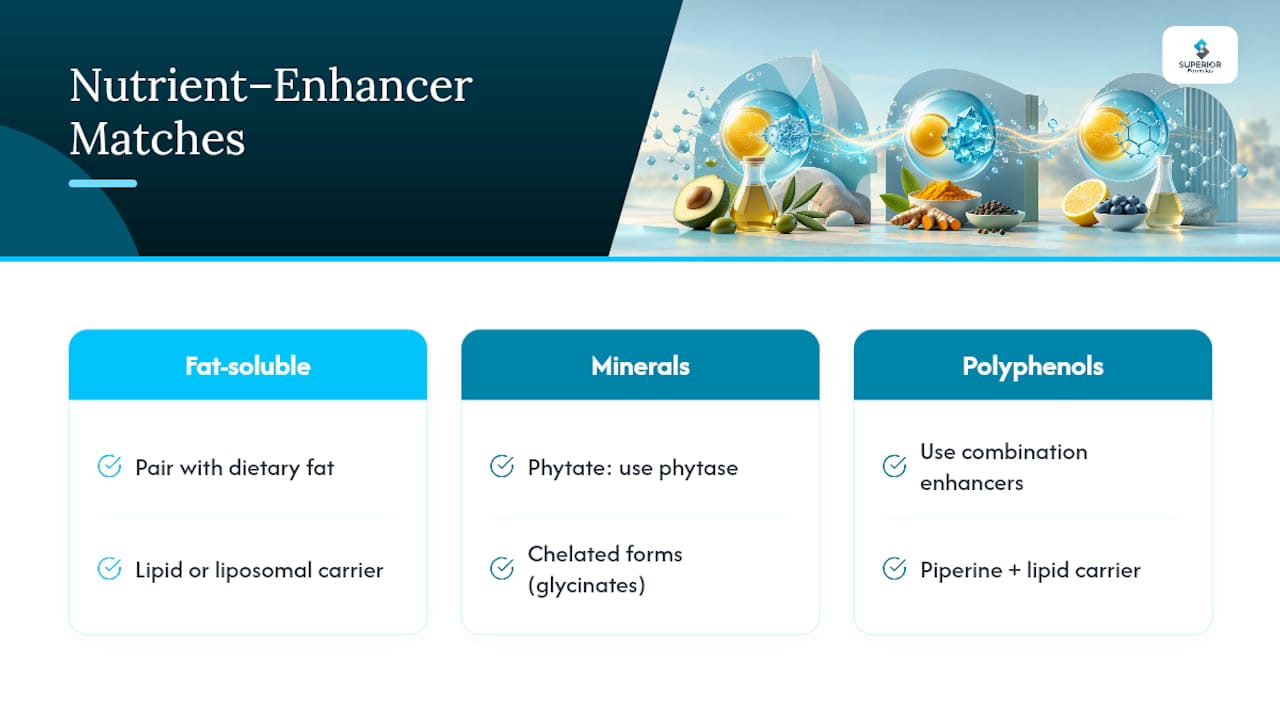
Fat-soluble vitamins and polyphenols (vitamin D, vitamin E, curcumin, resveratrol) absorb best when paired with dietary fat or delivered inside a lipid-based or liposomal formulation. Taking these on an empty stomach without any fat source is one of the most common reasons people don’t see expected results.
Water-soluble vitamins face a different challenge: stability rather than solubility. Folate is a good example. Standard folic acid must be converted through several enzymatic steps to become active, and a meaningful percentage of people carry gene variants that slow this conversion. Choosing methylfolate, the already-active vitamer, sidesteps that bottleneck entirely.
Minerals bound in plant matrices benefit most from phytase treatment or chelated mineral forms (like glycinates), especially for anyone eating a largely plant-based diet where phytic acid intake runs high.
Polyphenols like curcumin and resveratrol face the toughest combination of problems: poor solubility, rapid metabolism, and fast excretion all at once. This is why combination strategies, piperine plus a lipid carrier, for example, tend to outperform any single enhancer alone. If you’re building a longevity-focused supplement routine, the polyphenol intake guide covers how formulation choice interacts with realistic dosing.
Safety, Interactions, and Dosing: What to Check Before You Combine Anything
Bioavailability enhancers that work by inhibiting metabolic enzymes carry a real tradeoff: the same mechanism that boosts a nutrient’s absorption can also boost a medication’s absorption, sometimes into unsafe territory. Piperine’s effect on CYP3A4 and P-gp is well documented enough that clinicians treat it as a genuine interaction risk, not a theoretical one.
- Know which drug classes are most exposed. Compounds metabolized heavily through CYP3A4, including many statins, calcium channel blockers, and some anticoagulants, are the ones most likely to see altered blood levels when combined with piperine or other enzyme-inhibiting botanicals.
- Account for higher-risk populations separately. Pregnant women, children, older adults on multiple medications, and anyone managing chronic disease with several prescriptions all need a lower threshold for caution before adding an absorption enhancer.
- Disclose every supplement to your prescriber, including “natural” ones. Piperine, glycyrrhizin, and quercetin are potent enough pharmacologically that they belong in the same conversation as prescription drugs.
- Avoid stacking multiple enhancers casually. Combining piperine with other P-gp or CYP inhibitors compounds the interaction risk without a clear added benefit.
- Start at a standard labeled dose and monitor, rather than assuming more enhancer means proportionally more benefit.
The goal of any enhancer strategy is optimized absorption within a safe therapeutic window, not the maximum possible absorption. Formulation approaches like liposomes or cyclodextrin complexation generally carry lower interaction risk than enzyme or transporter inhibitors, because they change how a compound is delivered rather than how your body metabolizes drugs. For anyone on multiple medications, that distinction is worth discussing with a pharmacist before choosing between the two approaches.
How to Choose a Bioavailability-Enhanced Supplement
Reading a supplement label critically takes about thirty seconds once you know what to look for. Trustworthy products name their enhancer technology specifically: “BioPerine® (95% piperine)” rather than “black pepper extract,” or “liposomal formulation with phosphatidylcholine” rather than “advanced absorption technology.”
- Check for a standardized, named extract with a specific percentage, not a proprietary blend hiding actual doses
- Look for third-party testing disclosure, since that’s the clearest signal a company stands behind its label claims
- Ask (or check the company’s site) whether the manufacturer has published stability data for the specific carrier used
- Confirm the product suggests timing guidance, since fat-soluble actives need to be taken with a meal containing some fat to work as intended
Pro Tip: If a curcumin product doesn’t mention piperine, a lipid carrier, or another named absorption technology anywhere on the label, assume you’re getting the raw compound’s typically poor bioavailability, regardless of how high the milligram count looks.
Before combining any new enhancer with a prescription medication, a quick conversation with a pharmacist or prescriber costs nothing and can catch an interaction before it becomes a problem. That step matters more with piperine-containing products than with most other supplement ingredients, given its established effect on drug metabolism. For a broader framework on evaluating supplement claims, the step-by-step supplement selection guide walks through the same evaluation logic in more depth.
The Evidence Behind This: What the Research Actually Supports
The strongest evidence in this space comes from a mix of source types: the Frontiers review’s synthesis of formulation strategies, the PMC herbal review’s mechanistic catalog of piperine, quercetin, and related compounds, and clinical and industry data specifically on BioPerine’s effect on curcumin absorption. Recent cycloamylose research adds a newer data point on complexation technology, though it remains early stage compared to piperine’s decades of use.
This company approaches formulation with a physician-formulated standpoint: ingredients selected for documented mechanisms, manufactured in GMP-certified facilities, and verified through third-party testing for purity and label accuracy. Those are the same criteria this article recommends you apply to any bioavailability-enhanced product, regardless of brand. For a deeper look at how evidence-based formulation decisions get made, the evidence-based formulations guide walks through the underlying framework.
Does Absorption Enhancement Wear Off With Long-Term Use?
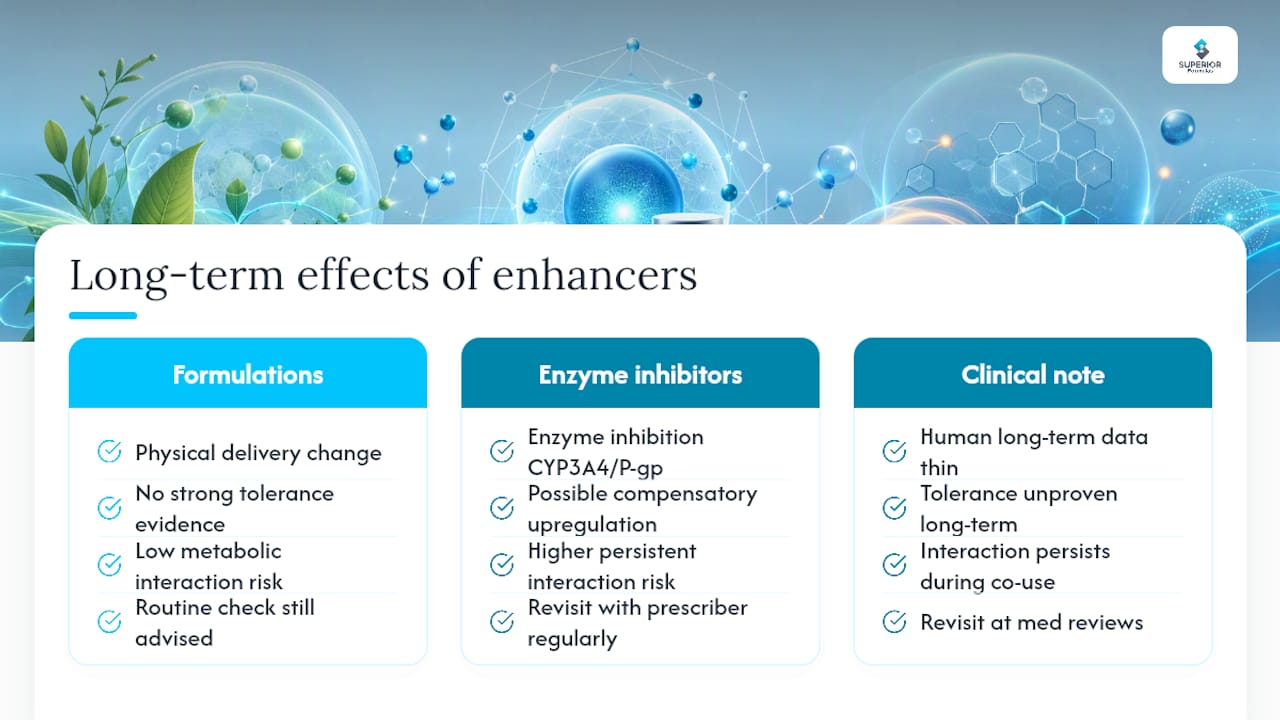
Chronic use of bioavailability enhancers raises a fair question: does your body adapt and blunt the effect over time? For formulation-based approaches like liposomes or cyclodextrin complexes, there’s no strong evidence of tolerance developing, since these methods change the physical delivery of a compound rather than triggering an adaptive biological response.
Enzyme-inhibiting botanicals are a different story, at least in theory. Chronic inhibition of CYP3A4 or P-gp could plausibly prompt some compensatory upregulation over extended periods, similar to patterns seen with certain pharmaceutical enzyme inhibitors. Human data specifically tracking piperine tolerance over months or years of continuous use remains thin, which is itself worth noting. Most piperine research covers single-dose or short-term co-administration rather than year-long use.
The more practical long-term concern isn’t diminishing returns; it’s sustained interaction risk. If you take a piperine-containing curcumin supplement daily for years alongside a CYP3A4-metabolized medication, that interaction potential doesn’t fade with time the way tolerance might. It persists for as long as both compounds are on board. This is one more reason periodic check-ins with a prescriber matter more for long-term enhancer users than for someone taking a plain vitamin with no metabolic interaction profile. Anyone managing a chronic condition with daily enhancer-containing supplements should treat that combination as a standing item to revisit at routine medication reviews, not a one-time decision made when the bottle was first purchased.
Are Bioavailability Enhancers Regulated Like Drugs?
In the United States, bioavailability enhancers sold as dietary ingredients fall under the same regulatory framework as other supplements: manufacturers are responsible for ensuring safety and truthful labeling, but ingredients like piperine, quercetin, and phytase don’t undergo the premarket approval process required for pharmaceuticals. This distinction matters because it puts more weight on the manufacturer’s own quality controls rather than a government pre-clearance step.
Labeling requirements do apply, though. A product claiming a specific enhancer must list it in the supplement facts panel with an accurate amount, and structure/function claims about absorption need to stay within permitted, non-disease-specific language. A supplement can say an ingredient “supports absorption” but can’t claim it treats or prevents a medical condition without crossing into drug-claim territory.
This regulatory gap is exactly why third-party testing and transparent sourcing matter so much when you’re evaluating an enhancer-containing product. Two products can carry an identical “BioPerine” claim on the label with meaningfully different actual piperine content, since verification isn’t mandated the way it would be for a prescription drug. Reading the transparency guide on supplement testing explains what third-party certification actually verifies, and what it doesn’t.
Innovation Has to Answer to Safety First
Formulation science has genuinely improved what supplements can accomplish. Cyclodextrin complexation and liposomal delivery represent real, measurable progress over the raw-powder-in-a-capsule era, and piperine’s effect on curcumin absorption is one of the better-documented wins in the entire natural products field.
But the instinct to chase maximal absorption misreads the goal. A compound that reaches circulation faster or in greater quantity isn’t automatically better if it also pushes a co-administered medication into an unpredictable range. The research consistently points toward optimization within a safe window, not brute-force maximization, and that distinction should guide product formulation as much as it guides how consumers combine supplements with their prescriptions.
Adoption should follow the evidence, not outpace it. Piperine has earned its place because human trial data backs it up. Newer carrier technologies deserve real interest but also patience, particularly where long-term safety data is still catching up to the formulation chemistry. Clinicians and formulators who want to discuss the mechanistic detail behind a specific ingredient pairing are always better served by that conversation than by a label claim alone.
— cristopher
Where Physician-Formulated Science Meets Practical Absorption
Choosing a bioavailability-enhanced supplement means trusting that the enhancer technology on the label is real, dosed accurately, and backed by more than a marketing claim. Superiorformulas builds its formulations around that exact standard: ingredients selected for documented mechanisms, manufactured in GMP-certified facilities, and verified through third-party testing rather than taken on faith.
That physician-formulated approach extends across their full line of longevity and cellular health products, each built on clinically studied polyphenols, adaptogens, and phytonutrients rather than proprietary blends that hide actual doses. If you want to see the formulation science and manufacturing standards behind a specific product before you buy, the Explore the Science page breaks down the research and quality controls ingredient by ingredient. It’s the next step for anyone ready to move from understanding bioavailability enhancers in theory to choosing a supplement built around them correctly.
This article is general information, not a substitute for advice from a qualified doctor. Consult a qualified healthcare professional about your own circumstances before acting on anything here.
Sources
- Micronutrient bioavailability: concepts, influencing factors, and strategies for improvement
- Bioavailability enhancers of herbal origin: An overview
- BioPerine® | Patented Black Pepper Extract | Manufacturer
- Cycloamylose and cyclic glucan inclusion complexes improve piperine solubility and stability (2025)
FAQ
What Enhances Bioavailability?
Standardized herbal compounds like piperine, lipid-based carriers such as liposomes, cyclodextrin or cycloamylose complexation, and enzymatic treatments like phytase for minerals are the main categories with documented enhancing effects.
What Two Supplements Should Never Be Taken Together?
There’s no single universal “never combine” pair, but piperine-containing supplements and CYP3A4-metabolized medications (many statins and calcium channel blockers among them) need caution together, since piperine can raise drug blood levels beyond intended ranges.
What Can Increase Bioavailability?
Pairing fat-soluble compounds with dietary fat, choosing standardized piperine extracts like BioPerine, and selecting liposomal or cyclodextrin-complexed formulations are the most evidence-backed ways to increase how much of a nutrient reaches circulation.
What Is Bioavailability in Supplements?
Bioavailability is the fraction of an ingested nutrient or compound that actually reaches systemic circulation intact, after surviving digestion, absorption across the gut wall, and first-pass metabolism in the liver.
Is Liposomal Vitamin C Better Than Regular Vitamin C?
Liposomal vitamin C is designed to survive digestion better than standard ascorbic acid by encasing it in a lipid shell, and early research supports improved uptake, though it typically costs more and standard vitamin C remains well absorbed in moderate doses.


