


Nutrition bioactives are naturally occurring food constituents, including phytochemicals, fibers, and peptides, that promote health effects beyond what essential vitamins and minerals provide. Unlike macronutrients or micronutrients, these compounds modulate oxidative stress, inflammation, and metabolic regulation at the cellular level. The FDA and bodies like the Institute for the Advancement of Food and Nutrition Sciences (IAFNS) have not established official daily intake recommendations for bioactives as of 2026. That gap makes understanding them both more important and more nuanced for anyone serious about longevity and cellular health.
What are nutrition bioactives and how do they work?
Bioactive compounds are naturally occurring food constituents like phytochemicals and fibers that provide health-promoting effects beyond basic nutrition. They are not essential for survival in the classical sense, but their absence from the diet is increasingly linked to accelerated aging, chronic inflammation, and metabolic dysfunction. Think of them as the body’s biochemical fine-tuners rather than its structural building blocks.
These compounds work through several distinct mechanisms:
- Antioxidant activity: Catechins and polyphenols activate antioxidant pathways, reducing oxidative damage to DNA and cell membranes. This directly supports cellular antioxidant defense and healthy aging.
- Anti-inflammatory signaling: Compounds like curcumin and omega-3 fatty acids suppress pro-inflammatory cytokines, lowering systemic inflammation linked to cardiovascular disease and metabolic syndrome.
- Metabolic pathway modulation: Beta-glucans reduce LDL cholesterol, and certain flavonoids activate the Nrf2 pathway, a master regulator of cellular resilience. These effects connect directly to longevity pathway activation.
- Gut microbiota interaction: Dietary bioactives shape gut microbiota composition, which then metabolizes these compounds into short-chain fatty acids and other beneficial metabolites that provide systemic benefits.
The gut microbiome connection is where things get genuinely surprising. Bioactive effectiveness depends on bidirectional interactions with gut microbiota rather than the compound alone. Two people eating identical amounts of resveratrol can experience completely different health outcomes based on their microbial profiles. This explains why clinical trials on standardized doses often produce inconsistent results across populations.
Pro Tip: Fermented foods like kimchi, kefir, and miso support the gut microbiome that processes bioactives. Eating them alongside polyphenol-rich foods may improve how well your body actually uses those compounds.
What are common types and food sources of nutritional bioactive compounds?
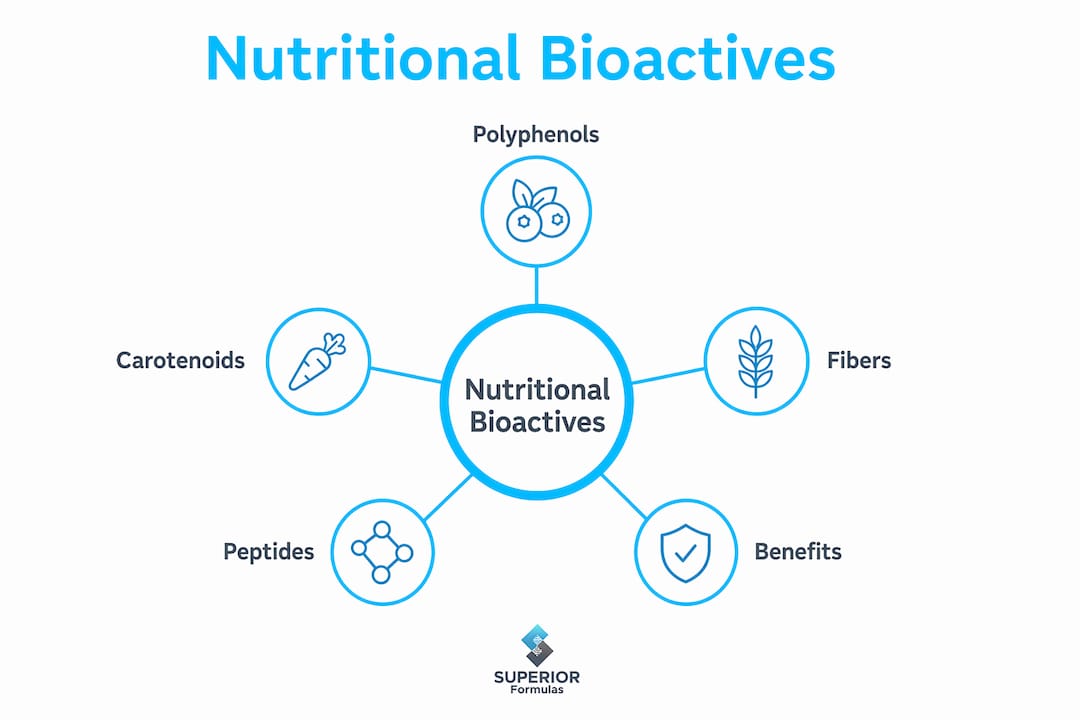
Nutritional bioactive compounds fall into several well-studied categories, each with distinct mechanisms and food sources. Knowing which foods deliver which compounds gives you a practical framework for building a bioactive-rich diet.
| Bioactive Class | Primary Food Sources | Key Health Effect |
|---|---|---|
| Polyphenols | Berries, red wine, green tea, dark chocolate | Antioxidant, anti-inflammatory |
| Carotenoids | Carrots, tomatoes, sweet potatoes, leafy greens | Cellular protection, eye health |
| Beta-glucans | Oats, barley, mushrooms | LDL cholesterol reduction |
| Catechins | Green tea, apples, cocoa | Antioxidant pathway activation |
| Organosulfur compounds | Garlic, onions, cruciferous vegetables | Detoxification, cardiovascular support |
| Omega-3 fatty acids | Fatty fish, flaxseed, walnuts | Anti-inflammatory, brain health |
| Probiotics | Yogurt, kefir, sauerkraut, kimchi | Gut microbiota support |
| Prebiotics | Chicory root, Jerusalem artichoke, leeks | Microbiome fuel, metabolite production |
Whole food matrices provide co-factors that enhance bioactive protection and absorption better than isolated supplements. The fiber, water content, and structural complexity of a whole blueberry, for example, creates a delivery environment that a blueberry extract capsule simply cannot replicate. Synergistic effects from food structure improve bioavailability in ways that are difficult to engineer into a pill.
Emerging research also points to agri-food by-products as promising bioactive sources. Grape pomace, olive mill waste, and citrus peels are rich in polyphenols and fibers, though they currently lack robust clinical evidence in humans. Sustainability drives much of this research, and functional foods fortified with these extracts are beginning to appear on the market. For now, whole fruits, vegetables, legumes, whole grains, fermented foods, and fatty fish remain the most clinically validated sources.
What challenges affect the effectiveness of dietary bioactives?
Understanding the benefits of bioactives is only half the picture. Several real-world factors determine whether the compounds you consume actually reach target tissues and produce measurable effects.
-
Bioavailability and bioaccessibility. Compounds abundant in food can be trapped within cell walls or degraded during digestion. Eating whole foods provides better pharmacokinetics than isolated supplements because the food matrix protects compounds through the digestive process.
-
Individual gut microbiome variability. Your personal microbiome profile largely determines your response to specific bioactives. Individual gut microbiota profiles explain why one person experiences clear cardiovascular benefits from daily green tea while another sees minimal change.
-
Lack of standardized dosing. No official intake recommendations exist for most bioactives. This creates real uncertainty when choosing supplements, since products vary widely in extract concentration, purity, and the form of the compound used.
-
Hormetic dose-response effects. Many bioactives follow a hormetic pattern. Low doses activate beneficial adaptive pathways; excessive doses may cause oxidative stress or pro-oxidant effects. Therapeutic windows require clinically validated dosing, not the megadose approach common in unregulated supplements.
-
Extract standardization challenges. Extract standardization remains a major industry challenge. Two products labeled “quercetin 500mg” can differ significantly in actual bioavailable content depending on extraction method, carrier, and formulation quality.
Pro Tip: When evaluating a bioactive supplement, look for products that specify the standardized extract percentage (e.g., “95% curcuminoids”) and are manufactured in GMP-certified facilities with third-party testing. Vague labeling is a red flag.
How can you incorporate bioactive nutrients safely and effectively?
Practical application matters more than theoretical knowledge. Here is how to build a bioactive-rich lifestyle that actually works.
- Prioritize dietary diversity. Eating a wide range of fruits, vegetables, whole grains, legumes, and fermented foods delivers overlapping classes of bioactives that work synergistically. Aim for color variety on your plate, since different pigments signal different phytochemical classes.
- Use functional foods strategically. Foods fortified with bioactives, such as oat-based products with added beta-glucans or probiotic-enriched yogurts, can fill gaps in a busy diet. They are not replacements for whole foods, but they are a practical bridge.
- Avoid megadosing supplements. The hormetic dose-response principle means more is not always better. Follow clinically validated dosing guidelines and consult a healthcare professional before adding high-dose bioactive supplements to your routine.
- Support your gut microbiome first. Since your microbiome determines how well you metabolize bioactives, gut health is the foundation. Include prebiotic foods like chicory, leeks, and garlic alongside probiotic sources to maintain a diverse microbial community.
- Evaluate supplement quality rigorously. Look for science-driven supplementation standards: GMP certification, third-party testing, standardized extracts, and transparent ingredient sourcing. Quality varies enormously across the supplement market.
- Consider personalized nutrition approaches. Microbiome profiling and genetic testing are becoming accessible tools for understanding your individual response to specific bioactives. This kind of personalized data can help you prioritize which compounds are worth supplementing versus which you get adequately from food.
The goal is not to chase every trending bioactive compound. The goal is to build a consistent, evidence-based dietary pattern that delivers a broad spectrum of these compounds daily, supported by targeted supplementation where genuine gaps exist.
Key Takeaways
Nutritional bioactive compounds deliver measurable health benefits through antioxidant, anti-inflammatory, and metabolic mechanisms, but their effectiveness depends on bioavailability, gut microbiome health, and clinically validated dosing.
| Point | Details |
|---|---|
| Definition of bioactives | Food compounds beyond essential nutrients that modulate oxidative stress, inflammation, and metabolism. |
| Gut microbiome is central | Your microbiome profile determines how well you absorb and benefit from specific bioactives. |
| Whole foods outperform isolates | Food matrix co-factors improve bioavailability better than most isolated supplement forms. |
| Dosing requires clinical guidance | Hormetic effects mean megadosing bioactive supplements can cause harm rather than benefit. |
| Quality standards matter | Choose GMP-certified, third-party-tested supplements with standardized extract percentages. |
What I’ve learned about bioactives that most articles get wrong
The conversation around bioactives tends to split into two camps: breathless enthusiasm for the latest superfood, and academic skepticism that dismisses anything not proven in a randomized controlled trial. Both miss the point.
What clinical experience and research consistently show is that bioactives are not magic bullets. They are modulators. They shift the body’s baseline toward resilience when delivered consistently, in the right forms, and in the context of a healthy gut environment. The person eating a diverse, whole-food diet and supporting their microbiome will get far more from a polyphenol supplement than someone with dysbiosis and a processed-food baseline.
The part that genuinely surprises people is the hormetic dose-response reality. The supplement industry has conditioned consumers to believe that higher doses equal stronger effects. With bioactives, that logic breaks down. Resveratrol at physiological doses activates SIRT1 and supports cellular repair. At megadoses, it can interfere with the same pathways it is supposed to support. This is not a fringe finding. It is consistent across multiple compound classes and multiple research groups.
My practical recommendation is to treat whole foods as your primary bioactive delivery system and supplements as precision tools for specific, identified gaps. The role of polyphenols in longevity is well-documented, but that documentation is built on dietary patterns, not supplement bottles. Use the science to guide your plate first, then your supplement stack second.
— cristopher
Superiorformulas and science-backed bioactive support
Superiorformulas was founded by a physician-scientist with a specific goal: to create supplements that reflect how bioactives actually work in the body, not how they are marketed.
Every Superiorformulas formulation uses clinically studied ingredients, standardized extracts, and GMP-certified manufacturing with third-party testing for purity. The product line targets longevity pathways including Nrf2 activation, antioxidant support, and cellular resilience, using polyphenols, adaptogens, and phytonutrients selected for their scientific backing. For readers ready to move from understanding bioactives to applying that knowledge, the Superiorformulas supplement catalog offers physician-formulated options built on the same evidence base covered here. Clean formulations, transparent sourcing, and no unnecessary fillers.
FAQ
What are nutrition bioactives in simple terms?
Nutrition bioactives are naturally occurring compounds in food, such as polyphenols, carotenoids, and beta-glucans, that promote health beyond what basic vitamins and minerals provide. They work by modulating oxidative stress, inflammation, and metabolic pathways at the cellular level.
Are bioactives the same as nutrients?
Bioactives are not classified as essential nutrients because a deficiency does not cause a defined disease state. They are food components that influence health and disease risk, but no official daily intake recommendations currently exist for most of them.
Why do bioactives work differently for different people?
Individual gut microbiota profiles largely determine personal response to specific bioactives because microbial metabolism converts these compounds into their active forms. This variability explains why clinical trials on standardized doses often produce inconsistent results across different populations.
Is it better to get bioactives from food or supplements?
Whole food matrices provide better bioavailability than isolated supplements because food structure protects compounds during digestion and delivers co-factors that enhance absorption. Supplements serve a useful role for targeted gaps but should not replace a diverse, whole-food diet.
Can you take too many bioactive supplements?
Many bioactives follow a hormetic dose-response pattern, where low doses activate beneficial pathways and excessive doses may trigger pro-oxidant or stress effects. Clinically validated dosing is required, and megadosing without professional guidance carries real risk.


