


Longevity trends in 2026 are defined by a decisive shift from extending lifespan to maximizing healthspan, the number of years lived with full physical and cognitive function. This distinction is no longer philosophical. It is now the organizing principle behind the most significant scientific breakthroughs, consumer health movements, and clinical trials of the year. Healthspan over lifespan has become the new frontier, with molecular biology, AI-powered biosensors, and evidence-based therapeutics converging to make precision aging science accessible. For health-conscious individuals and researchers, understanding these shifts is the difference between following trends and acting on them.
What are the major scientific breakthroughs shaping longevity trends in 2026?
The most consequential development in 2026 longevity science is the arrival of universal transcriptomic aging clocks. These tools measure gene expression patterns across tissues and species to predict biological age and mortality risk with a level of precision that earlier DNA methylation clocks could not achieve. The TACO (Transcriptomic Age Calculator Online) platform, developed at the Gladyshev Lab, integrates 4,539 rodent and 6,626 primate samples to build modular clocks linked to disease states and longevity interventions. This means researchers can now test whether a given compound or lifestyle intervention actually slows biological aging at the cellular level, not just in self-reported outcomes.
Genetic and molecular research has added another layer of specificity. A 2026 study published in npj Aging identified 30 genes, 11 splicing events, and 39 metabolites associated with longevity and epigenetic aging. Drug targets like CASP8, PSRC1, and SORT emerged from this analysis, giving pharmaceutical and nutraceutical researchers a clearer map of where molecular interventions can have the greatest impact. The integration of genome-wide association studies (GWAS) with multi-layer molecular data is what makes this possible, connecting genetic variation directly to aging phenotypes.

On the therapeutic side, UT Health San Antonio launched one of the most closely watched rapamycin clinical trials in aging research. The multi-phase, randomized, placebo-controlled trial enrolls adults aged 65 to 90 to determine optimal dosing, safety, and biological effects on aging markers. Rapamycin inhibits the mTOR pathway, which regulates cellular growth and metabolism, and animal studies have consistently shown healthspan benefits. Moving this into rigorous human trials marks a shift from speculative off-label use to regulatory-grade evidence generation.
Technology is closing the monitoring gap. A University of Chicago team developed a stretchable AI patch that performs on-device computation with 99.6% accuracy for cardiac wavefront detection and 83.5% accuracy for heart attack risk assessment, all without server reliance. On-device AI inference eliminates latency, which is critical for real-time physiological monitoring in aging intervention tracking.
- Transcriptomic clocks (TACO/TaAge): Predict biological age across tissues and species using RNA-seq data
- Molecular longevity markers: 30 genes and 39 metabolites now linked to aging and drug targets
- Rapamycin trials: First large-scale, randomized human trials for healthspan extension
- Edge AI biosensors: Real-time cardiac and metabolic monitoring without cloud dependency
Pro Tip: If you are evaluating a longevity intervention, check whether the supporting research uses transcriptomic or epigenetic clock endpoints. These surrogate biomarkers are now the gold standard for measuring biological age change in clinical trials.
How is the longevity market evolving from lifespan to healthspan?
Consumer attitudes toward aging have shifted measurably. The Mintel US Longevity and Healthy Ageing Report 2026 shows that 73% of adults aged 55 and older are already taking active steps to manage their health. That figure represents a market that has moved past awareness into behavior. The more significant finding is that women and younger generations are emerging as the next major audience for longevity products, a demographic that has historically been underserved by messaging focused on older male biohackers.
The language of longevity is also changing. Consumers no longer respond primarily to promises of living to 120. They respond to functional vitality, cognitive sharpness, physical independence, and sustained energy. This reframing matters for product development and communication strategy. Brands that lead with “add years to your life” are losing ground to those that lead with “stay sharp, stay mobile, stay yourself.”
| Audience segment | Primary longevity priority | Communication approach |
|---|---|---|
| Adults 55+ | Physical independence and mobility | Evidence-based, reassuring, practical |
| Women 35 to 55 | Cognitive health and hormonal balance | Personalized, science-forward, accessible |
| Younger adults (25 to 40) | Prevention and performance optimization | Data-driven, habit-focused, aspirational |
| Researchers and clinicians | Biomarker validation and trial endpoints | Mechanistic, peer-reviewed, precise |
One of the most important market dynamics in 2026 is the backlash against “longevity washing,” a term describing products that use longevity branding without credible scientific backing. Consumers are becoming more sophisticated, and skepticism is rising. Brands that cannot point to specific molecular mechanisms, validated ingredients, or clinical trial data are losing credibility with the audiences that matter most.
- The shift from elite biohacking to everyday achievable habits is expanding the addressable market significantly
- Gender-specific messaging is becoming a competitive differentiator, not an afterthought
- Credibility signals such as GMP certification, third-party testing, and peer-reviewed citations are now baseline expectations
Pro Tip: When evaluating a longevity product, look for specific ingredient citations tied to published research, not just general claims about “cellular health.” The difference between a credible formulation and a marketing exercise is traceable evidence.
What distinguishes lifespan from healthspan, and why does it matter?
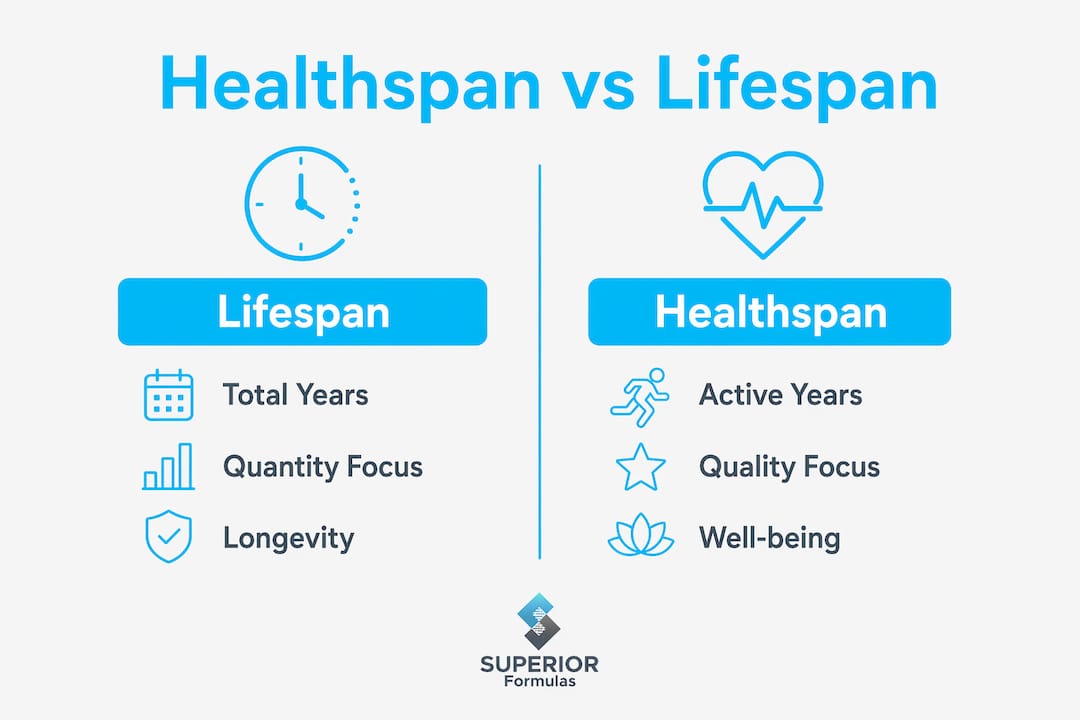
Lifespan is defined as the total number of years a person lives. Healthspan is defined as the number of those years spent with full physical function, cognitive clarity, and independence. The distinction is not semantic. A person who lives to 90 but spends the last 20 years managing chronic disease, cognitive decline, and physical dependency has a very different aging experience than one who maintains vitality into their mid-80s.
The scientific community has largely converged on healthspan as the more meaningful target, for both quality-of-life and public health reasons. Extending lifespan without extending healthspan increases the burden of age-related disease on individuals, families, and healthcare systems. The rapamycin trials at UT Health San Antonio are specifically designed to measure healthspan markers, including metabolic function, immune resilience, and physical performance, rather than mortality alone.
| Dimension | Lifespan focus | Healthspan focus |
|---|---|---|
| Primary metric | Total years lived | Years lived with full function |
| Clinical endpoints | Mortality, survival rates | Biomarkers, functional assessments |
| Intervention targets | Disease treatment | Prevention and cellular maintenance |
| Consumer relevance | Abstract, long-term | Immediate, quality-of-life driven |
| Research tools | Epidemiology, survival studies | Transcriptomic clocks, molecular markers |
For consumers, this distinction shapes which interventions are worth prioritizing. Compounds that improve metabolic flexibility, reduce chronic inflammation, and support cellular repair directly address healthspan. Polyphenols, adaptogens, senolytics, and Nrf2-activating compounds all operate through pathways that protect cellular function rather than simply extending biological time. Understanding longevity nutrients through this lens changes how you evaluate what belongs in your daily protocol.
The healthspan framework also has regulatory implications. Because “aging” is not classified as a disease by the FDA, clinical trials must target specific age-related conditions such as sarcopenia, metabolic syndrome, or cognitive decline. Validated biomarkers, including transcriptomic and epigenetic clocks, are now being used as surrogate endpoints to satisfy regulatory requirements while still measuring the broader aging process.
What practical tools and interventions should you watch in 2026?
The most immediately applicable development for health-conscious individuals is the arrival of wearable edge AI biosensors. The stretchable AI patch from the University of Chicago processes physiological data on-device, achieving 99.6% cardiac wavefront accuracy without server dependency. For aging intervention tracking, this means continuous, real-time data on cardiovascular and metabolic markers without the privacy and latency issues of cloud-based systems. Consumer-grade versions of this technology are expected to reach the market within the next 18 to 24 months.
For researchers and clinicians, the following developments represent the most significant near-term opportunities:
- Transcriptomic clock endpoints: Use TACO or TaAge platforms to evaluate whether interventions produce measurable biological age reduction across tissues, not just symptomatic improvement.
- Rapamycin trial data: Monitor published results from the UT Health San Antonio trials for dosing and safety data that will inform clinical practice and product formulation.
- Molecular longevity targets: The GWAS-derived drug targets including CASP8 and PSRC1 represent the next generation of precision longevity therapeutics worth tracking in the pipeline.
- Senolytic compounds: Senolytics clear senescent cells that accumulate with age and drive chronic inflammation. Clinical trials with compounds like dasatinib and quercetin are generating early human data.
- Validated supplement protocols: Polyphenols, NAD+ precursors, and Nrf2 activators are the most evidence-supported supplement categories for healthspan. Knowing how to identify research-backed supplements is the practical skill that separates informed choices from marketing-driven ones.
Personalization is the direction the entire field is moving. Molecular clocks and biomarker panels allow individuals to measure their biological age, track the impact of interventions, and adjust protocols based on real data rather than population averages. This is not yet standard clinical practice, but the tools to do it exist today for those willing to seek them out.
Pro Tip: If you are building a longevity protocol in 2026, prioritize interventions with at least one of the following: a randomized controlled trial in humans, a mechanistic study using transcriptomic or epigenetic clock endpoints, or a validated molecular target from GWAS research. Anything short of that is hypothesis, not evidence.
Key takeaways
Longevity in 2026 is defined by the healthspan imperative: extending the years you live well, supported by transcriptomic clocks, molecular targets, and evidence-based therapeutics.
| Point | Details |
|---|---|
| Healthspan over lifespan | Quality of functional years now drives research priorities, consumer demand, and clinical trial design. |
| Transcriptomic clocks as gold standard | TACO and TaAge tools measure biological age across tissues, enabling precise intervention evaluation. |
| Rapamycin enters rigorous trials | UT Health San Antonio’s randomized trials mark the shift from off-label use to regulatory-grade evidence. |
| Edge AI biosensors arrive | Stretchable AI patches deliver real-time physiological monitoring with 99.6% cardiac accuracy on-device. |
| Credibility is the market differentiator | Consumers and researchers alike now require traceable molecular evidence, not just longevity branding. |
Why the healthspan shift is the most important story in aging science right now
I have followed longevity research for over a decade, and the 2026 moment feels genuinely different from previous cycles of hype. What changed is not the ambition of the science. It is the quality of the tools. Transcriptomic clocks give researchers a way to measure biological aging that is interpretable, reproducible, and tied to actual cellular function. That was not true five years ago, when most aging biomarkers were either too noisy or too narrow to be useful as clinical endpoints.
The rapamycin trials represent something I did not expect to see this soon: a serious, well-designed human trial for a compound that has been discussed in longevity circles for years but never subjected to rigorous dose-finding in healthy older adults. The fact that UT Health San Antonio built a multi-phase, randomized, placebo-controlled design signals that the field has learned to speak the language of regulatory science. That matters enormously for what comes next.
What I find most encouraging is the democratization angle. The evidence-based supplements conversation has moved from elite biohacking forums to mainstream consumer health. The Mintel data showing 73% of adults 55 and older taking active health steps confirms that the audience for credible, science-backed longevity products is large and growing. The risk is that this audience gets flooded with low-quality products riding the trend. The opportunity is that brands and researchers who prioritize molecular evidence and transparent formulation will earn lasting trust.
My honest concern is the gap between what the science can currently deliver and what the market is promising. Senolytics, rapamycin, and transcriptomic monitoring are real and promising. But they are not yet ready for unsupervised consumer use. The most responsible path forward is rigorous evaluation, validated biomarkers, and honest communication about what is proven versus what is plausible.
— cristopher
How Superiorformulas approaches the science of healthy aging
Superiorformulas was built on the premise that the gap between peer-reviewed longevity science and consumer supplements should not exist. Every formulation in the Superiorformulas line is developed by a physician-scientist with direct reference to molecular mechanisms, clinical trial data, and validated ingredient research. That means Nrf2-activating compounds, polyphenols with documented bioavailability, and adaptogens selected for their mechanistic evidence, not their marketing appeal.
If the science covered in this article, from transcriptomic clocks to healthspan-focused therapeutics, reflects how you think about your own health, the next step is understanding exactly what goes into a formulation designed to support cellular resilience and healthy aging. Explore the science behind Superiorformulas and see how physician-formulated precision translates into what you take every day.
FAQ
What is the difference between lifespan and healthspan?
Lifespan is the total number of years lived. Healthspan is the number of those years spent with full physical function, cognitive clarity, and independence. Longevity research in 2026 prioritizes healthspan because extending life without preserving function increases disease burden rather than quality of life.
What are transcriptomic aging clocks?
Transcriptomic aging clocks measure gene expression patterns across tissues to predict biological age and mortality risk. Tools like TACO integrate thousands of mammalian samples to produce modular aging clocks that researchers use to evaluate whether interventions actually slow cellular aging.
Is rapamycin safe for healthy aging?
Rapamycin is currently under investigation in large-scale human trials at UT Health San Antonio, enrolling adults aged 65 to 90 in a randomized, placebo-controlled design. Safety and optimal dosing data are not yet finalized, so clinical use outside of supervised trials is premature.
How can I evaluate a longevity supplement’s credibility?
Look for formulations that cite specific molecular mechanisms, reference peer-reviewed clinical studies, and are manufactured in GMP-certified facilities with third-party testing. Generic claims about “cellular health” without traceable ingredient evidence are a reliable signal of insufficient scientific backing.
What healthy aging trends in 2026 are most relevant for everyday consumers?
The most accessible trends are the shift toward functional vitality messaging, the rise of validated supplement categories like polyphenols and NAD+ precursors, and the growing availability of wearable biosensors for real-time health monitoring. Each of these gives health-conscious individuals concrete tools to support healthspan without waiting for clinical-stage therapeutics.
Among the formulations built around these 2026 longevity trends is our Formula 1 — LONGEVITY Daily Nrf2 Activate+, which was designed with exactly this clinical rationale in mind. Explore the science behind the formulation to see how it applies to your own routine.
Recommended
- The Role of Nutrition in Longevity After 35 | SUPERIOR Formulas
- Longevity Nutrients: Science-Backed Choices for Cellular Health - SUPERIOR Formulas
- How Dietary Supplements Support Longevity and Cellular Health - SUPERIOR Formulas
- Examples of Healthy Aging Nutrients for Adults 35+ | SUPERIOR Formulas


