


Alpha-lipoic acid is an antioxidant and metabolic modulator, and the clearest, best-supported clinical benefit is easing diabetic neuropathy symptoms. Oral doses between 600 mg and 1,800 mg per day have shown measurable improvement in nerve pain and microcirculation in multiple randomized trials. Other frequently cited advantages, like better insulin sensitivity, general antioxidant support, and neuroprotection, have real but thinner evidence behind them. Here’s the honest breakdown before you decide whether ALA belongs in your routine.
- Diabetic neuropathy: strong evidence. Multiple randomized trials and meta-analyses back symptom relief and improved microcirculation at 600 to 1,800 mg per day.
- Insulin sensitivity and metabolic markers: moderate evidence. Several clinical studies show favorable shifts, but results vary by population and study design.
- Neuroprotection and cognitive support: preliminary evidence. Mechanistic and small-cohort data are promising, though large human trials are still missing.
- Antioxidant support broadly: strong mechanistic evidence, moderate clinical translation. ALA’s chemistry explains why it helps, even where outcome data are still catching up.
If you’re managing blood sugar or nerve-related symptoms tied to diabetes, ALA is the group most likely to see a real difference. If you’re on insulin or any glucose-lowering medication, talk to your prescriber before starting: ALA can amplify blood sugar drops.
Key Takeaways
ALA’s strongest, best-documented benefit is symptom relief for diabetic neuropathy at 600 to 1,800 mg per day, with other metabolic and antioxidant benefits showing moderate to preliminary support.
| Point | Details |
|---|---|
| Strongest evidence | Diabetic neuropathy improvement is backed by multiple RCTs at 600–1,800 mg/day oral dosing. |
| Moderate evidence | Insulin sensitivity and metabolic markers show favorable but inconsistent results across studies. |
| Weakest claims | Weight loss and lipid effects have small, inconsistent supporting data despite common marketing claims. |
| Safety priority | Anyone on insulin or glucose-lowering medication needs blood sugar monitoring before adding ALA. |
| Formulation matters | Stabilized R-ALA offers better absorption than standard racemic ALA for long-term cellular health use. |
| Where to start | Superiorformulas offers physician-formulated, third-party tested options for readers seeking evidence-based ALA sourcing. |
Table of Contents
- What Are the Real ALA Benefits, and Why Do They Happen?
- Which Health Conditions Does ALA Actually Help?
- How Much ALA Should You Take, and Which Form Works Best?
- Is ALA Safe, and What Interactions Should You Watch For?
- How Do You Actually Use ALA Well?
- How Strong Is the Evidence, and What’s Still Unknown?
- What Should You Look for in a Quality ALA Supplement?
- How Should ALA Fit Into a Long-Term Wellness Plan?
- Get Physician-Formulated ALA Without the Guesswork on Sourcing
- Where Can You Read More on ALA Research?
- Frequently Asked Questions About ALA Benefits
- Sources
What Are the Real ALA Benefits, and Why Do They Happen?
ALA’s benefits trace back to one unusual biochemical trick: it and its reduced form, dihydrolipoic acid (DHLA), work as a matched antioxidant pair that operates in both watery and fatty environments. Most antioxidants are one or the other. Vitamin C works in water. Vitamin E works in fat. ALA and DHLA move between both, which is part of why researchers describe it as a “universal antioxidant” rather than a niche one.
This amphiphilic quality (soluble in water and lipids alike) lets ALA patrol places other antioxidants can’t reach easily, including nerve tissue protected by the blood-brain barrier.
Here’s what that translates to at the cellular level:
- Scavenges reactive oxygen species directly, neutralizing the free radicals that damage cell membranes and DNA.
- Regenerates other antioxidants, including glutathione, vitamin C, and vitamin E, essentially recharging your body’s existing defense systems instead of just adding a new one.
- Chelates heavy metals, binding to metals like mercury and lead so they can be cleared rather than accumulate in tissue.
- Supports mitochondrial enzyme function, acting as a cofactor in the pyruvate dehydrogenase complex, which matters for how efficiently cells convert food into usable energy.
- Crosses the blood-brain barrier, giving it access to nervous system tissue that many supplements never reach.
These mechanisms aren’t theoretical window dressing. They’re the biochemical explanation for why ALA shows up so consistently in neuroprotective and metabolic research.
ALA’s dual solubility means it can regenerate glutathione inside cell membranes while simultaneously mopping up free radicals in the surrounding fluid, a combination that helps explain both its nerve-protective effects and its role in mitochondrial energy metabolism.
That mitochondrial connection is worth sitting with for a second. If you’ve read about mitochondria and longevity, you already know that energy-producing cellular machinery tends to degrade with age. ALA doesn’t reverse that clock, but it does support the enzymatic machinery that keeps mitochondria functioning under oxidative stress.
Which Health Conditions Does ALA Actually Help?
Evidence for ALA isn’t uniform across the claims you’ll see on supplement labels. Some benefits rest on a stack of randomized trials. Others rest on a handful of small studies and a reasonable biological theory. Here’s the condition-by-condition reality.
Diabetic neuropathy: strong evidence. This is where ALA has the deepest research base. Oral trials using 600 to 1,800 mg per day report measurable reductions in burning, tingling, and numbness, along with improved microcirculation likely tied to nitric-oxide-mediated vasodilation, according to the PMC review of clinical trials. This benefit shows up most reliably in people with type 2 diabetes who’ve had symptomatic neuropathy for a defined period, not necessarily in early or asymptomatic nerve damage.
This is a real signal, not a settled one.
Neuroprotection and cognitive function: preliminary evidence. Small clinical cohorts and a substantial body of preclinical work point toward benefit, largely because of ALA’s ability to cross into brain tissue and blunt oxidative damage there, per mechanistic reviews. Don’t expect a cognitive enhancer here. Expect a plausible protective agent that needs more human data.
Cardiovascular endpoints: mixed, limited evidence. Some monograph-level summaries note modest effects on markers related to vascular function, but head-to-head cardiovascular outcome trials are sparse, according to the Drugs.
Weight and lipid management: weak, inconsistent evidence. This is one of the most overstated ALA benefits online. Patient-facing reviews are blunt about it: the evidence for weight loss is small and inconsistent. If someone is selling you ALA as a fat-loss supplement, they’re leaning on hope more than data.
Liver health: preliminary evidence. Institutional resources list liver disease among ALA’s potential applications, largely tied to its antioxidant and metal-chelating properties, per the Johns Hopkins Health Library. Human outcome trials here remain limited.
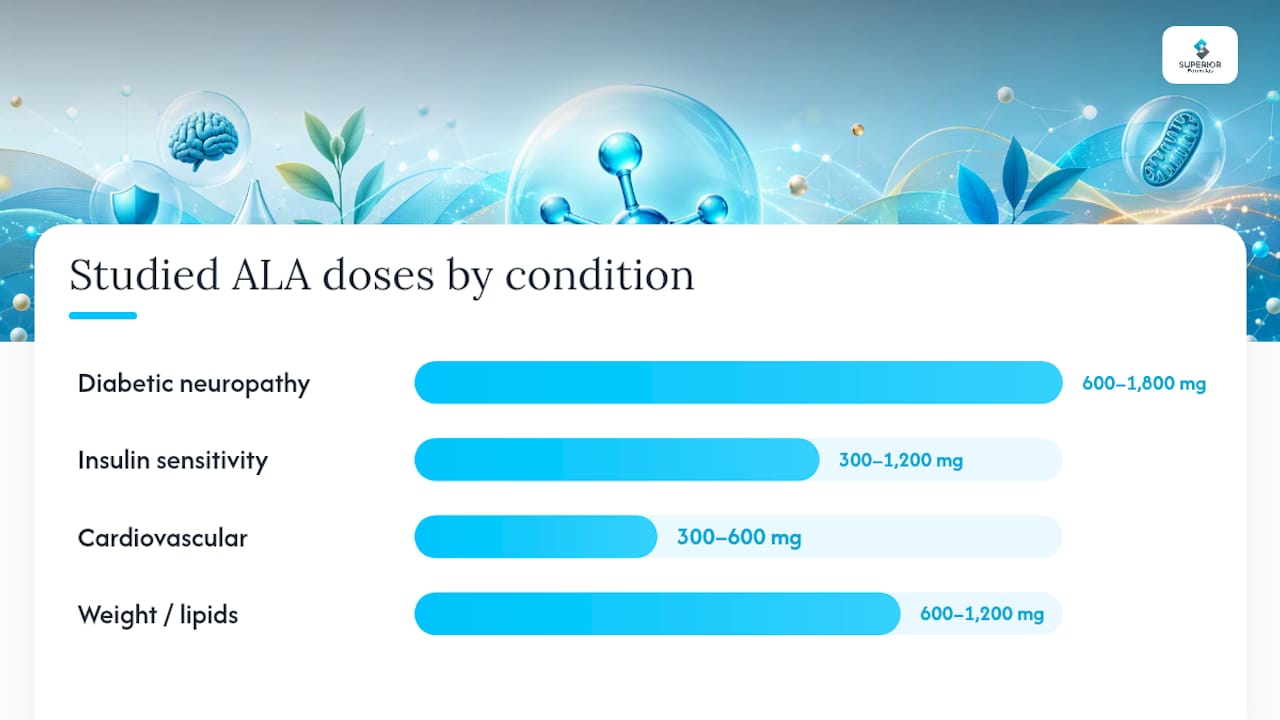
| Condition | Typical Studied Dose | Key Outcomes Measured | Evidence Strength |
|---|---|---|---|
| Diabetic neuropathy | 600–1,800 mg/day, oral | Nerve pain scores, microcirculation | Strong |
| Insulin sensitivity/metabolic | 300–1,200 mg/day | Insulin resistance markers | Moderate |
| Neuroprotection/cognition | Varies (preclinical to small trials) | Oxidative stress markers, cognitive scores | Preliminary |
| Cardiovascular | 300–600 mg/day | Vascular function markers | Preliminary to mixed |
| Weight/lipids | 600–1,200 mg/day | Body weight, lipid panels | Weak/inconsistent |
| Liver health | Not standardized | Liver enzyme markers | Preliminary |
How Much ALA Should You Take, and Which Form Works Best?
The most heavily studied oral range runs over a broad span per day, but the dose with the best track record for neuropathy sits around a moderate clinical dose daily, according to StatPearls’ clinical summary. Higher doses appear in some trials, but 600 mg represents the sweet spot where benefit and tolerability tend to line up.
| Dose Range | Typical Duration | Common Use Case | Notable Side Effects |
|---|---|---|---|
| 300 mg/day | 4–12 weeks | Starting/titration dose | Minimal |
| 600 mg/day | 8–12 weeks | Diabetic neuropathy (standard) | Occasional mild GI upset |
| 1,200–1,800 mg/day | Studied short to mid-term | Higher-intensity neuropathy protocols | More frequent GI side effects |
| Up to 1,800 mg/day | Limited studies | Research settings | Higher risk of nausea, cramping |
Formulation matters just as much as dose. ALA occurs as a racemic mixture (equal parts R and S enantiomers) in most standard supplements, but the R-ALA form is the one your body actually produces naturally. Some practitioners prefer stabilized sodium R-ALA (Na-RALA) or purified R-ALA formulations for longevity-focused use, since these forms tend to have better stability and absorption than standard racemic mixtures.
Oral and intravenous ALA aren’t interchangeable. IV administration produces higher bioavailability and faster therapeutic response in some clinical settings, but it’s used almost exclusively in supervised medical protocols. Daily oral dosing remains the practical, real-world standard for anyone managing long-term antioxidant or metabolic support, per a review of therapeutic applications spanning 1998 to 2024.
- Start low (around 300 mg) and increase gradually rather than jumping straight to 1,200 mg.
- Split higher doses across two intakes if you notice stomach upset at a single larger dose.
- Reassess after 8 to 12 weeks. Neuropathy studies typically ran this long before showing meaningful symptom change.
Pro Tip: Taking ALA on an empty stomach, at least 30 minutes before eating or two hours after a meal, tends to improve absorption compared with taking it alongside food. If it upsets your stomach that way, taking it with a small amount of food is a reasonable trade-off for consistency.
Is ALA Safe, and What Interactions Should You Watch For?
ALA is generally well tolerated, especially at doses of 600 mg per day or below, but it can cause gastrointestinal discomfort and, more importantly, it can lower blood sugar. That second point matters most if you’re already on medication that does the same thing.
Who should be cautious or avoid ALA altogether:
- Pregnant or breastfeeding individuals, since safety data in these groups is too limited to draw firm conclusions.
- People on insulin or oral hypoglycemic medications, because combining them with ALA raises the risk of hypoglycemia.
- Anyone with thyroid conditions, since ALA may interfere with thyroid hormone levels in some reported cases.
- People with autoimmune conditions, where evidence on ALA’s immune-modulating effects is mixed and not well established.
- Children, given the lack of pediatric safety data outside isolated case reports.
Drug interaction watch list: if you take metformin, sulfonylureas, or insulin, ALA supplementation calls for closer blood glucose monitoring, ideally in consultation with the clinician managing your diabetes care, according to patient guidance from the University of Rochester Medical Center. Chemotherapy drugs that rely on oxidative mechanisms may also interact with ALA’s antioxidant activity, so oncology patients should flag any supplement use with their care team.
Doses at or below 600 mg per day are associated with minimal side effects beyond occasional mild nausea. At 1,200 mg and above, gastrointestinal complaints become noticeably more common, and isolated toxicity cases exist at very high intakes, including a documented adolescent ingestion incident near 1,800 mg reported in clinical toxicology literature. That case involved an acute overdose scenario, not routine supplementation, but it’s a useful reminder that “natural” doesn’t mean unlimited.
If you notice persistent stomach upset, unusual fatigue, or symptoms of low blood sugar (shakiness, sweating, confusion) after starting ALA, stop and check in with a healthcare provider before continuing.
How Do You Actually Use ALA Well?
Getting real benefit from ALA is less about finding the “best” product and more about being consistent and realistic about what it can and can’t do.
- Start at 300 mg daily for the first one to two weeks to gauge tolerance before increasing.
- Move to 600 mg daily if you’re targeting neuropathy-related symptoms or broader metabolic support, splitting the dose if needed.
- Give it 8 to 12 weeks before judging whether it’s working. This mirrors the timeline used in most successful neuropathy trials.
- Pair it with diet and movement, not instead of them. ALA supports metabolic pathways; it doesn’t replace the work those pathways still need from you. Diet and exercise remain the more powerful levers for long-term cholesterol and metabolic control.
- Track how you feel, particularly nerve symptoms, energy, and any signs of blood sugar shifts, so you and your clinician have real data to evaluate.
ALA also pairs reasonably with other antioxidants and B vitamins when used thoughtfully. Because it works by regenerating glutathione and vitamins C and E rather than replacing them, stacking it with a broader antioxidant support strategy can amplify what each nutrient does on its own, rather than duplicating effort.
Pro Tip: If cellular health and longevity are your primary goals rather than acute neuropathy management, look for stabilized R-ALA over standard racemic ALA. It’s the form your body produces naturally, and the added manufacturing stability tends to translate into more consistent absorption over months of daily use.
How Strong Is the Evidence, and What’s Still Unknown?
Diabetic neuropathy is the one benefit that holds up under repeated, well-designed scrutiny. Randomized controlled trials and meta-analyses converge on it. Everything else on the ALA benefits list ranges from “promising and plausible” to “mechanistically interesting but thin on humans.”
The gaps aren’t small:
- Sample sizes in many trials are modest, often in the dozens to low hundreds rather than the thousands you’d want for definitive conclusions.
- Study durations tend to be short, frequently 8 to 24 weeks, which says little about years-long use.
- IV and oral studies get lumped together in casual summaries, despite meaningfully different bioavailability profiles, a distinction a review of therapeutic applications takes care to separate out.
- Long-term safety data past a year or two is sparse, leaving open questions about what daily use for a decade actually looks like.
- Standardized dosing protocols don’t exist across the research, making it hard to compare outcomes across studies directly.
The highest-priority research questions right now: long-term safety in healthy adults (not just diabetic patients), standardized dosing protocols that let studies actually be compared, and outcomes in vulnerable populations like older adults with multiple chronic conditions. Until those exist, treat ALA as a well-supported tool for specific uses and a reasonably promising one for broader antioxidant support.
What Should You Look for in a Quality ALA Supplement?
Not all ALA capsules on a shelf are equivalent, and the difference often comes down to details that never make it onto the front label.
- Third-party testing through organizations like USP or NSF confirms what’s actually in the bottle matches what’s on the label.
- GMP-certified manufacturing reduces the risk of contamination and inconsistent potency between batches.
- Clear labeling of R-ALA versus racemic ALA, since the natural enantiomer behaves differently in the body than the synthetic mix.
- Verified potency and expiration dating, since ALA can degrade over time if poorly stabilized.
- No unnecessary fillers or additives that add bulk without adding benefit.
Stabilized sodium R-ALA formulations matter here for a specific reason: R-ALA is the enantiomer your body produces on its own, but it’s chemically less stable than the racemic form, which is part of why cheaper products default to the mixture. Formulation science that stabilizes R-ALA without sacrificing shelf life is a genuine manufacturing achievement, not a marketing footnote. Physician-formulated approaches that emphasize clinically studied ingredient sourcing tend to take this distinction seriously rather than defaulting to the cheapest raw material.
Pro Tip: When comparing products, check whether the label specifies “R-ALA” or “stabilized R-ALA” rather than just “alpha-lipoic acid.” The absence of that detail usually means you’re looking at the standard racemic mixture, which is not inherently bad, just a different (and less bioavailable) starting point.
How Should ALA Fit Into a Long-Term Wellness Plan?
Working through the clinical literature on alpha-lipoic acid leaves a clear impression: this is a genuinely useful antioxidant with one standout, well-earned use case (diabetic neuropathy) and several other plausible benefits that deserve cautious optimism rather than blanket enthusiasm.
Where ALA earns its place is as a complement to foundational habits, not a substitute for them. Someone managing blood sugar through diet, movement, and medication can reasonably add ALA to that stack and expect a supporting role in nerve health and oxidative stress management. Someone hoping ALA alone will undo years of poor metabolic habits is setting up for disappointment. The research consistently frames lifestyle intervention as the primary lever, with ALA operating in a supporting position behind it.
The one caveat worth repeating: if you’re on any glucose-lowering medication, this isn’t a supplement to add casually. Monitor your blood sugar, loop in your prescriber, and adjust expectations based on what your own numbers tell you over the following weeks, not on what a single study abstract promised.
Get Physician-Formulated ALA Without the Guesswork on Sourcing
Finding a well-formulated, properly dosed ALA supplement usually means digging through vague labels, unclear enantiomer claims, and fillers you didn’t ask for. Superiorformulas builds its formulations differently: physician-led, backed by clinically studied ingredient sourcing, and manufactured in GMP-certified facilities with third-party testing to confirm what’s actually in the bottle.
For readers who’ve made it this far, the practical next step is straightforward. If diabetic neuropathy support, antioxidant defense, or broader metabolic and cellular health are the goals behind reading this article, a formulation built around clinically informed dosing and transparent labeling removes much of the label-reading guesswork covered above. Explore Superiorformulas’ longevity and cellular health formulations to see how physician-formulated ALA sourcing compares to what’s sitting on a typical drugstore shelf, and place an order if the fit feels right for where you’re at.
Where Can You Read More on ALA Research?
- The PMC review on diabetic peripheral neuropathy synthesizes multiple randomized trials and remains the strongest single resource on ALA’s best-supported use case.
- StatPearls’ clinical entry on alpha-lipoic acid offers a physician-oriented summary of dosing, mechanism, and documented safety concerns.
- The biological mechanisms and health benefits review walks through ALA’s antioxidant chemistry in more depth than most consumer resources attempt.
- Johns Hopkins Health Library’s overview provides an institutional perspective on ALA’s range of studied clinical applications.
- Examine breaks down formulation differences, including R-ALA versus racemic mixtures, in practical detail.
Frequently Asked Questions About ALA Benefits
Is it safe to take ALA every day? Daily use at 600 mg or below is generally well tolerated for most healthy adults, based on the dosing patterns used across clinical trials. Anyone on diabetes medication should monitor blood sugar closely and check in with their prescriber first.
What is the best time of day to take ALA? Taking it on an empty stomach, ideally 30 minutes before or two hours after eating, tends to improve absorption. If that causes stomach discomfort, taking it with a small meal is a reasonable adjustment.
Does ALA help with weight loss? The evidence here is thin and inconsistent. ALA may support metabolic processes tied to insulin sensitivity, but it shouldn’t be treated as a weight-loss supplement on its own.
Can ALA replace diabetes medication? No. ALA is a complementary antioxidant, not a replacement for prescribed glucose-lowering treatment. It may support nerve health alongside standard care, but stopping medication in favor of ALA is not supported by the evidence.
What’s the difference between R-ALA and regular ALA? Regular (racemic) ALA contains an even split of R and S enantiomers, while R-ALA isolates the form your body naturally produces. R-ALA and stabilized R-ALA salts generally offer better absorption, though they typically cost more to manufacture.
Sources
- Alpha‑lipoic acid in the treatment of diabetic peripheral neuropathy (PMC review)
- StatPearls: Alpha‑Lipoic Acid
- Alpha‑Lipoic Acid: Biological Mechanisms and Health Benefits (review)
- Alpha‑lipoic acid: Benefits and side effects (Medical News Today)
Recommended
- Antioxidant Support: Evidence-Based Steps for Healthy Aging - SUPERIOR Formulas
- Longevity Nutrients: Science-Backed Choices for Cellular Health - SUPERIOR Formulas
- How Dietary Supplements Support Longevity and Cellular Health - SUPERIOR Formulas
- Why Antioxidant Supplements Matter for Longevity | SUPERIOR Formulas


