


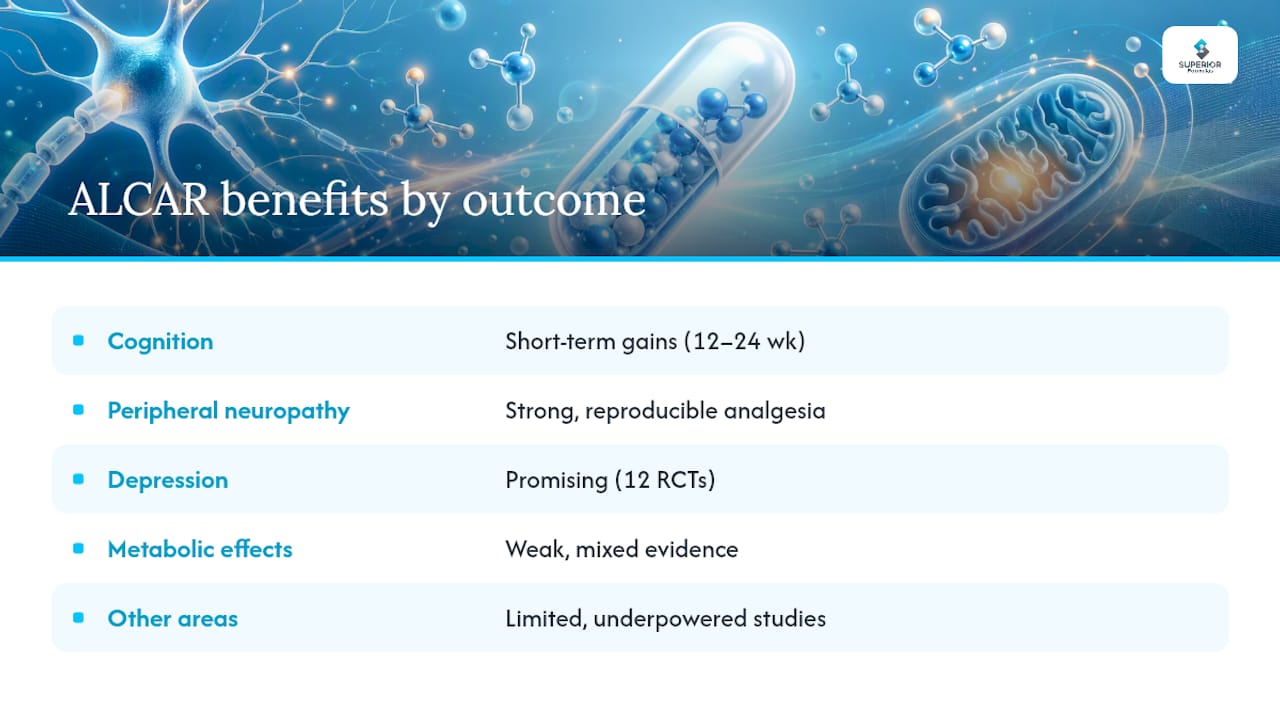
 has documented, clinically studied benefits for cognition in older adults, nerve pain from diabetic and chemotherapy-related neuropathy, and certain depressive symptoms. The catch: most trials run 8 to 24 wee...&media=http://cdn//csuxjmfbwmkxiegfpljm.supabase.co/storage/v1/object/public/blog-images/organization-27528/1789235090442_Acetyl-L-Carnitine-Benefits-by-Health-Outcome-overview-diagram.jpeg)


Acetyl-L-carnitine (ALCAR) has documented, clinically studied benefits for cognition in older adults, nerve pain from diabetic and chemotherapy-related neuropathy, and certain depressive symptoms. The catch: most trials run 8 to 24 weeks at doses between 1.5 and 3 grams daily, and effects often fade or turn inconsistent over the long haul. GI upset and a fishy body odor are the most common complaints, and anyone on blood thinners or undergoing cancer treatment needs a clinician’s input before starting. What follows breaks down exactly where the evidence holds up, where it doesn’t, and how to use ALCAR responsibly if you decide it fits your health plan.
TL;DR:
- ALCAR shows short-term cognitive benefits in older adults with mild complaints, but gains often fade after 24 weeks, according to meta-analyses.
- Evidence strongly supports its use for diabetic peripheral neuropathy, with consistent pain and nerve function improvements across larger studies.
- The strongest antidepressant effects are observed at doses around 3 grams daily for two months, but effects tend to not persist long-term, especially beyond 24 weeks.
- Clinical trials indicate doses between 1.5 and 3 grams daily are most effective, and benefits are usually short-term and outcome-specific.
- Users on blood thinners or active cancer treatment should consult a physician, and the supplement may cause gastrointestinal side effects and body odor.
Table of Contents
- Acetyl L Carnitine Benefits by Health Outcome
- How Strong Is the Clinical Evidence, Really?
- How Acetyl-L-Carnitine Works in the Brain and Body
- Dosing, Formulations, and Bioavailability
- Safety, Side Effects, and Drug Interactions
- Who Should Consider Acetyl-L-Carnitine, and Who Should Avoid It
- Why This Article’s Evidence Holds Up
- A Measured Take on Where ALCAR Actually Fits
- Where to Learn More About Physician-Formulated Options
- Sources
- FAQ
Acetyl L Carnitine Benefits by Health Outcome
The clinical picture on ALCAR is a patchwork. Some outcomes have a reasonably consistent signal behind them. Others show promise in a handful of trials but haven’t held up under closer scrutiny. Here’s the outcome-by-outcome breakdown that health-conscious adults actually need before deciding whether ALCAR belongs in a supplement routine.
Cognition and memory. Older adults with mild cognitive complaints tend to see the clearest short-term response. Trials using roughly 1,500 mg per day for 45 to 90 days have reported measurable improvements in memory, mood, and stress response in this population, according to a summary from PeaceHealth. The benefit window matters, though: gains tend to show up at 12 to 24 weeks and often don’t persist at 52 weeks, a pattern that shows up repeatedly across pooled analyses.
Peripheral neuropathy. This is arguably where ALCAR has its strongest supporting data. A narrative review covering more than 1,700 patients found ALCAR produced measurable analgesic effects and improved nerve function in people with peripheral neuropathy, according to a review published on ResearchGate. Diabetic neuropathy patients show up frequently in these trials, and the pain-reduction signal is one of the more reproducible findings in the ALCAR literature.
Depression and mood. A 2018 meta-analysis of 12 randomized trials found ALCAR reduced depressive symptoms compared with placebo, using median doses around a few grams per day for about two months, and some smaller trials found effects comparable to standard antidepressants with fewer side effects, per the PubMed record. That comparison comes from limited sample sizes, so it’s a promising signal rather than a settled equivalence.
Metabolic and exercise-related effects. This is the weakest category. Some small trials report modest improvements in fasting glucose or body weight, but the overall evidence is mixed enough that ALCAR shouldn’t be viewed as a metabolic fix on its own. If you’re focused on cellular energy support more broadly, mitochondrial-targeting compounds covered in research on mitophagy supplements offer useful context on what human trials can and can’t confirm in this space.
Other studied areas. Smaller bodies of research exist for fertility support, fibromyalgia symptom relief, and hepatic encephalopathy, but sample sizes are limited and results haven’t been replicated widely enough to draw firm conclusions.
The throughline across all these outcomes: ALCAR’s benefits are real but bounded. Short-term, adjunctive, outcome-specific. Not a cure, and not consistent across every population studied.
How Strong Is the Clinical Evidence, Really?
Evidence strength for ALCAR splits sharply by outcome and by how long a trial ran. Cognitive trials show a fairly reliable pattern: a 2003 meta-analysis pooling 21 trials and 1,204 adults found measurable benefit at earlier time points, and a Cochrane-style review found decreased symptom severity at 12 to 24 weeks. That same review found the effect disappeared by 52 weeks. Short-term signal, long-term silence.
Neuropathy trials tell a more encouraging story in aggregate. Pooled data across more than 1,700 patients points toward consistent pain reduction and nerve-function improvement, which is why neuropathy remains one of the better-supported use cases for ALCAR.
Three factors explain why researchers keep landing on different conclusions:
- Dose variation. Trials in the moderate gram-per-day range report varying outcomes depending on dose used, making cross-trial comparison difficult.
- Follow-up length. Studies lasting several weeks tend to show benefit; studies extending many months often do not, particularly for cognitive outcomes.
- Population heterogeneity. A trial recruiting healthy older adults with mild complaints produces different results than one recruiting patients with diagnosed dementia or active cancer treatment.
Statistic to hold onto: across the major cognitive meta-analyses, the pattern of benefit at 12 to 24 weeks followed by null results at 52 weeks shows up consistently enough that the NIH Office of Dietary Supplements stops short of recommending ALCAR for routine clinical use in cognitive decline or dementia. That’s an important distinction for anyone expecting a long-term cognitive intervention rather than a short-term supportive one.
Publication era matters too. Older trials, particularly from the 1990s and early 2000s, tend to report larger effect sizes than more recent, more rigorously controlled studies. That’s a familiar pattern in supplement research generally, and it’s part of why guidance like understanding what counts as clinical evidence in supplements matters before taking any single trial’s headline number at face value.
How Acetyl-L-Carnitine Works in the Brain and Body
ALCAR’s core job is acting as an acetyl donor. It ferries acetyl groups into mitochondria, where they help free up coenzyme A, or CoA, so fatty-acid oxidation can keep running efficiently. Think of it as a buffer that keeps the cell’s energy-production machinery from bottlenecking. That mitochondrial buffering role is the mechanistic basis for most of the metabolic claims tied to ALCAR.
The brain angle is more specific. ALCAR crosses the blood-brain barrier more readily than plain L-carnitine, largely because the attached acetyl group assists transport, according to the Linus Pauling Institute. Once inside the central nervous system, ALCAR may support acetylcholine synthesis, a neurotransmitter tied directly to memory and learning. That’s the biological rationale behind ALCAR’s use in cognition research specifically, rather than in metabolic supplementation generally.
There’s also emerging preclinical evidence that ALCAR modulates gene expression by donating acetyl groups that alter histone acetylation in brain regions tied to mood and neural plasticity. Animal studies suggest this could explain unusually fast antidepressant-like effects. That mechanism hasn’t been confirmed in humans, so treat it as a plausible explanation rather than a proven pathway.
Dosing, Formulations, and Bioavailability
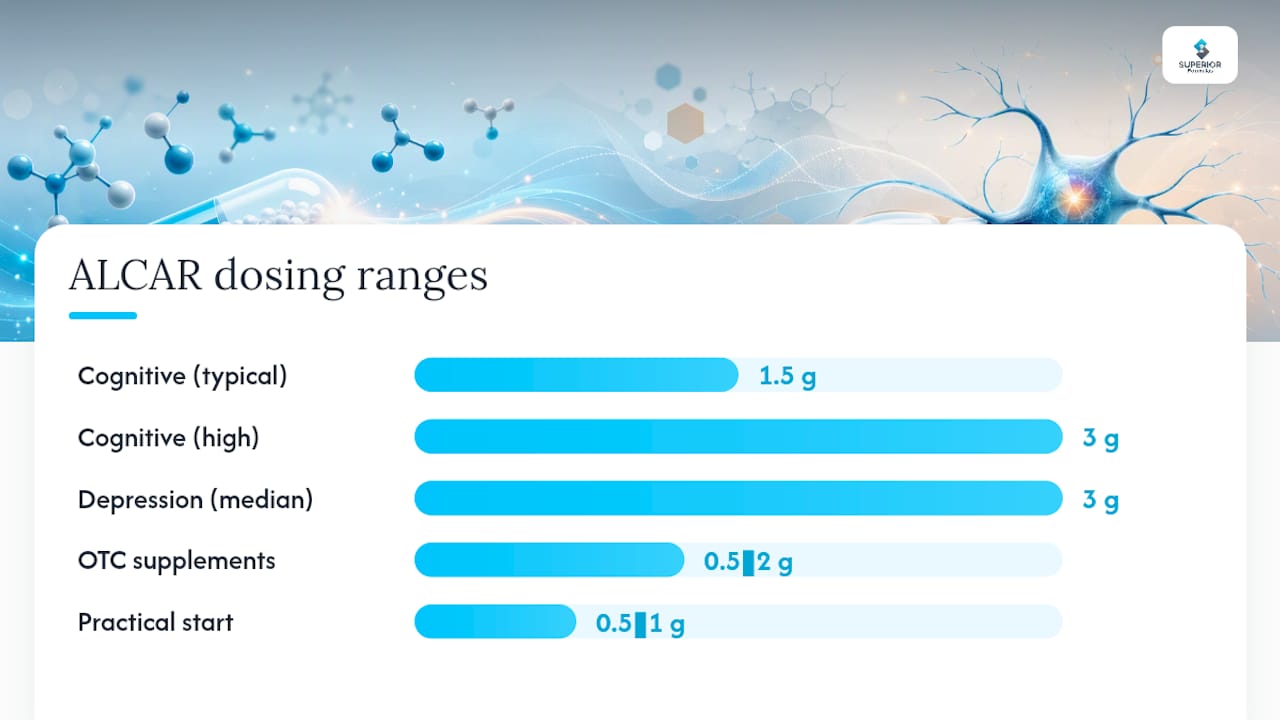
Trial doses for ALCAR generally fall into two ranges depending on the outcome being studied. Cognitive trials often use around 1,500 mg per day, sometimes scaling to 3 g/day divided across doses, typically for 45 to 90 days, per PeaceHealth’s clinical summary. Depression trials in the meta-analysis discussed earlier used median doses closer to 3 g/day for about 8 weeks.
Common supplement doses sold over the counter tend to run lower, usually between 0.5 and 2 g/day. The Linus Pauling Institute notes a common recommendation around 0.5 to 1 g/day for general supplementation, which sits well below the higher end of clinical trial protocols.
ALCAR and plain L-carnitine are not interchangeable. ALCAR’s acetyl group gives it meaningfully better brain availability, which is exactly why neurological and psychiatric research favors it over standard L-carnitine formulations.
Practical starting points worth following:
- Start at the lower end of the range, around 500 mg to 1 g daily, to gauge tolerance.
- Split doses across the day rather than taking one large dose. This tends to reduce GI side effects noticeably.
- Reassess after 6 to 12 weeks. If you’re not noticing any subjective change by then, the odds of a delayed benefit are low.
- Talk to a clinician before combining ALCAR with prescription medications, particularly anticoagulants.
Pro Tip: If you’re sensitive to stomach upset from other supplements, take ALCAR with food and split your daily dose into two smaller servings rather than one large one. Most GI complaints in trials trace back to single high-dose administration.
Safety, Side Effects, and Drug Interactions
The most common complaints with ALCAR are gastrointestinal: nausea, diarrhea, vomiting, and general stomach upset. A distinctive fish-like breath or body odor also shows up in a meaningful share of users, according to WebMD’s supplement profile. Neither is dangerous, but both are common enough that new users should expect the possibility.
The interaction and caution list matters more:
- Blood thinners. ALCAR may interact with anticoagulant medications, so anyone on warfarin or similar drugs needs clinician oversight before adding it.
- Active cancer treatment. This deserves real caution. One breast cancer trial using taxane chemotherapy found that certain ALCAR dosing over several months increased neuropathy severity rather than reducing it, according to clinical trial summaries cataloged by NCBI. That’s the opposite of the benefit seen in diabetic neuropathy trials, and it’s a clear signal that context and underlying condition change the risk profile substantially.
- Pregnancy and breastfeeding. Safety data here is limited, so ALCAR use during pregnancy or lactation should only happen under direct medical supervision.
Statistic to hold onto: a study of 409 breast cancer patients on taxane chemotherapy found increased neuropathy severity at 3 g/day over 24 weeks, a striking reminder that the same compound helping one neuropathy population can hurt another.
Regulatory context matters too. In the United States, ALCAR is sold as a dietary supplement, not an FDA-approved drug, and it is not approved to treat, cure, or prevent any disease.
Who Should Consider Acetyl-L-Carnitine, and Who Should Avoid It
ALCAR fits best as a targeted, time-limited trial rather than a lifelong staple for everyone. Certain profiles show the clearest potential upside based on the trial data covered above.
Likely to benefit:
- Older adults reporting mild cognitive complaints, particularly memory or mental clarity issues.
- People diagnosed with diabetic peripheral neuropathy looking for adjunctive pain relief.
- Some patients with depressive symptoms, used alongside, not instead of, standard care.
Should avoid or seek direct medical supervision:
- Anyone undergoing active cancer treatment, especially taxane-based chemotherapy regimens.
- People taking anticoagulant or blood-thinning medications.
- Pregnant or breastfeeding individuals, given the lack of safety data.
- Anyone managing a severe psychiatric or neurologic condition that already requires structured medical treatment.
A practical trial approach looks like this: pick a trial-consistent dose, commit to 6 to 12 weeks, and track specific outcomes rather than vague impressions. If nothing measurable shifts by that point, the supplement likely isn’t providing meaningful benefit for your situation.
Why This Article’s Evidence Holds Up
This guide draws on peer-reviewed meta-analyses, the NIH Office of Dietary Supplements factsheet, and clinical summaries from established health libraries rather than marketing claims. .
The editorial content is built on standards similar to those applied in some product development:
- Supplement lines grounded in published clinical research rather than trend-chasing ingredients.
- Manufacturing in facilities following quality standards with some level of product testing.
- Internal clinical resources covering related compounds, including alpha lipoic acid’s evidence and limits and urolithin A’s trial data for older adults, for readers who want to compare mitochondrial-support strategies side by side.
Readers wanting a broader view of how ALCAR fits into a longevity-focused regimen can also check science-backed picks for aging support.
A Measured Take on Where ALCAR Actually Fits
ALCAR works best as one piece of a larger strategy, not a standalone fix. Sleep, exercise, and nutrition still do more heavy lifting for brain and metabolic health than any single supplement. Where ALCAR earns its place is as an adjunct, particularly for neuropathic pain, with expectations set at “modest and short-term” rather than “transformative.” For anything involving cancer treatment, anticoagulants, or serious neurologic conditions, loop in a clinician before you start. This article is informational, not a substitute for personalized medical guidance.
— cristopher
Where to Learn More About Physician-Formulated Options
Superiorformulas takes the same evidence-first approach to product development that this article takes to research. Every formulation starts with a physician-scientist evaluating the published data, not a marketing brief. Products are manufactured in GMP-certified facilities and verified through third-party testing, so the label matches what’s actually in the bottle.

If mitochondrial and cellular health are on your radar alongside cognitive support, it’s worth seeing how Superiorformulas approaches formulation quality and ingredient sourcing directly. For readers interested in complementary evidence-based wellness content, Emberk’s look at turkey tail coffee covers a similar evidence-focused approach to a different functional ingredient. Visit the Superiorformulas product line to see how physician-formulated standards translate into finished supplements, and decide for yourself whether a targeted, research-backed formulation belongs in your routine.
Sources
- Carnitine - Health Professional Fact Sheet | NIH Office of Dietary Supplements
- Acetyl-L-Carnitine – Health Information Library | PeaceHealth
- Meta-analysis of ALCAR for depressive symptoms (PubMed record)
FAQ
What are the negative side effects of acetyl-L-carnitine?
The most common issues are gastrointestinal, including nausea, diarrhea, and vomiting, plus a fish-like breath or body odor that some users notice at higher doses, according to WebMD.
Is it safe to take L-carnitine every day?
Daily use at typical supplement doses (0.5 to 2 g/day) is generally well tolerated, but anyone on blood thinners, undergoing cancer treatment, or pregnant should get clinician guidance first.
Does acetyl-L-carnitine work for weight loss?
The evidence here is genuinely mixed. Some small trials report modest improvements in fasting glucose or body weight, but ALCAR isn’t a reliable standalone weight-loss tool based on current research.
What should I avoid when taking acetyl-L-carnitine?
Avoid combining it with anticoagulant medications without medical supervision, and use particular caution during active cancer treatment, since one trial found it increased neuropathy severity in chemotherapy patients rather than easing it.
How long does it take to notice benefits from ALCAR?
Most clinical trials measuring cognitive or mood benefits ran 45 to 90 days at trial doses, so a 6 to 12 week evaluation window is a reasonable practical benchmark for most people.


