


If your goal is to boost mitochondrial quality, the best-supported oral option today is urolithin A. Trials have used it at 500 to 1,000 mg per day, and it consistently activates mitophagy while producing modest but measurable gains in muscle endurance.
Here’s what to expect before you dig into the evidence:
- Dose range: 500 to 1,000 mg per day, taken with a meal containing fat
- Time to effect: 8 to 16 weeks of consistent use
- Safety profile: generally well tolerated, with mild GI upset the most common complaint
- The real primary drivers: resistance training, adequate protein, and zone 2 cardio still outperform any capsule
The rest of this guide walks through the trial data, the alternatives worth knowing about, and a practical protocol you can actually follow.
TL;DR:
- Urolithin A is supported by human trials at 500 to 1,000 mg daily, with benefits usually seen after 8 to 16 weeks of consistent use.
- Its safety profile is generally good, with no serious adverse events reported and mild gastrointestinal upset being the most common side effect.
- Functional improvements are modest and mainly limited to muscle endurance and mitochondrial biomarkers, not comprehensive aging outcomes.
- The supplement works through pathways involving PINK1 and Parkin proteins that tag damaged mitochondria for recycling, which decline with age.
- Supplement quality depends on third-party tested, standardized doses aligned with clinical research, and proper storage to ensure ingredient stability.
Table of Contents
- What Does the Human Evidence Say About Urolithin A and Mitophagy?
- Which Other Supplements Support Mitochondrial Function?
- How Do You Choose a Product and Dose It Correctly?
- Is Urolithin A Safe, and What Side Effects Should You Expect?
- Who Should Try Mitophagy Supplements, and Who Should Wait?
- How to Run an 8 to 16 Week Mitophagy Supplement Trial
- What Should You Look for in a Physician-Formulated Supplement?
- The Overlooked Gap Between Mitophagy Hype and Mitophagy Evidence
- Where to Find a Trial-Backed Mitophagy Formula
- Key Takeaways
- Sources
What Does the Human Evidence Say About Urolithin A and Mitophagy?
Urolithin A is one of the few compounds with direct evidence in humans of activating mitophagy, the cellular process that clears out damaged mitochondria so healthier ones can take their place. That distinction sets it apart from most other longevity supplements, which rely on animal data or plausible mechanisms rather than measured outcomes in people.
Randomized trials, including work published in Cell Reports Medicine and JAMA Network Open, gave middle-aged and older adults oral urolithin A at 500 to 1,000 mg daily for roughly 12 to 16 weeks. Participants showed molecular signatures consistent with improved mitochondrial health and modest gains in muscle endurance compared to placebo.
By the numbers: Trial doses clustered between 500 and 1,000 mg/day, with functional changes emerging between 8 and 16 weeks, and no serious adverse events reported across the study periods.
Mechanistically, urolithin A appears to work through pathways related to PINK1 and Parkin, two proteins that tag damaged mitochondria for recycling, as explained in this mTOR pathway peptide research primer. When that tagging system slows down with age, defective mitochondria linger longer than they should, and cellular energy output suffers. A University of Washington research team reported that older adults taking urolithin A performed better on small endurance tests and showed improved mitochondrial biomarkers relative to placebo.
The limitations matter too. Sample sizes in these trials have been modest, follow-up periods stop well short of a year, and effect sizes are described as measurable rather than dramatic. This is encouraging early evidence, not proof of a dramatic transformation.
- Trials to date run 8 to 16 weeks, not multi-year timelines
- Functional improvements are real but modest, not sweeping
- Most studies focused on muscle endurance and biomarkers, not broader aging outcomes
Which Other Supplements Support Mitochondrial Function?
Several other compounds show promise for mitochondrial health, though none match urolithin A’s direct human evidence for mitophagy specifically.

Spermidine has human randomized trials behind it, but most measure cognitive or longevity-adjacent endpoints rather than direct mitophagy markers. It’s a reasonable complementary choice, not a substitute.
NAD+ precursors like NR and NMN support mitochondrial biogenesis and metabolic function, which overlaps with mitophagy’s goals without directly triggering the same clearance pathway. Human results here remain mixed, with some trials showing metabolic shifts and others showing little functional change.
CoQ10, creatine, resveratrol, and melatonin all have mechanistic plausibility for mitochondrial support, and creatine in particular has strong evidence for muscle performance. But direct mitophagy trial data in humans is thin for this group compared to urolithin A.
If you’re prioritizing by evidence strength:
- Urolithin A: strongest direct mitophagy evidence in humans
- Spermidine: solid human data, different primary endpoints
- NR/NMN: indirect support, mixed human results
- CoQ10, creatine, resveratrol: mechanistically supportive, limited direct mitophagy data
Your personal goals should guide which of these you layer in, if any. Someone chasing muscle performance might prioritize creatine alongside urolithin A. Someone focused on general cellular resilience might look at our breakdown of mitochondrial function and longevity for broader context.
How Do You Choose a Product and Dose It Correctly?
Not every bottle labeled “mitophagy support” deserves a place in your routine. A short checklist separates the credible options from marketing noise.
- Look for human evidence, not just cell-culture or rodent studies, tied to the specific ingredient and dose on the label.
- Confirm third-party testing. A certificate of analysis (COA) should be available on request or posted publicly.
- Check the dose per capsule. It should land within the 500 to 1,000 mg range used in actual trials, not a fraction of it.
- Ask about stability testing. Urolithin A degrades under poor storage conditions, so manufacturers should document shelf-life data.
Standard dosing starts at 500 mg per day, with some trials using 1,000 mg daily for slightly stronger signals. Take it with a meal that includes some fat, since absorption improves in that context.
Stacking matters more than most people assume. Clinical commentary consistently frames urolithin A as an additive layer on top of resistance training, zone 2 cardio, and adequate protein intake, not a replacement for any of them.
Pro Tip: Track one simple metric before you start, like a timed walk or a set number of push-ups, and repeat that same test at 8 and 16 weeks. Consistency in your measurement matters more than picking the “perfect” one.
Is Urolithin A Safe, and What Side Effects Should You Expect?
The safety data from human trials is reassuring within the doses studied. No serious adverse events were reported in trials using up to 2,000 mg per day for short durations, and the most common complaint across studies was mild gastrointestinal upset.
That said, researchers urge some restraint. Mitophagy is a balancing act, and recent mechanistic reviews caution against excessive activation of autophagy pathways, favoring restoration of normal function over aggressive overdrive. Sticking to trial-tested doses rather than assuming “more is better” reflects that caution.
A few groups should pause and talk to a physician before starting:
- Pregnant or breastfeeding individuals, since safety data doesn’t cover these populations
- Anyone in active cancer treatment or on immunosuppressive therapy
- People on complex medication regimens, where interaction data remains limited
Who Should Try Mitophagy Supplements, and Who Should Wait?
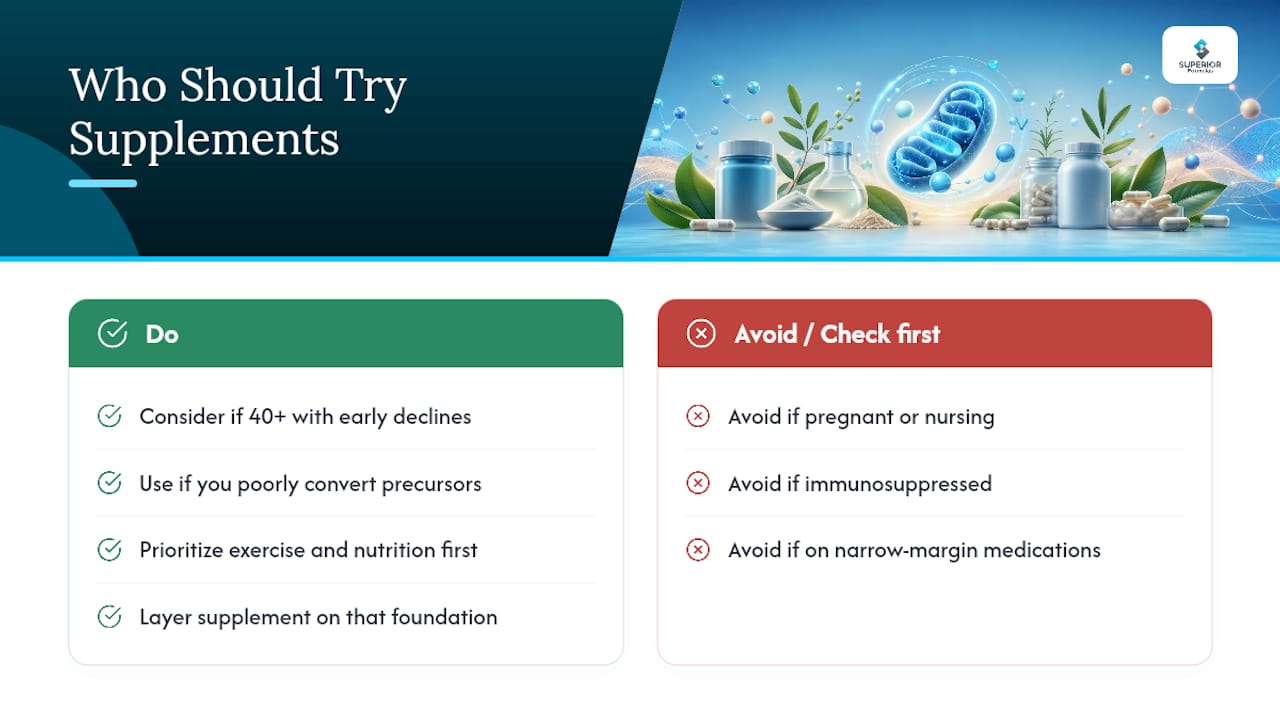
The best candidates are adults 40 and older noticing early declines in endurance or muscle recovery, particularly those unlikely to generate meaningful urolithin A from dietary sources like pomegranate and walnuts alone. Gut bacteria composition varies widely, and not everyone converts precursor compounds efficiently, which is exactly why a standardized supplement can matter.
Others should hold off or check with a clinician first: pregnant or nursing individuals, people managing immunosuppression, and anyone on medications with narrow safety margins.
For everyone else, exercise and nutrition remain the higher-leverage interventions. A supplement layers on top of that foundation. It doesn’t replace it.
How to Run an 8 to 16 Week Mitophagy Supplement Trial
A structured trial beats guesswork, and it doesn’t need to be complicated.
- Start at 500 mg per day of a third-party-tested urolithin A product, taken with a meal containing fat. Reserve 1,000 mg/day for later, and only with clinician input if you’re managing other health conditions.
- Commit to two to three resistance sessions and two zone 2 cardio sessions weekly. This is non-negotiable groundwork, not optional.
- Pick one repeatable metric (walk time, grip strength, a specific exercise count) and record it before you start.
- Reassess at week 8, then again at week 16. If side effects are intolerable or you see no signal by 16 weeks, it’s reasonable to stop.
Consistency across those eight to sixteen weeks matters more than the exact number on the bottle.
What Should You Look for in a Physician-Formulated Supplement?
Superiorformulas was founded by a physician-scientist with a focus on clinically studied ingredients rather than trend-driven formulations. That background shapes how the company approaches mitochondrial and cellular health products, from ingredient sourcing to third-party verification.
When evaluating any supplement page, a few practical labels tell you whether a company takes quality seriously:
- Availability of a certificate of analysis (COA) for the specific batch
- Clear labeling of standardized extract percentages, not vague proprietary blends
- Dose per serving that matches published clinical research
- Documented stability testing showing the ingredient holds potency through its shelf life
Products manufactured in GMP-certified facilities with third-party testing give you a paper trail you can actually verify, rather than trusting a label at face value. For readers who want the underlying research behind ingredient selection, our science pages walk through the reasoning behind specific formulations, including cellular resilience and healthy aging pathways like Nrf2 activation.
The Overlooked Gap Between Mitophagy Hype and Mitophagy Evidence
Most coverage of mitophagy supplements skips straight to enthusiasm. It treats mitophagy activation as an unambiguous good and implies more is always better. The research doesn’t support that framing. Mitophagy is a quality-control system, and the goal is restoring normal function in a system that’s slowed down with age, not cranking it into overdrive.
The conventional advice also underweights how thin the evidence is for most “mitochondrial support” ingredients outside urolithin A. Compounds like resveratrol and CoQ10 get marketed with the same confidence as urolithin A, despite having far less direct human trial data behind the mitophagy claim specifically. That’s a meaningful distinction for anyone spending money based on evidence rather than momentum.
What I’d prioritize, in order: get the exercise and protein foundation solid first, since no supplement matches that leverage. Then, if you want to add a supplement, choose the one with the clearest human trial data at a dose that mirrors what was actually studied. Urolithin A earns that spot right now. Everything else is a reasonable complement, not a replacement.
— cristopher
Where to Find a Trial-Backed Mitophagy Formula
Superiorformulas exists for readers who’ve just read through the evidence and want a product built to match it, not a marketing claim bolted onto a random blend. The company’s formulations are developed by a physician-scientist with third-party testing and GMP manufacturing behind every batch, which addresses the exact checklist covered above: verifiable dosing, standardized extracts, and documented quality control.
That matters more with mitophagy-related ingredients than most supplement categories, since dose and standardization directly affect whether you see the biomarker changes reported in trials. If you’re ready to start an 8 to 16 week trial with a product built around clinically studied ingredients, visit Explore the Science to see the formulation reasoning and find the mitochondrial support option that fits your goals.
Key Takeaways
Urolithin A remains the most human-trial-backed oral supplement for activating mitophagy, working best alongside resistance training, protein intake, and a realistic 8 to 16 week evaluation window.
| Point | Details |
|---|---|
| Best evidence base | Urolithin A shows direct mitophagy activation in randomized human trials at 500 to 1,000 mg/day. |
| Timeline matters | Functional and biomarker changes typically emerge between 8 and 16 weeks, not days or weeks. |
| Safety is favorable | Trials report no serious adverse events, with mild GI upset the most common side effect. |
| Lifestyle comes first | Resistance training, zone 2 cardio, and adequate protein remain the primary drivers of mitochondrial health. |
| Quality control matters | Superiorformulas offers physician-formulated, third-party-tested options built around clinically studied doses. |
Sources
- Dietary Mitophagy Enhancer: A Strategy for Healthy Brain …
- Mitophagy in human health, ageing and disease | Nature Metabolism


