


Urolithin A activates mitophagy, and in human clinical trials, daily supplementation has improved leg muscle strength by roughly 10 to 12% and shifted mitochondrial biomarkers within four months. The evidence for muscle performance and mitochondrial health outcomes is the strongest and most consistent finding in the research. Claims about lifespan extension or broad anti-aging effects remain preliminary; they rest mostly on animal data rather than confirmed human trials.
TL;DR:
- Urolithin A improves muscle strength by roughly 10 to 12 percent over four months at doses of 500 to 1,000 mg daily, confirmed by randomized human trials.
- Benefits such as mitochondrial biomarker improvements and reduced inflammation have been observed at higher doses, but endurance and cognitive claims lack strong human evidence.
- The compound mainly works by activating mitophagy pathways that clear damaged mitochondria, potentially reducing cellular inflammation related to aging.
- Effectiveness depends on consistent daily use over months, as biological and functional changes take time to manifest, with early gene expression shifts preceding strength gains.
- Since gut bacteria influence natural urolithin A production, standard supplements offer a more reliable intake than diet alone, especially for those with less efficient microbiomes.
Table of Contents
- Urolithin A Benefits: The Evidence Hierarchy
- How Urolithin A Works: Mitophagy, Mitochondria, and Inflammation
- Human Clinical Evidence: Trials, Outcomes, and Limits
- Dosage, Timing, and What to Expect
- Safety, Reported Side Effects, and Who Should Check with a Doctor First
- Practical Guidance: Pairing Urolithin A With Exercise and Lifestyle
- Expert Perspective and How Superiorformulas Approaches the Evidence
- How Urolithin A Compares to Other Mitochondrial Health Supplements
- Cognitive Benefits and Neurodegenerative Disease: What’s Actually Known
- Urolithin A and Aging: Reading the Longevity Signal Correctly
- Does Urolithin A Interact With Medications or Other Supplements?
- What Urolithin A’s Evidence Actually Tells Us
- Superiorformulas’ Approach to Mitochondrial Support
- Sources
Urolithin A Benefits: The Evidence Hierarchy
Not every claimed benefit of urolithin A carries the same weight. Some outcomes come from well-designed randomized controlled trials in real people. Others come from cell cultures or mice, and calling those “benefits” for a human reader is premature. Sorting the two apart matters more than any other single thing in this article.
At the top of the evidence pyramid sits muscle strength and endurance. A randomized, placebo-controlled trial in middle-aged and older adults found that 500 to 1,000 mg of urolithin A daily improved leg muscle strength by approximately 10 to 12% over four months, alongside gains in exercise performance. That is a functional outcome measured with a dynamometer, not a self-reported feeling of vigor.
Pro Tip: If you’re evaluating any mitochondrial supplement, ask whether the claimed benefit was measured with a functional test (grip strength, 6-minute walk distance, VO2) or only inferred from a lab marker. The two are not interchangeable.
Mitochondrial biomarkers rank close behind. Trials have recorded reductions in plasma acylcarnitines, which signal improved fat oxidation efficiency in muscle mitochondria, along with activation of Parkin, a protein central to the mitophagy pathway. Some cohorts also showed meaningful drops in C-reactive protein, an inflammation marker, at the 1,000 mg dose.
Here’s how the current benefit list breaks down by evidence strength:
- Muscle strength gains (10 to 12%): Confirmed in randomized human trials over 4 months at 500 to 1,000 mg/day.
- Mitochondrial biomarker improvement (lower acylcarnitines, Parkin activation): Confirmed in the same human trial cohorts.
- Reduced systemic inflammation (lower CRP): Observed at higher doses in a subset of trial participants.
- Walking endurance (6-minute walk test): Directionally favorable but rated low certainty in a systematic review, meaning more trials are needed before it counts as settled.
- Cognitive and neuroprotective effects: Preclinical only, based on rodent models of neurodegeneration, not yet validated in people.
- Lifespan extension: Observed in worms and mice, hypothesis-generating for humans, unconfirmed by any human longevity trial.
That pooled walk test estimate deserves a closer look. A corrected meta-analysis of the available randomized trials found a mean improvement of 17.03 meters, with a wide confidence interval that crossed zero. The direction favors urolithin A, but the certainty does not yet support a strong claim.
How Urolithin A Works: Mitophagy, Mitochondria, and Inflammation
Mitophagy is your cells’ quality-control system for mitochondria. Old, damaged mitochondria generate excess reactive oxygen species and produce less usable energy. Mitophagy tags those damaged units for removal and recycling, clearing space for newer, more efficient mitochondria to take over. This process naturally slows with age, and that slowdown tracks closely with the muscle weakness, fatigue, and metabolic sluggishness many people associate with getting older.
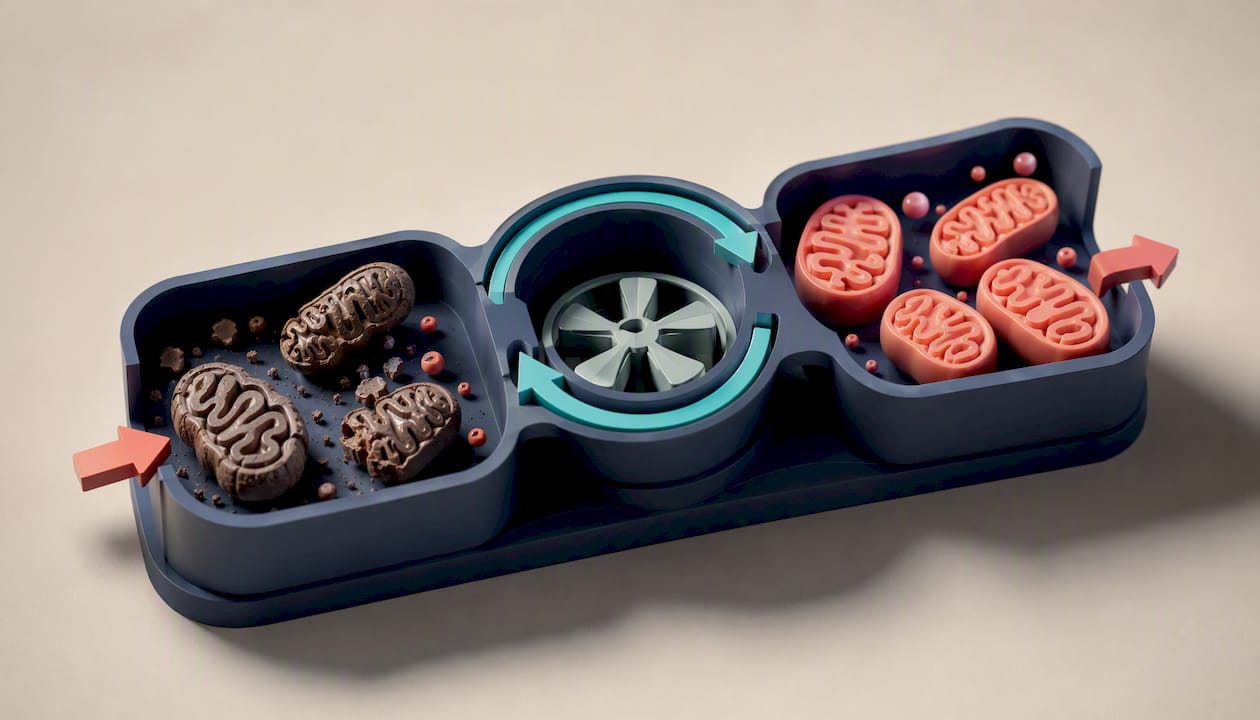
Urolithin A’s defining mechanism is that it turns mitophagy back on. Rather than acting as a generic antioxidant that mops up free radicals after the fact, it works upstream, prompting the cell to clear out the mitochondria causing the problem in the first place. That distinction shapes everything about how the compound is studied and dosed.
Three pathways do most of the work:
- PINK1–Parkin signaling: Damaged mitochondria accumulate PINK1 on their surface, which recruits Parkin. Parkin then tags the mitochondrion for mitophagy. Preclinical research shows urolithin A upregulates this pathway, increasing Parkin activation and clearing damaged mitochondrial units more efficiently.
- SIRT1–PGC-1α activation: This pathway governs mitochondrial biogenesis, essentially building new mitochondria to replace the ones just cleared out. Preclinical models show increased oxidative phosphorylation proteins and improved cellular respiration when this axis is engaged.
- AMPK–mTOR balance: AMPK senses cellular energy stress and promotes catabolic, cleanup-oriented processes including mitophagy, while mTOR governs growth and protein synthesis. Urolithin A appears to shift this balance toward the AMPK side under the right conditions, favoring maintenance over unchecked growth.
The connection to inflammation follows a fairly direct line. Damaged mitochondria that escape mitophagy tend to leak molecular debris, mitochondrial DNA fragments and reactive oxygen species, that the immune system reads as danger signals. Chronic low-grade activation of that response is sometimes called “inflammaging.” By clearing damaged mitochondria before they leak, more efficient mitophagy plausibly reduces one contributor to that background inflammatory noise, which lines up with the CRP reductions seen in trial data at higher doses.
For muscle bioenergetics specifically, the logic is straightforward: muscle tissue is dense with mitochondria because contraction demands constant ATP turnover. A muscle fiber full of aging, inefficient mitochondria produces less force and tires faster. Swap in a fresher mitochondrial population through active turnover, and the tissue has more capacity to generate power and resist fatigue. That is the mechanistic story behind the strength gains measured in trial participants, though it’s worth remembering mechanism and outcome are two different kinds of evidence, and both matter here.
Readers who want the fuller biological picture of why mitochondrial quality drives so much of the aging process can find more detail in how mitochondria shape longevity.
Human Clinical Evidence: Trials, Outcomes, and Limits
The strongest human data on urolithin A comes from a randomized, placebo-controlled trial in middle-aged and older adults, testing daily doses between 500 and 1,000 mg over four months. Participants receiving urolithin A showed leg muscle strength improvements of roughly 10 to 12%, along with measurable gains in exercise performance and mitochondrial health biomarkers. The same trial recorded reductions in plasma acylcarnitines, a marker tied to more efficient fat metabolism in muscle, and drops in CRP at the higher dose tested.
An earlier first-in-human study established the groundwork for those findings. That trial confirmed urolithin A is orally bioavailable and induces a molecular signature of improved mitochondrial and cellular health in skeletal muscle after four weeks of dosing at 500 to 1,000 mg per day. That’s an important detail: the gene expression shifts associated with mitochondrial health showed up before the four-month mark, suggesting cellular changes precede the functional strength gains that take longer to manifest.
Statistic snapshot: A pooled analysis of the available randomized trials found a 6-minute walk test improvement averaging 17.03 meters with urolithin A versus placebo, but the 95% confidence interval spanned negative 5.33 to positive 39.40 meters. Translation: the trend favors the supplement, but the current trial pool is too small and too varied to call it settled.
That same systematic review used GRADE criteria, the standard framework researchers use to rate confidence in a body of evidence, and rated the overall certainty of muscle health outcomes as low. That is not a dismissal. It’s an honest accounting of where the field stands: real signal, insufficient volume of high-quality trials to eliminate doubt.
Here’s what the current body of trials does and doesn’t support:
- Supported by multiple RCTs: Muscle strength improvement, mitochondrial gene expression changes, acylcarnitine reduction.
- Supported by single-trial or moderate evidence: CRP reduction at higher doses, Parkin pathway activation in humans.
- Directionally favorable but low certainty: 6-minute walk test distance, broader endurance and functional mobility outcomes.
- Not yet tested in adequately powered human trials: Cognitive performance, neurodegenerative disease progression, all-cause mortality or lifespan extension.
A few methodological limits explain why the certainty ratings stay conservative. Trial sample sizes to date have been moderate, typically in the range of a few dozen to roughly 100 participants per study, which limits statistical power to detect smaller effects. Populations studied have skewed toward middle-aged and older adults, so extrapolating to younger athletic populations involves some guesswork. Dosing protocols have also varied across trials, some using 500 mg, others 1,000 mg, which makes head-to-head comparison of effect sizes imprecise.
Future trials need to address three specific gaps. First, larger cohorts powered specifically for walk-distance and VO2 outcomes, since the current pooled estimate has too wide a confidence interval to be conclusive. Second, longer duration studies beyond four months to see whether strength gains plateau, continue accumulating, or reverse after discontinuation. Third, head-to-head dose comparison trials that isolate whether 1,000 mg genuinely outperforms 500 mg for functional outcomes, rather than relying on cross-trial comparisons that mix populations and protocols. Until those trials exist, readers should treat the muscle strength finding as solid and the endurance/mobility finding as promising but provisional.
Dosage, Timing, and What to Expect
Human trials have tested urolithin A in a fairly narrow band: 250 to 1,000 mg per day, with the clearest strength and biomarker benefits observed at 500 to 1,000 mg daily. That range isn’t arbitrary. It reflects the doses researchers found effective without meaningful safety concerns, and it’s the range most dosage-focused clinical reviews point back to when discussing practical use.
Timing matters more than most people expect walking into this. Mitochondrial gene expression shifts can appear within four weeks of consistent dosing, based on the first-in-human bioavailability data. But the functional payoff, the actual strength gain you could measure with a grip test or leg press, generally takes two to four months of daily use to show up clearly in trial data. This is not a fast-acting stimulant. It is a slow remodeling process, and expecting next-week results sets you up for disappointment even if the compound is working exactly as intended.
A few practical notes worth keeping in mind:
- Consistency beats dose-chasing. Trial benefits came from daily use sustained over months, not occasional or cycled dosing.
- Effects likely accumulate. Biomarker shifts appear early; functional strength gains build on top of that foundation over subsequent weeks.
- Standardized supplemental urolithin A outperforms precursor strategies for most people. Taking the active compound directly bypasses the gut conversion step that trips up a large share of the population, a point worth understanding fully in the next section.
- Set a multi-month check-in, not too early. Judging results too early is the most common reason people abandon a strategy that was actually working.
Safety, Reported Side Effects, and Who Should Check with a Doctor First
Urolithin A has a favorable safety profile across the human trials conducted so far. Studies testing daily doses from 250 to 1,000 mg, along with single doses up to 2,000 mg, reported no major safety signals. That range of testing, including a dose double the highest typical daily amount given as a one-time exposure, gives researchers reasonable confidence in the tolerability window.
Reported side effects have been mild and infrequent. Some trial participants noted occasional muscle soreness or mild gastrointestinal symptoms, similar to what shows up in the placebo arms of many supplement trials, making it hard to attribute those symptoms definitively to urolithin A itself rather than normal background noise.
Still, “generally well tolerated in trials” is not the same as “appropriate for everyone without a second thought.” A few groups should talk to a clinician before starting:
- Anyone on prescription medication for chronic conditions, since interaction data (covered further below) remains thin.
- Pregnant or breastfeeding individuals, because trials to date have not included these populations.
- People with existing kidney or liver conditions, given that any compound metabolized and cleared by these organs warrants extra caution when organ function is already compromised.
- Anyone starting a new supplement regimen alongside a significant health condition, simply as good practice regardless of the specific compound.
The honest summary: the safety data collected so far is reassuring, but it comes from a limited number of trials over a matter of months, not years of real-world use across millions of people. That’s a meaningfully different evidence base than something like a common vitamin with decades of population-level safety tracking.
Practical Guidance: Pairing Urolithin A With Exercise and Lifestyle
Urolithin A’s mechanism works best alongside the same physiological triggers that naturally prompt mitochondrial turnover, which is exercise. Treating it as a standalone fix misreads what the trial data actually shows.
- Match the exercise type to your goal. If strength is the priority, pair urolithin A with resistance training, since that’s the training modality used in the trials showing 10 to 12% strength gains. If endurance capacity matters more to you, combine it with regular aerobic work, given that mitochondrial turnover mechanisms respond to the same signals that endurance training triggers naturally.
- Set a monitoring timeline before you start, not after. Track a functional baseline, grip strength, a timed walk, or a specific lift, then retest at the two-month and four-month marks. That window matches when trial participants showed measurable change.
- Treat sleep and protein intake as non-negotiable partners, not afterthoughts. Mitochondrial rebuilding requires raw material and recovery time; supplementing on top of poor sleep or inadequate protein blunts the biological process you’re trying to support.
Pro Tip: Log your functional test results the same way each time, same time of day, same warmup, same equipment. Small measurement inconsistencies can hide a real four-month improvement or manufacture a fake one.
Urolithin A amplifies training adaptations rather than replacing them. It’s a lever on an existing system, not a substitute for the system itself.
Expert Perspective and How Superiorformulas Approaches the Evidence
Superiorformulas was founded by a physician scientist, and that clinical background shapes how the brand evaluates ingredients like urolithin A: by weighting randomized controlled trial outcomes and biomarker data over marketing claims. Formulations move forward only when the underlying research meets a threshold of trial-level, not anecdotal, evidence.
[Author bio placeholder for cristopher: credentials, background in evidence synthesis, and track record reviewing mitochondrial health trials.]
Every Superiorformulas product is manufactured in a GMP-certified facility and verified through third-party testing, standards meant to confirm that what’s on the label matches what’s in the capsule. [Brand signal placeholder: insert specific certification details, batch testing methodology, or proprietary clinical data where available.]
That evaluation standard extends to how the brand frames expectations for readers: real trial data supports meaningful muscle and mitochondrial benefits, while longevity claims stay appropriately hedged until human trials catch up to the animal research.
How Urolithin A Compares to Other Mitochondrial Health Supplements
CoQ10 is probably the most familiar mitochondrial supplement, and the comparison to urolithin A is instructive precisely because the two work through different mechanisms entirely. CoQ10 supports the electron transport chain, essentially helping existing mitochondria produce ATP more efficiently. Urolithin A does something upstream of that: it prompts the cell to clear out damaged mitochondria and build fresher ones through mitophagy and biogenesis. One optimizes the machinery you already have. The other renews the machinery itself.
NAD+ precursors like NMN and NR represent another popular category, working by replenishing a coenzyme that mitochondria and numerous cellular repair pathways depend on. That approach addresses a different bottleneck than urolithin A’s mitophagy activation, and there isn’t head-to-head human trial data comparing the two directly on functional outcomes like strength or endurance.
Generic antioxidant supplements, vitamin C, vitamin E, and similar compounds, take a third approach: neutralizing reactive oxygen species after they’re produced. Urolithin A’s mechanism is arguably more targeted, since it reduces the source of some of that oxidative burden by clearing the damaged mitochondria generating excess ROS in the first place, rather than mopping up downstream.
None of this means urolithin A replaces these other approaches. It occupies a distinct mechanistic niche, one with human trial data behind its muscle and biomarker outcomes that several competing mitochondrial supplements still lack.
Cognitive Benefits and Neurodegenerative Disease: What’s Actually Known
Neurons are extraordinarily mitochondria-dependent tissue, which makes mitophagy activation a logical candidate for supporting brain health as we age. That logic has driven real preclinical interest, but the human evidence gap here is wider than for muscle outcomes.
Animal models of neurodegeneration have shown some encouraging signals with urolithin A exposure, particularly around markers of neuronal mitochondrial function. Those findings are worth watching. They are not, however, equivalent to a human trial demonstrating improved memory, processing speed, or reduced disease progression in people living with cognitive decline.
Researchers reviewing the overall evidence base have been direct about this gap: human benefits are most concretely validated for muscle performance and mitochondrial biomarkers, while claims extending into cognitive protection or neurodegenerative disease remain hypothesis-generating rather than confirmed.
If you’re specifically interested in urolithin A for brain health reasons, the honest framing is this: the mechanistic rationale (mitochondrial quality control mattering enormously for energy-hungry neurons) is sound, and it parallels the muscle findings closely enough to justify continued research. But no adequately powered human trial has yet tested cognitive outcomes directly. Treat any specific cognitive claim you encounter with real skepticism until that trial exists.
Urolithin A and Aging: Reading the Longevity Signal Correctly
Aging research draws a hard line between markers that predict healthy function and interventions proven to extend lifespan, and urolithin A currently sits more comfortably on the first side of that line. The muscle strength and mitochondrial biomarker changes documented in human trials matter because declining muscle function is itself one of the strongest predictors of age-related disability and loss of independence, regardless of the underlying cause.
Animal studies have shown lifespan extension effects with urolithin A exposure, which is genuinely interesting and part of why the compound draws so much longevity-focused attention. But mouse and worm lifespan data doesn’t automatically translate to humans, and no trial has run long enough, or included mortality as an endpoint, to make that claim about people.
What the current human data does support is a case for functional aging markers, walking speed, grip strength, muscle mass maintenance, that correlate strongly with healthy years lived, even without a formal lifespan claim attached. That’s a meaningful distinction. Improving the biomarkers and functional measures tied to how well someone ages is a real, trial-supported benefit. Extending the total number of years someone lives is a separate and much larger claim that the human evidence doesn’t yet support.
The honest longevity framing: urolithin A shows promise as a tool that supports the biological systems underlying healthy aging, without yet being a proven lifespan-extension intervention in humans.
Does Urolithin A Interact With Medications or Other Supplements?
Interaction data for urolithin A remains one of the thinner parts of the research base, and that thinness itself is worth stating plainly rather than glossing over. Most published human trials focused on safety, tolerability, and efficacy outcomes in relatively healthy or moderately healthy participants, not on systematic interaction testing against common prescription drugs.
That gap matters most for a few specific situations. People taking medications metabolized through the liver’s cytochrome P450 enzyme pathways should be cautious, since many botanical and polyphenol-derived compounds can influence these enzymes, even when direct urolithin A data on this point is limited. Anyone on blood thinners, immunosuppressants, or medications with a narrow therapeutic window (where small changes in blood levels carry real consequences) falls into the same cautious category.
Combining urolithin A with other mitochondrial-support supplements, CoQ10 or NAD+ precursors, for instance, hasn’t been tested in combination trials either. There’s no red flag suggesting a dangerous interaction, but there’s also no trial confirming the combination is more effective than either compound alone. Stacking supplements based on individually promising mechanisms, without combination trial data, is a common and understandable instinct that nonetheless outpaces the evidence.
The practical takeaway is straightforward: if you take any prescription medication, particularly one with a narrow safety margin, run your supplement plan by a pharmacist or physician before adding urolithin A. This isn’t a compound with known dangerous interactions on record. It’s a compound that simply hasn’t been tested against most medications yet, and treating those as equivalent would be a mistake.

What Urolithin A’s Evidence Actually Tells Us
The conventional wisdom on urolithin A tends to run in one of two unhelpful directions: either it gets oversold as an anti-aging breakthrough on the strength of mouse lifespan data, or it gets dismissed entirely because “the studies are small.” Both miss what’s actually interesting here.
What the research supports is more specific and, frankly, more useful than either extreme. Urolithin A has real, trial-confirmed effects on muscle strength and mitochondrial biomarkers in middle-aged and older adults, the population that arguably needs those benefits most. That’s not a hypothetical. It’s a measured outcome from randomized, placebo-controlled data.
Where I think readers get misled is the assumption that a supplement’s value depends on it also being a proven longevity drug. It doesn’t. A four-month intervention that measurably improves leg strength in aging adults has standalone value, independent of whether it also adds years to a lifespan. Prioritize the muscle and mitochondrial evidence first. Let the longevity story develop on its own timeline, because rushing that conclusion doesn’t serve anyone.
— cristopher
Superiorformulas’ Approach to Mitochondrial Support
Superiorformulas builds its cellular health formulations the same way this article evaluates urolithin A: by starting with clinical trial evidence, not marketing momentum. As a physician-founded company, the brand prioritizes ingredients with documented human biomarker data, manufactured in GMP-certified facilities and verified through third-party testing for purity and consistency.
That evidence-first standard is exactly what separates a formulation built around trial-supported dosing from one built around trend-chasing. If you’re weighing whether a mitochondrial-support supplement fits into your routine, the products detailed on the Superiorformulas product page outline the specific formulations, dosing rationale, and quality standards behind each one. Review the current lineup and dosing details before your next order to see how the clinical framework covered in this article translates into an actual product.
Sources
You cannot eat urolithin A directly from most foods, because it doesn’t exist ready-made in your kitchen. Instead, certain foods, pomegranates, walnuts, and specific berries, contain compounds called ellagitannins. Your gut bacteria have to convert those ellagitannins into urolithin A before your body can use it.
That conversion step is where things get complicated. Research on urolithin A production shows that not everyone’s gut microbiome carries the specific bacterial strains needed to complete this conversion efficiently. Some people convert dietary ellagitannins into meaningful amounts of urolithin A. Others convert very little, no matter how much pomegranate juice they drink. Researchers sometimes call this “microbiome luck,” and it means two people eating identical diets can end up with dramatically different urolithin A exposure in their bloodstream.
This variability is the central reason standardized urolithin A supplements exist at all. A few things worth understanding about the diet-versus-supplement question:
- Urolithin A improves muscle strength, exercise performance, and biomarkers of mitochondrial health in a randomized trial in middle-aged adults
- Effects of Urolithin A supplementation on muscle health outcomes in humans from randomized controlled trials
- The mitophagy activator urolithin A is safe and induces a molecular signature of improved mitochondrial and cellular health in humans
That last point matters more than it might seem. If the human evidence base is built on direct urolithin A dosing, then recommending pomegranate juice as an equivalent strategy is a leap the data doesn’t support.


